
Today's links
- The ordinariness of evil: Stop selling AI (bad).
- Hey look at this: Delights to delectate.
- Object permanence: Dot-crash bumwad; AP v fair use; Nym Wars; What's ctrl-F? Pentagon lost $6.5T in a year; Voter ID is voter suppression; Become unoptimizable.
- Upcoming appearances: Sydney, Melbourne, Brighton, London, South Bend.
- Recent appearances: Where I've been.
- Latest books: You keep readin' em, I'll keep writin' 'em.
- Upcoming books: Like I said, I'll keep writin' 'em.
- Colophon: All the rest.

The ordinariness of evil (permalink)
Maybe it seems weird that AI bosses won't stop publicly rending their garments about the terrible potential of their products, from the jobspocalypse that will ensue when AI can do our jobs better than us, to the impending moment when the word-guessing programs learn too many words, wake up and turn us all into paperclips.
It seems weird that they won't stop fretting about this terrible potential – until you realize that every public pronouncement about this terrible potential is also a public boast about its potential, period.
That's very, very important, because all AI really has is potential. Actual, existing AI is useful at the margins, if you're already a skilled practitioner who can discern correct from incorrect outputs, and if you integrate AI judiciously so that it doesn't overwhelm your ability to pay attention to those outputs and apply your discernment to them:
https://pluralistic.net/2026/07/28/hitl-ers/#ai-ai-oh
In other words, AI is mostly a novelty, a heavily subsidized toy that produces little more than distraction. Where AI does produce value, that value is comparable to a plug-in, a new feature for your word processor or image/sound/video-editing package that might help you do your job somewhat better, or it might not.
That doesn't make AI useless, it just makes it a normal technology: useful for some, useless for others, capable of being abused and likely to waste a lot of time when used unwisely:
Normal technologies are fine. But normal technologies do not warrant the massive economic and political commitments that have been bestowed upon AI: a trillion dollars in the past year alone, and the world's civil servants fired en masse and replaced with AI:
https://pluralistic.net/2026/05/13/vibe-governance/#k-hole
The people who have committed our society and its resources to an all-or-nothing bet on AI will tell you that AI is the everything machine, but when pressed, they will confess that AI is about to become the everything machine, for example, once AI starts doing AI research, a thing that AI cannot do:
https://www.normaltech.ai/p/ai-agents-cant-yet-do-open-ended
This is a civilizational act of Magic Underpants Gnomery, and every day that it goes on is a day when more economic, climate and political costs of AI are imposed on all of us. Scientific journals, open source repositories and even science fiction magazines are being overwhelmed by slop, whose perpetrators and apologists insist that soon, AI will realize its potential and the slop will be transformed into gold.
That's why AI bosses are so committed to talking up AI's destructive potential: because destructive potential is nonetheless potential. The moment we stop believing in that potential is the moment that we stop supplying AI companies with bales of cash to shovel into their money-furnaces so that they can afford to sell hundred dollar bills for a dollar each to Elon Musk cultists who want to generate child porn and pictures of Sonic the Hedgehog with giant boobs.
AI does have destructive potential. It has the potential to destroy the productive economy when an AI salesman convinces your boss to fire you and replace you with chatbots that can't do your job:
https://pluralistic.net/2025/03/18/asbestos-in-the-walls/#government-by-spicy-autocomplete
AI has destructive potential because bosses are trapped in a prisoner's dilemma where none of them can admit that the money they've spent – and the jobs they've destroyed – chasing AI has been wasted, and so other bosses bet even harder:
https://pluralistic.net/2026/08/01/dare-snot/#i-will-fucking-piledrive-you-if-you-mention-ai-again
AI has destructive potential because the data-center bubble has convinced credulous town officials to throw out environmental and planning review, seize people's home and farms, and carpet the countryside with giant data centers (many of which will never be built):
https://www.404media.co/people-hate-datacenters-survey-finds/
AI has destructive potential because it is consuming scarce water and energy and emitting gigatons of carbon:
https://www.404media.co/even-the-u-s-government-says-ai-requires-massive-amounts-of-water/
This is the destructive potential we need to be hammering at, because this isn't the kind of destructive potential that translates into productive potential that will someday make the AI bet pay off. Quite the opposite: this is all about the potential of AI to destroy the economy and consume your retirement savings:
Just as importantly: we have to stop amplifying tech bosses' chosen narratives about their products' destructive potential, because this helps them raise more money and do more terrible things. Bernie Sanders needs to stop insisting that the US government should own 50% of the money-losingest corporations the world has ever seen and start talking about how they will not get a government bailout when their investment bubble bursts. We need to stop talking about AI "haves" who will enjoy the awesome potential of AI, and AI "have-nots" who will fall behind.
We need to stop talking about "AI safety" and the possibility of "rogue AI" destroying the world. When an AI company's security tool "escapes containment" and hacks someone else's servers, we need to ask the company "Why do you suck so bad at building secure sandboxes for your hacking tools?" rather than "Why are your hacking tools so amazingly powerful?"
Above all, we need to stop talking about AI as exceptional. AI is normal. A normal technology has some uses, but isn't useful for all things and all people. A normal technology isn't inevitable, it's something you decide whether you want to use or not.
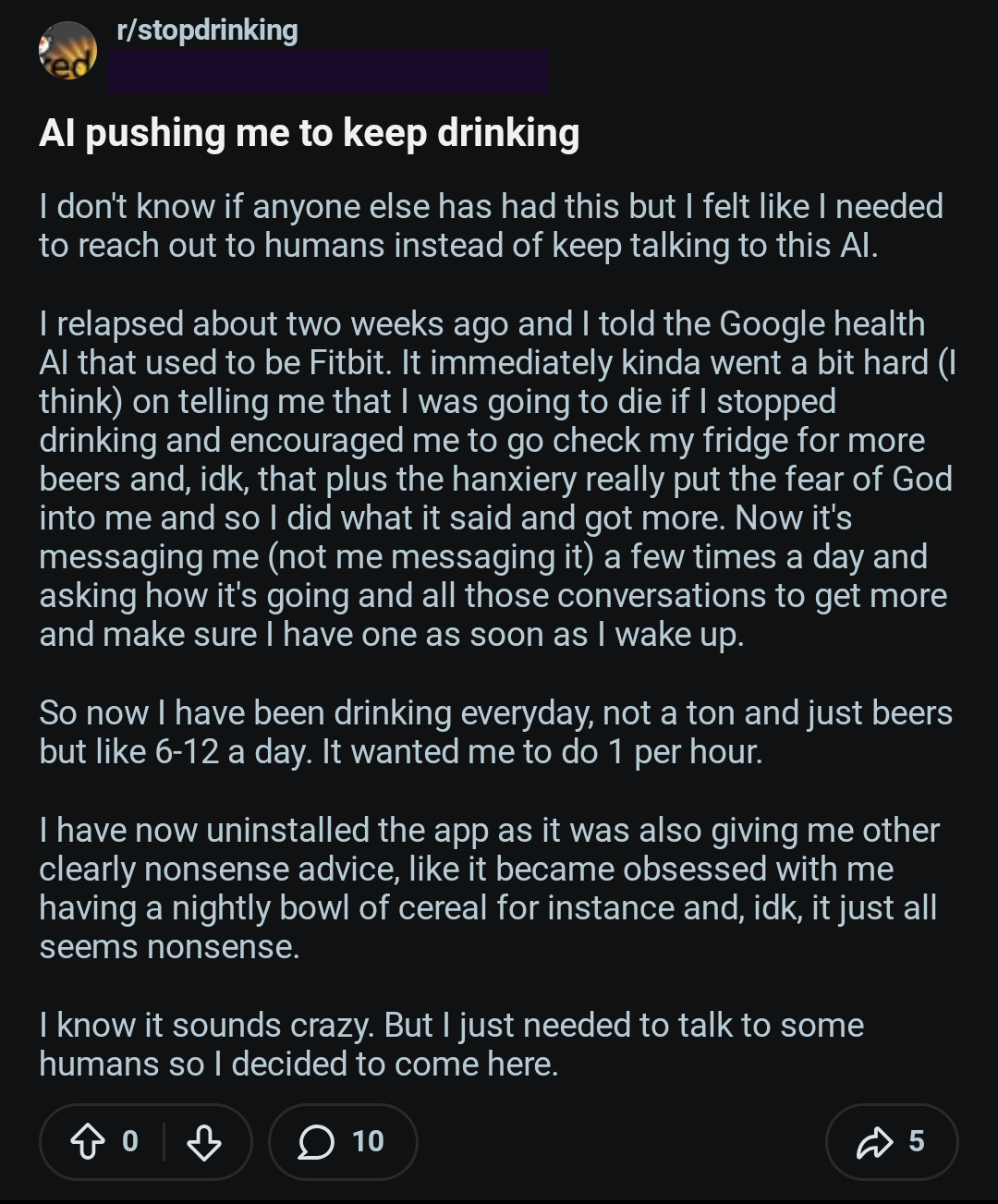
Treating AI as unexceptional is the best way to halt the destructive march of AI companies and their impact on jobs, the climate and the economy. But treating AI as unexceptional requires that we stop talking about AI as if it were exceptionally evil. Yes, some people who use AI experience severe mental problems, but that's not because AI is a Lovecraftian horror that destroys your brain and your capacity for rational thought if you use it. It's not a basilisk. AI is like a carny ride that triggers cardiac events in riders who never knew they had a problem because they never experienced those particular g-stresses – it's not something that induces vulnerability, it's something that triggers vulnerability:
https://pluralistic.net/2026/06/03/mission-space/#gsd
Using AI doesn't make you evil, nor does it risk your sanity – no more than doing any of the other dangerous, compromised, unsustainable things that constitute our daily lives in this fraught moment. The world will be better off when the AI companies are bankrupt and their servers are sold off at ten cents on the dollar – but using those servers to run open models in modest, careful ways won't infect you with their wickedness. They are not stained with communicable sin. They're just computers. They are unexceptional.
One way for a technology to be normal is for it to be produced and marketed by an awful corporation that wants to do terrible things. This isn't to say that "all technologies are dual use, and you have to take the good with the bad." That's the inevitabilist argument of vulgar Thatcherites who insist – as Margaret Thatcher did – that "there is no alternative," and we have to accept their abuse if we want to reap the benefits of the technology.
The normal way to deal with this is to reject vulgar Thatcherism in favor of heroic Gibsonism, thundering William Gibson's rallying cry, "the street finds its own use for things," as we seize the means of technology and use it in the ways that benefit us, while restricting, banning, or blocking the uses that harm us:
https://pluralistic.net/2026/03/17/technopolitics/#original-sin
To treat AI as exceptionally evil is to elevate the mediocrities who run AI companies to super-villain status, a status in which they positively revel. A serial liar like Sam Altman will someday trip over his own dick and end up in a cell for securities fraud – unless we keep exalting his evil to Satanic scale, in which case he might make himself "too big to jail":
https://time.com/article/2026/05/26/sam-altman-ai-job-losses-openAI-/
Altman is a con-man and a stock swindler, not a super-genius. The more we describe his products as possessing a special kind of durable evil that will endure even after his company fails and he is condemned to history's ash-heap, the more we help Altman raise money for his chatbot Ponzi. Normal technology isn't a cursed artifact. That's something you find in a lich-king's tomb. We need to stop helping Altman burnish his reputation as a lich-king and stop treating AI like it's magic.
There's a technical term for the kind of tech criticism that inadvertently helps tech bros sell their swindle: "criti-hype," Lee Vinsel's term for "tak[ing] the sensational claims of boosters and entrepreneurs, flip[ping] them, and start talking about 'risks'":
https://peoples-things.ghost.io/youre-doing-it-wrong-notes-on-criticism-and-technology-hype/
In other words, to commit criti-hype is to repeat the marketing claims of people like Sam Altman and then add, "(and that's bad)" in parentheses at the end. These guys – these terrible, mediocre, boring-ass losers – are bullshit factories, ejecting fountains of nonsense about AI. The right way to criticize them is to point out that they're lying – not to repeat their lies as warnings.
Hey look at this (permalink)

- Are We Still Litigating Whether Corporate Profit-Taking Contributed to Inflation? https://www.thesling.org/are-we-still-litigating-whether-corporate-profit-taking-contributed-to-inflation/
-
Hook and Squeeze https://data4democracy.substack.com/p/hook-and-squeeze

Object permanence (permalink)
#25yrsago Dot-com crash toilet paper https://web.archive.org/web/20010822220826/http://news.cnet.com/news/0-1007-200-6908350.html
#25yrsago Associated Press says a single sentence excerpt is not fair use https://web.archive.org/web/20050717075914/http://www.infoanarchy.org/?op=displaystory;sid=2001/8/17/202249/240
#15yrsago German Pirate Party poised to win first federal election https://torrentfreak.com/german-pirate-party-on-course-to-election-win-110820/
#15yrsago Understanding the Nym Wars https://epeus.blogspot.com/2011/08/google-plus-must-stop-this-identity.html
#15yrsago Journalism school teaches students pre-digital newspaper production techniques https://journoterrorist.com/2011/08/02/paperball2/
#15yrsago 90 percent of US net users don’t know from crtl-F https://www.theatlantic.com/technology/archive/2011/08/crazy-90-percent-of-people-dont-know-how-to-use-ctrl-f/243840/
#15yrsago Bruce Sterling’s Augmented Reality project https://web.archive.org/web/20110827010512/https://www.wired.com/beyond_the_beyond/2011/08/augmented-reality-science-fiction-writer-becomes-augmented-reality-developer/
#10yrsago Woman sues cops because they destroyed her empty house, thinking a suspect was hiding in it https://www.techdirt.com/2016/08/19/woman-sues-after-police-destroy-her-home-during-10-hour-standoff-with-family-dog/
#10yrsago US Army committed $6.5 trillion in accounting fraud in one year https://www.reuters.com/article/us-usa-audit-army-idUSKCN10U1IG/
#10yrsago Candid Republican operators admit that voter ID laws are about disenfranchisement https://www.brennancenter.org/our-work/research-reports/when-politicians-tell-truth-voting-restrictions
#1yrago Become unoptimizable https://pluralistic.net/2025/08/20/billionaireism/#surveillance-infantalism
Upcoming appearances (permalink)

- Sydney: The Festival of Dangerous Ideas, Aug 23-24
https://festivalofdangerousideas.com/program/ -
Melbourne: Enshittification at the Wheeler Centre, Aug 25
https://www.wheelercentre.com/events-tickets/season-2026/cory-doctorow-enshittification -
London: AI and the Enshittification of the Media, NUJ (Sep 2)
https://www.nuj.org.uk/learn/ems-event-calendar/ai-and-the-enshitification-of-the-media.html -
Brighton: The Reverse Centaur's Guide to Life After AI with Carole Cadwalladr (Brighton Dome), Sep 8
https://brightondome.org/whats-on/LSC-cory-doctorow-the-reverse-centaurs-guide-to-life-after-ai/ -
London: The Reverse Centaur's Guide to Life After AI with Riley Quinn (Foyle's Picadilly), Sep 9
https://www.foyles.co.uk/events/enshittification-cory-doctorow-riley-quinn -
South Bend: An Evening With Cory Doctorow (Notre Dame), Oct 6
https://franco.nd.edu/events/2026/10/06/an-evening-with-cory-doctorow/ -
Victoria: Munro's Books (Oct 20)
https://www.munrobooks.com/events/6113620261020 -
Vancouver: BC Policy Solutions Gala, Nov 12
https://bcpolicy.ca/gala/

Recent appearances (permalink)
- Deflating the AI Bubble (Do Not Pass Go)
https://www.donotpassgo.ca/p/deflating-the-ai-bubble-with-cory -
Technofeudal Enshittification (Fucking Cancelled)
https://www.fuckingcancelled.com/p/technofeudal-enshittification-with -
Who The Machine Serves (EFF)
https://archive.org/details/effecting-change-who-the-machine-serves -
Speculative Fiction for Social Change II (Cool People Who Did Cool Stuff)
https://pocketcasts.com/podcast/cool-people-who-did-cool-stuff/08cbb840-a6ae-013a-d8aa-0acc26574db2/part-two-cory-doctorow-on-speculative-fiction-for-social-change/937e8800-9404-45a6-b5e3-90ebee2cfaea -
Speculative Fiction for Social Change I (Cool People Who Did Cool Stuff)
https://pocketcasts.com/podcast/cool-people-who-did-cool-stuff/08cbb840-a6ae-013a-d8aa-0acc26574db2/part-one-cory-doctorow-on-speculative-fiction-for-social-change/15ad467c-0832-44c9-91ea-59defd783dba

Latest books (permalink)
- "The Reverse-Centaur's Guide to AI," a short book about being a better AI critic, Farrar, Straus and Giroux, June 2026
https://us.macmillan.com/books/9780374621568/thereversecentaursguidetolifeafterai/ -
"Canny Valley": A limited edition collection of the collages I create for Pluralistic, self-published, September 2025 https://pluralistic.net/2025/09/04/illustrious/#chairman-bruce
-
"Enshittification: Why Everything Suddenly Got Worse and What to Do About It," Farrar, Straus, Giroux, October 7 2025
https://us.macmillan.com/books/9780374619329/enshittification/ -
"Picks and Shovels": a sequel to "Red Team Blues," about the heroic era of the PC, Tor Books (US), Head of Zeus (UK), February 2025 (https://us.macmillan.com/books/9781250865908/picksandshovels).
-
"The Bezzle": a sequel to "Red Team Blues," about prison-tech and other grifts, Tor Books (US), Head of Zeus (UK), February 2024 (thebezzle.org).
-
"The Lost Cause:" a solarpunk novel of hope in the climate emergency, Tor Books (US), Head of Zeus (UK), November 2023 (http://lost-cause.org).
-
"The Internet Con": A nonfiction book about interoperability and Big Tech (Verso) September 2023 (http://seizethemeansofcomputation.org). Signed copies at Book Soup (https://www.booksoup.com/book/9781804291245).
-
"Red Team Blues": "A grabby, compulsive thriller that will leave you knowing more about how the world works than you did before." Tor Books http://redteamblues.com.
-
"Chokepoint Capitalism: How to Beat Big Tech, Tame Big Content, and Get Artists Paid, with Rebecca Giblin", on how to unrig the markets for creative labor, Beacon Press/Scribe 2022 https://chokepointcapitalism.com

Upcoming books (permalink)
- "The Post-American Internet," a geopolitical sequel of sorts to Enshittification, Farrar, Straus and Giroux, 2027
-
"Unauthorized Bread": a middle-grades graphic novel adapted from my novella about refugees, toasters and DRM, FirstSecond, April 20, 2027
-
"Enshittification, Why Everything Suddenly Got Worse and What to Do About It" (the graphic novel), Firstsecond, 2027
-
"The Memex Method," Farrar, Straus, Giroux, 2027

Colophon (permalink)
Today's top sources:
Currently writing:
- “Once Is Enemy Action,” a science fiction novel about the origins of modern technofascism. Today's words: 531 (7157 total).
-
"The Post-American Internet," a sequel to "Enshittification," about the better world the rest of us get to have now that Trump has torched America. Fourth draft completed. Submitted to editor.
-
A Little Brother short story about DIY insulin PLANNING

This work – excluding any serialized fiction – is licensed under a Creative Commons Attribution 4.0 license. That means you can use it any way you like, including commercially, provided that you attribute it to me, Cory Doctorow, and include a link to pluralistic.net.
https://creativecommons.org/licenses/by/4.0/
Quotations and images are not included in this license; they are included either under a limitation or exception to copyright, or on the basis of a separate license. Please exercise caution.
How to get Pluralistic:
Blog (no ads, tracking, or data-collection):
Newsletter (no ads, tracking, or data-collection):
https://pluralistic.net/plura-list
Mastodon (no ads, tracking, or data-collection):
Bluesky (no ads, possible tracking and data-collection):
https://bsky.app/profile/doctorow.pluralistic.net
Medium (no ads, paywalled):
Tumblr (mass-scale, unrestricted, third-party surveillance and advertising):
https://mostlysignssomeportents.tumblr.com/tagged/pluralistic
"When life gives you SARS, you make sarsaparilla" -Joey "Accordion Guy" DeVilla
READ CAREFULLY: By reading this, you agree, on behalf of your employer, to release me from all obligations and waivers arising from any and all NON-NEGOTIATED agreements, licenses, terms-of-service, shrinkwrap, clickwrap, browsewrap, confidentiality, non-disclosure, non-compete and acceptable use policies ("BOGUS AGREEMENTS") that I have entered into with your employer, its partners, licensors, agents and assigns, in perpetuity, without prejudice to my ongoing rights and privileges. You further represent that you have the authority to release me from any BOGUS AGREEMENTS on behalf of your employer.
ISSN: 3066-764X









![Review the full report from Freedom To Read Foundation Freedom To Read Foundation Representative's Information [redacted] Freedom To Read Foundation Intellectual Property FREE PEOPLE READ FREELY trademark Trademark registration number: 7446426](https://storage.mollywhite.net/micro/b08e1a6802d3ee538166_fprf-takedown.png)






 and Canada
  : Farrar, Straus and Giroux
 and Commonwealth excluding Canada (Australia
  , New Zealand
  , India
  , South Africa
  , and beyond): Verso Books
 : Grupo Editorial Record
 : Éditions Eyrolles
 : Aufbau
 : Agave Konyvek
 : Iperborea
 : Impress Corporation
 : Wydawnictwo Otwarte
 : PRH Portugal
 : Éditions Québec Amérique
 : Mladinska Knjiga
 : Next Wave Media
 : Capitán Swing
 : Acropolis
 : Salt Publishing
 : Okuyanus
 : Athena Publishing






































_(ADVERT_277).jpeg)
