Thu, 28 May 2026 11:24:23 +0000 Fullscreen Open in Tab
Pluralistic: Hold on for dear life (28 May 2026)


Today's links

  • Hold on for dear life: Not your keys, not your wallet, entirely your problem.
  • Hey look at this: Delights to delectate.
  • Object permanence: Who owns "Web 2.0"; EFF saves bloggers' sources; Non-porn porn; Redaction fails; Canadian Tories say markets, not government, will help flood victims; Forced gold-farming; Walkaway cover; Oracle eats shit in Java API case; Captain America was a Nazi spy; Who Broke the Internet? (Pt IV).
  • Upcoming appearances: London, Kansas City, LA, Menlo Park, Toronto, NYC, Edinburgh.
  • Recent appearances: Where I've been.
  • Latest books: You keep readin' em, I'll keep writin' 'em.
  • Upcoming books: Like I said, I'll keep writin' 'em.
  • Colophon: All the rest.


A shirtless man bound to a chair; his head is bandaged and his torso is covered in wounds. Standing beside him, a hand on his shoulder, is a desperate, suited man brandishing a hot poker. The background is an out-of-focus giant bitcoin logo.

Hold on for dear life (permalink)

From the earliest days of technopolitics, the role of technology in resisting authoritarianism was unclear. On the one hand, there's the indisputable fact that modern cryptography, properly implemented, can deliver a degree of privacy that is proof against all technological attacks.

That is to say, if you pull out your distraction rectangle, fire up the camera, and tap the shutter button, in the ensuing eyeblink instant the image you've captured will be scrambled so thoroughly that it could never be unscrambled without the secret key unlocked by your passphrase or biometrics. Even if every hydrogen atom in the universe were converted into a computer, and even if all those computers spent all the time between now and the end of the universe trying to guess what the key was, we would run out of universe and time long before we ran out of possible keys.

What's more, this extremely robust form of scrambling and descrambling can be combined with other techniques to block tampering with the encrypted data, and to allow parties to reliably identify who scrambled the data and also to restrict who may unscramble it. These remarkable technological facts have inspired many excited debates about what they mean for our politics, most notably among a group of people who called themselves "cypherpunks":

https://web.archive.org/web/20151102012232/https://www.wired.com/1993/02/crypto-rebels/

One cypherpunk faction believed that modern cryptography could enable a kind of technological secession: by allowing ordinary people to communicate, transact and collaborate without the possibility of state interception or control, crypto could make states themselves obsolete.

But another faction pointed out that no amount of mathematics could help you if an agent of the state – or a criminal the state failed to protect you from – tortured you until you revealed the secret passphrase needed to unlock your secrets. This was (ironically) called "rubber hose cryptanalysis" (as in "Tell me your passphrase or I'll hit you with this rubber hose again"). Later, this became known as a "wrench attack" after a famous XKCD comic about $1m worth of security technology being defeated by hitting someone with a $5 wrench until they divulged the password:

https://xkcd.com/538/

Once you stipulate to the problem of wrench attacks and rubber-hose cryptanalysis, it becomes apparent that your cryptography is only as good as your physical defenses. What's more, the most effective physical defenses we have come from a strong rule of law, because even the thickest safe door benefits from the threat of prison for anyone who breaks into the safe, and the most effective tool for preventing a cop from hitting you with a rubber hose is the existence of a judge who can send that cop to prison for abusing your civil rights.

But what do you do if you already live under tyranny? The rule of law is a great defense, but cryptography alone can't bring about the rule of law. What is the role of technology in this foundational struggle?

My technopolitics faction – the faction associated with the Electronic Frontier Foundation, where I've worked for a quarter-century – has an answer: the role of encryption is to provide a measure of privacy and security that is best used to organize political struggles to demand the rule of law and respect for human rights. Encryption isn't proof against rubber hoses, but it is effective against many other forms of state repression, and it can provide a technical edge for those engaged in a political struggle.

Another faction – the faction most associated with bitcoin and subsequent cryptocurrency projects – rejects the role of the state altogether, and seeks to replace states (and state-regulated institutions like courts and banks) with mathematics. Rather than asking courts to interpret contracts, we can put our trust in self-executing "smart contracts," and rather than asking banks to safeguard our financial integrity, we can use cryptographic software to ensure that money only moves when the person it belongs to tells it to.

This has many problems. Smart contracts are slow, expensive, and unreliable. The number of people who understand contracts is small, the number of people who understand the software that embodies smart contracts is likewise small, and the Venn intersection of the two is more of a sphincter. What's more, there is irreducible ambiguity in all but the simplest of contracts, which means that even a "self-executing" contract ends up relying on a human adjudicator (an "oracle") who can be bribed or intimidated into cheating:

https://pluralistic.net/2022/02/14/externalities/#dshr

And when it comes to transactions, crypto proves to be unwieldy, expensive and complex, so that nearly all crypto users end up directing an intermediary (like Coinbase) to hold and move their cryptographic assets for them. The upshot is that cryptocurrency mostly replaces banks – imperfect, but heavily regulated and insured – with unregulated tech platforms with murky ownership and often defective security procedures, who may or may not be insured (or even locatable) in the event of a collapse or a breach. Consequently, cryptocurrency has become a scam magnet of unprecedented and unstoppable power, and hardly a day goes by without people being ripped off in the most ghastly ways imaginable:

https://www.web3isgoinggreat.com/

For bitcoin maxis and other anti-state cypherpunks, this is just a skill issue. Anyone who doesn't understand how to manage their own keys and turns to a platform to hold and move their crypto is getting what they deserve. As the maxim goes, "Not your keys, not your wallet," which is cypherpunkspeak for "caveat emptor."

That's where the wrench attacks come in. Because if you are in possession of keys that can be used to irreversibly and instantaneously steal large sums of money and move it to jurisdictions where the perpetrators are beyond any legal or physical recourse (e.g. North Korea), then there is a massive incentive for your adversaries to kidnap you and hit you with a wrench or a rubber hose.

That's precisely what's going on. People with substantial cryptocurrency holdings face grave personal danger, and the physical attacks on their person grow bolder, more violent, and more sadistic by the day:

https://github.com/jlopp/physical-bitcoin-attacks/blob/master/README.md

As crypto critic David Rosenthal writes, this problem is even worse than it seems at first blush:

https://blog.dshr.org/2026/05/wrench-attacks.html

For one thing, cryptocurrencies depend on "public ledgers" that indelibly, publicly record every transaction in the network. Cryptocurrency is nothing without these ledgers, and they have to be immutable and public to work. This is very bad news for anyone who relies on anonymity as their defense against physical attacks.

That's because "reidentification attacks" (where an anonymous person in a dataset is positively identified) get easier to perform over time. You might be represented in a database of hospital prescribing activities by a random number, and that number might be hard to associate with your real identity…at first. But with every subsequent release of data – whether in the form of an anonymized data-set or a breach – it gets easier to cross-reference the facts associated with your record with other facts from other records, such that a detailed, identifying picture of you emerges one fact at a time.

For example, if the taxi company you use suffers a breach that reveals journeys associated with every doctor's appointment at the hospital, now an attacker can pick out the home or work address of the single person who visited the hospital just before you received your prescription. The longer an "anonymized" data-set sits around in public view, the easier it gets to de-anonymize it:

https://www.nature.com/articles/s41467-019-10933-3

Combine the fact that permanent ledgers make it progressively easier to identify people whom you can torture into revealing their crypto keys with the irreversible, instantaneous nature of crypto transfers and you get some very juicy targets indeed. "Not your keys, not your wallet" means it's "not anyone else's problem" when you get robbed. You can't ask the bank to interdict or reverse the transaction.

Rosenthal provides a litany of the escalating security measures crypto holders are turning to as this problem goes progressively more dangerous and terrifying. There's the guy who splits his keys up in four physical vaults at four separate locations, whose management is instructed to make him wait a minimum of seven days when he asks to retrieve them. Despite all this, he keeps his identity secret:

https://www.bloomberg.com/news/articles/2026-05-19/crypto-conferences-up-security-after-attacks-scams

Rosenthal quotes Nicholas Weaver, who asks what kind of "internet of money" bitcoin can be if it can't be safely stored on a computer connected to the actual internet:

https://doi.org/10.1145/3208095

But an equally valid question is, what kind of escape from tyranny is it that requires you to hide your identity at all times lest you be snatched off the street and brutally tortured? What kind of "liberty" requires you to spend $860,000 armoring your two top execs' personal vehicles to protect them from gunfire and light artillery?

https://www.ft.com/content/71d7486d-89b5-48ac-8f94-857578c0a03b

It costs $6.2m/year to protect Coinbase's CEO – "more than the combined amount that JPMorgan Chase & Co., Goldman Sachs Group Inc. and Nvidia Corp. spent on their respective CEOs":

https://www.bloomberg.com/news/articles/2025-05-18/crypto-high-rollers-go-big-on-bodyguards-to-deter-kidnappers

Crypto true believers exhort one another to "HODL" (hold on for dear life). Selling your crypto during downturns is considered a moral failing. But now, crypto holders – especially those who manage their own keys – are literally holding on for dear life, as they are hunted by crime syndicates and state actors alike.

It's a good reminder of how badly crypto has failed on its own terms, delivering its biggest users into an existence of fear and physical peril that rivals the plight of even the most hunted dissidents in the most repressive societies. Worse: as cryptocurrency lobbyists have fused crypto with the world's largest and most corrupt governments (especially the Trump regime), crypto now has all the exposure to state coercion that made banks so unsuitable, but without the (inconstant, insufficient) protections offered by traditional banking.

And that's before we talk about the energy consumption problems, the scams enabled by crypto, and the rampant human trafficking that those scams necessitate:

https://www.pbs.org/newshour/show/how-human-trafficking-victims-are-forced-to-run-pig-butchering-investment-scams

People in my technopolitical faction have a saying of our own: "'Crypto' means cryptography." Cryptography plays a hugely important role in protecting people from crime and state repression. It is no substitute for the rule of law and democracy, but it remains a key tool for securing and defending both:

https://pluralistic.net/2022/03/27/the-best-defense-against-rubber-hose-cryptanalysis/

Cryptocurrency, on the other hand? That's the worst of all worlds.


Hey look at this (permalink)


A shelf of leatherbound history books with a gilt-stamped series title, 'The World's Famous Events.'

Object permanence (permalink)

#20yrsago Can anyone own “Web 2.0?” https://memex.craphound.com/2006/05/26/can-anyone-own-web-2-0/

#20yrsago iRiver gives customers the choice of switching off DRM https://web.archive.org/web/20060619150812/http://www.iriver.com/mtp/

#20yrsago EFF scores win against Apple: bloggers’ sources are protected https://web.archive.org/web/20060602020337/http://blog.wired.com/27BStroke6/index.blog?entry_id=1489151

#15yrsago Anonymous pre-paid credit-cards and money-laundering https://web.archive.org/web/20110529001021/https://www.forbes.com/feeds/ap/2011/05/23/technology-lt-fea-plastic-money-laundering_8481416.html

#15yrsago More incompetence revealed on the part of France’s “three-strikes” copyright enforcer https://web.archive.org/web/20120520073256/https://arstechnica.com/tech-policy/2011/05/french-three-strikes-anti-piracy-software-riddled-with-flaws/

#15yrsago Montage: Non-pornographic scenes from pornographic movies https://www.youtube.com/watch?v=DVBhVDXLpaI

#15yrsago Improper court record redaction: a study https://blog.citp.princeton.edu/2011/05/25/studying-frequency-redaction-failures-pacer/

#15yrsago Texas anti-TSA-grope bill killed by threat to shut down all Texas airports https://www.texastribune.org/2011/05/24/fed-threat-shuts-down-tsa-groping-bill-in-texas/?r

#15yrsago Canadian Tories refuse to send soldiers to help flood victims because they’d compete with the private sector https://web.archive.org/web/20110527053822/https://www.theglobeandmail.com/news/national/quebec/ottawa-initially-refuses-request-for-more-troops-to-aid-quebec-flood-victims/article2033562/

#15yrsago Gold-farming in a Chinese forced-labor camp https://www.theguardian.com/world/2011/may/25/china-prisoners-internet-gaming-scam

#10yrsago Edward Snowden performs radical surgery on a phone to make it “go black” https://web.archive.org/web/20160527125043/https://www.wired.com/2016/05/snowden-vice-cell-phone-hack/

#10yrsago FBI is investigating copyright trolls Prenda Law for fraud https://web.archive.org/web/20160526005012/https://popehat.com/2016/05/25/fbi-actively-investigating-prenda-law-team-for-fraud/

#10yrsago How a pharma company made billions off mass murder by faking the science on Oxycontin https://web.archive.org/web/20160524112437/http://static.latimes.com/oxycontin-part1/

#10yrsago GOP officials won’t let the FEC stop bosses from forcing employees to give to PACs https://web.archive.org/web/20160526114245/https://prospect.org/blog/checks/fec-deadlocks-over-employer-political-coercion

#10yrsago Undetectable proof-of-concept chip poisoning uses analog circuits to escalate privilege https://www.ieee-security.org/TC/SP2016/papers/0824a018.pdf

#10yrsago “Pickup artist” douche uses copyright to sue Youtube critics, fans raise $100K defense fund https://www.gofundme.com/f/h3h3defensefund

#10yrsago The best thing you will read about the revelation that Captain America was a Nazi spy https://web.archive.org/web/20160623131614/https://storify.com/rahaeli/captain-america

#10yrsago Revealed: the amazing cover for Walkaway, my first adult novel since 2009 https://reactormag.com/cover-reveal-walkaway-cory-doctorow//

#10yrsago Tor Project is working on a web-wide random number generator https://blog.torproject.org/mission-montreal-building-next-generation-onion-services/

#10yrsago Jury hands Oracle its ass, says Google doesn’t owe it a penny for Java https://www.eff.org/deeplinks/2016/05/eff-applauds-jury-verdict-favor-fair-use-oracle-v-google

#10yrsago Arcade cabinet enthusiasts discover trove of 50+ games in ship, derelict for 30 years https://arcadeblogger.com/2016/05/06/arcade-raid-the-duke-of-lancaster-ship/

#5yrsago Monopolists are winning the repair wars https://pluralistic.net/2021/05/26/nixing-the-fix/#r2r

#1yrago Who Broke the Internet, Part IV https://pluralistic.net/2025/05/26/babyish-radical-extremists/#cancon


Upcoming appearances (permalink)

A photo of me onstage, giving a speech, pounding the podium.


A screenshot of me at my desk, doing a livecast.

Recent appearances (permalink)


A grid of my books with Will Stahle covers..

Latest books (permalink)


A cardboard book box with the Macmillan logo.

Upcoming books (permalink)

  • "The Reverse-Centaur's Guide to AI," a short book about being a better AI critic, Farrar, Straus and Giroux, June 2026 (https://us.macmillan.com/books/9780374621568/thereversecentaursguidetolifeafterai/)

  • "Enshittification, Why Everything Suddenly Got Worse and What to Do About It" (the graphic novel), Firstsecond, 2026

  • "The Post-American Internet," a geopolitical sequel of sorts to Enshittification, Farrar, Straus and Giroux, 2027

  • "Unauthorized Bread": a middle-grades graphic novel adapted from my novella about refugees, toasters and DRM, FirstSecond, April 20, 2027

  • "The Memex Method," Farrar, Straus, Giroux, 2027


Colophon (permalink)

Today's top sources:

Currently writing: "The Post-American Internet," a sequel to "Enshittification," about the better world the rest of us get to have now that Trump has torched America. Third draft completed. Submitted to editor.

  • "The Reverse Centaur's Guide to AI," a short book for Farrar, Straus and Giroux about being an effective AI critic. LEGAL REVIEW AND COPYEDIT COMPLETE.

  • "The Post-American Internet," a short book about internet policy in the age of Trumpism. PLANNING.

  • A Little Brother short story about DIY insulin PLANNING


This work – excluding any serialized fiction – is licensed under a Creative Commons Attribution 4.0 license. That means you can use it any way you like, including commercially, provided that you attribute it to me, Cory Doctorow, and include a link to pluralistic.net.

https://creativecommons.org/licenses/by/4.0/

Quotations and images are not included in this license; they are included either under a limitation or exception to copyright, or on the basis of a separate license. Please exercise caution.


How to get Pluralistic:

Blog (no ads, tracking, or data-collection):

Pluralistic.net

Newsletter (no ads, tracking, or data-collection):

https://pluralistic.net/plura-list

Mastodon (no ads, tracking, or data-collection):

https://mamot.fr/@pluralistic

Bluesky (no ads, possible tracking and data-collection):

https://bsky.app/profile/doctorow.pluralistic.net

Medium (no ads, paywalled):

https://doctorow.medium.com/

Tumblr (mass-scale, unrestricted, third-party surveillance and advertising):

https://mostlysignssomeportents.tumblr.com/tagged/pluralistic

"When life gives you SARS, you make sarsaparilla" -Joey "Accordion Guy" DeVilla

READ CAREFULLY: By reading this, you agree, on behalf of your employer, to release me from all obligations and waivers arising from any and all NON-NEGOTIATED agreements, licenses, terms-of-service, shrinkwrap, clickwrap, browsewrap, confidentiality, non-disclosure, non-compete and acceptable use policies ("BOGUS AGREEMENTS") that I have entered into with your employer, its partners, licensors, agents and assigns, in perpetuity, without prejudice to my ongoing rights and privileges. You further represent that you have the authority to release me from any BOGUS AGREEMENTS on behalf of your employer.

ISSN: 3066-764X

2026-05-27T16:35:08-07:00 Fullscreen Open in Tab
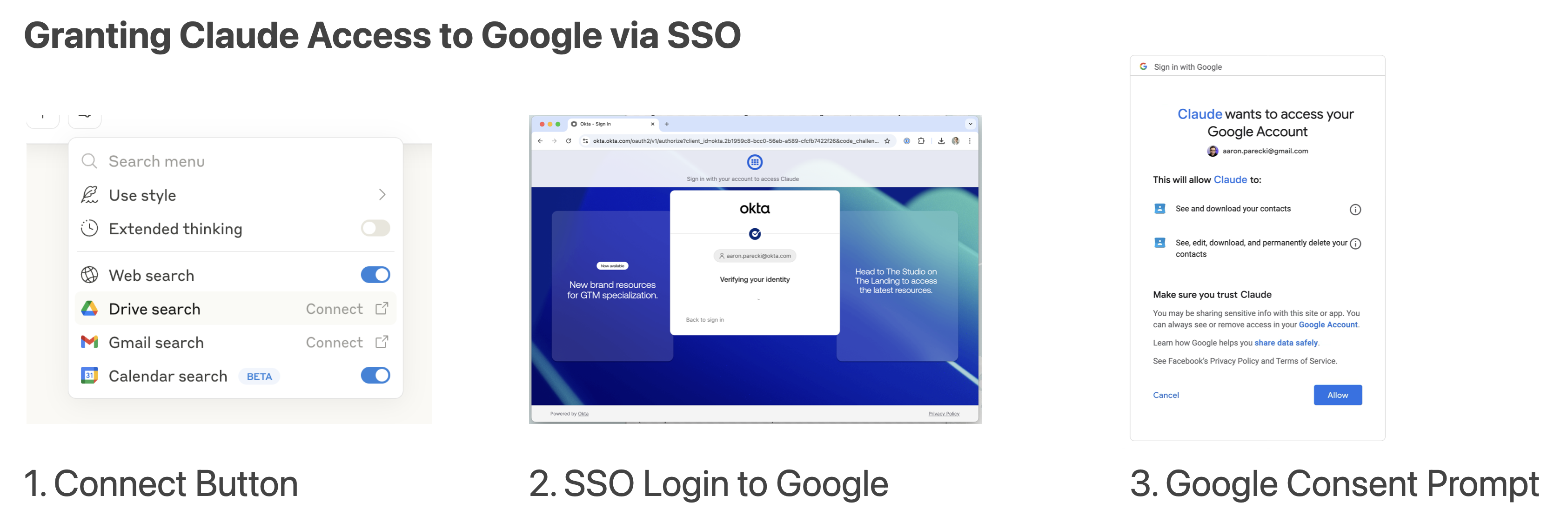
Cross-Domain API Access: Beyond the "Obvious" Shortcuts

Cross-domain access is everywhere in today's software landscape. Whether you look at enterprise SaaS applications, AI agents interacting with user data across multiple platforms, or "integrated experiences" pulling information from a calendar, a chat tool, and a wiki—everything eventually needs to talk across boundaries.

Development teams frequently reach for the quickest path to wire these systems together. Usually, teams fall back on two "obvious" architectural shortcuts. However, as experience deploying these architectures at scale demonstrates, both models break down in production.

Let's take a closer look at why these shortcuts fail and what a resilient cross-domain pattern actually looks like.

🧶 Shortcut #1: Have the IdP issue the access token directly

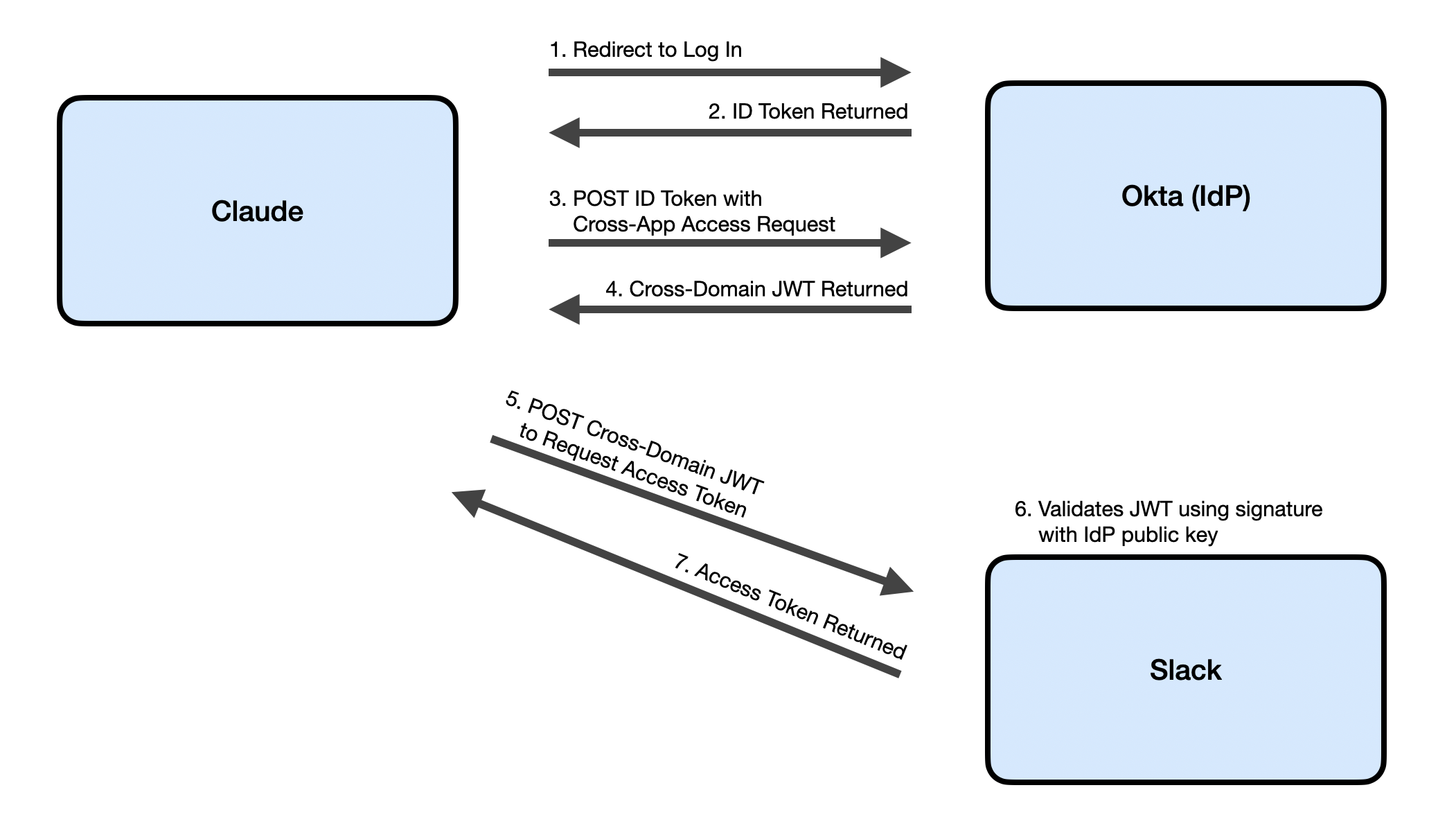
The pattern: the client takes its ID Token to the IdP, exchanges it for an access token, and sends that access token straight to the resource app's API.

Why it's tempting: it reuses the IdP that everyone already trusts. It feels like a clean, one-stop shop.

Why it breaks: every API on the receiving end now has to trust a growing list of foreign token issuers — each with its own quirks around token format, claim conventions, key rotation, and revocation. 

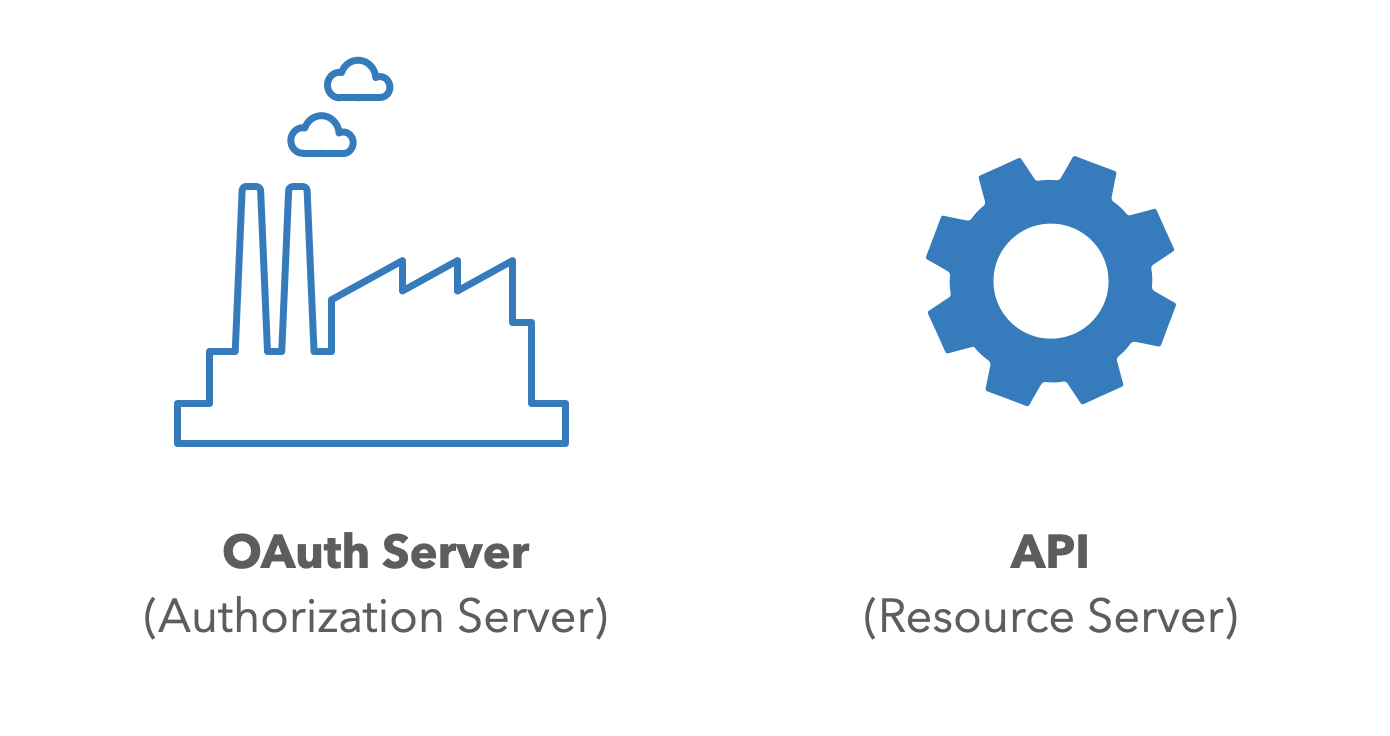
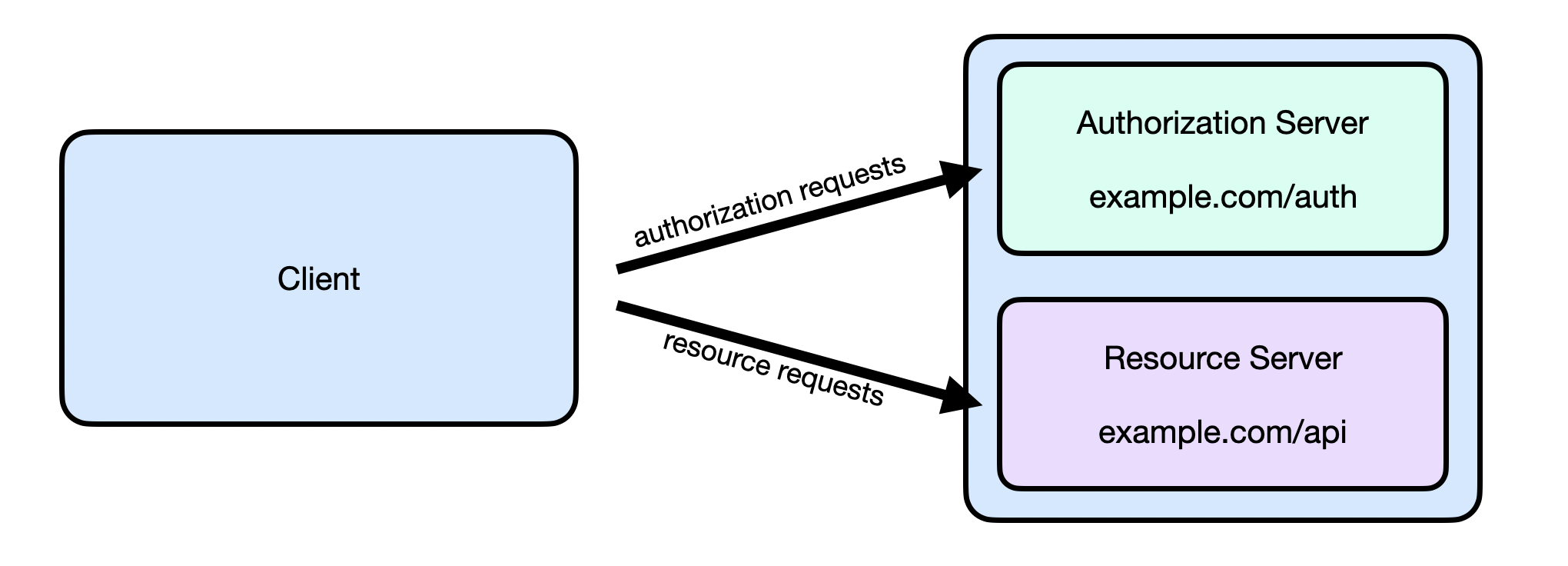
Suddenly your API team is in the federation business, doing one-off integrations per IdP. That's not a sustainable model for building APIs at scale. APIs are far better served by having a local authorization server issuing the tokens they validate — one issuer, one model, one set of rules.

🪪 Shortcut #2: Send the ID Token across domains

The pattern: skip the IdP-issued access token and present the original ID Token directly at the receiving app's authorization server, exchanging it for a locally issued access token.

Why it's tempting: ID Tokens are standardized, so it feels like it sidesteps the trust-fan-out problem from #1.

Why it breaks: ID Tokens are issued for one audience — the application the user signed into. Sending them somewhere else violates that audience binding, opens up replay and misuse risks.

🎯 What Cross-App Access does differently

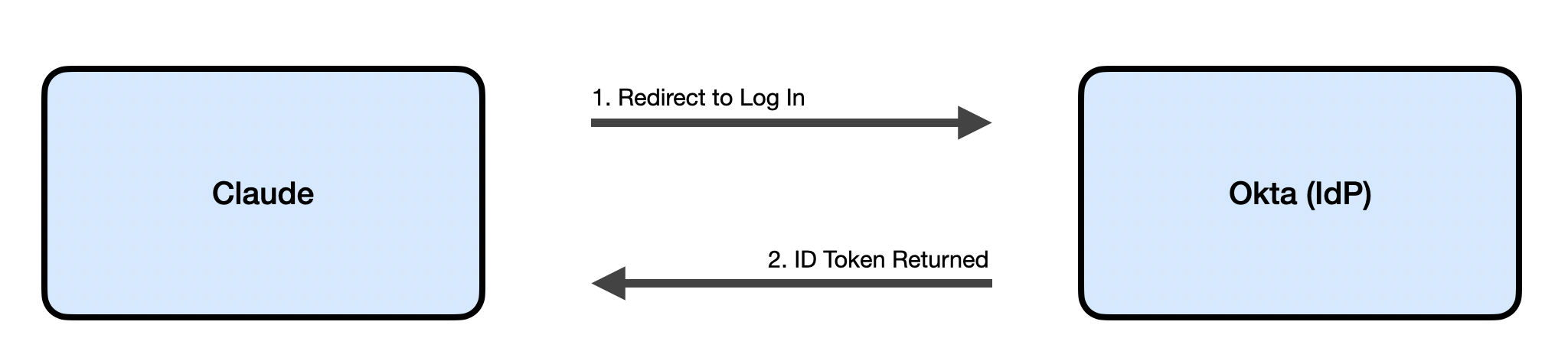
Cross-App Access (XAA) uses a two-stage flow — and each stage exists specifically to fix one of the problems above.

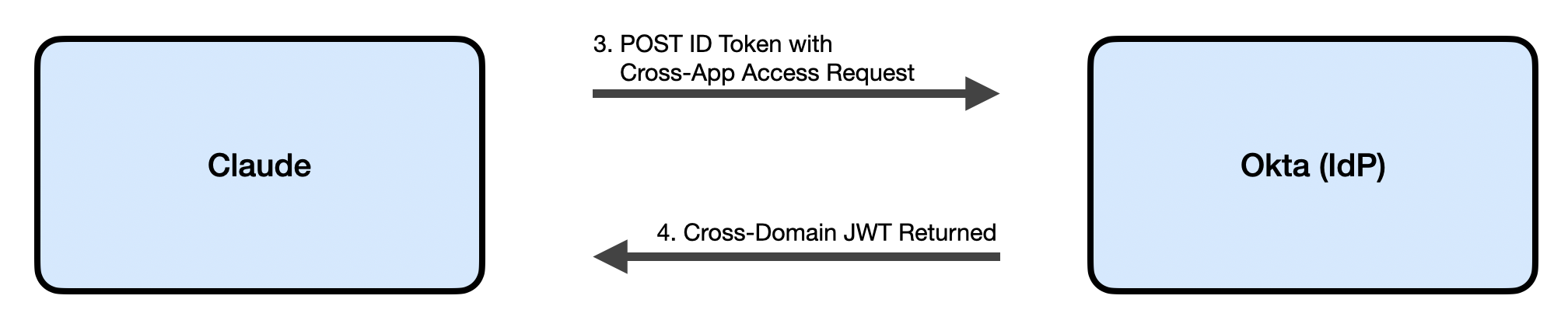
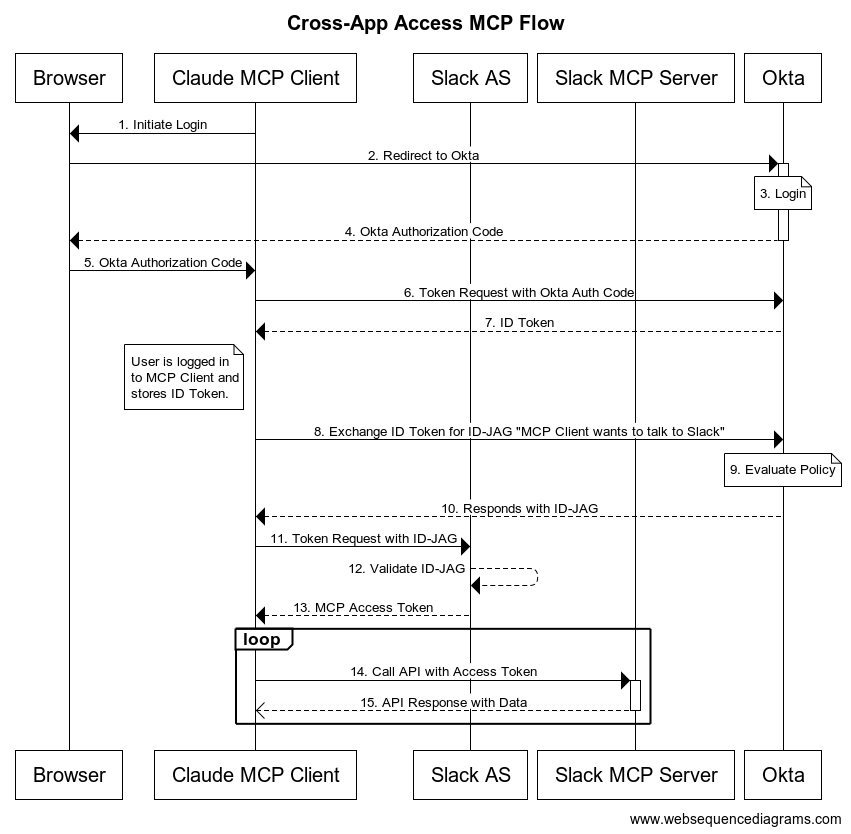
Stage 1: The client makes a Token Exchange request to the IdP to exchange the ID Token for an ID-JAG: a purpose-built, short-lived, audience-bound grant for the resource authorization server.

No ID Token misuse, no audience confusion. The IdP also stays in the loop to govern whether this cross-app access should happen at all — exactly where enterprise IT already manages who can access what.

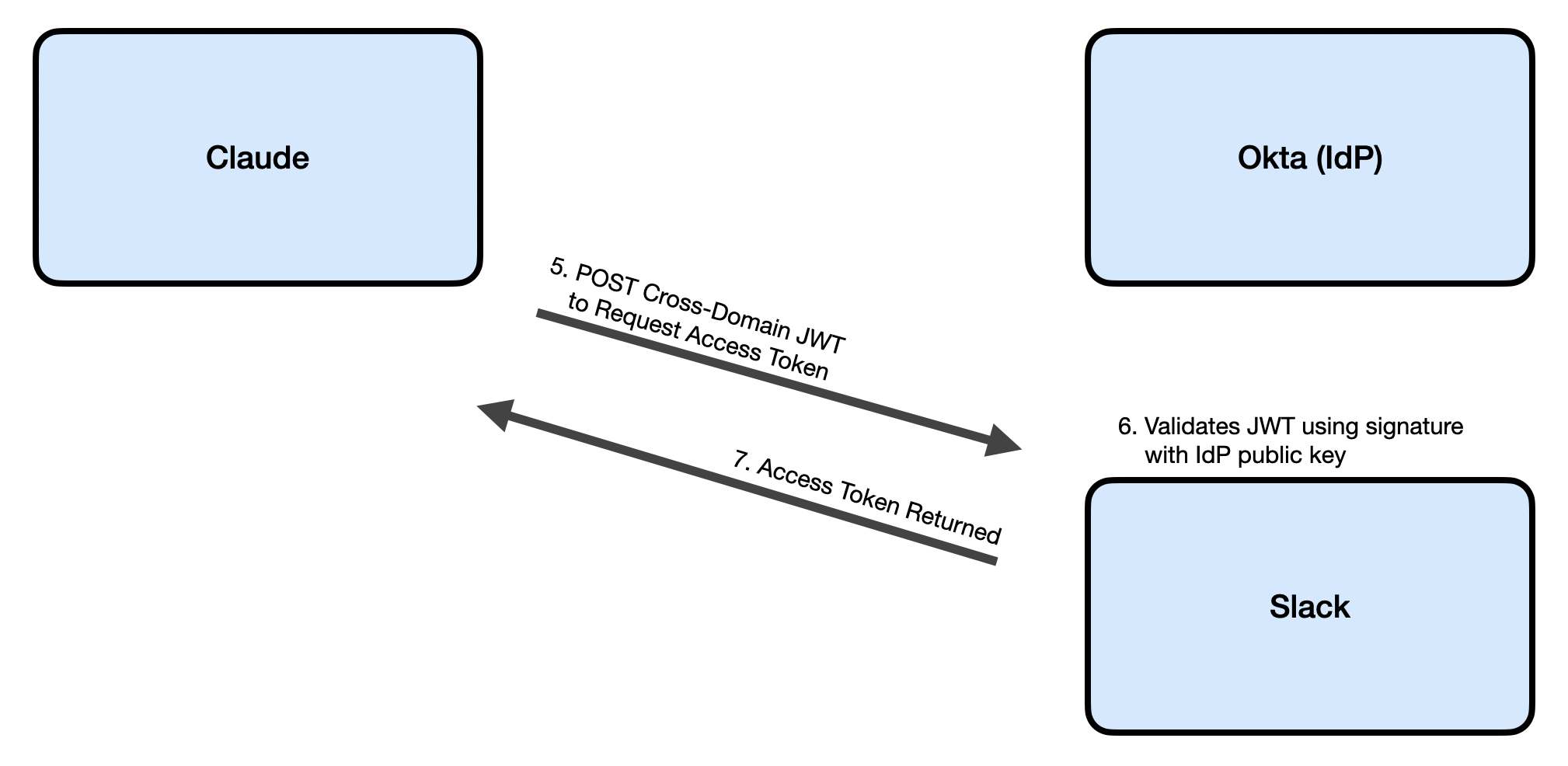
Stage 2: The resource app's authorization server exchanges the ID-JAG for its own access token. The API keeps its local AS, its own token format, and its own revocation story. It only has to trust the access tokens issued by its own AS — not a foreign access token.

We can push all the complexity of user login, token minting, and cross-domain policy evaluation onto the specialized identity components, keeping the resource API free to do the much simpler task of validating its own domain's access tokens and serving data.

If you're designing cross-domain access for an AI agent, an enterprise suite, or any multi-vendor ecosystem, this is the pattern to follow. The IETF draft: https://datatracker.ietf.org/doc/draft-ietf-oauth-identity-assertion-authz-grant/

Wed, 27 May 2026 07:57:41 +0000 Fullscreen Open in Tab
Pluralistic: AI and a world without migrants (27 May 2026)


Today's links


A hand-tinted image of elderly people in the lounge of a nursing home. Three killer robots have been inserted into the scene.

AI and a world without migrants (permalink)

I don't care who you are, there will always be times when hell is other people. Not because other people are horrible – quite the opposite! Other people are wonderful, but boy are they ever stubborn.

From boardgames to romance, team sports to movement politics, business ideas to construction projects, there's so much important, enjoyable and essential stuff you can't do alone. But other people insist on having their own priorities and goals, and they mulishly refuse to organize their lives to suit your priorities.

Our species has put a lot of work into resolving this conundrum. Not only did we evolve a whole brain structure – the neocortex – that helps us understand others' perspectives, but we also evolved many social structures (like laws and teams and governments and families and committees and bureaucracies) to help us coordinate with others to do superhuman things (that is, things that exceed the capacity of a single human).

These structures are imperfect, but they're better than the alternative: coercion. Persuading others is not without its pitfalls, but compared to forcing others to bend to your will, "persuasion" is the hands-down favorite.

Not for everyone, though. There has always been a group of people who refused to acknowledge that other people have perfectly valid reasons for wanting to pursue their own goals rather than yours. We call most of those people "toddlers" and devote sizable social effort to helping them outgrow this belief.

But there's another group of people who carry this belief into adulthood. If they're of regular means, we call those people "bullies." However, if they're sufficiently wealthy, we call them "billionaires" (this is the same force that allows money to transmute a "hoarder" into a "collector").

Just lately though, we've come up with a new solution to the problem of hell being other people. Rather than coercing other people into arranging their affairs to suit our needs, we've devoted trillions of dollars to replacing people with pliant chatbots, in the hopes that these chatbots can be made so effective that we can just dispense with other people altogether.

Many everyday people have replaced their romantic partners with chatbots ("AI boyfriends"/"AI girlfriends"), and they've formed active communities to revel in the delights of pursuing love with someone who demands no moral consideration or compromise, glorying in a world of love without lovers:

https://www.cbc.ca/listen/cbc-podcasts/1353-the-naked-emperor/episode/16215328-e1-love-bots

There's a whole community of people who have stopped listening to music created by people in favor of made-to-order slop, exulting in a world of music without musicians:

https://www.theverge.com/ai-artificial-intelligence/937059/nobody-wants-to-tell-me-why-they-only-listen-their-own-suno-slop

These are foundationally solipsistic exercises, fantasy worlds in which you are the only real person and everyone else is a bot, an NPC, a phantom. AI has democratized solipsism, a privilege that was once the exclusive purview of billionaires, whose belief that most other people weren't fully real let them inflict the kind of mass pain on millions that is a prerequisite for amassing a truly vast fortune:

https://pluralistic.net/2025/08/18/seeing-like-a-billionaire/#npcs

No surprise then that billionaires were easy marks for AI hustlers, who promised the possibility of a world without people, where an army of "agents" could do the jobs that presently demand the contributions of unreasonable human beings who refuse to acknowledge that your priorities trump theirs.

Jeff Bezos built the world's most advanced automated warehouses, and the workers in those warehouses are seriously injured at 300% of the national rate, and they are not allowed pee breaks (nevertheless, these workers unreasonably insist on metabolizing fluids and expelling the waste). The automation and the injuries aren't unrelated facts. The inhumane treatment is caused by the automation, because when you commit hundreds of billions to automation capex, you need to work those assets to recoup the investment. In a human/machine collaboration, humans will always be the bottlenecks. To maximize return on automation, you need to drive the human peripherals that serve the machines at the absolute limit of human endurance. Jeff Bezos's machines don't just use humans, they use them up:

https://pluralistic.net/2025/05/27/rancid-vibe-coding/#class-war

Billionaires poured trillions into AI because they are obsessed with the fantasy of a world without people. Mark Zuckerberg would like to replace your on-platform friends with chatbots. Sure, your friends are the reason you're stuck on his platforms, but your friends are stubborn and thus suboptimal. Remember: hell is other people, so while your friends unreasonably refuse to leave Facebook with you and follow you to another platform (this is bad for you, but good for Zuck), they also refuse to organize their social media lives to "maximize your engagement" and thus the number of ads you see (which is bad for Zuck). By replacing your friends with chatbots, Zuck hopes to reinvent social media without the socializing:

https://pluralistic.net/2026/04/17/for-youze/#forever

Billionaires are betting that bosses (and other would-be billionaires) will spend trillions buying AI products, captured by the fantasy of a workplace without workers. They think AI could be the remedy for the ancient, nameless dread that bosses experience every time they contemplate the fact that if they don't show up for work, everything hums along fine; whereas if the workers don't show up, the whole enterprise collapses. Secretly, bosses are haunted by the fear that they're not driving the car, they're strapped into the back seat, amusing themselves with a toy steering-wheel:

https://pluralistic.net/2026/01/05/fisher-price-steering-wheel/#billionaire-solipsism

That's what the Hollywood strikes were about: studio bosses' fantasy of movies without actors and screenplays without screenwriters. Since the invention of the studio system itself, studio bosses have wrestled with the fact that talented people who are beloved by audiences have bargaining leverage, which they use to demand better outputs and higher wages (this is the same conundrum faced by hospital administrators confronting nurses and doctors, college administrators confronting faculty, etc):

https://pluralistic.net/2026/01/20/i-would-prefer-not-to/#i-cant-do-that-boss

This solipsistic drive is what powers investment in AI "persuasion" technologies, making billions for latter-day Cambridge Analyticas who peddle the outlandish tale of having built a mind-control ray. It's a winning sales-pitch because it plays into the fantasy of a world where customers do as they're told, organizing their lives according to your priorities, at the expense of their own wellbeing:

https://pluralistic.net/2025/05/07/rah-rah-rasputin/#credulous-dolts

It's not just captains of industry who are occupied with furious, all-consuming fantasies of a world without people. Dictators, autocrats and technocrats in the political world love AI because it dangles the possibility of a world without bureaucrats and public officials. If the civil service can be replaced with chatbots, then the will of the dictator can be translated directly into policy without any tedious negotiations with experts who understand how things work and have deep moral commitments to the public good:

https://pluralistic.net/2026/05/13/vibe-governance/#k-hole

A world without people is especially attractive to politicians presiding over aging, declining nations whose most ardent voters have been convinced that migrants are a threat to their nation (rather than its salvation).

Objectively speaking, the only way that a rich country with an aging workforce can remain wealthy and powerful is by wooing working-age people from elsewhere to migrate to that country. Even if every tradwife is kept in a state of continuous gestation courtesy of a fertility-obsessed natalist, there's still going to be decades during which your wealthy, aging population will need young, skilled people to do all the essential labor. From picking crops, to staffing hospitals, to building homes, to filing lawsuits, to preparing tax-returns, your quiverfull child army will be too young to take over for years to come.

Trapped in the political impossibility of a country whose productive activities are absolutely reliant on young, strong, resourceful, skilled migrants, and a xenophobic political movement that scapegoats these migrants and revels in the spectacle of ethnic cleansing, politicians see AI as a way out of their double-bind. If migrants can be replaced with AI, then you can satisfy the racist sadism of your most ardent voters without shutting down the country for lack of workers.

In other words: in feeding the fantasy of a world without people, AI serves the fantasy of a world without migrants. Unlike gastarbeiters, bracero fruit-pickers and Saudi quasi-slaves, AI makes no demands, requires no moral consideration, and does not attempt to germinate a culture, a cuisine, or a language in your sacred soil.

This grotesque fantasy has always lurked in the subtext of the automation story. The plot of Disney's Big Hero 6 boils down to: "In future-America/Japan, it will be more politically possible to have robots look after our aging parents than it will be to welcome the millions of skilled health-workers in the Pacific Rim who are eminently qualified to do the job." Big Hero 6 is the solution to the problem of building a nursing home without nurses.

The wealthy have always dreamed of transforming the proletariat into the precariat: desperate workers who do as they're told. But in the automation story of which AI is the latest chapter (and purportedly the climax), the precariat becomes the unnecessariat: workers who are surplus to requirements and can be vaporized or liquidated or warehoused or simply ignored.

In the fantasy world of total automation, the owners of AI can make the world go around without any of us, which means that we will exist solely at their sufferance, and will therefore have to act like the NPCs they half-believe we are already, organizing everything we do around their priorities.

This is the foundation of Sam Altman's obsession with a biometrically controlled universal basic income. Altman can't stop fantasizing about a world in which all the productive work is done by his software, and the state's sole purpose is to supply us – the unnecessariat – with vouchers we can only redeem for services provided by Altman's robot army. It's charter schools for everything, with Altman at the top, all wrapped up in a layer of dystopian retinal scanning:

https://www.wired.com/story/worldcoin-sam-altman-orb/

Billionaires and would-be billionaires are absolute suckers for this solipsistic bullshit, because they genuinely don't think other people are real. They love "effective altruism" because it counsels them to make as much money as possible, without regard to how many people they cheat, hurt, or kill…provided that they pledge to use these ill-gotten gains to improve the lives of 10^53 imaginary artificial people who will come into existence in 10,000 years. After all, the total benefit of even the most infinitesimal welfare gains experienced by 10^53 people vastly exceeds all the pleasures that all eight billion actual, living people are capable of experiencing:

https://www.semafor.com/article/11/21/2023/how-effective-altruism-led-to-a-crisis-at-openai

It all makes perfect sense – provided you don't believe that other people are really, truly real.


Hey look at this (permalink)


A shelf of leatherbound history books with a gilt-stamped series title, 'The World's Famous Events.'

Object permanence (permalink)

#15yrsago California prison overcrowding, in photos https://web.archive.org/web/20110525171353/https://www.motherjones.com/politics/2011/05/california-prison-overcrowding-photos

#15yrsago What Will Come After: the sweet melancholy of the zombie apocalypse https://memex.craphound.com/2011/05/25/what-will-come-after-the-sweet-melancholy-of-the-zombie-apocalypse/

#10yrsago If Donald Trump ever talks to a real journalist, these are the questions he should answer https://www.nationalmemo.com/21-questions-for-donald-trump

#10yrsago Norwegian Consumer Council broadcasts live, marathon reading of app Terms of Service https://web.archive.org/web/20160526145553/https://www.forbrukerradet.no/vilkar-og-personvern-minutt-for-minutt/

#10yrsago Pastejacking: using malicious javascript to insert sneaky text into pasted terminal commands https://github.com/dxa4481/Pastejacking

#10yrsago Why medieval monks filled manuscript margins with murderous rabbits https://web.archive.org/web/20160614000551/https://jonkanekojames.com/2015/05/02/why-are-there-violent-rabbits-in-the-margins-of-medieval-manuscripts/

#10yrsago Students: court orders government agencies to offer educational discount on FOIA requests https://web.archive.org/web/20160525155102/https://www.techdirt.com/articles/20160521/16031934508/appeals-court-tells-government-it-must-extend-educational-institution-foia-fee-price-break-to-students.shtml

#10yrsago The euphemisms news reporters use when a sports figure injures his penis and testicles https://web.archive.org/web/20160525125452/https://fivethirtyeight.com/features/media-groin-draymond-green-steven-adams/

#10yrsago Company says facial features reveal terrorists and pedophiles 80% of the time https://web.archive.org/web/20160525130941/https://www.washingtonpost.com/news/innovations/wp/2016/05/24/terrorist-or-pedophile-this-start-up-says-it-can-out-secrets-by-analyzing-faces/

#5yrsago We promised this vaccine waiver 20 years ago https://pluralistic.net/2021/05/25/the-other-shoe-drops/#quid-pro-quo


Upcoming appearances (permalink)

A photo of me onstage, giving a speech, pounding the podium.


A screenshot of me at my desk, doing a livecast.

Recent appearances (permalink)


A grid of my books with Will Stahle covers..

Latest books (permalink)


A cardboard book box with the Macmillan logo.

Upcoming books (permalink)

  • "The Reverse-Centaur's Guide to AI," a short book about being a better AI critic, Farrar, Straus and Giroux, June 2026 (https://us.macmillan.com/books/9780374621568/thereversecentaursguidetolifeafterai/)

  • "Enshittification, Why Everything Suddenly Got Worse and What to Do About It" (the graphic novel), Firstsecond, 2026

  • "The Post-American Internet," a geopolitical sequel of sorts to Enshittification, Farrar, Straus and Giroux, 2027

  • "Unauthorized Bread": a middle-grades graphic novel adapted from my novella about refugees, toasters and DRM, FirstSecond, April 20, 2027

  • "The Memex Method," Farrar, Straus, Giroux, 2027


Colophon (permalink)

Today's top sources:

Currently writing: "The Post-American Internet," a sequel to "Enshittification," about the better world the rest of us get to have now that Trump has torched America. Third draft completed. Submitted to editor.

  • "The Reverse Centaur's Guide to AI," a short book for Farrar, Straus and Giroux about being an effective AI critic. LEGAL REVIEW AND COPYEDIT COMPLETE.

  • "The Post-American Internet," a short book about internet policy in the age of Trumpism. PLANNING.

  • A Little Brother short story about DIY insulin PLANNING


This work – excluding any serialized fiction – is licensed under a Creative Commons Attribution 4.0 license. That means you can use it any way you like, including commercially, provided that you attribute it to me, Cory Doctorow, and include a link to pluralistic.net.

https://creativecommons.org/licenses/by/4.0/

Quotations and images are not included in this license; they are included either under a limitation or exception to copyright, or on the basis of a separate license. Please exercise caution.


How to get Pluralistic:

Blog (no ads, tracking, or data-collection):

Pluralistic.net

Newsletter (no ads, tracking, or data-collection):

https://pluralistic.net/plura-list

Mastodon (no ads, tracking, or data-collection):

https://mamot.fr/@pluralistic

Bluesky (no ads, possible tracking and data-collection):

https://bsky.app/profile/doctorow.pluralistic.net

Medium (no ads, paywalled):

https://doctorow.medium.com/

Tumblr (mass-scale, unrestricted, third-party surveillance and advertising):

https://mostlysignssomeportents.tumblr.com/tagged/pluralistic

"When life gives you SARS, you make sarsaparilla" -Joey "Accordion Guy" DeVilla

READ CAREFULLY: By reading this, you agree, on behalf of your employer, to release me from all obligations and waivers arising from any and all NON-NEGOTIATED agreements, licenses, terms-of-service, shrinkwrap, clickwrap, browsewrap, confidentiality, non-disclosure, non-compete and acceptable use policies ("BOGUS AGREEMENTS") that I have entered into with your employer, its partners, licensors, agents and assigns, in perpetuity, without prejudice to my ongoing rights and privileges. You further represent that you have the authority to release me from any BOGUS AGREEMENTS on behalf of your employer.

ISSN: 3066-764X

Tue, 26 May 2026 09:45:37 +0000 Fullscreen Open in Tab
Pluralistic: The AI bubble isn't like the internet bubble (26 May 2026)


Today's links


The head and shoulder of a supine bearded man in a chambray shirt. He is tied down with ropes around his shoulders. Four tiny figures with suits and grotesque plutocratic heads are prying his mouth open by yanking at his hair and beard. Once of the men is shoving an evil robot into his mouth.

The AI bubble isn't like the internet bubble (permalink)

One of the surprise breakout software products of the early web was Lotus Notes, a kind of primitive precursor to all-in-one office productivity suites like GDocs, Office365, etc. It was so important that its creator, Ray Ozzie, was promoted to Microsoft's Chief Software Architect, succeeding Bill Gates himself:

https://knowledge.wharton.upenn.edu/podcast/knowledge-at-wharton-podcast/the-man-who-would-change-microsoft-ray-ozzies-vision-for-connected-software/

People who remember Notes tend to deride it for its clunky user interface and demi-functional administrative tools. But what made Notes so central to Microsoft wasn't its polish – it was the fact that Notes represented a brokered peace between IT managers, who wanted mainframe-like control over everything their users could do with business equipment, and the users themselves – workers who kept smuggling internet-based tools into the enterprise network on the very sensible grounds that they had a job to do, and these were the best tools to do it.

The arrival of internet-based tools – especially ones that ran in browsers – represented a major challenge to IT departments, who had been long accustomed to dictating terms to their users. If the IT manager and the compliance department decided that the best way to manage disclosure and leak risks was to block all email attachments for outside users, then that was that: no one could send those attachments.

But after the internet arrived on the corporate desktop, employees who needed to get documents to supply chain partners and customers could treat these IT policies as damage and route around them. Just fire up your Hotmail or Yahoo mail window, or hop on MSN Messenger or ICQ or AIM, or drop the file on an anonymous FTP server and send the link to your counterparty. Job done!

IT managers hated this, and to be fair to them, they weren't (always) wrong. These outside tools came from a variety of untrustworthy sources, including malicious sites that pushed virus-infected versions to their users. Also, by evading firewall rules with these tools, users made it impossible to achieve the compliance goals that IT had been charged with enforcing, and it was IT's asses on the line if the company got in trouble as a result.

Foundationally, IT was being asked to do two irreconcilable things: they were supposed to be enabling workers to get their jobs done, and they were supposed to be stopping those workers from doing things that could harm the business. This can't be done, because the only way to eliminate the possibility that a worker will take an action that harms the business is to gag that worker and lock them in a dungeon. Workers need flexibility and freedom to achieve business goals, and that flexibility and freedom means that those workers might (deliberately or accidentally) thwart the business's goals.

What's more, workers will always run into situations that were not anticipated by policy, and if they are denied any agency or initiative, they will fail to get their jobs done. In work, the exception is the rule, hence the importance of "process knowledge" (all the implicit knowledge shared among workers across the firm and its suppliers and customers, which cannot be captured or recorded):

https://pluralistic.net/2025/09/08/process-knowledge/#dance-monkey-dance

Indeed, there's a form of labor action called a "work to rule," in which workers only do the things dictated by their rulebooks, without taking any of the routine additional measures dictated by process knowledge. Merely by following every rule to the letter, workers can grind a shop to a halt:

https://en.wikipedia.org/wiki/Work-to-rule

Since the dawn of personal computers, workers and IT departments have come into conflict, as workers literally smuggled technology into the business that could do things the IT department had (often arbitrarily and capriciously) prohibited. When Visicalc emerged as the killer app for the Apple ][+, workers snuck these computers into work and used them to sort spreadsheets in ways that IT had declined to permit. They didn't do this to cheat or steal from the company – the whole point was to do a better job.

So it was with the early web: workers discovered a myriad of new capabilities in the free-to-use world of web-based tools and realized how these tools would make them much more effective at their jobs. The fact that IT wouldn't let them do these things was just more evidence that IT – and the managers who set IT's agenda – didn't understand the business as well as workers.

It didn't help that IT managers' first line of defense was the high-tech version of abstinence-only education: "You only think you need your work computers to do this, but really, you don't, so stop trying":

https://www.theguardian.com/technology/2009/jun/16/computer-security-abstinence

Abstinence-only education never works, but where "you only think you need this" failed, Lotus Notes succeeded. Lotus Notes provided a whole suite of tools that largely (if imperfectly) replaced the universe of free tools that workers were using to evade their IT departments' edicts, so they could get their jobs done. At the same time, Lotus Notes provided a set of management tools that let IT fine-tune how these tools worked, giving them (some) of the controls they needed to achieve their compliance goals.

Like all brokered peace settlements, Lotus Notes left both sides feeling like they'd made a compromise they could live with, giving up some of their goals, but keeping the things that really mattered to them.

It's impossible to overstate how important Lotus Notes and similar products were, because workers demanded the right to use the web on their work computers, and they made those demands so forcefully that managers had to completely re-do their IT policies, lest those workers treat them as damage and route around them. Back then, the tech press was full of stories about these conflicts, as workers insisted that the new technology that was sweeping the nation was so foundational and transformative that they had to be allowed to use it.

What we never saw back then were stories about how managers had to monitor workers to ensure that they were using the web as much as possible. No one had to force workers to find ways to integrate the web into their workflows.

In other words, the story of the web at work was the opposite of the story of AI at work. Today, you can't turn around without reading a story about bosses who are threatening to fire workers if they don't increase their AI usage:

https://www.businessinsider.com/boss-track-ai-use-career-2025-8

Virtually every major company now has a program to force workers into using AI:

https://www.cnbc.com/2026/05/05/ai-use-work-employee-monitoring-tech-surveillance.html

It's conceivable that over the past quarter-century, bosses have become technophiles while workers have fallen prey to superstitious technophobia, but it hardly seems likely. Historically, workers have always been enthusiastic about tools that let them do a better job – indeed, it's a truism that labor-led automation produces improvements in quality, while capital-driven automation increases throughput (often at the expense of quality).

Workers aren't the only typical early adopters who find AI lacking. As a group, teenagers and young adults hate AI:

https://www.nytimes.com/2026/04/09/style/gen-z-ai-gallup-study.html

That's not what it was like during the early web days. Back then, young people entering the workforce were passionate devotees of the web, to the point where the business press routinely ran articles asking how today's workplaces were going to adapt to the demands of these webbed-up workers.

https://www.nber.org/digest/apr03/internet-changes-labor-market

AI boosters insist that the deficits we see in AI – its lack of profitability, its primitive and error-riddled outputs – are no different from the shakedown problems of the early web (and we know how the web turned out!). But this is a profoundly flawed comparison: the early web and AI are very different from one another.

For one thing, the early web may have lost money, but it had great unit economics. Every new web user brought the web closer to profitability, as did every new use of the web, and every new generation of web technology. By contrast, AI has – in the memorable phrasing of Ed Zitron – "dogshit unit economics." Every new AI user makes AI less profitable, as does every new use for AI, and each generation of AI loses more money than the last. AI is the money-losingest endeavor in human history:

https://pluralistic.net/2025/09/27/econopocalypse/#subprime-intelligence

In other words, the early web was a technology that grew more profitable every day, which workers and young people had to force on their bosses – and AI is a technology that grows less profitable every day, and bosses have to force it on workers and young people.

Now, it's true that some workers don't have to be forced to use AI. Workers who enjoy a high degree of autonomy (that is to say, workers who are positioned to ignore workplace coercion) can adopt AI in ways that they feel suited to, just as those early web users and Visicalc smugglers did. They can fulfill the maxim that labor-driven automation improves quality, while resisting capital's insistence that automation be used to increase throughput at quality's expense.

They can act as centaurs (workers assisted by technology), not as reverse-centaurs (workers who are recruited to serve as peripherals for machines). As with all technology questions, what the technology does is nowhere near as important as who the tech does it for and who the tech does it to:

https://pluralistic.net/2025/09/11/vulgar-thatcherism/#there-is-an-alternative

And there's another group of workers who adopt AI voluntarily: workers who see that AI can do a lot of work that they view as dull and unimportant for them. These workers might be right – there are plenty of bullshit jobs out there:

https://memex.craphound.com/2018/06/20/david-graebers-bullshit-jobs-why-does-the-economy-sustain-jobs-that-no-one-values/

But it's also possible that they're wrong, and they're substituting AI for something that really should be done by a person.

But on the plus side, at least no one has to force them to adopt AI.


Hey look at this (permalink)


A shelf of leatherbound history books with a gilt-stamped series title, 'The World's Famous Events.'

Object permanence (permalink)

#25yrsago Website graveyard https://web.archive.org/web/20010516224100/http://www.disobey.com/ghostsites/

#20yrsago Canadian students ask govt to save them from copyright https://web.archive.org/web/20060629014007/https://action.web.ca/home/cfs/en_alerts.shtml?x=88910&AA_EX_Session=d56bebd39174d9839ec3ee5fa6fe93a4

#20yrsago Lifespan of best-sellers falls 6/7ths in 40 years https://web.archive.org/web/20060601231943/https://www.lulu.com/static/pr/05_19_06.php

#15yrsago Sarkozy’s false-flag E-G8 attracts withering scorn https://web.archive.org/web/20121109010803/https://arstechnica.com/tech-policy/2011/05/france-attempts-to-civilize-the-internet-internet-fights-back/

#15yrsago Tool reveals ISP traffic-shaping https://web.archive.org/web/20120514151210/https://arstechnica.com/tech-policy/2011/05/new-shaperprobe-tool-detects-isp-traffic-shaping/

#15yrsago Falun Gong sues Cisco over complicity in China’s “Golden Shield” – allege torture, murder https://web.archive.org/web/20110524065718/http://news.cnet.com/8301-1023_3-20065219-93.html

#15yrsago Scenes from Los Angeles’s teacher-librarian witch-hunt https://mizzmurphy.blogspot.com/2011/05/message-received.html

#15yrsago Denmark bans Marmite https://www.theguardian.com/theguardian/2011/may/24/uk-should-ban-sandi-toksvig

#10yrsago As mobile carriers ramp up bribery program, Internet coalition says no to “zero rating” https://web.archive.org/web/20160524233609/https://motherboard.vice.com/read/medium-mozilla-and-kickstarter-signed-a-letter-against-zero-rating

#10yrsago Philippines’ new “dictator” will give a hero’s burial to Ferdinand Marcos https://web.archive.org/web/20160526135257/http://www.msn.com/en-ph/news/world/philippine-dictator-marcos-to-get-heros-burial-duterte/ar-BBtnPJH

#10yrsago Judge handcuffs public defender for speaking out in court https://web.archive.org/web/20160525151444/http://www.reviewjournal.com/news/las-vegas/las-vegas-judge-handcuffs-public-defender-courtroom

#10yrsago Sanders donors flock to Tim Canova’s campaign against DNC Chair Debbie Wasserman Schultz https://edition.cnn.com/2016/05/23/politics/debbie-wasserman-schultz-primary-opponent-fundraising/index.html

#10yrsago Algorithmic risk-assessment: hiding racism behind “empirical” black boxes https://www.propublica.org/article/machine-bias-risk-assessments-in-criminal-sentencing

#10yrsago Plagiarism detection app vs Russia’s elites: 1-2 fake PhDs discovered every day https://www.slate.com/articles/news_and_politics/cover_story/2016/05/the_thriving_russian_black_market_in_dissertations_and_the_crusaders_fighting.html

#10yrsago Technology’s “culture of compliance” must be beaten back in the name of justice https://bb9.berlinbiennale.de/all-problems-can-be-illuminated-not-all-problems-can-be-solved/

#10yrsago Grass in the park at the center of San Francisco gentrification debate is now for rent https://sfist.com/2016/05/23/rec_parks_pilot_program_allows_you/

#10yrsago Lawsuit: Texas’s largest jail is full of people who are locked up for being poor https://web.archive.org/web/20160524134738/https://thinkprogress.org/economy/2016/05/23/3781076/texas-bail-lawsuit/

#10yrsago After the precariat, the unnecessariat: the humans who are superfluous to corporations https://morecrows.wordpress.com/2016/05/10/unnecessariat/

#5yrsago Watomatic, for lower Whatsapp switching costs https://pluralistic.net/2021/05/24/how-about-nah/#comcom


Upcoming appearances (permalink)

A photo of me onstage, giving a speech, pounding the podium.


A screenshot of me at my desk, doing a livecast.

Recent appearances (permalink)


A grid of my books with Will Stahle covers..

Latest books (permalink)


A cardboard book box with the Macmillan logo.

Upcoming books (permalink)

  • "The Reverse-Centaur's Guide to AI," a short book about being a better AI critic, Farrar, Straus and Giroux, June 2026 (https://us.macmillan.com/books/9780374621568/thereversecentaursguidetolifeafterai/)

  • "Enshittification, Why Everything Suddenly Got Worse and What to Do About It" (the graphic novel), Firstsecond, 2026

  • "The Post-American Internet," a geopolitical sequel of sorts to Enshittification, Farrar, Straus and Giroux, 2027

  • "Unauthorized Bread": a middle-grades graphic novel adapted from my novella about refugees, toasters and DRM, FirstSecond, April 20, 2027

  • "The Memex Method," Farrar, Straus, Giroux, 2027


Colophon (permalink)

Today's top sources:

Currently writing: "The Post-American Internet," a sequel to "Enshittification," about the better world the rest of us get to have now that Trump has torched America. Third draft completed. Submitted to editor.

  • "The Reverse Centaur's Guide to AI," a short book for Farrar, Straus and Giroux about being an effective AI critic. LEGAL REVIEW AND COPYEDIT COMPLETE.

  • "The Post-American Internet," a short book about internet policy in the age of Trumpism. PLANNING.

  • A Little Brother short story about DIY insulin PLANNING


This work – excluding any serialized fiction – is licensed under a Creative Commons Attribution 4.0 license. That means you can use it any way you like, including commercially, provided that you attribute it to me, Cory Doctorow, and include a link to pluralistic.net.

https://creativecommons.org/licenses/by/4.0/

Quotations and images are not included in this license; they are included either under a limitation or exception to copyright, or on the basis of a separate license. Please exercise caution.


How to get Pluralistic:

Blog (no ads, tracking, or data-collection):

Pluralistic.net

Newsletter (no ads, tracking, or data-collection):

https://pluralistic.net/plura-list

Mastodon (no ads, tracking, or data-collection):

https://mamot.fr/@pluralistic

Bluesky (no ads, possible tracking and data-collection):

https://bsky.app/profile/doctorow.pluralistic.net

Medium (no ads, paywalled):

https://doctorow.medium.com/

Tumblr (mass-scale, unrestricted, third-party surveillance and advertising):

https://mostlysignssomeportents.tumblr.com/tagged/pluralistic

"When life gives you SARS, you make sarsaparilla" -Joey "Accordion Guy" DeVilla

READ CAREFULLY: By reading this, you agree, on behalf of your employer, to release me from all obligations and waivers arising from any and all NON-NEGOTIATED agreements, licenses, terms-of-service, shrinkwrap, clickwrap, browsewrap, confidentiality, non-disclosure, non-compete and acceptable use policies ("BOGUS AGREEMENTS") that I have entered into with your employer, its partners, licensors, agents and assigns, in perpetuity, without prejudice to my ongoing rights and privileges. You further represent that you have the authority to release me from any BOGUS AGREEMENTS on behalf of your employer.

ISSN: 3066-764X

Mon, 25 May 2026 08:21:45 +0000 Fullscreen Open in Tab
Pluralistic: No honor among (ad-tech) thieves (25 May 2026)


Today's links

  • No honor among (ad-tech) thieves: Including "and" and "the."
  • Hey look at this: Delights to delectate.
  • Object permanence: Budweiser nunchuks; GOP vote-suppressor voted illegally; Airbnb enshittifies; Oculus enshittifies; Nintendo copyfrauds its fans; Meritocracy to eugenics pipeline; Ultima Online crisis management; SNES cartridge urinal; JJ Abrams x Axanar, "Sex Criminals"; Beating school filters for fun; Orphan works; Japanese ATM heist; How the Sacklers rigged the game.
  • Upcoming appearances: London, Kansas City, LA, Menlo Park, Toronto, NYC, Edinburgh.
  • Recent appearances: Where I've been.
  • Latest books: You keep readin' em, I'll keep writin' 'em.
  • Upcoming books: Like I said, I'll keep writin' 'em.
  • Colophon: All the rest.


A painting of three lemons on a white background. Each has been altered to add a horrific eye staring out of it. From behind two of the lemons loom carny barkers, gesticulating wildly and waving canes.

No honor among (ad-tech) thieves (permalink)

It shouldn't come as a surprise to learn that a company that uses dishonest tactics to spy on you for profit will also use dishonest tactics to sell the resulting surveillance data.

The only reason this wouldn't be obvious is if you've fallen into the trap of thinking "if you're not paying for the product, you're the product." Companies that cheat when the opportunity arises will cheat everyone: customers, users, regulators, suppliers and employees. You're the product if the company can get away with making you the product:

https://pluralistic.net/2022/11/14/luxury-surveillance/#liar-liar

The digital surveillance swindle is a con from top to bottom: it's not just that they spy on you, it's also that they lie to you about how and why and where they spy on you and what happens to the data they swindle out of you. They're not just cheats, in other words – they're also liars.

Of course they're liars! If their terms of service were honest, they'd say something like, "By being desperate enough to use this product, you 'agree' that we're allowed to come over to your house and punch your grandmother, wear your underwear, make long-distance calls and eat all the food in your fridge."

So they lie like crazy. But they don't just lie to us: they lie to the people they sell our surveillance data to as well. Of course they do! Those people are the ones giving them the money! By tricking the people paying for the product, these surveillance swindlers can get them to pay more!

This is the basis of Tim Hwang's essential 2020 book Subprime Attention Crisis:

https://pluralistic.net/2020/10/05/florida-man/#wannamakers-ghost

Core to Hwang's thesis is that these ads aren't just dangerous, they're also ineffective. The danger of these ads is the erosion of privacy and the mobilization of private data for state repression and fraud, but not particularly for persuasion. The idea that ad-tech companies have realized the ancient dream of building a mind-control ray via the novel technique of "hacking your dopamine loop" is a story that the ad-tech swindlers cooked up to help them sell ads:

https://pluralistic.net/2021/09/30/dont-believe-the-criti-hype/#ordinary-mediocrities

Critics who repeat these outlandish claims are helping these companies sell ads to credulous advertisers, who are getting robbed to the tune of hundreds of billions of dollars. This is the process that Lee Vinsel calls "criti-hype," which is when you "take the sensational claims of boosters and entrepreneurs, flip them, and start talking about 'risks'":

https://peoples-things.ghost.io/youre-doing-it-wrong-notes-on-criticism-and-technology-hype/

Criti-hype is satisfying because the hype itself is so fantastically overblown. These companies claim they're going to save/destroy/conquer the world, transform the very nature of humanity, etc, and so critics who repeat those claims (brackets derogatory) can style themselves as defenders of the world and humanity itself.

This is also a very profitable style of criticism: there's a huge commercial market for people who claim to be defending the world from conquest by evil dopamine-hacking sorcerers and/or superintelligent paperclip-maximizers that can chatbot you into killing yourself and/or voting for Trump (brackets derogatory).

The opposite of criti-hype is materialistic criticism, grounded in independently verifiable claims about how these scams work. To be a good tech critic, you need to start by assuming that a company that lies to its users about what it's doing is perfectly capable of lying to its customers and investors about what it's doing (that is, "even if you're paying for the product, you're still the product").

That's demonstrably, verifiably true of the commercial surveillance industry. Commercial spies lie to their customers like crazy, and always have. Think of the department store magnate John Wannamaker's famous quip that "half my advertising dollars are wasted, I just don't know which half." Man, did someone ever do a sell-job on old Wannamaker: imagine believing that only half of your advertising dollars are wasted. Today, thanks to creepy ad-tech analytics, we know that the true figure is around 99%.

Hwang's book documents lots more ad-tech fraud that's every bit as audacious as the Wannamaker-era con-jobs. For example, there's the fact that when Procter and Gamble zeroed out its $200m/year surveillance advertising program, they saw a zero percent drop in sales because (to a first approximation) all $200m of that annual spend was disappearing down the fraud-hole.

There's been plenty more examples since, rivaling previous eras for audacity and outlandishness. In 2023, Mozilla Labs investigated the ways that modern cars spy on their drivers and concluded that, when it came to privacy, cars were "the worst product category" they had ever evaluated, and recommended that you not buy any of the cars currently offered for sale:

https://www.mozillafoundation.org/en/privacynotincluded/articles/its-official-cars-are-the-worst-product-category-we-have-ever-reviewed-for-privacy/

Mozilla's report investigated two things: which data your car was collecting and selling about you (lots) and what data your car company claimed it had collected about you and was offering for sale (way, way more).

For example, Nissan and Kia claimed that they had data about your sex life, a thing that cannot be reasonably inferred from the sensors in your car (unless you have a highly specific sex life). Six car companies claimed they had your genetic data (again, not a thing that any of the sensors in your car can know about).

What's more, all of these scams have only gotten worse in the intervening three years:

https://cleantechnica.com/2026/05/22/mozilla-foundation-condemns-data-collection-by-cars/

These companies are spying on you, and lying to you about how much they respect your privacy, and lying to their commercial customers about all the fiendish ways they've cooked up for invading your privacy.

Everyone in the ad-tech sector is lying to everyone else in the ad-tech sector, in other words. It's your basic hive of scum and villainy. Back in 2023, Cox Media – part of the sprawling media conglomerate that includes Cox Cable – told advertisers that they had a new product called "Active Listening" that recorded and transcribed all the conversations you have around your smart speakers, smart TVs, smart watches and phones:

https://www.404media.co/heres-the-pitch-deck-for-active-listening-ad-targeting/

It was a lie. There are plenty of ways that these devices spy on you, of course. Your smart TV is a cesspool of surveillance and data-exfiltration, but that data doesn't include your conversations:

https://pluralistic.net/2022/12/03/painful-burning-dribble/#law-of-intended-consequences

Same for your smart speaker, which not only gathers tons of information about you for sale and targeting, but also leaks your voice data all the time, whenever you utter any of its "trigger words," which include over 1,000 phrases that sound like its trigger words:

https://pluralistic.net/2020/07/02/big-river/#triggered

Cox, in other words, was running the same equal-opportunity scam that your auto-maker runs: deceiving you about how little data they were stealing from you, and deceiving their customers about how much data they were gathering on you.

That said, there was something remarkable and unique about Cox's fraud: because they were ripping off other (better-connected) fraudsters, their lies triggered an investigation by Donald Trump's FTC, who never met a scammer they wouldn't defend (from another scammer):

https://arstechnica.com/tech-policy/2026/05/marketer-that-claimed-it-could-tap-devices-for-ad-targeting-will-pay-880k-settlement/

Still, there are limits to this "honor among thieves" business. The settlement Trump's FTC extracted from Cox for lying to other liars is less than $1m – basically, change that Cox can find down the back of its sofa:

https://arstechnica.com/tech-policy/2026/05/marketer-that-claimed-it-could-tap-devices-for-ad-targeting-will-pay-880k-settlement/

Still, the Cox settlement is a great criti-hype object lesson, a reminder that these creepy, lying companies lie to everyone, including their customers, which means that even if you're paying for the product, you're still the product.


Hey look at this (permalink)


A shelf of leatherbound history books with a gilt-stamped series title, 'The World's Famous Events.'

Object permanence (permalink)

#25yrsago Best email disclaimer award https://web.archive.org/web/20010526174903/http://www.theregister.co.uk/content/35/19057.html

#25yrsago Kaycee hoax FAQ https://web.archive.org/web/20010629212706/https://rootnode.org/article.php?sid=26

#25yrsago Crisis management in Ultima Online https://web.archive.org/web/20010605015828/http://www.newyorker.com/FACT/

#25yrsago E3 is all softcore porn now https://web.archive.org/web/20010702122044/https://www.salon.com/tech/feature/2001/05/22/e3_2001/print.html

#25yrsago Canadian payphone infinite long distance glitch https://web.archive.org/web/20010608183145/https://www.wired.com/news/culture/0,1284,43967,00.html

#20yrsago Kids make a sport out of outsmarting school web-filters https://web.archive.org/web/20060821224237/http://news.com.com/Kids+outsmart+Web+filters/2009-1041-6062548.html

#20yrsago Orphan works legislation https://web.archive.org/web/20060531135239/http://www.copybites.com/2006/05/chairman_lamar_.html

#20yrsago U. Florida cops ask fiction writer for fingerprints, DNA https://memex.craphound.com/2006/05/22/u-florida-cops-ask-fiction-writer-for-fingerprints-dna/

#20yrsago HDMI, the Manchurian DRM – a Broadcast Flag dormant until 2010 https://web.archive.org/web/20060523193853/https://arstechnica.com/news.ars/post/20060521-6880.html

#15yrsago The Filter Bubble: how personalization changes society https://memex.craphound.com/2011/05/22/the-filter-bubble-how-personalization-changes-society/

#15yrsago Last decade’s English libel legal sharks poised to make a new fortune on stupid privacy lawsuits and superinjuctions https://memex.craphound.com/2011/05/22/last-decades-english-libel-legal-sharks-poised-to-make-a-new-fortune-on-stupid-privacy-lawsuits-and-superinjuctions/

#15yrsago RIAA boss takes home $3 mil+ https://lefsetz.com/wordpress/2011/05/21/another-member-of-the-overpaid/

#15yrsago Vindictive game company invites employees to pan reviewer’s novel after bad review https://maroonersrock.com/2011/05/conduit-2-developer-calls-for-internal-retaliation-against-author-of-negative-joystiq-review/

#15yrsago France lobbies G8 for Internet control and censorship https://www.laquadrature.net/en/2011/05/20/frances-g8-focuses-on-control-and-restrictions-to-online-freedoms/

#15yrsago Budweiser nunchuks: American Ninja https://web.archive.org/web/20110701153712/http://www.todayandtomorrow.net/2011/05/19/american-ninja/

#15yrsago GOP legislative aide works on punitive voter ID bill, boasts of illegally voting in another district https://web.archive.org/web/20110522014606/http://host.madison.com/wsj/news/local/govt-and-politics/elections/article_ede5d49e-8272-11e0-a6e0-001cc4c03286.html

#15yrsago Raising a kid without disclosing their sex https://web.archive.org/web/20110523180952/http://www.parentcentral.ca/parent/babiespregnancy/babies/article/995112–parents-keep-child-s-gender-secret

#15yrsago Byron Sonne: Canadian security geek jailed for taunting G20 security theatre https://web.archive.org/web/20110518195236/http://www.torontolife.com/daily/informer/from-print-edition-informer/2011/05/03/how-byron-sonne’s-obsessions-with-the-g20-security-apparatus-cost-him-everything/

#15yrsago HOWTO make a SNES cartridge urinal https://blog.pricecharting.com/2011/05/how-to-build-video-game-urinal.html

#15yrsago German police raid German Pirate Party’s servers two days before election https://web.archive.org/web/20120516010632/https://arstechnica.com/tech-policy/2011/05/german-police-seize-pirate-party-servers-looking-at-anons-toolkit/

#10yrsago JJ Abrams urges Paramount to drop its lawsuit over fan Star Trek movie https://web.archive.org/web/20160522121940/https://deadline.com/2016/05/star-trek-axanar-lawsuit-ending-jj-abrams-paramount-1201760721/

#10yrsago Pat Buchanan on the Republican Party’s historical opposition to free trade deals https://web.archive.org/web/20160521162845/http://www.theamericanconservative.com/buchanan/free-trade-vs-the-republican-party/

#10yrsago United offered men-only “executive” flights until 1970 https://viewfromthewing.com/united-airlines-men-only-executive-service/

#10yrsago Elderly man kills wife because they couldn’t afford her medicine https://www.nytimes.com/2016/05/20/us/florida-man-says-he-killed-sick-wife-because-he-couldnt-afford-her-medicine-sheriffs-say.html?_r=0

#10yrsago Sex Criminals: Robin Hood bank robbers who can stop time when they orgasm https://memex.craphound.com/2016/05/21/sex-criminals-robin-hood-bank-robbers-who-can-stop-time-when-they-orgasm/

#10yrsago Airbnb stealth-updates terms of service, says it’s not an insurer and requires binding arbitration https://memex.craphound.com/2016/05/20/airbnb-stealth-updates-terms-of-service-says-its-not-an-insurer-and-requires-binding-arbitration/

#10yrsago Oculus breaks promise, uses DRM to kill app that let you switch VR systems https://web.archive.org/web/20160520161939/https://motherboard.vice.com/read/new-oculus-drm-cross-platform

#10yrsago Nintendo claims ownership over fans’ Minecraft/Mario mashups https://web.archive.org/web/20160521193334/http://arstechnica.com/gaming/2016/05/nintendo-issues-copyright-claims-on-mario-themed-minecraft-videos/

#10yrsago Paypal refuses to deliver online purchases to UK addresses containing “Isis” https://b2fxxx.blogspot.com/2016/05/the-tyranny-of-algorithm-yet-again.html

#10yrsago 30 students debate mass surveillance on Capitol Hill https://web.archive.org/web/20160521000031/https://theintercept.com/2016/05/20/high-school-debaters-bring-surveillance-encryption-arguments-to-capitol-hill/

#10yrsago What the NSA’s assault on whistleblowers taught Snowden https://www.theguardian.com/us-news/2016/may/22/how-pentagon-punished-nsa-whistleblowers

#10yrsago Massive, coordinated ATM heist in Japan nets $12.7 million (¥‎1.4 billion) https://web.archive.org/web/20160523102154/http://mainichi.jp/english/articles/20160522/p2g/00m/0dm/044000c

#5yrsago How the Sacklers rigged the game https://pluralistic.net/2021/05/23/a-bankrupt-process/#sacklers

#5yrsago Consent theater https://pluralistic.net/2021/05/20/consent-theater/

#5yrsago Debunking the arguments for vaccine apartheid https://pluralistic.net/2021/05/21/wait-your-turn/#vaccine-apartheid

#5yrsago How the filibuster dies https://pluralistic.net/2021/05/22/not-with-a-bang/#theory-of-change

#1yrago Strange Bedfellows and Long Knives https://pluralistic.net/2025/05/21/et-tu-sloppy-steve/#fractured-fairytales

#1yrago The meritocracy to eugenics pipeline https://pluralistic.net/2025/05/20/big-cornflakes-energy/#caliper-pilled


Upcoming appearances (permalink)

A photo of me onstage, giving a speech, pounding the podium.


A screenshot of me at my desk, doing a livecast.

Recent appearances (permalink)


A grid of my books with Will Stahle covers..

Latest books (permalink)


A cardboard book box with the Macmillan logo.

Upcoming books (permalink)

  • "The Reverse-Centaur's Guide to AI," a short book about being a better AI critic, Farrar, Straus and Giroux, June 2026 (https://us.macmillan.com/books/9780374621568/thereversecentaursguidetolifeafterai/)

  • "Enshittification, Why Everything Suddenly Got Worse and What to Do About It" (the graphic novel), Firstsecond, 2026

  • "The Post-American Internet," a geopolitical sequel of sorts to Enshittification, Farrar, Straus and Giroux, 2027

  • "Unauthorized Bread": a middle-grades graphic novel adapted from my novella about refugees, toasters and DRM, FirstSecond, April 20, 2027

  • "The Memex Method," Farrar, Straus, Giroux, 2027


Colophon (permalink)

Today's top sources:

Currently writing: "The Post-American Internet," a sequel to "Enshittification," about the better world the rest of us get to have now that Trump has torched America. Third draft completed. Submitted to editor.

  • "The Reverse Centaur's Guide to AI," a short book for Farrar, Straus and Giroux about being an effective AI critic. LEGAL REVIEW AND COPYEDIT COMPLETE.

  • "The Post-American Internet," a short book about internet policy in the age of Trumpism. PLANNING.

  • A Little Brother short story about DIY insulin PLANNING


This work – excluding any serialized fiction – is licensed under a Creative Commons Attribution 4.0 license. That means you can use it any way you like, including commercially, provided that you attribute it to me, Cory Doctorow, and include a link to pluralistic.net.

https://creativecommons.org/licenses/by/4.0/

Quotations and images are not included in this license; they are included either under a limitation or exception to copyright, or on the basis of a separate license. Please exercise caution.


How to get Pluralistic:

Blog (no ads, tracking, or data-collection):

Pluralistic.net

Newsletter (no ads, tracking, or data-collection):

https://pluralistic.net/plura-list

Mastodon (no ads, tracking, or data-collection):

https://mamot.fr/@pluralistic

Bluesky (no ads, possible tracking and data-collection):

https://bsky.app/profile/doctorow.pluralistic.net

Medium (no ads, paywalled):

https://doctorow.medium.com/

Tumblr (mass-scale, unrestricted, third-party surveillance and advertising):

https://mostlysignssomeportents.tumblr.com/tagged/pluralistic

"When life gives you SARS, you make sarsaparilla" -Joey "Accordion Guy" DeVilla

READ CAREFULLY: By reading this, you agree, on behalf of your employer, to release me from all obligations and waivers arising from any and all NON-NEGOTIATED agreements, licenses, terms-of-service, shrinkwrap, clickwrap, browsewrap, confidentiality, non-disclosure, non-compete and acceptable use policies ("BOGUS AGREEMENTS") that I have entered into with your employer, its partners, licensors, agents and assigns, in perpetuity, without prejudice to my ongoing rights and privileges. You further represent that you have the authority to release me from any BOGUS AGREEMENTS on behalf of your employer.

ISSN: 3066-764X

Thu, 21 May 2026 15:03:37 +0000 Fullscreen Open in Tab
Pluralistic: Shopping isn't politics (21 May 2026)


Today's links

  • Shopping isn't politics: The personal isn't political.
  • Hey look at this: Delights to delectate.
  • Object permanence: Neither arphid nor RFID; Gor novel sex slave cult; Violent economist sex criminals; Vade et caca in pilleum et ipse traheatur super aures tuo; "We Stand on Guard"; Healthy FLOSS; Lawsuits 2.0; CDC v zombie apocalypse; Gandhi's speeches; Apple v games about Palestine; Second Life chuds v Bernie; UK was never a "white" country; Dead, broke; Who Broke the Internet? (III)
  • Upcoming appearances: Hay-on-Wye, London, Kansas City, LA, Menlo Park, Toronto, NYC, Edinburgh.
  • Recent appearances: Where I've been.
  • Latest books: You keep readin' em, I'll keep writin' 'em.
  • Upcoming books: Like I said, I'll keep writin' 'em.
  • Colophon: All the rest.


A grocery store egg refrigerator, lined with stacks of egg cartons. The middle stack has been replaced with the capitol dome.

Shopping isn't politics (permalink)

I've written before about the futility of "voting with your wallet." Billionaires love it when you try to vote with your wallet, because while billionaires only represent 0.00004% of the population, their wallets are 100,000 times larger than average, which means that when we vote with wallets, a billionaire's vote counts 100,000 times more than yours:

https://pluralistic.net/2025/09/13/consumption-choices/

The idea of voting with your wallet is fundamentally antiprogressive, and not only because wallet-voting favors the wealthy. The ideological basis for voting with your wallet is the belief that politics are slow and unresponsive, while markets dynamically optimize for human wellbeing. By voting with your wallet, you are supposedly injecting information about your preferences and dispreferences into a vast, distributed computer we call "the market," which uses "demand signals" to decide how we live our lives.

This belief is incompatible with the idea of politics – that is, the idea that our lives can be shaped by representative democracy, deliberation, and/or solidarity. It's a nihilistic view that insists that the only nice things we can have are the things that "the market" chooses for us. If "the market" doesn't decide to swap out fossil fuels for cleantech, then that's that – any attempt to draw down our carbon emissions through regulation will only "distort the market." If you're roasting in a drought, drowning in a flood, or being incinerated by a wildfire, your only move is to go shopping and hope that by buying a Tesla, you will emit a "demand signal" that "tips the market equilibrium" to "not killing you and everyone you love."

Shopping isn't politics. Politics are politics, and shopping is shopping.

This isn't to say shopping can't improve your life! I am a materialist, and having nice things is nice. If there's a lovely independent coffee shop in your neighborhood where the baristas are treated well and the coffee is delicious and the vibes are impeccable, then by all means, get your coffee there. If you love the staff and selections at your neighborhood indie bookstore, then you should buy your books there. If you love the discourse on Mastodon or Bluesky and find yourself feeling sick and angry when you use Twitter or Facebook, then ditch the legacy social media and take up residence in the Fediverse and/or Atmosphere.

But don't kid yourself that this is politics. No matter how indie your coffee, books and social media, your consumption choices will not have a material impact on Starbucks, Amazon or Twitter. Going vegan won't make the meat industry treat animals better. Taking the bus won't induce improvements to your town's public transit network.

Having nice things is nice, and the more nice things you have – good food, good health, good books, good coffee, good social media and good transit – the more space and energy you'll have to devote to politics.

But what about boycotts? Surely the Montgomery bus boycott, the anti-Apartheid boycott, the California grape boycott and the BDS movement were politics, right?

They sure were. But they weren't shopping. The Montgomery bus boycott lasted 382 days, during which time organizers worked with bus riders, cab drivers, the UAW and community groups to provide material and legal support and alternatives like car pools, all while communicating about their specific demands. After 382 days, the courts ruled in their favor, their demands were met, and Montgomery's buses desegregated:

https://en.wikipedia.org/wiki/Montgomery_bus_boycott

That wasn't "shopping." The bus boycott didn't consist of a bunch of individual choices to walk to work, repeatedly made by a city full of Black people and their allies. The shopping part was the least important part of the whole matter, and the meaningful part of the shopping was never individual. If the boycott was nothing more than shopping, it would have broken as soon as individual people found themselves unable to convince their bosses to tolerate their late, sweaty arrival at work, day after day. The boycott worked because it was politics.

And because the boycott was politics, it left behind a movement: the boycott brought people into solidarity with each other, and when they comprehensively defeated their political adversary – National City Lines – they went on to form the backbone of the civil rights movement, going from strength to strength.

Of course, shopping is part of a boycott. It's the individual part that each participant in the boycott undertakes. But without the collective, organized part, shopping is no way to effect change.

Is voting politics? Well, sure, but voting is to politics as shopping is to boycotts. For several decades now, most voters have been asked to chose the lesser of two evils (and now they're asked to choose the significantly lesser of two evils). Voting can change things, when there's something good to vote for, or something very bad to vote against, and when lots of people show up at the polls.

But to make voting effective, you have to do politics. You have to get involved in the primary races that select the candidate. You have to go to candidates' meetings and ask tough questions. You have to ring doorbells for your chosen candidate, volunteer to take your neighbors to the polls and volunteer to defend the polls from chuds and ICE fascists. The part of voting that takes place in the booth is the least important part of politics.

It's obvious why we might prefer to substitute voting or shopping for politics: they're activities you do alone. You don't have to find anyone else to do them with you. You don't have to convince anyone else to do them with you. You don't have to argue about them or justify them. They are zipless fucks, a source of satisfaction without connection, compromise or complication.

Of course, that's also why voting and shopping make a poor substitute for politics. All the retail therapy in the world can't lift your spirits the way that solidarity and community will. Doing politics creates solidaristic ties with the people around you, who might help you if you lose your job and can't buy groceries, or break your leg and can't get to the grocery store, or if ICE fascists try to kidnap you while you're out shopping.

Solidarity gets you through times of no money way better than money gets you through times of no solidarity – just ask the psycho billionaires who wanted Doug Rushkoff to invent a system of bomb-collars that would keep their post-apocalyptic mercenaries from whacking them and stealing their bunkers:

https://pluralistic.net/2022/09/13/collapse-porn/#collapse-porn

Last weekend, I walked through a crowd of tens of thousands of coked-up fascists in central London on my way to meet up with 250,000 comrades marching for an end to genocide in Palestine and a new British social compact based on mutual aid, pluralism, and care. Walking through those flag-draped chuds was incredibly demoralizing:

https://www.newstatesman.com/politics/2026/05/cokeheads-and-christians-a-day-at-tommy-robinsons-rally

But when I got off the tube at South Kensington and found there were so many of us we were backed up all the way from the every street entrance to the bottom of the escalators, my morale surged. Hours later, when we all reached Pall Mall together, I was ready to take on the world. That's what politics does for you: it makes you feel like you belong to a polity and that together, you can really change the world.

Politics runs on solidarity, but shopping destroys it. Individual consumption choices don't change the world, but if you've been convinced that the only way to change the world is by voting with your wallet then when the world stays terrible, you can only conclude that your friends and neighbors have ruined by things by voting (shopping) wrong.

In politics, we build bonds of mutual regard and understanding that we use to navigate our differences. But when you vote with your wallet, all that's left is the endless policing of your allies' consumption choices, endless scolding for their failure to leave Twitter, or give up meat, or eschew chatbots. Shopping for change ends up replacing politics with petty snooping and endless sniping and attempts to bully or shame people into consuming different things.

If "the personal is political," then every political disappointment in your life is down to your friends' personal defects. If you let yourself get tricked into organizing your life around "living your politics" – that is, giving up on nice things in the hope that this will make politics change, and then getting mad at people who consume different things from you – then you will end up sucked into the stupidest fights imaginable with the people you need to get along with in order to do politics.

Once again, this isn't to say that you shouldn't choose to have nice things. Buy stuff you like, shop at places you like. And when circumstances allow all of us to start making consumption choices in unison – as when Comrades Trump and Putin stage an orgy of demand-destruction for fossil fuels, catapulting the world into the Gretacene – then by all means, take the win. That is one of the rare instances in which we can do political change with consumption!

https://pluralistic.net/2026/05/04/hope-in-the-dark/#hormuzed-into-the-gretacene

And there definitely are times where a single individual can intervene in the system in a powerful way that really fucks up the worst actors in our society:

https://www.theverge.com/tech/931532/bambu-agpl-pawel-jarczak-open-source-threat-dmca-github

These usually involve using technology to "move fast and break things," which is fine, actually! It's fine to move fast and break things belonging to Elon Musk, Mark Zuckerberg or some other monster. Indeed, it's practically a moral imperative:

https://pluralistic.net/2026/01/30/zucksauce/#gandersauce

But even in those highly leveraged, highly individualized opportunities to make a dent in the universe, you'll make a bigger dent, and have more fun, if you do it as politics, with a big group of people, in bonds of solidarity.


Hey look at this (permalink)


A shelf of leatherbound history books with a gilt-stamped series title, 'The World's Famous Events.'

Object permanence (permalink)

#25yrsago Software-based antennas https://web.archive.org/web/20010518225333/http://www.etenna.com/

#25yrsago Aimster loses trademark to AOL https://web.archive.org/web/20010523001415/http://msnbc.com/news/575492.asp?cp1=1

#25yrsago House to ban online anonymity https://web.archive.org/web/20010526220254/https://www.wired.com/news/politics/0,1283,43938,00.html

#20yrsago Lawsuits of Web 2.0 https://web.archive.org/web/20060528001734/http://www.fuckedsuit.com/

#20yrsago Is one month’s piracy worth more than France’s GDP? https://decordove.com/one-month-of-torrents-is-worth-more-than-the-gdp-of-france-riaa-rant.php

#20yrsago Audio from Bruce Sterling’s “Neither Arphid nor RFID” rant https://web.archive.org/web/20060614140414/https://dev1.manme.org.uk/~luke/Sterling_SPACE_160506.mp3

#20yrsago Cops raid “sex slave cult” based on science fiction novels http://news.bbc.co.uk/1/hi/uk/4996410.stm

#15yrsago Legal rebuttal: “vade et caca in pilleum et ipse traheatur super aures tuo” https://newyorkpersonalinjuryattorneyblog.com/2011/05/joseph-rakofsky-i-have-an-answer-for-you.html

#15yrsago List of economists involved in violent sex crimes, for Ben Stein https://blog.xkcd.com/2011/05/18/answering-ben-steins-question/

#15yrsago MAFIAA wants warrantless searches of CD and DVD factories https://web.archive.org/web/20110520232527/https://www.wired.com/threatlevel/2011/05/riaa-warrantless-seizures/

#15yrsago CDC explains how to prepare for a zombie apocalypse https://web.archive.org/web/20110519201602/http://emergency.cdc.gov/socialmedia/zombies_blog.asp

#10yrsago 129 of Gandhi’s speeches on India and self-rule https://archive.org/details/HindSwaraj?and[]=subject%3A"Post+Prayer+Speech"

#10yrsago A backer message as Earth leaves beta and goes 1.0 https://web.archive.org/web/20160521054706/http://www.nature.com/nature/journal/v533/n7603/full/533432a.html

#10yrsago EFF files Chelsea Manning appeal on hacking conviction https://www.eff.org/press/releases/eff-asks-court-reverse-chelsea-mannings-conviction-violating-federal-anti-hacking-law

#10yrsago Apple rejects game about Palestine because political messages disqualify games from consideration https://web.archive.org/web/20160520111154/https://arstechnica.com/gaming/2016/05/apple-says-game-about-palestinian-child-isnt-a-game/

#10yrsago Nerdcore rapper Sammus’s amazing OSCON keynote https://www.youtube.com/watch?v=ELczJ07XPnw

#10yrsago Everything is a Remix on “The Force Awakens” https://www.youtube.com/watch?v=PKvsc6a03Es

#10yrsago Angry dudes are downranking woman-oriented TV shows on review sites https://web.archive.org/web/20160519014153/https://fivethirtyeight.com/features/men-are-sabotaging-the-online-reviews-of-tv-shows-aimed-at-women/

#10yrsago Second Life’s Trump army lays siege to Bernie Sanders’s virtual HQ with swastika cannons https://web.archive.org/web/20160428093534/https://motherboard.vice.com/read/second-life-donald-trump-bernie-sanders

#10yrsago Xenophobic UK politician ranting about “political correctness” gets a public spanking from an historian https://web.archive.org/web/20160520224731/http://indy100.independent.co.uk/article/ukip-councillor-attempts-to-blast-bbc-for-historical-inaccuracy-gets-destroyed-by-actual-historian–ZyZAasU2fb

#10yrsago A look at digital habits of 13 year olds shows desire for privacy, face-to-face time https://blogs.lse.ac.uk/parenting4digitalfuture/2016/04/18/the-class-living-and-learning-in-the-digital-age/

#10yrsago Big Vitamin bankrolls naturopaths’ attempts to go legit and get public money https://web.archive.org/web/20160520123659/https://www.statnews.com/2016/05/17/naturopaths-go-mainstream/

#10yrsago We Stand on Guard: in 100 years, America seizes Canada for its water https://memex.craphound.com/2016/05/18/we-stand-on-guard-in-100-years-america-seizes-canada-for-its-water/

#5yrsago Apple's complicity in Chinese state oppressionhttps://pluralistic.net/2021/05/18/unhealthy-balance-sheet/#think-manorialism

#5yrsago Community Health Services sued its way through the pandemic https://pluralistic.net/2021/05/18/unhealthy-balance-sheet/#health-usury

#5yrsago What Would Open Source Look Like If It Were Healthy https://pluralistic.net/2021/05/18/unhealthy-balance-sheet/#user-personas

#5yrsago Dead, broke https://pluralistic.net/2021/05/19/zombie-debt/#damnation

#1yrago Who Broke the Internet? Part III https://pluralistic.net/2025/05/19/khan-thought/#they-were-warned


Upcoming appearances (permalink)

A photo of me onstage, giving a speech, pounding the podium.


A screenshot of me at my desk, doing a livecast.

Recent appearances (permalink)


A grid of my books with Will Stahle covers..

Latest books (permalink)


A cardboard book box with the Macmillan logo.

Upcoming books (permalink)

  • "The Reverse-Centaur's Guide to AI," a short book about being a better AI critic, Farrar, Straus and Giroux, June 2026 (https://us.macmillan.com/books/9780374621568/thereversecentaursguidetolifeafterai/)

  • "Enshittification, Why Everything Suddenly Got Worse and What to Do About It" (the graphic novel), Firstsecond, 2026

  • "The Post-American Internet," a geopolitical sequel of sorts to Enshittification, Farrar, Straus and Giroux, 2027

  • "Unauthorized Bread": a middle-grades graphic novel adapted from my novella about refugees, toasters and DRM, FirstSecond, April 20, 2027

  • "The Memex Method," Farrar, Straus, Giroux, 2027


Colophon (permalink)

Today's top sources:

Currently writing: "The Post-American Internet," a sequel to "Enshittification," about the better world the rest of us get to have now that Trump has torched America. Third draft completed. Submitted to editor.

  • "The Reverse Centaur's Guide to AI," a short book for Farrar, Straus and Giroux about being an effective AI critic. LEGAL REVIEW AND COPYEDIT COMPLETE.

  • "The Post-American Internet," a short book about internet policy in the age of Trumpism. PLANNING.

  • A Little Brother short story about DIY insulin PLANNING


This work – excluding any serialized fiction – is licensed under a Creative Commons Attribution 4.0 license. That means you can use it any way you like, including commercially, provided that you attribute it to me, Cory Doctorow, and include a link to pluralistic.net.

https://creativecommons.org/licenses/by/4.0/

Quotations and images are not included in this license; they are included either under a limitation or exception to copyright, or on the basis of a separate license. Please exercise caution.


How to get Pluralistic:

Blog (no ads, tracking, or data-collection):

Pluralistic.net

Newsletter (no ads, tracking, or data-collection):

https://pluralistic.net/plura-list

Mastodon (no ads, tracking, or data-collection):

https://mamot.fr/@pluralistic

Bluesky (no ads, possible tracking and data-collection):

https://bsky.app/profile/doctorow.pluralistic.net

Medium (no ads, paywalled):

https://doctorow.medium.com/

Tumblr (mass-scale, unrestricted, third-party surveillance and advertising):

https://mostlysignssomeportents.tumblr.com/tagged/pluralistic

"When life gives you SARS, you make sarsaparilla" -Joey "Accordion Guy" DeVilla

READ CAREFULLY: By reading this, you agree, on behalf of your employer, to release me from all obligations and waivers arising from any and all NON-NEGOTIATED agreements, licenses, terms-of-service, shrinkwrap, clickwrap, browsewrap, confidentiality, non-disclosure, non-compete and acceptable use policies ("BOGUS AGREEMENTS") that I have entered into with your employer, its partners, licensors, agents and assigns, in perpetuity, without prejudice to my ongoing rights and privileges. You further represent that you have the authority to release me from any BOGUS AGREEMENTS on behalf of your employer.

ISSN: 3066-764X

Tue, 19 May 2026 07:17:09 +0000 Fullscreen Open in Tab
Pluralistic: There's no such thing as "age verification" (19 May 2026)


Today's links

  • There's no such thing as "age verification": The foreseeable and foreseen consequences of "something must be done"/"there, I've done something."
  • Hey look at this: Delights to delectate.
  • Object permanence: Apple Stores exist; Responsible spam; Australia loves Hollywood('s copyright); TCP over Syrian donkey; Icelandic Pirate get funded; Algorithmic cruelty; Trump loves data brokers; Douglas Adams, vindicated; Blog history; Sex names; Flickr's Gamma; "Fuzzy Nation"; The Intercept publishes Snowden docs; Software version of CIA sabotage manual; Who owns covid vaccines? Anal clenching v depression; Web is 10; Danish birds x ringtones; Office-supply X-wing; Nintendo 3DS license sucks is unbelievably bad; Public Interest Internet.
  • Upcoming appearances: Berlin, Hay-on-Wye, London, Kansas City, LA, Menlo Park, Toronto, NYC, Edinburgh.
  • Recent appearances: Where I've been.
  • Latest books: You keep readin' em, I'll keep writin' 'em.
  • Upcoming books: Like I said, I'll keep writin' 'em.
  • Colophon: All the rest.


An 18th century wax anatomical model depicting a woman's torso, the skin removed to reveal the organs. Perched on the torso is an enormous fly, its face in her stomach.

There's no such thing as "age verification" (permalink)

"Object permanence" is the ability to understand that even if you can't see something, it still exists. Most toddlers acquire a thorough sense of object permanence by the age of two. But when it comes to technopolitics, object permanence eludes even full-grown lawmakers. These motherfuckers would lose a game of peek-a-boo.

Over and over again, politicians are warned about the ways that their pet policies will a) produce enormous collateral damage, and; b) be easily evaded by the people they're seeking to control, giving rise to a cascade of ever-more extreme measures. And yet, they swallow a spider to catch a fly and then act baffled and hurt when we tell them it's their own damn fault that they now have to swallow a bird to catch the spider:

https://pluralistic.net/2025/01/13/wanting-it-badly/#is-not-enough

The foreseeable and foreseen consequences of bad technopolicy are all around us, but in the eternal now of a politics utterly devoid of object permanence, no one is allowed to remember what happened the last time we did something stupid, especially not when we're on the verge of doing that same stupid thing again, only worse:

https://pluralistic.net/2024/10/07/foreseeable-outcomes/#calea

Technopolitics are defined by Bruce Schneier's "security syllogism," which goes, "Something must be done! There, I've done something." "Something" doesn't have to fix the problem, and "something" doesn't have to anticipate what will happen next. So long as "something" is done, the issue is resolved and the politician can chalk up a win.

This gives rise to some genuinely bizarre consensus hallucinations, in which we pretend that the reality decreed by policy matches up with actual reality. Take "streaming." There is no such thing as "streaming." A "stream" is just "a download that is transmitted to an application that doesn't have a 'Save As…' button":

https://pluralistic.net/2025/09/01/fulu/#i-am-altering-the-deal

Once you decree that there is such a thing as a stream, you must bend heaven and earth to ensure that no "Save As…" buttons are added to the "streaming" program. You have to pass laws that make it illegal to inspect code. To modify code. To report on defects in code. To index information about defects in code. To index information about mods. To link to indices that compile defects and mods. You have to swallow the fly, the spider, the bird, the cat, the dog, and the whole damned horse:

https://memex.craphound.com/2012/01/10/lockdown-the-coming-war-on-general-purpose-computing/

Then there's that perennial fave, "bans on working cryptography." To ban working cryptography, you have to outlaw free/open source software. You have to inspect every device that comes into your country. You have to erect a Great Firewall that blocks every site that might carry working cryptography. You make it impossible to reliably update the software in pacemakers, anti-lock brakes and nuclear power plants, and you make it easy for identity thieves, foreign powers and corporate spies to raid your government, your corporations, and your households – and it still won't work!

https://memex.craphound.com/2018/09/04/oh-for-fucks-sake-not-this-fucking-bullshit-again-cryptography-edition/

The latest consensus hallucination to take over our political classes is "age verification," a thing that manifestly does not exist. You can't "verify the age" of an internet user – you can only attempt to attribute every byte that traverses the entire internet to affirmatively identified persons:

https://pluralistic.net/2025/08/14/bellovin/#wont-someone-think-of-the-cryptographers

This comes at enormous cost. It is a gift to every future dictator, every identity thief, and every would-be sexual exploiter of children, who will have access to the hacked, leaked, and badly secured troves of data that this doomed effort produces.

Yes, doomed. Because even when it comes to kids, "age verification" is just a way of convincing young people to familiarize themselves with VPNs. This was entirely obvious from the very instant that "age verification" was mooted, and yet our policymakers pretended they couldn't hear the chorus of people who pointed it out to them. When cornered on the issue, they were affronted: "Can't you see that something must be done? How dare you attempt to stop me from doing something?"

And now, every single one of these chucklefucks is proposing bans on VPNs, from Utah:

https://www.eff.org/deeplinks/2026/04/utahs-new-law-regulating-vpns-goes-effect-next-week

To the UK:

https://www.theregister.com/security/2026/05/18/mozilla-warns-uk-breaking-vpns-will-not-magically-fix-britains-age-check-mess/5241770

They were warned that this would happen. We told them not to swallow that fly. Now we're telling them not to swallow whole bucketloads of spiders. I fully expect that next year, they'll be telling us that once they swallow this herd of horses, it will all be OK.

(Image: Fir0002/Flagstaffotos, https://www.gnu.org/licenses/fdl-1.3.html, modified)


Hey look at this (permalink)


A shelf of leatherbound history books with a gilt-stamped series title, 'The World's Famous Events.'

Object permanence (permalink)

#25yrsago The Hubble Constant is 42 https://web.archive.org/web/20010607103335/http://www.best.com/~sirlou/42.html

#25yrsago The history of weblogs http://www.rebeccablood.net/essays/weblog_history.html

#25yrsago Head-shaver’s FAQ https://web.archive.org/web/20010616023912/http://www.geocities.com/shaverg/

#25yrsago "Sex" in your surname https://web.archive.org/web/20010830005021/http://bissex.net/paul/profanity.gif

#25yrsago Apple announces retail stores https://web.archive.org/web/20010521193320/http://www.apple.com/retail/

#25yrsago ISOC standard for "responsible" spam https://web.archive.org/web/20030923030913/ftp://ftp.rfc-editor.org/in-notes/rfc3098.txt

#25yrsago Anal clenching v depression https://web.archive.org/web/20011201070537/http://members.aol.com/nishigaki3/index.htm?mtbrand=AOL_US

#25yrsago The Web is 10 https://www.w3.org/Talks/C5_17_May_91.html

#25yrsago Danish birds imitate ringtones https://web.archive.org/web/20010603204210/http://www.ananova.com/news/story/sm_288774.html?menu

#20yrsago Wired News publishes damning docs from EFF vs AT&T https://web.archive.org/web/20060602044459/http://www.wired.com/news/technology/1,70908-0.html

#20yrsago Canadian privacy commissioners against DRM https://web.archive.org/web/20060530122338/https://www.intellectualprivacy.ca/

#20yrsago How the RIAA’s suit against XM came from Napster, MP3.com and Grokster https://web.archive.org/web/20060524092537/https://www.eff.org/deeplinks/archives/004679.php

#20yrsago Gmail downgraded, no longer cracks PDFs https://web.archive.org/web/20060603055956/https://akira.arts.kuleuven.ac.be/andreas/blog/archives/2006/05/gmail-cripples-drmed-pdf-files-view-as-html-functionality.html

#20yrsago Australia puts out for Hollywood with new copyright law https://web.archive.org/web/20060520192521/https://blogs.smh.com.au/mashup/archives//004567.html

#20yrsago FeedRinse: filters for your RSS and a happier Internet https://web.archive.org/web/20060915062158/http://www.nyu.edu/classes/siva/archives/003114.html

#20yrsago Flickr goes Gamma https://web.archive.org/web/20081219225627/http://blog.flickr.net/en/2006/05/16/alpha-beta-gamma/

#15yrsago UK copyright reforms sound sane, useful https://web.archive.org/web/20160724041821/https://www.theguardian.com/media/2011/may/17/copyright-law-overhaul-for-uk

#15yrsago Life with Ubuntu and a ThinkPad https://www.theguardian.com/technology/2011/may/17/computing-opensource

#15yrsago Scalzi’s Fuzzy Nation: a masterful, likable reboot of one of the great sf classics https://memex.craphound.com/2011/05/16/scalzis-fuzzy-nation-a-masterful-likable-reboot-of-one-of-the-great-sf-classics/

#15yrsago Piracy sends “Go the Fuck to Sleep” to #1 on Amazon https://web.archive.org/web/20110516023258/http://www.baycitizen.org/books/story/go-f-sleep-case-viral-pdf/

#15yrsago Serendipity, the net and cities: are we living in bubbles? Do we have to? https://ethanzuckerman.com/2011/05/12/chi-keynote-desperately-seeking-serendipity/

#15yrsago Texas close to banning TSA searches, TSA invents desperate new constitutional interpretations https://tenthamendmentcenter.com/2011/05/14/in-public-statement-tsa-lies-about-the-constitution/

#15yrsago Syrian dissidents use donkeys to smuggle videos to Jordan https://web.archive.org/web/20110518132126/http://www.dbune.com/news/world/6097-donkeys-take-over-from-dsl-as-syria-shuts-down-internet.html

#15yrsago Walter Jon Williams uses pirate ebooks to rescue his backlist https://www.walterjonwilliams.net/2011/05/crowdsource-please/

#15yrsago Chicago water boss: if we took the sewage out of the Chicago River, people might swim and drown! https://web.archive.org/web/20110516121105/https://www.chicagotribune.com/news/local/breaking/chibrknews-official-cleaning-chicago-river-a-waste-of-money-20110513,0,7553787.story

#15yrsago HOWTO Make an office-supply X-Wing Fighter https://www.instructables.com/X-Wing-Fighter-from-Office-Supplies/

#15yrsago Yale opens up image library, starts with 250,000 free images https://web.archive.org/web/20110514111440/https://opac.yale.edu/news/article.aspx?id=8544

#15yrsago Nintendo 3DS license: We’ll brick your device if we don’t like your software choices, you have no privacy, we own your photos https://web.archive.org/web/20110518014329/https://www.pcworld.com/businesscenter/article/227957/nintendo_3ds_targeted_in_antidrm_campaign.html

#10yrsago Copyright trolls Rightscorp are teetering on the verge of bankruptcy https://web.archive.org/web/20160518103417/https://arstechnica.com/tech-policy/2016/05/anti-piracy-firm-rightscorps-q1-financials-read-like-an-obituary/

#10yrsago Trump campaign cancels interview after overhearing reporter speaking in Spanish https://www.buzzfeednews.com/article/adriancarrasquillo/trump-campaign-canceled-a-reporters-interview-after-they-hea#.ul9L3rXy8

#10yrsago Phoenix airport threatens to kick out TSA, hire private (unaccountable) contractors https://www.csmonitor.com/USA/USA-Update/2016/0514/Is-Phoenix-airport-opting-out-of-the-TSA

#10yrsago US Gov’t survey: Half of Americans reluctant to shop online due to privacy & security fears https://www.ntia.gov/federal-register-notice/2016/request-comments-benefits-challenges-and-potential-roles-government-fostering-advancement-internet

#10yrsago Iceland’s Pirate Party to receive millions in election funding https://web.archive.org/web/20160514102817/http://www.independent.co.uk/news/world/europe/icelands-pirate-party-secures-more-election-funding-than-all-its-rivals-as-it-continues-to-top-polls-a7027606.html

#10yrsago Nebula Award swept by record number of women writers https://gizmodo.com/women-swept-the-2015-the-nebula-awards-1776706665

#10yrsago Algorithmic cruelty: when Gmail adds your harasser to your speed-dial https://web.archive.org/web/20160515184025/https://blog.lizdenys.com/2016/05/14/inboxs-accidentally-abusive-algorithm/

#10yrsago Transport for London blames Tube delays on “wrong type of sun” https://web.archive.org/web/20160516133847/https://www.independent.co.uk/news/uk/london-underground-blame-too-much-sunshine-for-tube-delays-a7031986.html

#10yrsago The Intercept begins publishing Snowden docs https://web.archive.org/web/20160516172510/https://theintercept.com/snowden-sidtoday/

#10yrsago A software developer’s version of the CIA’s bureaucratic sabotage manual https://www.antipope.org/charlie/blog-static/2016/05/updating-a-classic.html

#5yrsago Who owns the covid vaccines? https://pluralistic.net/2021/05/16/entrepreneurial-state/#patient-zero-money

#5yrsago Big Pharma's vicious battle against universal covid vaccination https://pluralistic.net/2021/05/15/how-to-rob-a-bank/#roll-the-dice

#5yrsago The S&L crisis perfected finance crime https://pluralistic.net/2021/05/15/how-to-rob-a-bank/#crimogenics

#5yrsago Newsom's California fiber dream https://pluralistic.net/2021/05/15/how-to-rob-a-bank/#fiber-now

#5yrsago The Public Interest Internet https://pluralistic.net/2021/05/17/disgracenote/#enclosure

#5yrsago Paygo, false consciousness and the IRS https://pluralistic.net/2021/05/17/disgracenote/#false-consciousness

#1yrago Trump's CFPB kills data broker rule https://pluralistic.net/2025/05/15/asshole-to-appetite/#ssn-for-sale


Upcoming appearances (permalink)

A photo of me onstage, giving a speech, pounding the podium.


A screenshot of me at my desk, doing a livecast.

Recent appearances (permalink)


A grid of my books with Will Stahle covers..

Latest books (permalink)


A cardboard book box with the Macmillan logo.

Upcoming books (permalink)

  • "The Reverse-Centaur's Guide to AI," a short book about being a better AI critic, Farrar, Straus and Giroux, June 2026 (https://us.macmillan.com/books/9780374621568/thereversecentaursguidetolifeafterai/)

  • "Enshittification, Why Everything Suddenly Got Worse and What to Do About It" (the graphic novel), Firstsecond, 2026

  • "The Post-American Internet," a geopolitical sequel of sorts to Enshittification, Farrar, Straus and Giroux, 2027

  • "Unauthorized Bread": a middle-grades graphic novel adapted from my novella about refugees, toasters and DRM, FirstSecond, April 20, 2027

  • "The Memex Method," Farrar, Straus, Giroux, 2027


Colophon (permalink)

Today's top sources:

Currently writing: "The Post-American Internet," a sequel to "Enshittification," about the better world the rest of us get to have now that Trump has torched America. Third draft completed. Submitted to editor.

  • "The Reverse Centaur's Guide to AI," a short book for Farrar, Straus and Giroux about being an effective AI critic. LEGAL REVIEW AND COPYEDIT COMPLETE.

  • "The Post-American Internet," a short book about internet policy in the age of Trumpism. PLANNING.

  • A Little Brother short story about DIY insulin PLANNING


This work – excluding any serialized fiction – is licensed under a Creative Commons Attribution 4.0 license. That means you can use it any way you like, including commercially, provided that you attribute it to me, Cory Doctorow, and include a link to pluralistic.net.

https://creativecommons.org/licenses/by/4.0/

Quotations and images are not included in this license; they are included either under a limitation or exception to copyright, or on the basis of a separate license. Please exercise caution.


How to get Pluralistic:

Blog (no ads, tracking, or data-collection):

Pluralistic.net

Newsletter (no ads, tracking, or data-collection):

https://pluralistic.net/plura-list

Mastodon (no ads, tracking, or data-collection):

https://mamot.fr/@pluralistic

Bluesky (no ads, possible tracking and data-collection):

https://bsky.app/profile/doctorow.pluralistic.net

Medium (no ads, paywalled):

https://doctorow.medium.com/

Tumblr (mass-scale, unrestricted, third-party surveillance and advertising):

https://mostlysignssomeportents.tumblr.com/tagged/pluralistic

"When life gives you SARS, you make sarsaparilla" -Joey "Accordion Guy" DeVilla

READ CAREFULLY: By reading this, you agree, on behalf of your employer, to release me from all obligations and waivers arising from any and all NON-NEGOTIATED agreements, licenses, terms-of-service, shrinkwrap, clickwrap, browsewrap, confidentiality, non-disclosure, non-compete and acceptable use policies ("BOGUS AGREEMENTS") that I have entered into with your employer, its partners, licensors, agents and assigns, in perpetuity, without prejudice to my ongoing rights and privileges. You further represent that you have the authority to release me from any BOGUS AGREEMENTS on behalf of your employer.

ISSN: 3066-764X

Sat, 16 May 2026 08:35:41 +0000 Fullscreen Open in Tab
Pluralistic: Making sense of Trump's unscheduled sudden midair disassembly of the American empire (16 May 2026)


Today's links


A detail from Dore's engraving depicting the drowning of the Leviathan - a great sea-serpent thrashing in a chaotic dark sea. The image has been altered: it has been hand-tinted. The sea serpent is wearing a MAGA hat. Drowning nearby are a beleagured Uncle Sam, an Android robot, and the Statue of Liberty.

Making sense of Trump's unscheduled sudden midair disassembly of the American empire (permalink)

For generations, the American empire was the most powerful force on earth, and so we tended to assume that it was the most durable force on earth – surely anything so powerful must also be eternal?

But power and durability aren't the same thing, as Le Guin reminded us with her oft-quoted maxim that "We live in capitalism, its power seems inescapable — but then, so did the divine right of kings":

https://www.ursulakleguin.com/nbf-medal

Monarchs may be powerful, but that power is derived from a manifestly incorrect belief in special blood, a belief that requires monarchs to inbreed. At best, this produces heads of state who can't stop bleeding and also can't tell you if their blood is blue or red; at worst, it yields heads of state who can't speak intelligibly, much less produce another generation of royals:

https://en.wikipedia.org/wiki/Charles_II_of_Spain

Oligarchy also produces a sequence of progressively weirder and more terrible rulers who rely on a mix of lies, flattery, coercion and personal cult nonsense to hold their coalition together in the face of mounting evidence for the system's bankruptcy. Thus Reagan begat GW Bush, who begat Trump, whose potential successors are a kennel of the least-charismatic chud podcasters ever to curse an RSS feed.

Trump's second term has resulted in a rapid, unscheduled, mid-air disassembly of the American empire. As Baldur Bjarnason writes, under Trump, America "first turned on their trading partners, then their allies in Europe, and then they delivered one of this century’s biggest economic and energy crises to their allies in Asia":

https://www.baldurbjarnason.com/2026/the-old-world-of-tech-is-dying/

The line comes from an excellent post entitled "The old world of tech is dying and the new cannot be born," about the impact of Trump's de-Americanization of the world on the US tech industry, and thus the world's relationship to tech more broadly. As Bjarnason writes, Trump's tech giants dominate the world because America dominates the world. It's not because the world likes American tech. As Bjarnason writes:

They are, more often than not, about as popular and respected as tobacco or pharmaceutical companies – some of them and their products are polling in terms of public sentiment in ranges similar to child molesters or authoritarian immigration enforcement entities – and their CEOs are some of the more despised public figures in recent history.

These very, very unpopular tech companies dominate because American trade policy insists that they must. They are allowed to violate local laws because stopping them from doing so would result in trade sanctions. It's true that US tech companies face fines abroad from time to time, but these are "the price list for inflicting societal suffering. Pick the one that suits your business model." US trading partners haven't really attempted to extinguish the unlawful conduct of US tech companies.

All of that is up for grabs now, thanks to Trump's uncontrollable compulsion to repeatedly hormuz himself (and America) in the foot. But – as Bjarnason writes – this didn't start with Trump. As ever, Trump is as much an effect as a cause, and the most important cause of Trump is the conversion of America into a financial economy, which started under Reagan, but was only finalized by Obama, who let the Wall Street looters who destroyed the world economy walk away unscathed, even as they stole the homes of millions of Americans:

https://web.archive.org/web/20170130083243/https://www.theguardian.com/commentisfree/2017/jan/16/how-barack-obama-paved-way-donald-trump-racism

Financial economies "suck the air out of the rest of the economy and make it less competitive." Keeping billionaires in megayachts comes at the expense of "research, education, infrastructure, and healthcare." Countries that financialize lag behind countries where the economy is based on making things, not extracting or financing things.

Generations of both imperial looting and domestic investment made America the richest country on earth. That wealth cushioned America's transition to oligarchy: for a while, the country could both "finance and billionaire parasites sucking its blood" and continue to invest in itself. But while you can double the wealth of a billionaire at the expense of a town or two, doubling the wealth of a centibillionaire requires the destruction of whole regions.

As America looted itself into irrelevance, China – a very different kind of autocracy – invested in domestic capacity and domestic consumption. China's hardly a well-run place: like any autocracy, it functions according to the whims of extremely fallible officials, which produces real-estate bubbles and other crises of production (to say nothing of the demographic crisis of the One Child policy) and necessitates steadily increasing oppression, from online surveillance to concentration camps in Xinjiang.

Bjarnason writes about how this Chinese/US world presents a "double bind" for the EU. Siding with the US is increasingly untenable: the EU exists in large part to promote its domestic industries, but the US is no longer content to leave these alone. As Bjarnason says, US economic policy is now, "whatever our oligarchs want to steal this month, they get."

US tech has extended so many tendrils into so many sectors that it's not possible to defend any industrial sector without impinging on the "technopoly," where "the only ideas and thoughts that have social and cultural legitimacy are those that support, are supported by, and are mediated through technology."

This means that continuing to work within the American system means a steady transfer of economic and political control of every aspect of your life to the US, a decaying empire ruled over by a mad king. Nevertheless, there is a strong, vestigial reflex to protect American tech in the EU, which leaves European power-brokers scrambling to come up with reasons that the EU should confine its tech regulation to empty symbolic gestures, while avoiding meaningful action at all costs:

https://cerre.eu/wp-content/uploads/2026/02/CERRE_Horizontal-Interoperability-of-Social-Networking-Services.pdf

But the American tech sector relies on the other sources of American power – the ones that Trump is so bent on destroying. Trump's de-dollarization of the world economy is pushing the world away from using American tech for payment processing and networking. The American empire created the form of the US tech sector. As Bjarnason writes, "without the weight of the US political empire behind it – if Airbnb or Uber had been local startups – much fewer countries in the world would have loosened their regulations and consumer protections to accommodate them to the point where they prospered as they did."

Trump isn't the first US leader to make a strategic blunder (the US has lost every war it's fought since WWII, after all). But Trump's blunders are different in that they "deliberately signal the end [the US] empire." Hormuz and tariffs have driven people away from the US dollar, and everyone knows who to blame for the senseless deaths in the Gulf and the global privation caused by oil rationing.

That's bad news for a software industry that "shifted its entire value proposition from 'we make tools that help you make or save money' to using political clout and the dollar hegemony to capture, control, and loot entire sectors of the various economies of the world. That strategy only works when you’re in charge."

DOGE wiped out the health systems of the global south, and now Trump's trade negotiators are demanding that these countries promise to keep their hands off of US tech in exchange for reinstating a small trickle of the aid they lost. These countries are rejecting those demands:

https://www.reuters.com/business/healthcare-pharmaceuticals/zambia-says-us-health-deal-must-be-uncoupled-minerals-access-2026-05-04/

It's all up for grabs, in other words. The post-American internet is being born in a post-American world, and the shape of both is impossible to determine from this side of the veil. Bjarnason quotes Gramsci: "the old is dying and the new cannot be born."

I hold out high hopes for a world of international digital public goods: free and open software that replaces America's extractive, defective black boxes with transparent, auditable, trustworthy alternatives that are under the control of the people who use them:

https://pluralistic.net/2026/04/16/pascals-wager/#doomer-challenge

But – as Bjarnason says – even the intellectual property framework that the free/open source movement relies on to make its licenses enforceable is an artifact of the collapsing American empire. If the global copyright system collapses with America, there won't be any impediments to reverse-engineering and improving the tech around us – but there also won't be any way to enforce the free software licenses that keep that software open:

https://pluralistic.net/2026/04/02/limited-monopoly/#petardism

The whole essay is very good and – like so many great essays – it raises more questions than it answers. It's also full of standout one-liners like this one:

How do LLMs affect productivity and quality? (Much like leaded petrol. There’s some potential benefit for individual users with literally decades of expertise, provided nobody else uses LLMs. The results are catastrophic when everybody is using them.)

Consider moving it to the top of your weekend reading.


Hey look at this (permalink)


A shelf of leatherbound history books with a gilt-stamped series title, 'The World's Famous Events.'

Object permanence (permalink)

#25yrsago Is the law copyrighted?
https://web.archive.org/web/20010519134232/http://www.uniontrib.com/news/uniontrib/sun/news/news_1n13own.html

#15yrsago Canadian copyright collective wants a music tax on memory cards https://web.archive.org/web/20110517205114/https://www.michaelgeist.ca/content/view/5798/125/

#10yrsago FBI Director: viral videos make cops afraid to do their jobs https://www.nytimes.com/2016/05/12/us/comey-ferguson-effect-police-videos-fbi.html?_r=2

#10yrsago Banker implicated in one of history’s biggest frauds says boss beat him with a tiny baseball bat https://web.archive.org/web/20160516173952/http://www.ibtimes.co.uk/barclays-banker-accused-rigging-libor-rate-hit-assistant-baseball-bat-1559792

#10yrsago Infested: an itchy, fascinating natural history of the bed bug https://memex.craphound.com/2016/05/14/infested-an-itchy-fascinating-natural-history-of-the-bed-bug/

#5yrsago A weapon of mass financial destruction https://pluralistic.net/2021/05/14/billionaire-class-solidarity/#club-deals

#1yrago Are the means of computation even seizable? https://pluralistic.net/2025/05/14/pregnable/#checkm8


Upcoming appearances (permalink)

A photo of me onstage, giving a speech, pounding the podium.


A screenshot of me at my desk, doing a livecast.

Recent appearances (permalink)


A grid of my books with Will Stahle covers..

Latest books (permalink)


A cardboard book box with the Macmillan logo.

Upcoming books (permalink)

  • "The Reverse-Centaur's Guide to AI," a short book about being a better AI critic, Farrar, Straus and Giroux, June 2026 (https://us.macmillan.com/books/9780374621568/thereversecentaursguidetolifeafterai/)

  • "Enshittification, Why Everything Suddenly Got Worse and What to Do About It" (the graphic novel), Firstsecond, 2026

  • "The Post-American Internet," a geopolitical sequel of sorts to Enshittification, Farrar, Straus and Giroux, 2027

  • "Unauthorized Bread": a middle-grades graphic novel adapted from my novella about refugees, toasters and DRM, FirstSecond, April 20, 2027

  • "The Memex Method," Farrar, Straus, Giroux, 2027


Colophon (permalink)

Today's top sources:

Currently writing: "The Post-American Internet," a sequel to "Enshittification," about the better world the rest of us get to have now that Trump has torched America. Third draft completed. Submitted to editor.

  • "The Reverse Centaur's Guide to AI," a short book for Farrar, Straus and Giroux about being an effective AI critic. LEGAL REVIEW AND COPYEDIT COMPLETE.

  • "The Post-American Internet," a short book about internet policy in the age of Trumpism. PLANNING.

  • A Little Brother short story about DIY insulin PLANNING


This work – excluding any serialized fiction – is licensed under a Creative Commons Attribution 4.0 license. That means you can use it any way you like, including commercially, provided that you attribute it to me, Cory Doctorow, and include a link to pluralistic.net.

https://creativecommons.org/licenses/by/4.0/

Quotations and images are not included in this license; they are included either under a limitation or exception to copyright, or on the basis of a separate license. Please exercise caution.


How to get Pluralistic:

Blog (no ads, tracking, or data-collection):

Pluralistic.net

Newsletter (no ads, tracking, or data-collection):

https://pluralistic.net/plura-list

Mastodon (no ads, tracking, or data-collection):

https://mamot.fr/@pluralistic

Bluesky (no ads, possible tracking and data-collection):

https://bsky.app/profile/doctorow.pluralistic.net

Medium (no ads, paywalled):

https://doctorow.medium.com/

Tumblr (mass-scale, unrestricted, third-party surveillance and advertising):

https://mostlysignssomeportents.tumblr.com/tagged/pluralistic

"When life gives you SARS, you make sarsaparilla" -Joey "Accordion Guy" DeVilla

READ CAREFULLY: By reading this, you agree, on behalf of your employer, to release me from all obligations and waivers arising from any and all NON-NEGOTIATED agreements, licenses, terms-of-service, shrinkwrap, clickwrap, browsewrap, confidentiality, non-disclosure, non-compete and acceptable use policies ("BOGUS AGREEMENTS") that I have entered into with your employer, its partners, licensors, agents and assigns, in perpetuity, without prejudice to my ongoing rights and privileges. You further represent that you have the authority to release me from any BOGUS AGREEMENTS on behalf of your employer.

ISSN: 3066-764X

Fri, 15 May 2026 12:38:04 +0000 Fullscreen Open in Tab
Pluralistic: No one wants a permanent gerontocracy (15 May 2026)


Today's links


The Supreme Court building, with the justices seated before it. The justices float, disembodied, their skins tinted green, their skulls shining through their faces. The court is titled at a spooky angle. Behind it loom dark clouds and a glowing moon.

No one wants a permanent gerontocracy (permalink)

Perhaps the most demoralizing part of Trumpismo is the fear that the people around you are so cruel and senseless that they approve of the violence, the racism, the pig-ignorant lies and rampant theft:

https://www.techdirt.com/2025/07/08/who-goes-maga/

One of the things keeping me going in these dark days is the pollster G Elliot Morris, whose "Strength in Numbers" newsletter is a reliable, robust and nuanced source of information about the way other people – including Trump's base – feel about him from moment to moment. Reading items like "A reminder: Very few people support Donald Trump's presidency" make it easier to get through the day:

https://www.gelliottmorris.com/p/a-reminder-very-few-people-support

It's a very good piece, breaking down the collapse in support for Trumpismo and confidence in Trump's mental health, even among the people who have historically stood by him, even though – incredibly! – about a third of Americans still support him and believe in his fitness to rule.

But the most interesting part of this post is the eye-popping poll result on a question that is only incidentally about Trump: the extremely broad, bipartisan support for both age limits and term limits for the House, the Senate, the Presidency and the Supreme Court.

How broad and bipartisan are these results?

  • 80% of Americans want age limits in the House and Senate (D78%, R83%; I79%);

  • Most Americans want age limits for the presidency (R73%, I61%) (the most popular age limit is 79);

  • Most Americans (65%) want an 18-year term limit for Supreme Court justices;

  • Most Americans (79%) want age limits for Supreme Court justices.

As Morris writes, this represents "a level of cross-partisan agreement that’s almost unheard of on a high-salience issue."

There are different ways to parse this out. The past decade has shown that, in the absence of a hard rule to the contrary, incumbents will stay in office long after it's obvious they should step down. That was true of Biden, who continued to campaign for a presidential term long after it was obvious that he was no longer physically and mentally capable of doing the job.

It was true of Ruth Bader-Ginsburg, whose commitment to the symbolic value of having her successor appointed by the first woman president allowed Trump to appoint the monstrous Amy Coney Barrett to a lifetime on the Supreme Court, which could well last another 30 years. It was true of Antonin Scalia, who would have handed a Supreme Court pick to the Obama administration if it wasn't for Mitch McConnell's willingness to steal a seat for Neal Gorsuch.

It's true of Kay Granger, a sitting congresswoman whose staff hid the fact that her dementia had progressed to the point that she had to be moved to an assisted living facility – while still holding office:

https://www.politico.com/news/magazine/2025/03/14/kay-granger-dementia-dc-media-00210317

It was true of Gerry Connolly, who insisted that he – not AOC – should be the head of the Oversight Committee, despite the fact that he was dying of cancer:

https://www.pbs.org/newshour/politics/rep-gerry-connolly-announces-return-of-cancer-steps-down-as-top-oversight-democrat

It was true of Dianne Feinstein, who continued to serve in the Senate despite having advanced dementia:

https://www.motherjones.com/politics/2023/04/sen-dianne-feinsteins-saga-is-a-very-public-example-of-a-national-crisis/

These politicians are wed to a system of seniority and patronage that insists that everyone who "pays their dues" should get a turn. It's a system that relies on politicians banking favors from their peers and then paying them back by anointing successors, thus requiring politicians to serve until they are ready to choose that successor.

We have created a system in which no one dares to hand over power, because to do so is to unilaterally disarm, while the other side keeps their permanent gerontocrats in positions of authority. Not only does this system starve the pipeline of young politicians who can progress to fill those new roles, it also exposes each party to significant risk. If your majority rests on a handful of seats and your caucus includes a dozen people who are actuarially certain to die soon, then the whole system could be upended by a couple of highly likely blood-clots:

https://pluralistic.net/2023/07/01/designated-survivors/

It's not that every politician over the age of 70 (or 80, or 85) is incapable of doing the job: it's that a system that runs on a mix of incumbency advantage, seniority, patronage and hubris is a bad system and the only fix for it is to put hard limits on terms – both based on how many years you hold office, and how many years you walk the earth.

The system where everyone who pays their dues gets a turn was never going to work, and that should have been especially obvious to the system's longest-tenured participants, who've had decades to notice how long-lived their colleagues are, and to compare those lifespans to the number of committee chairs, senate seats and other treasures there are to be had in the halls of power.

There are lots of good ideas – like abolishing the Electoral College or limiting political spending – that are popular with a majority of Americans, but these ideas are often very unpopular with conservatives:

https://pluralistic.net/2023/10/18/the-people-no/#tell-ya-what-i-want-what-i-really-really-want

But this is a realm in which – as Morris says – there is "almost unheard-of…cross-partisan agreement." It's the one idea that all Americans – including older Americans (at least the ones who aren't in the House, Senate or Oval Office; or on the Supreme Court) agree on: rule by permanent gerontocracy is bad, and should end.

In not so many months, both parties are going to have to pick their next presidential candidates (in the case of Republicans, it may be sooner, depending on Trump's cheeseburger intake). Those primary contests are going to implicitly raise the issue of whether we should be ruled according to the principle of "everyone who pays their dues gets a turn." But a shrewd politician could win a lot of favor among voters (and fury among their colleagues) by campaigning on age- and term-limits for high office.

(Image: Pacamah, CC BY-SA 4.0, modified)


Hey look at this (permalink)


A shelf of leatherbound history books with a gilt-stamped series title, 'The World's Famous Events.'

Object permanence (permalink)

#25yrsago The life of a celeb PA https://www.theguardian.com/education/2001/may/14/highereducation.comment

#20yrsago DOJ moves in dark of night to quash EFF wiretapping lawsuit https://web.archive.org/web/20060524092447/https://www.eff.org/deeplinks/archives/004659.php

#20yrsago WolfenGitmo: Guantanamo Bay mod for Castle Wolfenstein https://web.archive.org/web/20060520203517/https://a.parsons.edu/~evan/school/?q=node/29

#20yrsago Where does booing come from? https://web.archive.org/web/20181215223044/https://slate.com/news-and-politics/2006/05/where-do-hecklers-come-from.html

#15yrsago Steven Levy on Facebook’s ironic privacy charge against Google https://web.archive.org/web/20110514121727/https://www.wired.com/epicenter/2011/05/facebook-privacy-problems/

#15yrsago Michael Moore’s “Some Final Thoughts on the Death of Osama bin Laden” https://web.archive.org/web/20110513181408/https://www.michaelmoore.com/words/mike-friends-blog/some-final-thoughts-on-death-of-osama-bin-laden

#15yrsago DHS’s “Secure Communities” program will deport battered woman for calling 9-1-1 on her abuser https://web.archive.org/web/20110514142235/https://blogs.ocweekly.com/navelgazing/2011/05/isaura_garcia_battered_secure.php

#15yrsago TSA: we’ll search your baby and it will make the country safer https://www.loweringthebar.net/2011/05/tsa-says-baby-frisking-justified.html

#10yrsago Telcoms companies try to rescue TV by imposing Internet usage caps on cord-cutters https://www.techdirt.com/2016/05/13/isps-are-now-forcing-cord-cutters-to-subscribe-to-tv-if-they-want-to-avoid-usage-caps/

#10yrsago The weird, humiliating nicknames George W Bush gave to everyone https://en.wikipedia.org/wiki/List_of_nicknames_used_by_George_W._Bush

#10yrsago “Tendril perversion”: when one loop of a coil goes the other way https://en.wikipedia.org/wiki/Tendril_perversion

#10yrsago Clicking “Buy now” doesn’t “buy” anything, but people think it does https://papers.ssrn.com/sol3/papers.cfm?abstract_id=2778072

#5yrsago Uber (Ch)eats https://pluralistic.net/2021/05/13/uber-cheats/#50-companies

#5yrsago The Democratic establishment https://pluralistic.net/2021/05/13/uber-cheats/#party-bosses

#1yrago Who Broke the Internet? Part II https://pluralistic.net/2025/05/13/ctrl-ctrl-ctrl/#free-dmitry


Upcoming appearances (permalink)

A photo of me onstage, giving a speech, pounding the podium.


A screenshot of me at my desk, doing a livecast.

Recent appearances (permalink)


A grid of my books with Will Stahle covers..

Latest books (permalink)


A cardboard book box with the Macmillan logo.

Upcoming books (permalink)

  • "The Reverse-Centaur's Guide to AI," a short book about being a better AI critic, Farrar, Straus and Giroux, June 2026 (https://us.macmillan.com/books/9780374621568/thereversecentaursguidetolifeafterai/)

  • "Enshittification, Why Everything Suddenly Got Worse and What to Do About It" (the graphic novel), Firstsecond, 2026

  • "The Post-American Internet," a geopolitical sequel of sorts to Enshittification, Farrar, Straus and Giroux, 2027

  • "Unauthorized Bread": a middle-grades graphic novel adapted from my novella about refugees, toasters and DRM, FirstSecond, April 20, 2027

  • "The Memex Method," Farrar, Straus, Giroux, 2027


Colophon (permalink)

Today's top sources:

Currently writing: "The Post-American Internet," a sequel to "Enshittification," about the better world the rest of us get to have now that Trump has torched America. Third draft completed. Submitted to editor.

  • "The Reverse Centaur's Guide to AI," a short book for Farrar, Straus and Giroux about being an effective AI critic. LEGAL REVIEW AND COPYEDIT COMPLETE.

  • "The Post-American Internet," a short book about internet policy in the age of Trumpism. PLANNING.

  • A Little Brother short story about DIY insulin PLANNING


This work – excluding any serialized fiction – is licensed under a Creative Commons Attribution 4.0 license. That means you can use it any way you like, including commercially, provided that you attribute it to me, Cory Doctorow, and include a link to pluralistic.net.

https://creativecommons.org/licenses/by/4.0/

Quotations and images are not included in this license; they are included either under a limitation or exception to copyright, or on the basis of a separate license. Please exercise caution.


How to get Pluralistic:

Blog (no ads, tracking, or data-collection):

Pluralistic.net

Newsletter (no ads, tracking, or data-collection):

https://pluralistic.net/plura-list

Mastodon (no ads, tracking, or data-collection):

https://mamot.fr/@pluralistic

Bluesky (no ads, possible tracking and data-collection):

https://bsky.app/profile/doctorow.pluralistic.net

Medium (no ads, paywalled):

https://doctorow.medium.com/

Tumblr (mass-scale, unrestricted, third-party surveillance and advertising):

https://mostlysignssomeportents.tumblr.com/tagged/pluralistic

"When life gives you SARS, you make sarsaparilla" -Joey "Accordion Guy" DeVilla

READ CAREFULLY: By reading this, you agree, on behalf of your employer, to release me from all obligations and waivers arising from any and all NON-NEGOTIATED agreements, licenses, terms-of-service, shrinkwrap, clickwrap, browsewrap, confidentiality, non-disclosure, non-compete and acceptable use policies ("BOGUS AGREEMENTS") that I have entered into with your employer, its partners, licensors, agents and assigns, in perpetuity, without prejudice to my ongoing rights and privileges. You further represent that you have the authority to release me from any BOGUS AGREEMENTS on behalf of your employer.

ISSN: 3066-764X

2026-05-15T00:00:00+00:00 Fullscreen Open in Tab
Moving away from Tailwind, and learning to structure my CSS

Hello! 8 years ago, I wrote excitedly about discovering Tailwind.

At that time I really had no idea how to structure my CSS code and given the choice between a pile of complete chaos and Tailwind, I was really happy to choose Tailwind. It helped me make a lot of tiny sites!

I spent the last week or so migrating a couple of sites away from Tailwind and towards more semantic HTML + vanilla CSS, and it was SO fun and SO interesting, so here are some things I learned!

As usual I’m not a full-time frontend developer and so all of my CSS learning has happened in fits and starts over many years.

it turns out Tailwind taught me a lot

When I started thinking about structuring CSS, I was intimidated at first: I’m not very good at structuring my CSS! But then I started reading blog posts talking about how to structure CSS (like A whole cascade of layers or How I write CSS in 2024) and I realized a couple of things:

  1. Every CSS code base has a bunch of different things going on (layouts! fonts! colours! common components!)
  2. It’s extremely useful to have systems or guidelines to manage each of those things, otherwise things descend into chaos
  3. Tailwind has systems for some of these, and I already know those systems! Maybe I can imitate the systems I like!

For example, Tailwind has:

the systems I’m going to talk about

I’m going to talk about a few aspects of my CSS codebase and my thoughts so far what kind of rules I want to impose on the codebase for each one. Some of them are copied from Tailwind and some aren’t.

  1. reset
  2. components
  3. colours
  4. font sizes
  5. utility classes
  6. the base
  7. spacing
  8. responsive design
  9. the build system

1. reset

I just copied Tailwind’s “preflight styles” by going into tailwind.css and copying the first 200 lines or so.

I noticed that I’ve developed a relationship with Tailwind’s CSS reset over time, for example Tailwind sets box-sizing: border-box on every element (which means that an element’s width includes its padding):

* { box-sizing: border-box; }

I think it would be a real adjustment for me to switch to writing CSS without these, and I’m sure there are lots of other things in the Tailwind reset (like html {line-height: 1.5;}) that I’m subconsciously used to and don’t even realize are there.

2. components

This next part is the bulk of the CSS!

The idea here is to organize CSS by “components”, in a way that’s spiritually related to Vue or React components. (though there might not actually be any Javascript at all in the site)

Basically the idea is that:

  1. Each “component” has a unique class
  2. The CSS for one component never overrides the CSS for any other component
  3. Each component has its own CSS file

So editing the CSS for one component won’t mysteriously break something in another component. And probably like 80% of the CSS that I would actually want to change is in various component files, so if I’m editing a 100-line component, I just have to think about those 100 lines. It’s way easier for me to think about.

For example, this HTML might be the .zine “component”.

<figure class="zine horizontal">
    <img src="whatever.jpg">
</figure>

And the CSS looks something like this, using nested selectors:

.zine {
  ...
  &.horizontal {
    ...
  }
  &.vertical {
    ...
  }
  &:hover {
    ...
  }
}

I haven’t done anything programmatic (like web components or @scope) that ensures that components won’t interfere with each other, but just having a convention and trying my best already feels like a big improvement.

Next: conventions to maintain some consistency across the site and keep these components in line with each other!

3. colours

colours.css has a bunch of variables like this which I can use as necessary. Colour is really hard and I didn’t want to revisit my use of colour in this refactor, so I left this alone.

The only guideline I’m trying to enforce here is that all colours used in the site are listed in this file.

:root {
  --pink: #fea0c2;
  --pink-light: #F9B9B9;
  --red: #f91a55;
  --orange: rgb(222, 117, 31);
  ...
}

4. font sizes

One thing I appreciated about Tailwind was that if I wanted to set a font size, I could just think “hm, I want the text to be big”, write text-lg, and be done with it! And maybe if it’s not big enough I’d use xl or 2xl instead. No trying to remember whether I’m using em or px or rem.

So I defined a bunch of variables, taken from Tailwind, like this:

  --size-xs: 0.75rem;
  --line-height-xs: 1rem;

  --size-sm: 0.875rem;
  --line-height-sm: 1.25rem;

Then if I want to set a font size, I can do it like this. It’s a little more verbose than Tailwind but I’m happy with it for now.

h3 {
  font-size: var(--size-lg);
  line-height: var(--line-height-lg);
}

5. utilities

There are some things like buttons that appear in many different components. I’m calling these “utilities”.

I copied some utility classes from Tailwind (like .sr-only for things that should only appear for screenreader users).

This section is pretty small and I try to be careful about making changes here.

6. the base

“base” styles are styles that apply across the whole site that I chose myself. I have to keep this section really small because I’m not confident enough to enforce a lot of styles across the whole site. These are the only two I feel okay about right now, and I might change the <section> one:

/* put a 950px column in the middle of each <section> */
section {
  --inner-width: 950px;
  padding: 3rem max(1rem, (100% - var(--inner-width))/2);
}

a {
  color: var(--orange);
}

I think for the base styles it’s going to be easiest for me to work kind of bottom up – first start with almost nothing in the base styles, and then move some styles from the components into base styles as I identify common things I want.

7. spacing

I haven’t completely worked out an approach to managing padding and margins yet. I’m definitely trying to be more principled than how I was doing it in Tailwind though, where I would just haphazardly put padding and margins everywhere until it looked the way I wanted.

Right now I’m working towards making the outer layout components in charge of spacing as much as possible. For example if I have a <section> with a bunch of children that I want to have space between them, I might use this to space the children evenly:

section > *+* {
  margin-top: 1rem;
}

Some inspiration blog posts:

8. responsive design: use more grid!

The way I was doing responsive design in Tailwind was to use a lot of media queries. Tailwind has this md:text-xl syntax that means “apply the text-xl style at sizes md or larger”.

I’m trying something pretty different now, which is to make more flexible CSS grid layouts that don’t need as many breakpoints. This is hard but it’s really interesting to learn about what’s possible with grid, and it’s a good example of something that I don’t think is possible with Tailwind.

For example, I’ve been learning about how to use auto-fit to automatically use 2 columns on a big screen and 1 column on a small screen like this:

  display: grid;
  grid-template-columns: repeat(auto-fit, minmax(min(100%, 400px), max-content));
  justify-content: center;

I also used grid-template-areas a lot which is an amazing feature that I don’t think you can use with Tailwind.

Some inspiration:

9. the build system: esbuild

In development, I don’t need a build system: CSS now has both built in import statements, like this:

@import "reset.css";
@import "typography.css";
@import "colors.css";

and built in nested selectors, like this:

.page {
  h2 { ...}
}

If I want, I can use esbuild to bundle the CSS file for production. That looks something like this.

esbuild style.css --bundle --loader:.svg=dataurl  --loader:.woff2=file --outfile=/tmp/out.css

Even though I usually avoid using CSS and JS build systems, I don’t mind using esbuild (which I wrote about in 2021 here) because it’s based on web standards and because it’s a static Go binary.

why migrate away from Tailwind?

A few people asked why I was migrating away from Tailwind. A few factors that contributed are:

  • Tailwind has become much more reliant on a build system since 2018, I think it’s impossible (?) to use newer versions of Tailwind without using a build system. So I’ve been using Tailwind v2 for years. (there’s also litewind apparently)
  • It’s always been true that you’re supposed to use Tailwind with a build system, but I’ve never really done that, so I have 2.8MB tailwind.min.css files (270K gzipped) in a lot of my projects and it feels a little silly.
  • I’m a lot better at CSS than I was when I started using Tailwind
  • Ultimately Tailwind is limiting: if you want to do Weird Stuff in your CSS, it’s not always possible with Tailwind. Those limits can be extremely useful (a lot of this post is about me reimplementing some of Tailwind’s limits!) but at this point I’d like to be able to pick and choose.
  • I ended up with sites that mixed both vanilla CSS and Tailwind in the same project and that was not fun to maintain
  • I got curious about what writing more semantic HTML would feel like.

CSS features I’m curious about

While doing this I learned about a lot of CSS features that I didn’t use but am curious about learning about one day:

one last reason I moved away from Tailwind

I’ve been talking a lot in this post about what I learned from using Tailwind, and that’s all true.

But I read this post 3 years ago called Tailwind and the Femininity of CSS that really stuck with me. I honestly probably started out with an attitude towards CSS a little like that post describes:

They’ve heard it’s simple, so they assume it’s easy. But then when they try to use it, it doesn’t work. It must be the fault of the language, because they know that they are smart, and this is supposed to be easy.

But in the last 10 years I’ve learned to really love and respect CSS as a technology.

So I decided years ago that I wanted to react to “CSS is hard” by getting better at CSS and taking it seriously as a technology, instead of devaluing it. Doing that changed everything for me: I learned that so many of my frustrations (“centering is impossible”) had been addressed in CSS a long time ago, and that also what “centering” means is not always straightforward and it makes sense that there are many ways to do it. CSS is hard because it’s solving a hard problem!

I’ve been so impressed by the new CSS features that have been built in the last 10-15 years (some of which I’ve talked about in this post!) and how they make it easier to use CSS, and spending the time to improve my CSS skills has been a really cool experience.

And that post made me feel like Tailwind contributes to the devaluing of CSS expertise, and like that’s not something I want to be a part of, even if Tailwind has been a useful tool for me personally. Especially in this time of LLMs where it feels more important than ever to value humans’ expertise.

Another blog post criticizing Tailwind that influenced me:

that’s all for now!

Thanks to Melody Starling who originally designed and wrote the CSS for wizardzines.com, everything cool and fun about the site is thanks to Melody.

Also I read so many incredible blog posts about CSS while working on this (from CSS Tricks, Smashing Magazine, and more), I’ve tried to link some of them throughout this post and I really appreciate how much folks in the CSS community share their practices.

2026-05-14T18:39:49+00:00 Fullscreen Open in Tab
Read "Genre glitches and unexpected promotional phrases as a sign of AI writing"
Thu, 14 May 2026 11:04:43 +0000 Fullscreen Open in Tab
Pluralistic: Kickstarting "The Reverse Centaur's Guide to Life After AI" (14 May 2026)


Today's links


A mockup of a smartphone displaying an audiobook app that's playing 'The Reverse Centaur's Guide to Life After AI'. Next to it appears this text: 'This book - ostensibly about AI, but more broadly about the new world of hyper-capitalism and high tech - is stunning in its clarity and breadth of vision. In trying to keep some kind of grasp on what is going on in the world, I read Doctorow obsessively. —Brian Eno'

Kickstarting "The Reverse Centaur's Guide to Life After AI" (permalink)

My next book, The Reverse Centaur's Guide to Life After AI, will be out in about a month – and (once again) Amazon's monopoly audiobook platform refuses to carry it, and so (once again) I'm pre-selling the audio, ebook and print edition in a Kickstarter campaign that proves that DRM-free isn't just the right way to reach an audience, it's also the best way to reach them:

https://www.kickstarter.com/projects/doctorow/the-reverse-centaurs-guide-to-life-after-ai

A mockup of a smartphone displaying an audiobook app that's playing 'The Reverse Centaur's Guide to Life After AI'. Next to it appears this text: 'An eye-opening take on AI . . . A sharply worded, irreverent, and deadly serious call to see through the sleight-of-hand performance of AI promoters. —Kirkus Reviews'

Reverse Centaur is a book about the realpolitik and the political economy of AI, written by a tech critic (me!) who is sick to the back teeth of hearing about AI. Central to the book's thesis:

  • The AI bubble is exceptionally bad and dangerous:

https://pluralistic.net/2026/05/07/dump-the-pumpers/#alpo-eaters-anonymous

A mockup of a smartphone displaying an audiobook app that's playing 'The Reverse Centaur's Guide to Life After AI'. Next to it appears this text: 'A bracing, daringly optimistic plan for how we can free ourselves from the awfulness. —John Hodgman (on Enshittification)'

  • The AI bubble is part of a lineage of pump-and-dump swindles created by monopolists who are desperate to convince investors that they can continue to grow even after they've saturated their markets:

https://pluralistic.net/2025/03/06/privacy-last/#exceptionally-american

  • In service to that stock swindle, AI companies have cooked up all kinds of ways to "juke the stats" to paint a false picture of AI adoption:

https://pluralistic.net/2025/05/02/kpis-off/#principal-agentic-ai-problem

A mockup of a smartphone displaying an audiobook app that's playing 'The Reverse Centaur's Guide to Life After AI'. Next to it appears this text: 'A masterly polemic, its scope so sweeping that it does, finally, seem to explain every pungent odor wafting from Silicon Valley. —Harper՚s (on Enshittification)'

  • AI is a normal technology, and in the absence of the bubble, we'd call this collection of technically interesting, sometimes useful tools "plug-ins":

https://pluralistic.net/2026/02/19/now-we-are-six/#stock-buyback

  • A chatbot can't do your job, but an AI salesman can absolutely convince your boss to fire you and replace you with a chatbot that can't do your job:

https://pluralistic.net/2025/03/18/asbestos-in-the-walls/#government-by-spicy-autocomplete

  • Despite the fact that the AI can't do your job, there are many ways that AI can be used to erode your wages and working conditions:

https://pluralistic.net/2026/04/06/empiricism-washing/#veena-dubal

  • The workers who say that their jobs are worse and the things they produce are much worse as a result of AI are correct; but the workers who say their work is much better thanks to AI are also correct. This only seems like a riddle until you understand that the most important fact about any technology (including AI) isn't what it does, but who it does it for and who it does it to:

https://pluralistic.net/2025/09/11/vulgar-thatcherism/#there-is-an-alternative

A mockup of a smartphone displaying an audiobook app that's playing 'The Reverse Centaur's Guide to Life After AI'. Next to it appears this text: 'You could not ask for a clearer, more ambitious or better-written business book than this one . . . Doctorow deserves thanks for his service. —The Financial Times (on Enshittification)'

  • When a boss fires a worker and gives their jobs to an AI, it usually means that they don't care if that job is done well, which is why customer service jobs are being handed over to AI:

https://pluralistic.net/2025/08/06/unmerchantable-substitute-goods/#customer-disservice

  • Bosses also love firing coders and replacing them with AI – first, because bosses are really angry about the decades when tech workers were in short supply and bosses had to pretend to like them, and second, because if you're selling AI as a way to replace workers, what better way to convince a potential customer than to fire the workers your own company depends upon? (All that said, the coders who are excited about their new AI coding tools have a point – when a worker is in charge of their work and thus when and how they use a tool, we should defer to their own experience):

https://pluralistic.net/2025/08/05/ex-princes-of-labor/#hyper-criti-hype

  • Artists are also a favorite target of AI bosses, which is weird, because the wages of creative workers add up to a total that rounds to zero when compared with the unimaginably large sums AI companies will have to take in if they are to pay back the trillions they've spent to date (let alone the trillions more they're proposing to spend in the near term). All of this raises a foundational question: can AI "art" ever be good? (Spoiler: probably not):

https://pluralistic.net/2025/03/25/communicative-intent/#diluted

  • Media companies say they have the answer to the AI art question: they'll create (or assert) a copyright that lets them control AI training. This is an incredibly transparent ruse: media companies are artists' class enemies, and if we get a new right to control AI training, our bosses will demand that we sign it away to them as part of their non-negotiable, one-sided standard contracts:

https://pluralistic.net/2024/11/18/rights-without-power/#careful-what-you-wish-for

A mockup of a smartphone displaying an audiobook app that's playing 'The Reverse Centaur's Guide to Life After AI'. Next to it appears this text: 'Essential to understanding today’s digital economy. —Rohit Chopra, Former head of the Consumer Financial Protection Bureau (on Enshittification)'

  • For creative workers, the answer to these new would-be tech bosses isn't asserting a new right that will be expropriated by the old media bosses who've been ripping us off forever. Our salvation lies in leaning into the US Copyright Office's interpretation that holds that AI-generated works can't be copyrighted, because copyright is only for human creations. That means that the only way our bosses can get a copyright over the things they want to sell is to pay us to make them:

https://pluralistic.net/2026/03/03/its-a-trap-2/#inheres-at-the-moment-of-fixation

  • Many of the seemingly urgent AI questions that people won't shut up about are distractions, because they assume that AI will lastingly infiltrate every part of our society. In reality, the AI companies are losing unimaginable amounts and have no path to profitability:

https://pluralistic.net/2025/06/30/accounting-gaffs/#artificial-income

  • The only jobs that AI can do better than humans are jobs that shouldn't exist, like figuring out how to maximize undetectable wage-theft:

https://pluralistic.net/2024/12/18/loose-flapping-ends/#luigi-has-a-point

  • AI is also really good at figuring out how to do individualized price-gouging, another thing that shouldn't exist:

https://pluralistic.net/2026/01/21/cod-marxism/#wannamaker-slain

  • Despite AI's manifest unsuitability to do jobs that should exist, bosses keep firing people and replacing them with chatbots that do their jobs very badly. This allows bosses to indulge their solipsistic fantasy of a world without people, in which customers, workers and suppliers are statistical artifacts and bosses are unitary geniuses who simply imagine a product or service and then it is delivered, without any ego-shattering confrontations with people who know how to do things:

https://pluralistic.net/2026/01/05/fisher-price-steering-wheel/#billionaire-solipsism

  • This is catastrophic, and not just for the parties involved today. The AI bubble will pop, and when it does, the chatbots that do these jobs (badly) will be switched off. Meanwhile, the workers those chatbots replaced will have retrained, retired, or become "discouraged." No one will be around to do those (necessary) jobs. AI is the asbestos we are shoveling into the walls of our civilization and our descendants will be digging it out for generations:

https://pluralistic.net/2025/09/27/econopocalypse/#subprime-intelligence

  • The real existential AI threat isn't that we'll accidentally teach the word-guessing program so many words that it awakens and becomes a vengeful god. The real risk is that when the bubble bursts we'll indulge the ruling class's reflex to austerity, and that this will continue the decades of mass economic traumatization that makes people into easy marks for fascists:

https://pluralistic.net/2026/04/12/always-great/#our-nhs

  • But when the AI bubble pops, that won't be the end of AI – it will be the end of the bubble. When the AI bubble pops, we'll have mountains of GPUs at fire-sale prices, skilled workers liberated from the imperative to help their bosses promote their stock swindle, and open source models that will yield tremendous dividends to anyone who sets out to optimize them:

https://pluralistic.net/2025/10/16/post-ai-ai/#productive-residue

As you can see from the links above, I developed The Reverse Centaur's Guide to Life After AI in the same way that I developed Enshittification: in public, through a series of essays, which I periodically synthesized into major, widely shared speeches:

https://pluralistic.net/2025/12/05/pop-that-bubble/#u-washington

Making my working notes public is a hugely effective way of producing and refining critical work, and it's been my method for 25 years now:

https://pluralistic.net/2021/05/09/the-memex-method/

It's a method that's let me produce a string of international bestsellers, published by some of the largest publishers in the world. Nevertheless, Amazon refuses to carry my audiobooks:

https://pluralistic.net/2022/07/25/can-you-hear-me-now/#acx-ripoff

That's because I have an iron-clad requirement that my work be sold in open formats, without the "digital rights management" that blocks you from moving the books you bought on Amazon to someone else's apps. Digital rights management (DRM) enjoys bizarre legal protections so that it's a felony for me to give you the tools you need to move the books I wrote out of an Amazon app and into a competitor's app:

https://pluralistic.net/2026/01/14/sole-and-despotic/#world-turned-upside-down

What's more, these outrageous legal rights extend around the world, because the US Trade Representative spent decades bullying America's trading partners into passing laws that criminalize the act of fixing the defects in America's tech exports, which is why farmers can't fix their John Deere tractors, hospitals can't fix their Medtronic ventilators, and no one can sell you an app that stops Apple and Google from spying on your phone:

https://pluralistic.net/2026/01/01/39c3/#the-new-coalition

Amazon's Audible controls 90% (!) of the audiobook market, and they will not sell any book unless they can permanently lock it to their platform. That means that every time a writer sells you an audiobook on Audible, they create a "switching cost" that stops you from leaving Audible for a competitor. Not only is this fundamentally unjust, it's also terrible for creators: if our audiences can't leave Amazon, then we can't leave Amazon either, which means Amazon can (and does!) steal millions of dollars from writers without losing our business:

https://pluralistic.net/2022/09/07/audible-exclusive/#audiblegate

Which is where these Kickstarter campaigns come in. Whenever I sell a new book to a publisher, I arrange to make my own independent audiobook for it, which I sell everywhere except the platforms that have mandatory DRM: Audible, Apple and Audiobooks.com. There are some very good DRM-free audiobook stores, notably Libro.fm and Downpour.com (Google Play also sells audiobooks without DRM). But most people have never heard of these, so it wasn't until I started pre-selling my audiobooks on Kickstarter that I was able to make my stubborn refusal to sell out to Audible into a paying proposition. My agent tells me that if I'd sold out to Audible, I'd have paid off my mortgage and I'd be able to give my kid a full ride through a fancy US college. I don't make that kind of money from these Kickstarters, but they do very well nevertheless, and they're a critical part of my family's finances.

The Kickstarter is live for the next three weeks:

https://www.kickstarter.com/projects/doctorow/the-reverse-centaurs-guide-to-life-after-ai

A mockup of 'The Reverse Centaur's Guide to Life After AI' and 'Enshittification' on e-readers, and smartphones displaying audiobook apps, as well as the paperback edition of 'Reverse Centaur.'

You can pre-order print copies of Reverse Centaur, as well as DRM-free ebooks and audiobooks (narrated by me!) for Reverse Centaur and Enshittification. Normally, I offer custom-signed copies of the print books, but Enshittification was so successful that I haven't stopped touring it and I'm in a new city every couple of days, so there's no way I can reliably get into a warehouse to sign the latest batch of orders. Instead, I'll be posting the contact details for every bookstore that's hosting me on my tours (US in June, UK in September) and you can order signed copies from them, which I'll personalize after my events there so they can ship them to you.

A mockup of a new Framework 13

I've also decided to raise money for the Electronic Frontier Foundation (eff.org), the nonprofit I've worked at for nearly 25 years. EFF is the oldest, best and most effective tech rights organization in the world, and its mission has only gotten more important over the years. EFF's outreach folks are offering a special membership package for backers of the Kickstarter, which includes an EFF hat and stickers, as well as an Enshittification pin and two Enshittification stickers:

https://pluralistic.net/2026/04/24/poop-emoji-plus-plus/#devin-washburn

The audiobook is fully recorded and finalized and you can listen to the first hour of it here:

https://archive.org/details/reverse-centaur-audio-sample

It came out great (as always!), thanks to the terrific direction of Gabrielle De Cuir of Skyboat Media and editing from Wryneck Studios' John Taylor Williams. Gabrielle's directed all my audiobooks since 2017, and John's been mastering my podcasts since 2006 (!!), so we constitute a very well-oiled machine.

Working out my ideas in public allows me to produce my Pluralistic newsletter, and with it, a large volume of free, high-quality work that's licensed under a generous Creative Commons license that lets anyone reproduce, translate, redistribute and even sell my articles. If you've enjoyed that work, I hope you'll consider backing the campaign! Selling books is how I pay the bills and keep the lights on, and as ever, this is the only way you can get a major publisher's ebooks and audiobooks with no DRM and no "terms of service." These are truly ebooks and audiobooks that you own. You can sell them, give them away, or lend them out – so long as you don't violate copyright law, we're all cool:

https://www.kickstarter.com/projects/doctorow/the-reverse-centaurs-guide-to-life-after-ai


Hey look at this (permalink)


A shelf of leatherbound history books with a gilt-stamped series title, 'The World's Famous Events.'

Object permanence (permalink)

#25yrsago RIP, Douglas Adams http://news.bbc.co.uk/1/hi/uk/1326657.stm

#20yrsago Douglas Coupland models his life & books on net rumors about him https://web.archive.org/web/20060515220320/https://www.wired.com/wired/archive/14.05/posts.html?pg=6

#15yrsago Vindictive lumber baron’s far-flung heirs inherit, 91 years after his death https://abcnews.com/Business/lumber-barons-descendants-receive-inheritance-92-years-death/story?id=13569633

#15yrsago R2D2 trashcan https://web.archive.org/web/20171208014511/https://i.imgur.com/x3w0I.jpg

#15yrsago Napier’s Bones: math and mysticism make for great international adventure https://memex.craphound.com/2011/05/12/napiers-bones-math-and-mysticism-make-for-great-international-adventure/

#15yrsago China’s shonky Disneyland-a-like park closed https://web.archive.org/web/20110515073221/https://thedisneyblog.com/2011/05/13/fake-disney-theme-park-in-china-forced-to-close/

#10yrsago Open letter to from EFF to members of the W3C Advisory Committee https://www.eff.org/deeplinks/2016/05/open-letter-members-w3c-advisory-committee

#10yrsago Gallery show of forks stolen from rich people, sealed to preserve crumbs & saliva https://web.archive.org/web/20160505183026/https://www.theguardian.com/artanddesign/2016/apr/27/crumbs-and-all-prince-harry-hillary-clinton-and-julia-gillard-have-cutlery-swiped-for-exhibition

#10yrsago German publishers owe writers €100M in misappropriated royalties https://uebermedien.de/4444/schoener-verlegen-mit-dem-geld-anderer-leute/

#10yrsago Chinese state-backed corporations beat US lawsuits with sovereign immunity https://www.reuters.com/article/us-china-usa-companies-lawsuits-idUSKCN0Y2131/

#10yrsago Anal fisting site breached: 100K passwords, usernames, email addresses and IPs extracted https://web.archive.org/web/20160511121337/https://motherboard.vice.com/read/rosebuttboard-ip-board

#10yrsago Reading With Pictures: awesome, classroom-ready comics for math, social studies, science and language arts https://memex.craphound.com/2016/05/12/reading-with-pictures-awesome-classroom-ready-comics-for-math-social-studies-science-and-language-arts/

#5yrsago Crooked Timber's Ministry for the Future Seminar https://pluralistic.net/2021/05/12/seminar-for-the-future/#imaginations

#1yrago Trump can't do ANYTHING for his base https://pluralistic.net/2025/05/12/greased-slide/#greased-pole


Upcoming appearances (permalink)

A photo of me onstage, giving a speech, pounding the podium.


A screenshot of me at my desk, doing a livecast.

Recent appearances (permalink)


A grid of my books with Will Stahle covers..

Latest books (permalink)


A cardboard book box with the Macmillan logo.

Upcoming books (permalink)

  • "The Reverse-Centaur's Guide to AI," a short book about being a better AI critic, Farrar, Straus and Giroux, June 2026 (https://us.macmillan.com/books/9780374621568/thereversecentaursguidetolifeafterai/)

  • "Enshittification, Why Everything Suddenly Got Worse and What to Do About It" (the graphic novel), Firstsecond, 2026

  • "The Post-American Internet," a geopolitical sequel of sorts to Enshittification, Farrar, Straus and Giroux, 2027

  • "Unauthorized Bread": a middle-grades graphic novel adapted from my novella about refugees, toasters and DRM, FirstSecond, April 20, 2027

  • "The Memex Method," Farrar, Straus, Giroux, 2027


Colophon (permalink)

Today's top sources:

Currently writing: "The Post-American Internet," a sequel to "Enshittification," about the better world the rest of us get to have now that Trump has torched America. Third draft completed. Submitted to editor.

  • "The Reverse Centaur's Guide to AI," a short book for Farrar, Straus and Giroux about being an effective AI critic. LEGAL REVIEW AND COPYEDIT COMPLETE.

  • "The Post-American Internet," a short book about internet policy in the age of Trumpism. PLANNING.

  • A Little Brother short story about DIY insulin PLANNING


This work – excluding any serialized fiction – is licensed under a Creative Commons Attribution 4.0 license. That means you can use it any way you like, including commercially, provided that you attribute it to me, Cory Doctorow, and include a link to pluralistic.net.

https://creativecommons.org/licenses/by/4.0/

Quotations and images are not included in this license; they are included either under a limitation or exception to copyright, or on the basis of a separate license. Please exercise caution.


How to get Pluralistic:

Blog (no ads, tracking, or data-collection):

Pluralistic.net

Newsletter (no ads, tracking, or data-collection):

https://pluralistic.net/plura-list

Mastodon (no ads, tracking, or data-collection):

https://mamot.fr/@pluralistic

Bluesky (no ads, possible tracking and data-collection):

https://bsky.app/profile/doctorow.pluralistic.net

Medium (no ads, paywalled):

https://doctorow.medium.com/

Tumblr (mass-scale, unrestricted, third-party surveillance and advertising):

https://mostlysignssomeportents.tumblr.com/tagged/pluralistic

"When life gives you SARS, you make sarsaparilla" -Joey "Accordion Guy" DeVilla

READ CAREFULLY: By reading this, you agree, on behalf of your employer, to release me from all obligations and waivers arising from any and all NON-NEGOTIATED agreements, licenses, terms-of-service, shrinkwrap, clickwrap, browsewrap, confidentiality, non-disclosure, non-compete and acceptable use policies ("BOGUS AGREEMENTS") that I have entered into with your employer, its partners, licensors, agents and assigns, in perpetuity, without prejudice to my ongoing rights and privileges. You further represent that you have the authority to release me from any BOGUS AGREEMENTS on behalf of your employer.

ISSN: 3066-764X

Wed, 13 May 2026 15:47:35 +0000 Fullscreen Open in Tab
Pluralistic: Billionaire solipsism, dictator solipsism, AI, and the fascist paradigm (13 May 2026)


Today's links


An aerial image of the planned city of Levittown, tinted light green. A circuit board bleeds through the open spaces on the town plan. Hovering over the town are Trump's disembodied, bloodshot eyes, in pouchy orange nests. Orange tentacles swarm over the town.

Billionaire solipsism, dictator solipsism, AI, and the fascist paradigm (permalink)

With great power comes great solipsism: the more power you wield over other people, the less real they become to you. To rule is to see people as aggregates, statistical artifacts, as a means to an end. It's how people seem when you're at the bottom of a k-hole.

Per Granny Weatherwax, this is the root of all evil: "Sin is when you treat people like things":

https://brer-powerofbabel.blogspot.com/2009/02/granny-weatherwax-on-sin-favorite.html

The problem (for powerful people) is that other people aren't things; they're people, with stubborn attachments to their own priorities and needs. This is a huge problem for social media bosses, since the force that keeps you stuck to their platforms is your love of your friends, which sucks (for social media bosses), because your friends refuse to organize their interactions with you to "maximize engagement." There is a group of platform users who are dedicated to maximizing your engagement: performers (which is why legacy social media platforms have reduced the quantum of your feed given over to your friends to a bare minimum and swapped in the amateur dramatics of theater kids). But even "influencers" demand treatment as people, not things (which is why legacy social media is squeezing out performers in favor of slop):

https://pluralistic.net/2026/04/17/for-youze/#forever

Running a social media service is especially solipsism-inducing, since the back-end of a social media service always reduces people to statistical artifacts to be steered, thwarted, or rewarded based on the degree to which they are "maximizing engagement." No wonder zuckermuskian social media bosses mythologize themselves as dopamine-hacking wizards who've built a mind-control ray. Skinnerism and solipsism fit together very neatly, seducing you into the belief that everyone else is a stimulus-responding automaton, programmed to think they have free will:

https://pluralistic.net/2025/05/07/rah-rah-rasputin/#credulous-dolts

(Of course, the AI boss version of this is the belief that everyone else is a "stochastic parrot":)

https://xcancel.com/sama/status/1599471830255177728

But in truth, any corporate boss is prone to solipsism. To maximize corporate profits, you must view other people – employees, suppliers and customers – as inconvenient problems to be solved, not true people with feelings and needs that are co-equal with your own.

This is why AI is so attractive to the ruling class. For corporate leaders, the fantasy of your own worth is always dangerously close to collapsing, due to the haunting knowledge that if you don't show up for work, everything continues as per normal; while if your workers don't show up for work, the shop closes down and stays closed. Bosses really want to be in the driver's seat, but ultimately they know that they're strapped into the back seat, playing with a Fisher Price steering wheel. AI is a way to wire that toy steering wheel directly into the drive-train: it's the fantasy that a boss can have an idea and the corporation will execute it, without any messy human needs or demands getting in the way:

https://pluralistic.net/2026/01/05/fisher-price-steering-wheel/#billionaire-solipsism

Solipsism is why bosses fetishize IP and ignore process knowledge. IP is the part of the job that the worker can explain (and that you can train an AI model on). Process knowledge is the part of the job that can't be abstracted, alienated or commodified. The very existence of process knowledge is the major impediment to de-skilling workers so they can be interchanged with other, more desperate, more timid workers (or with sycophantic AI):

https://pluralistic.net/2025/09/08/process-knowledge/#dance-monkey-dance

Of course, there's a whole group of powerful people outside of the political world who are gripped by solipsistic AI fantasies: politicians. Like social media bosses, politicians deal with people as statistical artifacts who respond to policy inputs with semi-predictable outputs:

https://en.wikipedia.org/wiki/Seeing_Like_a_State

And of course, politicians have their own detested class of workers whom they fantasize about replacing with chatbots: bureaucracies. When Trump et al bemoan the "deep state," they are engaged in the politicians' version of the corporate boss's solipsism: "I make policies, but to enact them, I have to convince civil servants to turn my agenda into action. This sucks. Can't we just have an all-powerful executive who decides on things and then those things just happen?"

Writing for Columbia's Knight First Amendment Institute, political scientist Henry Farrell and statistician Cosma Rohilla Shalizi have produced the definitive account of how AI psychosis has infected our political classes:

https://knightcolumbia.org/content/ai-as-social-technology

Farrell and Shalizi use this political AI psychosis to explain DOGE, framing DOGE as a project where politicians and their loyal vassals cut a deep wound in the administrative state on the basis that general AI was about to emerge. With godlike AI around the corner, these bureaucrats – who insist on having opinions based on long experience and ethical sensibilities – could be replaced with sycophantic chatbots who'd turn the will of the unitary executive into policy without any filtration through unreliable, squishy humans.

This is a political version of my maxim that "the fact that an AI can't do your job doesn't stop an AI salesman from convincing your boss to fire you and replace you with an AI that can't do your job." Private sector bosses are easy marks for AI salesmen, and not just because they want to reduce their wage bills, but also because it will fulfill the solipsist's fantasy of a corporation that turns the singular genius of the boss into a product without any messy demands from workers (and, if you're Zuckerberg and convinced that you've created a mind-control ray, your product can be rolled out without any messy demands from your customers, either, since you've hypnotized them into doing as they're told).

The public sector version of this is the fantasy that you can eliminate the civil service and use an army of chatbots to do the job – not merely as a way of slashing the federal budget, but also as a way of purifying the transfer of the leader's will to the people without any intervening loss of fidelity resulting from the need to have your policies interpreted (and willfuly misinterpreted) by bureaucrats.

This is a very important framing, and it explains why fascists like Trump and dead-eyed technocrats like Canadian Prime Minister Mark Carney are hell-bent on gutting their countries' civil service and replacing it with chatbots:

https://policyoptions.irpp.org/2026/04/carney-ai-government-risks/

This is how Muskism and DOGE connect to Trumpism and AI: Musk doesn't believe other people are real. He calls them "NPCs" (non-player characters). He wants to put a microchip in your head so he can "replace your bad programming":

https://pluralistic.net/2026/04/21/torment-nexusism/#marching-to-pretoria

It's the fascist paradigm: the idea that people are incapable of self-rule, save for a very small number of singular geniuses who should be put in a position of absolute authority over all of us, to keep us safe from our own foolish impulses:

https://pluralistic.net/2026/05/12/donella-meadows/#paradigmatic

The Technocrats – a protofascist Italian movement that once captured the imagination of Musk's great-grandfather, and now are frequently quoted and alluded to by the likes of Mark Andreessen – were addicted to the quantitative fallacy that infects economics and other disciplines. That's the idea that every social process can be expressed as a mathematical model, which can then be optimized.

The problem, of course, is that much of the real world is qualitative, and the act of quantizing those qualia is a very lossy process. To quantize a qualitative question is to incinerate all the qualitative aspects and then do mathematics on the dubious quantitative ash that is left behind:

https://locusmag.com/feature/cory-doctorow-qualia/

In their paper, Farrell and Shalizi cite Ben Recht's maxim that "you can’t optimize a trade-off":

https://www.argmin.net/p/are-there-always-trade-offs

But of course, we optimize trade-offs all the time. That's what being a boss means, and it's also at the very core of self-determination: the right to decide what trade-offs you want to make. What Recht means is "you can't optimize a trade-off for everyone else." Those stubborn not-quite-people – customers, workers, bureaucrats – insist that they want different trade-offs.

In translating the will of a supreme leader to policy without any intervening need for buy-in by humans, fascist projects like DOGE seek to optimize trade-offs according to the preferences of the supreme leader. AI in government is grounded in the idea that a sufficiently deserving leader can be trusted to vibe-code the entire apparatus of state, checked only by his own sense of rightness:

https://thehill.com/policy/international/5680714-trump-morality-international-law/

Farrell and Shalizi forcefully make the point that statecraft is not a set of discrete problems with provably correct answers that must be solved. Government is a matter of making choices between mutually exclusive policies that have benefits and costs, and those costs and benefits fall upon different groups differently.

The idea that you can simply feed every fact about a society into a chatbot and order it to "solve" the nation reveals a profound ignorance about the nature of political contests. There's no empirical way of deciding whose priorities deserve to be realized and who must be disappointed. There isn't even an empirical way to compare the benefits that one group receives to the costs another group pays.

What's more, any system that uses LLMs to make high-stakes tradeoffs between different societal priorities will be relentlessly targeted by the groups that stand to win or lose based on those decisions, and by bureaucrats whose careers depend on making the number go up. They will poison the LLMs' training data, and figure out how to trick it into deceiving their bosses about the situation on the ground.

Back in 2018, Yuval Harari predicted that LLMs would supercharge dictatorships by overcoming "authoritarian blindness" – when the suppression of political opinion is so effective that the first sign that a dictator has of his waning support is a mob that burns the presidential palace down. This prediction failed, because people who live under dictators have switched all the energy they used to use to put on a good show for the secret police into putting a good show on for the chatbots:

https://pluralistic.net/2023/07/26/dictators-dilemma/#garbage-in-garbage-out-garbage-back-in

Meanwhile, the "variability" introduced by bureaucrats who adapt political policies is a feature, not a bug. When a long-tenured public official receives a directive from on-high that they know will be a disaster if implemented unchanged, they can tweak the policy so that it is at least partially successful.

Fire that bureaucrat and hand the policy to a rigidly loyal LLM that will not deviate from its strict instructions and you will end up with nothing (rather than a perfect policy implementation). Indeed, you may end up with less than nothing, as resentful local populations sabotage your agenda.

Both Hayek and Marx agreed that people at the very periphery of the system have insights into local conditions that no boss/central planner can know (though they disagreed about what that fact implied). An LLM is the ultimate micro-manager, and government by Computer Says No would only work if the person writing the system prompt knew everything about everyone everywhere.

As Farrell and Shalizi write,

The frustrations of actually existing bureaucracy do not merely arise from inept or technically-inadequate solutions to the principal-agent problem. They emerge too from the collision of multiple incommensurable demands, each with its own problems and benefits, so that there are no optimal design solutions. Those who build or reform bureaucracies, like those who build other artifacts, need to satisfice across multiple intersecting needs and pathologies. Designs that neatly address one kind of problem may radically worsen others. Actually-existing AI has its own imperfections, some of which are endemic. Grafting AI systems onto existing bureaucracies will solve some problems but will worsen others and make altogether new ones. It will not eliminate the political difficulties of mediating across different, often non-commensurable, goals. Imagining replacing bureaucracy wholesale with AI is only plausible if one waves away the actual difficulties associated with real social technologies.


Hey look at this (permalink)


A shelf of leatherbound history books with a gilt-stamped series title, 'The World's Famous Events.'

Object permanence (permalink)

#25yrsago Woz's programmable remotes https://web.archive.org/web/20010603184833/http://www.celadon.com/Industrial/PIC200/pic200oem.html

#25yrsago Furbeowulf http://www.trygve.com/furbeowulf.html

#20yrsago Diebold voting machines can be 0wned in minutes https://blog.citp.princeton.edu/2006/05/11/report-claims-very-serious-diebold-voting-machine-flaws/

#20yrsago British farmer supplies gallows to totalitarian governments http://news.bbc.co.uk/2/hi/uk_news/england/suffolk/4754515.stm

#20yrsago Proposed law requires schools to censor MySpace, LJ, blogs, Flickr https://web.archive.org/web/20060521054806/http://www.pbs.org/teachersource/learning.now/2006/05/new_federal_legislation_would_1.html

#15yrsago Vernor Vinge on the promise, progress and threats of Augmented Reality https://www.ugotrade.com/2011/05/10/interview-with-vernor-vinge-smart-phones-and-the-empowering-aspects-of-social-networks-augmented-reality-are-still-massively-underhyped/

#15yrsago American oligarch buys the right to hire professors at Florida State U https://web.archive.org/web/20110511210435/https://www.tampabay.com/news/business/billionaires-role-in-hiring-decisions-at-florida-state-university-raises/1168680/

#15yrsago National Jukebox: public domain music archive from the Library of Congress https://www.loc.gov/collections/national-jukebox/about-this-collection/

#15yrsago America’s net censorship bill is back and worse than ever https://arstechnica.com/tech-policy/2011/05/revised-net-censorship-bill-requires-search-engines-to-block-sites-too/

#10yrsago DNC Host Committee composed of GOP megadonors, Net Neutrality haters, fracking boosters and anti-Obamacare lobbyists https://web.archive.org/web/20160511160814/https://theintercept.com/2016/05/11/lobbyists-dnc-2016-convention/

#10yrsago Minnesota lawmakers propose bizarre, dangerous PRINCE law https://www.eff.org/deeplinks/2016/05/minnesota-legislators-go-crazy-pushing-dangerous-prince-act

#10yrsago NZ Prime Minister John Key ejected from Parliament over Panama Papers rant https://www.nzherald.co.nz/nz/prime-minister-john-key-thrown-out-of-debating-chamber-by-speaker/A5LQPMGB56QXTGE2ZFIK2MSRPE/?c_id=1&amp;objectid=11637448

#10yrsago Putting two elevators in one shaft https://web.archive.org/web/20160512013856/https://www.wired.com/2016/05/thyssenkrup-twin-elevator/

#10yrsago Germany will end copyright liability for open wifi operators https://torrentfreak.com/germany-to-rescind-piracy-liability-for-open-wifi-operators-160511/

#10yrsago Save Firefox: The W3C’s plan for worldwide DRM would have killed Mozilla before it could start https://www.eff.org/deeplinks/2016/04/save-firefox

#5yrsago Let's eat all the cicadas https://pluralistic.net/2021/05/11/uniboob/#eat-the-brood#5yrsago

#5yrsago Cyclopedia Exotica https://pluralistic.net/2021/05/11/uniboob/#one-eye-and-three-dot-dot-dot


Upcoming appearances (permalink)

A photo of me onstage, giving a speech, pounding the podium.


A screenshot of me at my desk, doing a livecast.

Recent appearances (permalink)


A grid of my books with Will Stahle covers..

Latest books (permalink)


A cardboard book box with the Macmillan logo.

Upcoming books (permalink)

  • "The Reverse-Centaur's Guide to AI," a short book about being a better AI critic, Farrar, Straus and Giroux, June 2026 (https://us.macmillan.com/books/9780374621568/thereversecentaursguidetolifeafterai/)

  • "Enshittification, Why Everything Suddenly Got Worse and What to Do About It" (the graphic novel), Firstsecond, 2026

  • "The Post-American Internet," a geopolitical sequel of sorts to Enshittification, Farrar, Straus and Giroux, 2027

  • "Unauthorized Bread": a middle-grades graphic novel adapted from my novella about refugees, toasters and DRM, FirstSecond, April 20, 2027

  • "The Memex Method," Farrar, Straus, Giroux, 2027


Colophon (permalink)

Today's top sources:

Currently writing: "The Post-American Internet," a sequel to "Enshittification," about the better world the rest of us get to have now that Trump has torched America. Third draft completed. Submitted to editor.

  • "The Reverse Centaur's Guide to AI," a short book for Farrar, Straus and Giroux about being an effective AI critic. LEGAL REVIEW AND COPYEDIT COMPLETE.

  • "The Post-American Internet," a short book about internet policy in the age of Trumpism. PLANNING.

  • A Little Brother short story about DIY insulin PLANNING


This work – excluding any serialized fiction – is licensed under a Creative Commons Attribution 4.0 license. That means you can use it any way you like, including commercially, provided that you attribute it to me, Cory Doctorow, and include a link to pluralistic.net.

https://creativecommons.org/licenses/by/4.0/

Quotations and images are not included in this license; they are included either under a limitation or exception to copyright, or on the basis of a separate license. Please exercise caution.


How to get Pluralistic:

Blog (no ads, tracking, or data-collection):

Pluralistic.net

Newsletter (no ads, tracking, or data-collection):

https://pluralistic.net/plura-list

Mastodon (no ads, tracking, or data-collection):

https://mamot.fr/@pluralistic

Bluesky (no ads, possible tracking and data-collection):

https://bsky.app/profile/doctorow.pluralistic.net

Medium (no ads, paywalled):

https://doctorow.medium.com/

Tumblr (mass-scale, unrestricted, third-party surveillance and advertising):

https://mostlysignssomeportents.tumblr.com/tagged/pluralistic

"When life gives you SARS, you make sarsaparilla" -Joey "Accordion Guy" DeVilla

READ CAREFULLY: By reading this, you agree, on behalf of your employer, to release me from all obligations and waivers arising from any and all NON-NEGOTIATED agreements, licenses, terms-of-service, shrinkwrap, clickwrap, browsewrap, confidentiality, non-disclosure, non-compete and acceptable use policies ("BOGUS AGREEMENTS") that I have entered into with your employer, its partners, licensors, agents and assigns, in perpetuity, without prejudice to my ongoing rights and privileges. You further represent that you have the authority to release me from any BOGUS AGREEMENTS on behalf of your employer.

ISSN: 3066-764X

2026-05-12T18:22:43+00:00 Fullscreen Open in Tab
Note published on May 12, 2026 at 6:22 PM UTC
Tue, 12 May 2026 07:22:17 +0000 Fullscreen Open in Tab
Pluralistic: A fascist paradigm (12 May 2026)


Today's links


A king on a sumptuous, much elaborated throne; in one hand he holds a sceptre of office, in the other, the leashes for two fierce stone dogs that guard the throne. The king's head has been replaced with a character who was used as the basis for MAD Magazine's Alfred E Neumann. The new head sports a conical dunce cap. Behind the king is a UK Reform Party rosette. The background is an Egyptian temple, ganked from a Dore Old Testament engraving. The floor has been carpeted in sumptuous tabriz from the Ottoman court.

A fascist paradigm (permalink)

Yesterday, I attended a workshop on systems thinking and political change, which included a presentation on the work of Donella Meadows, whose Thinking in Systems is a canonical work on the subject:

https://en.wikipedia.org/wiki/Thinking_In_Systems:_A_Primer

"Systems thinking" is an analytical framework that treats the world as a mesh of interconnected, nonlinear components and relationships that can't be easily understood or steered. A complex system isn't merely "complicated." A mechanical watch is complicated, in that it has many parts that work together in ways that require training and specialized knowledge to understand. But it isn't "complex" because each part has a specific function that can be understood and adjusted.

In a complex system – say, an ecosystem – the parts are meshed in a web of unobvious relationships that make it difficult to predict what effect will follow from a given perturbation. When a blight kills off a plant species, the soil stability declines, resulting in landslides during the rainy season, changing the mineral content of nearby waterways, which creates microbial blooms or fish die-offs in a distant, downstream lake.

A slide showing a lever weighted down on one end by a circle labeled 'System' next to a fulcrum; the points along the lever are labeled with different potential interventions that can move the system, taken from the work of Donella Meadows.

But systems thinking isn't a counsel of despair that insists that you shouldn't do anything because you can never predict what will come of your actions. In Thinking in Systems, Meadows presents a hierarchy of leverage points for changing a system, ranked from least effective ("Constants, numbers, parameters") to most ("The power to shift paradigms to deal with new challenges"):

https://www.flickr.com/photos/doctorow/55264856861/

In all, Meadows theorizes 12 different "places to intervene in a system." The least effective of these – constants like taxes and standards, negative and positive feedback loops – are the sites of most of our political fights, and rightly so. They are the fine-tuning knobs of the system that adjust its margins. Once you have the rule of law ("the rules of the system"), you can drive change by amending, repealing or passing a law:

https://donellameadows.org/archives/leverage-points-places-to-intervene-in-a-system/

But when you're confronted with a system that is significantly, persistently dysfunctional, you will likely have to work at sites that are further up the hierarchy, such as "the distribution of power over the rules of the system" or "the goals of the system"; or the most profound of all, "the paradigm out of which the system — its goals, power structure, rules, its culture — arises."

Thinking about paradigms is a form of "meta-cognition," which is to say, "thinking about how you think." Your paradigm encompasses all your assumptions, including your assumptions about how to proceed from your other assumptions: "if x, then y" is a paradigm.

The workshop where we were discussing all of this is part of a group whose goal is reversing the antidemocratic movement in our society and the climate emergency that is its backdrop. But as I listened to the speaker and the ensuing discussion, it occurred to me that Meadows' theoretical work was a very good way of describing the successes of the fascist movement in the UK and around the world.

Fascists like Farage and Trump are, at their root, anti-democratic. Their pitch is that the people are incapable of self-determination (as Peter Thiel puts it, "democracy is incompatible with freedom"). They want us to think that all our neighbors are irrational and foolish, and that we, too, are irrational and foolish, and that our safety and prosperity can only be safeguarded if we seek out those few people who are born to rule and liberate them from the petty niceties and regulations that democracy and the rule of law demand.

In other words, the paradigm of democracy is that all of us are capable of both wise self-governance and self-rationalized misgovernance, and each of us has a useful perspective to contribute. The fascist paradigm is that we can't be trusted to rule ourselves, and only the people who are born with "good blood" are capable of directing our lives:

https://pluralistic.net/2025/05/20/big-cornflakes-energy/#caliper-pilled

This is the theory behind "race realism" and "human diversity" and all the other polite names the modern fascist uses to obscure the fact that they're reviving eugenics. It explains the panic over DEI, a panic driven by the belief that lesser people are being elevated to positions of rule and authority that they are genetically incapable of carrying out.

That's why, whenever a disaster arises, fascists demand to know the gender, race and sexual orientation of the pilot, the ship's captain, or the official in charge. If the person who crashed the cargo ship into the bridge has brown skin, we can add another line to the ledger of costs associated with the doomed project to put people who were born to be bossed around in the boss's seat (of course, if the pilot turns out to be a white guy, that proves nothing, except that mistakes sometimes happen).

The revival of fascism in this century has been scarily effective, and at times it can feel unstoppable. Meadows' work on systems thinking provides an explanation for that efficacy – and suggests a theory of change for dispatching fascism back to the graveyard of history. Fascists have made changes to things like laws and feedback loops, rules and distribution of power, but this all stems from a more profound alteration to the system, at the level of the paradigm.

Which suggests that the real fight we have is over that paradigm: we have to convince our neighbors that they are smart enough to rule themselves, and so are we, and so is everyone else. We have to convince them that even the smartest and wisest person (including us, including them) is capable of folly and needs to have checks on their (our) authority.

We need to attack the theory of the "unitary executive" and every other autocratic ideology head on. We have to insist that these aren't just unconstitutional, but that they are ideologically catastrophic. "No kings," because even an omnibenevolent king isn't omniscient, and that means that omnipotence is always omnidestructive in the long run.

The fascist revival has been scarily effective and resilient – and systems thinking offers an explanation for both that efficacy and that resiliency.


Hey look at this (permalink)


A shelf of leatherbound history books with a gilt-stamped series title, 'The World's Famous Events.'

Object permanence (permalink)

#25yrsago First aid for the dying dotcom http://modernhumorist.com/mh/0010/dotcom/

#20yrsago OpenStreetMap maps Isle of Wight, Manchester next https://wiki.openstreetmap.org/wiki/Mapchester_Mapping_Party_2006

#20yrsago Fueling model rockets with Oreo fillings https://web.archive.org/web/20060616192646/https://www.popsci.com/popsci/how20/600152d7d441b010vgnvcm1000004eecbccdrcrd.html

#20yrsago Legal guide for podcasters https://wiki.creativecommons.org/wiki/Welcome_To_The_Podcasting_Legal_Guide

#20yrsago Collection of 1100+ found grocery lists https://grocerylists.org/

#10yrsago Mayor of Jackson, MS: “I believe we can pray potholes away” https://www.wjtv.com/news/jackson-mayor-tony-yarber-we-can-pray-potholes-away/

#10yrsago What’s the best way to distribute numbers on the faces of a D120? https://web.archive.org/web/20160510182023/https://www.wired.com/2016/05/mathematical-challenge-of-designing-the-worlds-most-complex-120-sided-dice/

#10yrsago Billionaire Paypal co-founder Peter Thiel will be a California Trump delegate https://web.archive.org/web/20160510155226/https://www.wired.com/2016/05/investor-peter-thiel-will-california-delegate-trump/

#10yrsago McClatchy newspapers’ CEO pleased to announce that he’s shipping IT jobs overseas https://web.archive.org/web/20160510102956/https://www.computerworld.com/article/3067304/it-careers/newspaper-chain-sending-it-jobs-overseas.html

#10yrsago Peace in Our Time: how publishers, libraries and writers could work together https://locusmag.com/feature/cory-doctorow-peace-in-our-time/

#10yrsago Too Like the Lightning: intricate worldbuilding, brilliant speculation, gripping storytelling https://memex.craphound.com/2016/05/10/too-like-the-lightning-intricate-worldbuilding-brilliant-speculation-gripping-storytelling/

#5yrsago LA traveling toward free public transit https://pluralistic.net/2021/05/10/comrade-ustr/#get-on-the-bus

#5yrsago Biden's shift on vaccine patents is a Big Deal https://pluralistic.net/2021/05/10/comrade-ustr/#vaccine-diplomacy


Upcoming appearances (permalink)

A photo of me onstage, giving a speech, pounding the podium.


A screenshot of me at my desk, doing a livecast.

Recent appearances (permalink)


A grid of my books with Will Stahle covers..

Latest books (permalink)


A cardboard book box with the Macmillan logo.

Upcoming books (permalink)

  • "The Reverse-Centaur's Guide to AI," a short book about being a better AI critic, Farrar, Straus and Giroux, June 2026 (https://us.macmillan.com/books/9780374621568/thereversecentaursguidetolifeafterai/)

  • "Enshittification, Why Everything Suddenly Got Worse and What to Do About It" (the graphic novel), Firstsecond, 2026

  • "The Post-American Internet," a geopolitical sequel of sorts to Enshittification, Farrar, Straus and Giroux, 2027

  • "Unauthorized Bread": a middle-grades graphic novel adapted from my novella about refugees, toasters and DRM, FirstSecond, April 20, 2027

  • "The Memex Method," Farrar, Straus, Giroux, 2027


Colophon (permalink)

Today's top sources:

Currently writing: "The Post-American Internet," a sequel to "Enshittification," about the better world the rest of us get to have now that Trump has torched America. Third draft completed. Submitted to editor.

  • "The Reverse Centaur's Guide to AI," a short book for Farrar, Straus and Giroux about being an effective AI critic. LEGAL REVIEW AND COPYEDIT COMPLETE.

  • "The Post-American Internet," a short book about internet policy in the age of Trumpism. PLANNING.

  • A Little Brother short story about DIY insulin PLANNING


This work – excluding any serialized fiction – is licensed under a Creative Commons Attribution 4.0 license. That means you can use it any way you like, including commercially, provided that you attribute it to me, Cory Doctorow, and include a link to pluralistic.net.

https://creativecommons.org/licenses/by/4.0/

Quotations and images are not included in this license; they are included either under a limitation or exception to copyright, or on the basis of a separate license. Please exercise caution.


How to get Pluralistic:

Blog (no ads, tracking, or data-collection):

Pluralistic.net

Newsletter (no ads, tracking, or data-collection):

https://pluralistic.net/plura-list

Mastodon (no ads, tracking, or data-collection):

https://mamot.fr/@pluralistic

Bluesky (no ads, possible tracking and data-collection):

https://bsky.app/profile/doctorow.pluralistic.net

Medium (no ads, paywalled):

https://doctorow.medium.com/

Tumblr (mass-scale, unrestricted, third-party surveillance and advertising):

https://mostlysignssomeportents.tumblr.com/tagged/pluralistic

"When life gives you SARS, you make sarsaparilla" -Joey "Accordion Guy" DeVilla

READ CAREFULLY: By reading this, you agree, on behalf of your employer, to release me from all obligations and waivers arising from any and all NON-NEGOTIATED agreements, licenses, terms-of-service, shrinkwrap, clickwrap, browsewrap, confidentiality, non-disclosure, non-compete and acceptable use policies ("BOGUS AGREEMENTS") that I have entered into with your employer, its partners, licensors, agents and assigns, in perpetuity, without prejudice to my ongoing rights and privileges. You further represent that you have the authority to release me from any BOGUS AGREEMENTS on behalf of your employer.

ISSN: 3066-764X

Mon, 11 May 2026 09:43:59 +0000 Fullscreen Open in Tab
Pluralistic: 2024 (apart from the obvious) (11 May 2026)


Today's links

  • 2024 (apart from the obvious): Some unforced errors.
  • Hey look at this: Delights to delectate.
  • Object permanence: Denmark legalizing music trading; Babysuit; Patent Office invites "peer review"; DRM protest at the Bastille; Scientology's "super powers"; Banana Dalek; Florida v pediatricians' gun safety advice; Copyright filters and wage theft; "Who Broke the Internet?" Vatican astronomer v Creationism; Teens, privacy and Facebook; Čapek's graveside robot; Save iTunes; NZ laundered money for Latinamerica's looters; Memex Method.
  • Upcoming appearances: Barcelona, Berlin, Hay-on-Wye, London, NYC, Edinburgh.
  • Recent appearances: Where I've been.
  • Latest books: You keep readin' em, I'll keep writin' 'em.
  • Upcoming books: Like I said, I'll keep writin' 'em.
  • Colophon: All the rest.


A meat grinder; disappearing into the top is a sad donkey dressed in Democratic Party livery; emerging from the bottom is a Trump-wigged elephant in GOP livery. The grinder bears an 'I Voted' sticker, with a ? added to the end of it. The background is a Dore engraving of a cloudy sky, tinted blue.

2024 (apart from the obvious) (permalink)

Just as Hillary Clinton positioned her run as a third term for Obama ("America is already great"), so did Biden (and then Harris) position their campaigns as a second Biden term. As Biden said (in 2019): "Nothing would fundamentally change":

https://www.salon.com/2019/06/19/joe-biden-to-rich-donors-nothing-would-fundamentally-change-if-hes-elected/

So a vote for Biden would be a vote for another four years of forceful, material support for genocide; another four years of compromise with the Democratic establishment on student debt and healthcare gouging; and another four years of a president who was obviously in mental decline.

Harris's campaign was, "A vote for me is a vote for all of the above (minus the cognitive decline)." Actually, it was worse: by conspicuously failing to campaign on the Biden administration's record on reining in corporate power, a vote for Harris was "A vote for all of the above, minus the mental decline and the antitrust."

Whereas a vote for Trump was a vote for change, a vote to give the establishment a black eye. It was also a vote for genocide and racist pogroms and gangster kleptocracy, which is why many voters stayed home, casting a ballot for America's all-time favorite candidate, "None of the above," while any number of furious people and/or vicious racists turned out for Trump.

There's one book that crystallizes my thoughts on this better than any other: Naomi Klein's 2023 Doppelganger, which analyzes our politics in terms of (warped) "mirror images." One of the mirror world pairings that Klein analyzes is the progressive movement, a coalition of liberals and leftists (led by liberals).

Like every coalition, the two main groups that constitute "the progressives" do not agree on many important issues, though they do have common goals. Both groups support equality for people of all genders and races, but for liberals, an equal world is one that fixes the problem that 150 straight white men own everything by replacing 75 of them with racialized people, women and queer people (whereas the leftist fix is abolishing the system in which 150 people own everything).

Biden set himself up as a peacemaker for this coalition, and his "unity task force" divided up the appointments in his administration between the Warren-Sanders leftists and liberals, including those who clearly belonged to the Manchin-Sinematic universe. This meant that his administration worked at cross-purposes to itself, neutering its boldest initiatives, rendering them impotent.

Take Biden's plan to finally allow Medicare to negotiate drug prices with pharma companies, a move that was very long overdue. Before this, the way the system worked was: pharma companies named a price – any price! – and then Uncle Sucker paid it. No other country in the world operates this way, and, of course, the lion's share of pharma R&D costs are already borne by the American public (or they were, until Musk DOGEd the US research budget to death).

So the American public pays more than anyone else in the world to develop these drugs, and then they pay more than anyone else in the world to buy these drugs. This is madness, and putting an end to it is an obvious political win. But Biden found a way to do it that "balanced" the leftist principle of protecting people from capitalist exploitation with the liberal principle of protecting businesses lest the essential function of developing life-saving drugs become a state activity (rather than a market one).

Biden's solution? A "Build Back Better" plan that would allow the federal government to negotiate up to ten drug prices (and as few as zero drug prices), but the new prices would only kick in after the 2024 election, so no one would see the benefit of this in time for the next general election:

https://pluralistic.net/2021/11/18/bipartisan-consensus/#corruption

This is a solution that pleases no one – and that's the point. Biden and his team viewed the presidency as an institution for making sure everyone was equally unhappy, a philosophy that Anat Shenker-Osorio calls "pizzaburger politics." This is named for a thought-experiment in which half your family wants pizza and the other half wants burgers, so you serve them "pizzaburgers" and make everyone miserable and declare yourself to have the fair-handed wisdom of Solomon (yes, I'm aware that this analogy has a fatal flaw in that pizzaburgers actually sound delicious, but work with me here).

Biden prided himself on running a pizzaburger presidency, in which every move that satisfied the left of his party was neutralized by a concession to the party's right wing establishment:

https://pluralistic.net/2024/05/29/sub-bushel-comms-strategy/#nothing-would-fundamentally-change

(Trump enacted a mirror-world version of Biden's pharma price controls: TrumpRx, a program that claims to lower drug prices while those prices actually go up):

https://democrats-energycommerce.house.gov/sites/evo-subsites/democrats-energycommerce.house.gov/files/evo-media-document/e-c-democrats-trumprx-big-talk-little-savings.pdf

Biden's pizzaburger compromises made everyone unhappy. He appointed generational talents like Lina Khan, Jonathan Kanter and Rohit Chopra to run key agencies charged with crushing corporate power, and then gave lifetime appointments to corporate-friendly judges who blocked their rulemakings and penalties:

https://www.aljazeera.com/news/2023/7/11/us-judge-turns-down-challenge-to-microsoft-merger-with-activision

Of course, it wasn't just Biden's own judicial appointees who stood in his way; from the Supreme Court on down, on issues from student debt cancellation to noncompetes, judges blocked the Biden administration. When this happened, Biden somehow couldn't find his way to his bully pulpit. Rather than working the refs – the way Trump does, in ways that energize his base, stiffens his legislators' resolve and intimidates other judges – Biden tinkered in the margins to find ways to advance half-measures and stayed mum in public.

This compromise-oriented meekness carried over into Biden's relationship with Democratic lawmakers who sold out the American people. Rather than campaigning for the primary opponents of monsters like Fetterman, Sinema and Manchin, Biden worked behind the scenes to broker compromises, delivering yet another inedible pizzaburger (and acting hurt and bewildered when no one thanked him for it). The alternative? Constitutional hardball:

https://pluralistic.net/2024/10/18/states-rights/#cold-civil-war

It's not clear whether Harris's abbreviated campaign could have made the public case that she would govern in a more muscular fashion as befitted the polycrisis facing the nation, but she didn't even try. A couple Democratic Party insiders of my acquaintance tell me that Biden only agreed to step aside on the condition that Harris not criticize his record. I don't know if that's true, but even within that hypothetical constraint, Harris hardly presented herself as an avatar of change. She carried on Biden's tradition of conspicuously failing to campaign on the significant achievements of Biden's own trustbusters, and put her brother-in-law, the lawyer who helped Uber crush labor rights in California, in charge of her campaign:

https://www.nytimes.com/2024/08/04/us/politics/kamala-harris-tony-west.html

The point of all this is that the American people have, on two occasions, comprehensively rejected the "America is already great"/"Nothing would fundamentally change" politics of a liberal-dominated left/liberal progressive coalition. The senior partners in that coalition have driven the country into a ditch, letting Trump stage a fascist takeover that has us fighting not to win another election, but just to have another one.

Americans are sick of being told that their politicians can't do anything because "they're not the Green Lantern:"

https://pluralistic.net/2023/01/10/the-courage-to-govern/#whos-in-charge

America isn't already great. If we are to have more elections – much less win them – we will need to mobilize millions of people. You don't do that by telling them to oppose Trumpismo – you get them out in the streets by giving them something to support. That was Mamdani's winning message: "I know what a politician can do, and I will do it":

https://pluralistic.net/2026/02/24/mamdani-thought/#public-excellence


Hey look at this (permalink)


A shelf of leatherbound history books with a gilt-stamped series title, 'The World's Famous Events.'

Object permanence (permalink)

#25yrsago Denmark plans to legalize music trading https://edition.cnn.com/2001/TECH/internet/05/07/denmark.downloads.idg/index.html

#20yrsago Babysuit https://web.archive.org/web/20060513013815/https://www.gildlilies.com/pop_ups/phillip_toledano_kaleidoscope.htm

#20yrsago Patent office will ask the public to “peer review” inventions https://web.archive.org/web/20060512051743/http://www.dotank.nyls.edu/communitypatent/

#20yrsago Report from France’s DRM protest at Place de la Bastille https://web.archive.org/web/20170902135411/https://tofz.org/?dir=Paris%2Fevents%2FMarch

#20yrsago Interactive maps show your city’s floodline when the sea rises https://flood.firetree.net/

#20yrsago Scientology to open “Super Power” training center in FL https://web.archive.org/web/20060522112457/http://www.sptimes.com/2006/05/06/Tampabay/Scientology_nearly_re.shtml/
#20yrsago Homemade radios http://www.duntemann.com/radiogallery.htm

#20yrsago Vatican astronomer denounces Creationism as “paganism” https://web.archive.org/web/20060517013332/http://news.scotsman.com/international.cfm?id=674042006

#20yrsago Canada’s New Democratic Party embraces copyfighting musicians https://web.archive.org/web/20060520024734/http://www.ndp.ca/page/3713

#15yrsago Teens and privacy online: using Facebook is compatible with valuing privacy https://www.zephoria.org/thoughts/archives/2011/05/09/how-teens-understand-privacy.html

#15yrsago Ann Arbor library acquires lending, sharing and copying rights to Creative Commons music catalog https://annarborchronicle.com/2011/04/28/ann-arbor-library-signs-digital-music-deal/

#15yrsago Tin robot on Karel Čapek’s grave https://www.gilesorr.com/travels/Prague2011/BestPrague.20110421.6142.GO.CanonSX10.html

#15yrsago Just look at this banana Dalek. https://web.archive.org/web/20110716022131/https://www.daleksoftheday.com/2011/05/banana-dalek.html

#15yrsago NRA and Florida gag pediatricians: no more firearm safety advice for parents https://www.npr.org/2011/05/07/136063523/florida-bill-could-muzzle-doctors-on-gun-safety

#10yrsago Conservative economics: what’s happened to the UK economy after a year of Tory rule https://web.archive.org/web/20160509113126/https://www.independent.co.uk/news/business/news/what-has-happened-to-the-economy-under-the-tories-in-six-charts-a7017131.html

#10yrsago Save iTunes: how the W3C’s argument for web-wide DRM would have killed iTunes https://www.eff.org/deeplinks/2016/04/save-itunes

#10yrsago America’s courts are going dark https://www.justsecurity.org/30920/courts-going-dark/

#10yrsaogo Australian government issues report calling for copyright and patent liberalisation https://www.eff.org/deeplinks/2016/05/australian-productivity-commission-slams-protectionist-copyright-and-patent-laws

#10yrsago Panama Papers: New Zealand is the go-to money launderer for crooked Latin Americans https://www.rnz.co.nz/news/panama-papers/303356/nz-at-heart-of-panama-money-go-round

#10yrsago Safe Patient Project: searchable spreadsheet tells Californians whether their doc is on probation, and why https://web.archive.org/web/20160507002350/http://consumersunion.org/research/california-doctors-on-probation/

#5yrsago The Memex Method https://pluralistic.net/2021/05/09/the-memex-method/

#5yrsago How copyright filters lead to wage-theft https://pluralistic.net/2021/05/08/copyfraud/#beethoven-just-wrote-music

#1yrago Who broke the internet? https://pluralistic.net/2025/05/08/who-broke-the-internet/#bruce-lehman


Upcoming appearances (permalink)

A photo of me onstage, giving a speech, pounding the podium.


A screenshot of me at my desk, doing a livecast.

Recent appearances (permalink)


A grid of my books with Will Stahle covers..

Latest books (permalink)


A cardboard book box with the Macmillan logo.

Upcoming books (permalink)

  • "The Reverse-Centaur's Guide to AI," a short book about being a better AI critic, Farrar, Straus and Giroux, June 2026 (https://us.macmillan.com/books/9780374621568/thereversecentaursguidetolifeafterai/)

  • "Enshittification, Why Everything Suddenly Got Worse and What to Do About It" (the graphic novel), Firstsecond, 2026

  • "The Post-American Internet," a geopolitical sequel of sorts to Enshittification, Farrar, Straus and Giroux, 2027

  • "Unauthorized Bread": a middle-grades graphic novel adapted from my novella about refugees, toasters and DRM, FirstSecond, April 20, 2027

  • "The Memex Method," Farrar, Straus, Giroux, 2027


Colophon (permalink)

Today's top sources:

Currently writing: "The Post-American Internet," a sequel to "Enshittification," about the better world the rest of us get to have now that Trump has torched America. Third draft completed. Submitted to editor.

  • "The Reverse Centaur's Guide to AI," a short book for Farrar, Straus and Giroux about being an effective AI critic. LEGAL REVIEW AND COPYEDIT COMPLETE.

  • "The Post-American Internet," a short book about internet policy in the age of Trumpism. PLANNING.

  • A Little Brother short story about DIY insulin PLANNING


This work – excluding any serialized fiction – is licensed under a Creative Commons Attribution 4.0 license. That means you can use it any way you like, including commercially, provided that you attribute it to me, Cory Doctorow, and include a link to pluralistic.net.

https://creativecommons.org/licenses/by/4.0/

Quotations and images are not included in this license; they are included either under a limitation or exception to copyright, or on the basis of a separate license. Please exercise caution.


How to get Pluralistic:

Blog (no ads, tracking, or data-collection):

Pluralistic.net

Newsletter (no ads, tracking, or data-collection):

https://pluralistic.net/plura-list

Mastodon (no ads, tracking, or data-collection):

https://mamot.fr/@pluralistic

Bluesky (no ads, possible tracking and data-collection):

https://bsky.app/profile/doctorow.pluralistic.net

Medium (no ads, paywalled):

https://doctorow.medium.com/

Tumblr (mass-scale, unrestricted, third-party surveillance and advertising):

https://mostlysignssomeportents.tumblr.com/tagged/pluralistic

"When life gives you SARS, you make sarsaparilla" -Joey "Accordion Guy" DeVilla

READ CAREFULLY: By reading this, you agree, on behalf of your employer, to release me from all obligations and waivers arising from any and all NON-NEGOTIATED agreements, licenses, terms-of-service, shrinkwrap, clickwrap, browsewrap, confidentiality, non-disclosure, non-compete and acceptable use policies ("BOGUS AGREEMENTS") that I have entered into with your employer, its partners, licensors, agents and assigns, in perpetuity, without prejudice to my ongoing rights and privileges. You further represent that you have the authority to release me from any BOGUS AGREEMENTS on behalf of your employer.

ISSN: 3066-764X

2026-05-09T13:42:31+00:00 Fullscreen Open in Tab
Note published on May 9, 2026 at 1:42 PM UTC
Sat, 09 May 2026 12:51:02 +0000 Fullscreen Open in Tab
Pluralistic: Trump's fruitless search for a goreable ox (09 May 2026)


Today's links


Two men in suits seated next to each other. The younger man is pointing at a brochure. The younger man's head has been replaced with a whole roast chicken. The older man's head has been replaced with a large beef roast. The brochure has been replaced with vintage meat ads. The background is a cropped section of of a high-magnification scan of a US $100 bill, colors faded and shifted.

Trump's fruitless search for a goreable ox (permalink)

I've got good news and bad news for Trump. The good news: you can get elected by promising to do something about the cost of living crisis, and the president actually has a lot of ways to improve people's daily costs. The bad news: everything you could do to fix working people's cost of living will make an oligarch worse off.

This is the essential conundrum of Trumpismo: to keep his base happy, he needs to make their lives better; but to make their lives better, he'll have to make oligarchs angry. The oligarchs' wealth bonanza caused the cost of living crisis. Oligarchs' pleasure causes our suffering, so alleviating our suffering will reduce their pleasure.

This means that while Trump can promise help with prices, all he can deliver is union-busting, ICE lynchings, and pointless wars, none of which have any hope of materially improving the lives of working people. Indeed, all of this stuff makes working people materially worse off, as wages fall, crops rot in the fields, and gas prices shoot through the roof.

Trump would dearly love to find an ox he can safely gore, but all the good oxen are owned by his oligarch chums. Trump can't punish Ticketmaster, because the billions Ticketmaster steals from the WWE, F1 and football fans in his base all land in the pocket of oligarchs who own stock in Ticketmaster, and Trump can't afford to upset those oligarchs:

https://pluralistic.net/2024/06/03/aoi-aoi-oh/#concentrated-gains-vast-diffused-losses

Indeed, I can't think of a single corrupt racket that Trump can afford to do something about. Not even the only cost of living metric that can approach gas prices in the hierarchy of American electoral salience: grocery prices.

Your grocery bill went up because oligarchs price-gouge you. Eggflation was caused by Cal-Maine, the monopolist that owns every brand of eggs in your grocer's fridge, who jacked up prices because they knew they could:

https://pluralistic.net/2025/03/10/demand-and-supply/#keep-cal-maine-and-carry-on

Pepsi and Walmart conspired to force every retailer to jack up the prices of all Pepsi products (including Frito-Lay, Gatorade, Aquafina, etc) at every retailer's store, so that Walmart could also jack up their prices and still undersell their competition (naturally, Trump let them get away with it):

https://www.thebignewsletter.com/p/secret-documents-show-pepsi-and-walmart

This stuff isn't exactly a secret. Grocery store owners hold earnings calls with their investors where they boast about the fact that they can raise their prices far in excess of their increased costs, and blame it on inflation:

https://pluralistic.net/2023/03/11/price-over-volume/#pepsi-pricing-power

They boast about their "personalized pricing" swindles, whereby they use surveillance data to figure out how desperate you are and jack up the prices you see in their apps:

https://pluralistic.net/2025/12/11/nothing-personal/#instacartography

Trump has the power to put a stop to all of this, but still, he can't, because his oligarch pals would squeal, and when they squeal, Trump jumps. In theory, Trump has lots of power, but in practice, Trump can't do anything.

Which brings me to the cost of meat. Meat inflation has raced ahead of other forms of food inflation, even as the payments to ranchers and other producers fell sharply, leading to waves of bankruptcies:

https://www.thebignewsletter.com/p/beef-is-expensive-so-why-are-cattle

Partly, that's because meat processing is controlled by cartels, with 85% of all the beef being processed by four packers, and nearly every chicken going through one of four poultry processors. These middlemen jack up prices to grocers while colluding to push down the payments to their suppliers.

How do they rig those prices? After all, it's very illegal for these four companies to get together around a table to rig prices. Instead, they use a "price consultancy" called Agri Stats that does the price-rigging for them. Every week, the packers send a detailed list of all their costs and prices into Agri Stats, and Agri Stats "advises" them all to raise all their prices at once, and anyone who doesn't play along is pushed out of the Agri Stats cartel. Everyone wins – except families paying for groceries:

https://pluralistic.net/2023/10/04/dont-let-your-meat-loaf/#meaty-beaty-big-and-bouncy

Agri Stats has been doing this since the Reagan years, but they grew steadily more brazen, until, back in 2023, Biden's DOJ brought history's most obvious, easily won antitrust case against them:

https://www.meatpoultry.com/articles/29124-doj-sues-agri-stats-for-complicity-in-meat-market-manipulation

And wouldn't you know it, Trump just settled that case, in a way that will make Agri Stats much, much richer and give them far more opportunities to rig prices:

https://prospect.org/2026/05/08/meat-industry-agri-stats-department-of-justice-price-fix-trump/

Under the terms of the settlement, Agri Stats must "allow" restaurants, farmers, and other parts of the supply chain to pay it for the data it consolidates. This will allow more parties to collude to rig prices, and provide more income to Agri Stats. As David Dayen writes in The American Prospect, they've been "sentenced to make money."

Agri Stats isn't the only "price consultancy" that is used to launder a price-fixing cartel that's driving up the cost of living for all Americans, including Trump's base, in order to make oligarchs better off. Companies like Realpage do the same thing for residential rents:

https://pluralistic.net/2024/12/11/nimby-yimby-fimby/#home-team-advantage

Trump can't do anything about any of these scams, not without goring some oligarch's precious ox. But, as Dayen points out, there are dozens of Democratic state Attorneys General who can kill Trump's sweetheart deal for Agri Stats using the Tunney Act, which gives them standing to sue to force a federal judge to review the settlement and determine whether it is fair.

Whether any AG will seize the moment remains to be seen, of course, but it would be very good politics to do so – after all, the path to political power in America runs through credible promises to do something about the cost of living crisis.


Hey look at this (permalink)

'The Biggest Student Data Privacy Disaster in History': Canvas Hack Shows the Danger of Centralized EdTech https://www.404media.co/the-biggest-student-data-privacy-disaster-in-history-canvas-hack-shows-the-danger-of-centralized-edtech/


A shelf of leatherbound history books with a gilt-stamped series title, 'The World's Famous Events.'

Object permanence (permalink)

#25yrsago A dotcom founder's tale (funny) https://features.slashdot.org/story/01/05/04/1541239/the-worst-of-times

#20yrsago Shell UK abandons chip-and-pin after £1M fraud https://web.archive.org/web/20060508044110/https://www.snakeoillabs.com/2006/05/07/shell-stops-accepting-chip-and-pin-in-fraud-fiasco-bp-to-follow/

#15yrsago Typewriter bust: Grandfather https://web.archive.org/web/20110511033756/http://jemayer.tumblr.com/post/5260317696

#10yrsago Kobo “upgrade” deprives readers of hundreds of DRM-locked ebooks https://www.teleread.com/drm-nightmare-after-recent-upgrade-kobo-customers-report-losing-sony-books-from-their-libraries/

#10yrsago Venerable hacker zine Phrack publishes its first issue in four years https://phrack.org/issues/69/1

#10yrsago Panama Papers whistleblower issues statement, naming and shaming failed states and institutions https://web.archive.org/web/20160506180902/https://panamapapers.icij.org/20160506-john-doe-statement.html

#5yrsago The FTC's (kick-ass) Right to Repair report https://pluralistic.net/2021/05/07/pro-act-class-war/#we-fixit

#5yrsago The PRO Act and worker misclassification https://pluralistic.net/2021/05/07/pro-act-class-war/#sectoral-balances

#1yrago Mark Zuckerberg announces mind-control ray (again) https://pluralistic.net/2025/05/07/rah-rah-rasputin/#credulous-dolts


Upcoming appearances (permalink)

A photo of me onstage, giving a speech, pounding the podium.


A screenshot of me at my desk, doing a livecast.

Recent appearances (permalink)


A grid of my books with Will Stahle covers..

Latest books (permalink)


A cardboard book box with the Macmillan logo.

Upcoming books (permalink)

  • "The Reverse-Centaur's Guide to AI," a short book about being a better AI critic, Farrar, Straus and Giroux, June 2026 (https://us.macmillan.com/books/9780374621568/thereversecentaursguidetolifeafterai/)

  • "Enshittification, Why Everything Suddenly Got Worse and What to Do About It" (the graphic novel), Firstsecond, 2026

  • "The Post-American Internet," a geopolitical sequel of sorts to Enshittification, Farrar, Straus and Giroux, 2027

  • "Unauthorized Bread": a middle-grades graphic novel adapted from my novella about refugees, toasters and DRM, FirstSecond, April 20, 2027

  • "The Memex Method," Farrar, Straus, Giroux, 2027


Colophon (permalink)

Today's top sources:

Currently writing: "The Post-American Internet," a sequel to "Enshittification," about the better world the rest of us get to have now that Trump has torched America. Third draft completed. Submitted to editor.

  • "The Reverse Centaur's Guide to AI," a short book for Farrar, Straus and Giroux about being an effective AI critic. LEGAL REVIEW AND COPYEDIT COMPLETE.

  • "The Post-American Internet," a short book about internet policy in the age of Trumpism. PLANNING.

  • A Little Brother short story about DIY insulin PLANNING


This work – excluding any serialized fiction – is licensed under a Creative Commons Attribution 4.0 license. That means you can use it any way you like, including commercially, provided that you attribute it to me, Cory Doctorow, and include a link to pluralistic.net.

https://creativecommons.org/licenses/by/4.0/

Quotations and images are not included in this license; they are included either under a limitation or exception to copyright, or on the basis of a separate license. Please exercise caution.


How to get Pluralistic:

Blog (no ads, tracking, or data-collection):

Pluralistic.net

Newsletter (no ads, tracking, or data-collection):

https://pluralistic.net/plura-list

Mastodon (no ads, tracking, or data-collection):

https://mamot.fr/@pluralistic

Bluesky (no ads, possible tracking and data-collection):

https://bsky.app/profile/doctorow.pluralistic.net

Medium (no ads, paywalled):

https://doctorow.medium.com/

Tumblr (mass-scale, unrestricted, third-party surveillance and advertising):

https://mostlysignssomeportents.tumblr.com/tagged/pluralistic

"When life gives you SARS, you make sarsaparilla" -Joey "Accordion Guy" DeVilla

READ CAREFULLY: By reading this, you agree, on behalf of your employer, to release me from all obligations and waivers arising from any and all NON-NEGOTIATED agreements, licenses, terms-of-service, shrinkwrap, clickwrap, browsewrap, confidentiality, non-disclosure, non-compete and acceptable use policies ("BOGUS AGREEMENTS") that I have entered into with your employer, its partners, licensors, agents and assigns, in perpetuity, without prejudice to my ongoing rights and privileges. You further represent that you have the authority to release me from any BOGUS AGREEMENTS on behalf of your employer.

ISSN: 3066-764X

2026-05-08T15:13:55+00:00 Fullscreen Open in Tab
Published on Citation Needed: "Issue 105 – The new boogeyman"
Fri, 08 May 2026 12:19:36 +0000 Fullscreen Open in Tab
Pluralistic: Lee Lai's "Cannon" (08 May 2026)


Today's links


The Drawn & Quarterly cover for Lee Lai's 'Cannon.'

Lee Lai's "Cannon" (permalink)

Lee Lai's Cannon is an extraordinary graphic novel that turns out a beautifully told, subtle and ambiguous tale about Lucy (Lucy -> "Loose" -> "Loose Cannon" -> "Cannon"), a queer Chinese-Canadian chef at a Montreal restaurant whose messy family, work, personal and sex life are all falling apart in ways that are powerfully engrossing:

https://drawnandquarterly.com/books/cannon/

This is the second outing from Lee Lai, whose debut, Stone Fruit, swept many of the field's awards and won major critical acclaim. When a debut comes out that strong, it's sometimes followed with the dread "second book syndrome" in which a creator who has poured everything they ever thought about putting in a book now has to write another book, from scratch. But Cannon avoids any hint of that second book malaise; rather, it is jammed with dense and densely connected ideas, character beats and graphic signifiers that are brilliant in so many ways:

https://www.fantagraphics.com/products/stone-fruit

Cannon is a thirtysomething chef in a Montreal restaurant run by Guy, an instantly recognizable hustler who praises Cannon for her culinary abilities and her pliability, talks over her, demands the impossible from her kitchen colleagues and periodically breaks out into soliloquies about his own martyrdom to the hardships of entrepreneurship.

Cannon cares for her grandfather, who has been abandoned by her mother, who has been traumatized by the abuse he meted out to her during her upbringing. Now in decline and unable to care for himself, Cannon's grandfather continues his abusive ways, scaring off all of his home help, which means Cannon must devote even more time to him (she can't bring herself to put him in a care facility that will inevitably be full of white people who don't speak Chinese).

These familial duties leave Cannon isolated, with only one important friendship: Trish, an up-and-coming novelist whom Cannon has known since their school days in Montreal's suburban Eastern Townships, where they were the only queer Chinese girls either of them knew. Trish owes her professional acclaim to her own neurotic social instincts, which she polishes on the page with the help of an old writing teacher who serves as her mentor. Trish may be Cannon's oldest and best friend, but she's not actually a very good friend, and now that they're both in their 30s, neither Cannon nor Trish is entirely sure where they'd make new friends.

This is where Cannon starts, as Cannon tries to resolve all these bad situations, each of which is only worsening. Trish disapproves of Cannon's sexual affair with the new front-of-house woman at the restaurant – even as Trish begins a friends-with-benefits arrangement with a guy from her fitness club who clearly wants more than the odd tumble. Guy the restaurateur positions Cannon as his hatchet-woman and confidante, driving conflict in the kitchen that she is meant to hold the bag for. Her grandfather enters a terminal decline, and still her mother won't answer her calls and texts about it. And then, Cannon discovers that Trish has violated her in a way that is intimate and appalling.

These may sound like the beats that you'd find in a melodramatic soap opera, but Cannon's affect is so stoic, and her interiority is so beautifully and inventively depicted – Lai deploying the unique strengths of the graphic novel form here with total virtuosity – that the vibe is more David Lynch than Dallas.

The result is something that's beautiful, sharp, critical and lingering. Long after I closed the cover, I found myself mulling over the delicate ways that Lai raised the contradictions, sorrows and beauty of queer love, racial identity, camaraderie, self-control, and self-indulgence. Lai's characters have no answers, only questions that can never be fully resolved. Instead, these questions are the defining puzzles, defeats and triumphs of their lives.

It's a magnificent, sensitive and innovative work of storytelling.


Hey look at this (permalink)


A shelf of leatherbound history books with a gilt-stamped series title, 'The World's Famous Events.'

Object permanence (permalink)

#25yrsago Ebay paying newspapers to run listings in the classifieds section https://web.archive.org/web/20010506063910/http://www.business2.com/news/2001/05/ebaypapers.htm

#20yrsago Airline spoons of the world photo-gallery https://www.flickr.com/photos/airlinespoons

#20yrsago Coach passengers arrested for moving to first class http://news.bbc.co.uk/1/hi/england/manchester/4980364.stm

#15yrsago Hidden cognitive costs of doing stuff https://web.archive.org/web/20110507154653/https://us.lifehacker.com/5798202/the-cognitive-cost-of-doing-things

#15yrsago Syria’s man-in-the-middle attack on Facebook https://www.eff.org/deeplinks/2011/05/syrian-man-middle-against-facebook

#10yrsago Weird erotica author who was dragged into Hugo Awards mess pulls off epic troll https://web.archive.org/web/20160506175535/http://www.dailydot.com/lol/chuck-tingle-trolling-hugo-zoe-quinn-genius/

#10yrsago FBI has been harassing a Tor developer since 2015, won’t tell her or her lawyer why https://blog.patternsinthevoid.net/fbi-harassment.html

#10yrsago 2,000 US doctors endorse Sanders’ single-payer healthcare proposal https://web.archive.org/web/20160506095034/https://www.washingtonpost.com/news/wonk/wp/2016/05/05/2000-doctors-say-bernie-sanders-has-the-right-approach-to-health-care/

#10yrsago Community college evicts daycare center to make room for Goldman Sachs https://www.golocalprov.com/news/daycare-center-being-moved-out-of-ccri-for-goldman-sachs

#10yrsago Data-driven look at America’s brutal, racist debt-collection machine https://www.propublica.org/article/so-sue-them-what-weve-learned-about-the-debt-collection-lawsuit-machine

#10yrsago Homeland Security wants to subpoena Techdirt over the identity of a hyperbolic commenter https://www.techdirt.com/2016/05/06/homeland-security-wants-to-subpoena-us-over-clearly-hyperbolic-techdirt-comment/

#5yrsago NY AG attributes Net Neutrality fraud to telcos https://pluralistic.net/2021/05/06/boogeration/#pais-lies

#5yrsago Ed-tech apps spy on kids https://pluralistic.net/2021/05/06/boogeration/#i-spy

#5yrsago Scammers recycled covid nose-swabs https://pluralistic.net/2021/05/06/boogeration/#up-your-nose

#1yrago The Adventures of Mary Darling https://pluralistic.net/2025/05/06/nevereverland/#lesser-ormond-street


Upcoming appearances (permalink)

A photo of me onstage, giving a speech, pounding the podium.


A screenshot of me at my desk, doing a livecast.

Recent appearances (permalink)


A grid of my books with Will Stahle covers..

Latest books (permalink)


A cardboard book box with the Macmillan logo.

Upcoming books (permalink)

  • "The Reverse-Centaur's Guide to AI," a short book about being a better AI critic, Farrar, Straus and Giroux, June 2026 (https://us.macmillan.com/books/9780374621568/thereversecentaursguidetolifeafterai/)

  • "Enshittification, Why Everything Suddenly Got Worse and What to Do About It" (the graphic novel), Firstsecond, 2026

  • "The Post-American Internet," a geopolitical sequel of sorts to Enshittification, Farrar, Straus and Giroux, 2027

  • "Unauthorized Bread": a middle-grades graphic novel adapted from my novella about refugees, toasters and DRM, FirstSecond, April 20, 2027

  • "The Memex Method," Farrar, Straus, Giroux, 2027


Colophon (permalink)

Today's top sources:

Currently writing: "The Post-American Internet," a sequel to "Enshittification," about the better world the rest of us get to have now that Trump has torched America. Third draft completed. Submitted to editor.

  • "The Reverse Centaur's Guide to AI," a short book for Farrar, Straus and Giroux about being an effective AI critic. LEGAL REVIEW AND COPYEDIT COMPLETE.

  • "The Post-American Internet," a short book about internet policy in the age of Trumpism. PLANNING.

  • A Little Brother short story about DIY insulin PLANNING


This work – excluding any serialized fiction – is licensed under a Creative Commons Attribution 4.0 license. That means you can use it any way you like, including commercially, provided that you attribute it to me, Cory Doctorow, and include a link to pluralistic.net.

https://creativecommons.org/licenses/by/4.0/

Quotations and images are not included in this license; they are included either under a limitation or exception to copyright, or on the basis of a separate license. Please exercise caution.


How to get Pluralistic:

Blog (no ads, tracking, or data-collection):

Pluralistic.net

Newsletter (no ads, tracking, or data-collection):

https://pluralistic.net/plura-list

Mastodon (no ads, tracking, or data-collection):

https://mamot.fr/@pluralistic

Bluesky (no ads, possible tracking and data-collection):

https://bsky.app/profile/doctorow.pluralistic.net

Medium (no ads, paywalled):

https://doctorow.medium.com/

Tumblr (mass-scale, unrestricted, third-party surveillance and advertising):

https://mostlysignssomeportents.tumblr.com/tagged/pluralistic

"When life gives you SARS, you make sarsaparilla" -Joey "Accordion Guy" DeVilla

READ CAREFULLY: By reading this, you agree, on behalf of your employer, to release me from all obligations and waivers arising from any and all NON-NEGOTIATED agreements, licenses, terms-of-service, shrinkwrap, clickwrap, browsewrap, confidentiality, non-disclosure, non-compete and acceptable use policies ("BOGUS AGREEMENTS") that I have entered into with your employer, its partners, licensors, agents and assigns, in perpetuity, without prejudice to my ongoing rights and privileges. You further represent that you have the authority to release me from any BOGUS AGREEMENTS on behalf of your employer.

ISSN: 3066-764X

Thu, 07 May 2026 08:08:49 +0000 Fullscreen Open in Tab
Pluralistic: Bubbles are REALLY evil (07 May 2026)


Today's links


The royal carriage of king Louis Philippe is burned in front of the Chateau d'eau during the French revolution of 1848, Paris 24th February 1848.

Bubbles are REALLY evil (permalink)

I am on record as saying that every economic bubble is terrible, but some bubbles do at least leave behind a salvageable productive residue while others leave behind nothing but ashes; indeed, this is the thesis of my next book, The Reverse Centaur's Guide to Life After AI:

https://us.macmillan.com/books/9780374621568/thereversecentaursguidetolifeafterai/

Here's a historical comparison that's illuminating: Enron vs Worldcom. Both were monumental frauds, the CEOs of both companies died shortly after the frauds were discovered, but they have very different legacies. Enron – a scam that pretended to secure billions of dollars' worth of new efficiencies through "energy trading" but was actually just engineering rolling blackouts in order to jack up energy prices – left behind nothing.

Well, not quite nothing. Enron did leave behind a little useful residue after it burned to the ground: a giant repository of emails. You see, after Enron went bust, it was sued by its creditors, who demanded access to relevant emails from the company's Outlook server. But the company execs decided they didn't want to spend the money to weed out the irrelevant emails before the court-mandated disclosure, so instead they published all the emails ever sent or received by anyone at Enron, including tons of extremely private, personal, sensitive information relating to Enron's employees and customers:

https://en.wikipedia.org/wiki/Enron_Corpus

This became the "Enron Corpus" and it was the first large tranche of emails that were in the public domain and available to researchers. As a result, it became the gold standard dataset for researchers investigating social graphs, natural language, and many other subjects that subsequently became very important computer science fields and commercial applications.

As legacies go, the Enron Corpus is pretty small ball, and even so, it is decidedly mixed, both because the Enron Corpus constitutes a gross, ongoing privacy violation for a huge number of people; and because a lot of that social graph and natural language work that it jumpstarted has been put to deeply shitty purposes.

Then there's Worldcom: also a gigantic fraud, Worldcom falsified billions of dollars' worth of orders for new fiber optic lines, and it then dug up streets all over the world and installed them. When Worldcom went bankrupt, all that fiber stayed in the ground, and many people are still using it today. My home in Burbank has a 2GB symmetrical fiber connection through AT&T that runs on old Worldcom fiber that AT&T bought up for pennies on the dollar.

So while you have to squint really hard to find any benefit that can be salvaged from Enron, it's really easy to point at Worldcom's productive residue – it's a ton of fiber and conduit running under the streets of major cities around the world, ready to be lit up and bring the people nearby into the 21st century. Fiber, after all, is amazing, literally thousands of times better than copper or 5G or Starlink:

https://pluralistic.net/2026/04/07/swisscom/#stacked

Even though Enron's CEO Ken Lay and Worldcom's CEO Bernie Ebbers both received prison sentences after their fraud was revealed, the bubbles never stopped, and indeed, they only got worse. AI is the biggest bubble in human history, worse even than the South Sea Bubble:

https://en.wikipedia.org/wiki/South_Sea_Company

And like those earlier bubbles, some of our modern bubbles will leave behind nothing, while others will leave behind some productive residue. Take the cryptocurrency bubble. Crypto will go to zero, and when it does, all it will leave behind is shitty monkey JPEGs and even worse Austrian economics:

https://www.web3isgoinggreat.com/

As with Enron, you can find some productive residue from cryptocurrency if you look hard enough. A lot of programmers have had a heavily subsidized education in Rust programming and cryptographic fundamentals, both of which are unalloyed goods in our otherwise very insecure digital world.

Some of the underlying mechanisms from crypto are useful, even without blockchains. Take Metalabel, a system that lets collaborators on creative projects automate how they handle revenues from those projects by plugging DAO-like logic into traditional, dollar-based bank accounts. They're recycling some of the tooling from the crypto bubble to create a very useful utility, without the crypto:

https://www.metalabel.com/

But, as with the Enron Corpus, this is pretty small ball. The world has flushed away hundreds of billions to get paltry millions' worth of value out of crypto – the rest of that value disappeared into the pockets of crooked insiders who defrauded the public into parting with their savings.

If crypto will be Enron-like in its post-bubble life, what about AI? I think AI is more like Worldcom: there's a bunch of useful stuff that AI can do, after all. Take away the bubble and we'd call the things AI can do "plug-ins" and some people would use them, and others wouldn't, and some of those uses would be productive, and others would be foolish, but we wouldn't bet the world's economy on them, nor would we squander our last dribbles of potable water to cool their data centers.

After the AI bubble pops, there will be a lot of durable residue. The data centers will still stand. The GPUs will still be there, and if we don't "sweat the assets" by running them as hot and hard as they can tolerate, they won't burn out in 2-3 years. There will be lots of applied statisticians, skilled data-labelers, etc, looking for work. And there will be lots of open source models that have barely been optimized (why make an open source model more efficient when you're raising capital based on the promise of outspending everyone else in order to dominate a world of ubiquitous, pluripotent, winner-take-all centralized AI?):

https://pluralistic.net/2025/10/16/post-ai-ai/#productive-residue

That's a situation not unlike the post-dotcom bubble of the early 2000s. Almost overnight, the legion of humanities undergrads who'd been treated to subsidized training in perl, Python and HTML found themselves looking for work. Servers could be purchased in bulk for pennies on the dollar (with user data still on them!). I bought a "dining room set" of six $1,000+ fancy office chairs for $50 each (still wrapped in plastic!) from a dotcom founder who was selling them on the sidewalk out front of his failed startup's office in the Mission. He offered to sell me ten lifetime's supply of branded t-shirts for $20. I turned him down.

That was the birth of Web 2.0. All of a sudden, people who wanted to make real things that were good could do so, because they could find skilled workers, hardware, and office space at such knock-down prices that they could be funded out of pocket or put on a credit card. People got to pursue the web they wanted, free from asshole bosses and VCs. Not everything that got built in those heady days was good, but many good things got built.

I can easily imagine that the post-bubble AI scene will produce benefits comparable to Web 2.0 – projects built by and for people who want to do useful and fun things, without being distracted by the mirage of illusory billions promised by the stock swindlers who created the bubble.

I can easily imagine that I will find some of those post-bubble tools useful, and that in 20 years I will still be using them, just as today, I am still using some of those early post-dotcom bubble services and tools.

And despite all that, IT IS NOT WORTH IT.

The residue that is left behind by every bubble is subsidized, but that subsidy doesn't come from the deep-pocketed investors who are gripped by "irrational exuberance." It comes from mom-and-pop, normie, retail investors who have been tricked into giving their money to the insiders who inflated the bubble.

From Worldcom to Enron, from crypto to AI, the point of the bubble wasn't ever the residue or lack thereof – it was a transfer from working people to crooks. Bubbles are a system for moving the painfully sequestered life's savings of people who do things to people who steal things.

Since the Carter years, workers have been forced to flush their savings into the stock market, after the traditional "defined benefits pension" (that guarantees you an inflation-adjusted sum every month until you die) was replaced with 401(k)s and other "market-based pensions" (where you only get to survive after retirement if you bet correctly on the movement of stocks):

https://pluralistic.net/2022/05/29/against-cozy-catastrophies/

Despite this having all the appearances of a rigged game – finance industry insiders are always going to be better at betting on stocks than teachers, nurses, janitors and other productive workers – proponents of this system always insisted that workers weren't really the suckers at the table. But the stock market is like Kalshi or Polymarket in that one bettor's losses are another bettor's gains, and in those markets, nearly all the money is harvested by less than 1% of bettors:

https://www.coindesk.com/markets/2026/04/29/a-tiny-group-is-winning-on-polymarket-as-under-1-of-wallets-take-half-the-profits

Somehow, supposedly, we could beat those insiders and survive into our old age without having to eat dog food or become a burden on our kids by betting on the whole market, through index-tracker funds:

https://pluralistic.net/2022/03/17/shareholder-socialism/#asset-manager-capitalism

Supposedly, this would "diversify" our portfolios, which would insulate us from risks we could not understand, much less estimate. But thanks to private equity and the AI bubble, betting on "the whole market" is basically "betting on AI." 35% of the S&P 500 is tied up in seven AI companies, who are engaged in the obviously fraudulent (and Worldcom-adjacent) practice of passing the same $100b IOU around really quickly and pretending it's in all their bank accounts at once:

https://www.fool.com/investing/2025/11/05/ai-growth-stocks-is-there-still-room-to-run/

When the AI bubble pops, it will vaporize (at least) 35% of the US stock market and wipe out everyday savers who have been swindled into betting their futures on AI, based on the fraudulent representations of AI pitchmen. Millions of people who worked hard all their lives and deprived themselves of small comforts in order to save for their retirement will be wiped out. They will be made dependent on the Social Security system that Republicans are determined to starve into bankruptcy and then turn into (yet another) "market based system" that you will be required to convert into chips at the stock market casino where you're up against professional players who hold all the cards:

https://www.newsweek.com/major-social-security-change-proposed-to-build-wealth-11727844

Annihilating a third of the stock market will have severe knock-on effects, even though the median US worker only has $955 saved for retirement:

https://finance.yahoo.com/news/955-saved-for-retirement-millions-are-in-that-boat-150003868.html

Because wiping out the life's savings of everyone else will tank consumption for a generation. Retirees who have to sell their family homes to pay their medical bills won't be buying breakfast at the local diner or catching a Tuesday night movie. They won't be indulging their grandkids with nice birthday presents or helping their own kids buy their first home.

Worse still: the only thing our society knows how to do about economic catastrophe (for now, anyway) is to impose brutal austerity, and austerity drives voters into the arms of fascist strongmen, who blame all their woes on a scapegoated minority in order to win office, and then steal everything that's not nailed down:

https://pluralistic.net/2026/04/12/always-great/#our-nhs

Which is all to say, there's a world of difference between recognizing that the AI bubble is the superior sort of bubble in that it will leave a productive residue, and endorsing the AI bubble as a productive or morally acceptable way to produce that residue. It's one thing to anticipate salvaging something useful out of a catastrophe, and another thing altogether to deliberately induce or prolong that catastrophe so as to maximize the amount of salvage.

The swindlers who created this bubble are crooks who have set out to destroy the futures of a generation of savers. They are monsters, and their bubble needs to be popped as quickly as possible.


Hey look at this (permalink)


A shelf of leatherbound history books with a gilt-stamped series title, 'The World's Famous Events.'

Object permanence (permalink)

#20yrsago Judge mocks FCC’s legal argument for wiretapping VoIP https://web.archive.org/web/20060512141440/https://www.eff.org/deeplinks/archives/004638.php

#20yrsago Podcasting saved from the UN — for now https://web.archive.org/web/20060603152220/https://www.eff.org/deeplinks/archives/004637.php

#15yrsago Two billion people and the royal wedding: pretty damned unlikely https://www.gyford.com/phil/writing/2011/05/06/2-billion-viewers/

#15yrsago Mozilla tells DHS: we won’t help you censor the Internet https://torrentfreak.com/homeland-security-wants-mozilla-to-pull-domain-seizure-add-on-110505/

#15yrsago Foxconn workers forced to sign promise not to commit suicide due to working conditions https://memex.craphound.com/2011/05/05/foxconn-workers-forced-to-sign-promise-not-to-commit-suicide-due-to-working-conditions/

#15yrsago Shannon’s Law: a story about bridging Faerie and the mundane world with TCP-over-magic https://reactormag.com/shannons-law/

#15yrsago Green Army men with PTSD https://www.wearedorothy.com/collections/artworks/products/casualties-of-war

#10yrsago Deep Insert skimmers: undetectable, disposable short-lived ATM skimmers https://krebsonsecurity.com/2016/05/crooks-go-deep-with-deep-insert-skimmers/

#10yrsago How standardizing DRM will make us all less secure https://www.eff.org/deeplinks/2016/04/standardized-drm-will-make-us-less-safe

#10yrsago Excellent advice for generating and maintaining your passwords https://www.wired.com/2016/05/password-tips-experts/

#10yrsago Amid education funding emergency, Washington State gives Boeing, Microsoft $1B in tax breaks https://jeffreifman.com/2016/05/05/forget-boeing-microsofts-tax-break-costs-776-million/

#5yrsago MRNA vaccines and Clarke's Law https://pluralistic.net/2021/05/05/clarkes-third-law/#indistinguishable-from-magic

#5yrsago Stimmies killed the McJob https://pluralistic.net/2021/05/05/clarkes-third-law/#precariat-nostalgia

#1yrago Bridget Read's 'Little Bosses Everywhere' https://pluralistic.net/2025/05/05/free-enterprise-system/#amway-or-the-highway


Upcoming appearances (permalink)

A photo of me onstage, giving a speech, pounding the podium.


A screenshot of me at my desk, doing a livecast.

Recent appearances (permalink)


A grid of my books with Will Stahle covers..

Latest books (permalink)


A cardboard book box with the Macmillan logo.

Upcoming books (permalink)

  • "The Reverse-Centaur's Guide to AI," a short book about being a better AI critic, Farrar, Straus and Giroux, June 2026 (https://us.macmillan.com/books/9780374621568/thereversecentaursguidetolifeafterai/)

  • "Enshittification, Why Everything Suddenly Got Worse and What to Do About It" (the graphic novel), Firstsecond, 2026

  • "The Post-American Internet," a geopolitical sequel of sorts to Enshittification, Farrar, Straus and Giroux, 2027

  • "Unauthorized Bread": a middle-grades graphic novel adapted from my novella about refugees, toasters and DRM, FirstSecond, April 20, 2027

  • "The Memex Method," Farrar, Straus, Giroux, 2027


Colophon (permalink)

Today's top sources:

Currently writing: "The Post-American Internet," a sequel to "Enshittification," about the better world the rest of us get to have now that Trump has torched America. Third draft completed. Submitted to editor.

  • "The Reverse Centaur's Guide to AI," a short book for Farrar, Straus and Giroux about being an effective AI critic. LEGAL REVIEW AND COPYEDIT COMPLETE.

  • "The Post-American Internet," a short book about internet policy in the age of Trumpism. PLANNING.

  • A Little Brother short story about DIY insulin PLANNING


This work – excluding any serialized fiction – is licensed under a Creative Commons Attribution 4.0 license. That means you can use it any way you like, including commercially, provided that you attribute it to me, Cory Doctorow, and include a link to pluralistic.net.

https://creativecommons.org/licenses/by/4.0/

Quotations and images are not included in this license; they are included either under a limitation or exception to copyright, or on the basis of a separate license. Please exercise caution.


How to get Pluralistic:

Blog (no ads, tracking, or data-collection):

Pluralistic.net

Newsletter (no ads, tracking, or data-collection):

https://pluralistic.net/plura-list

Mastodon (no ads, tracking, or data-collection):

https://mamot.fr/@pluralistic

Bluesky (no ads, possible tracking and data-collection):

https://bsky.app/profile/doctorow.pluralistic.net

Medium (no ads, paywalled):

https://doctorow.medium.com/

Tumblr (mass-scale, unrestricted, third-party surveillance and advertising):

https://mostlysignssomeportents.tumblr.com/tagged/pluralistic

"When life gives you SARS, you make sarsaparilla" -Joey "Accordion Guy" DeVilla

READ CAREFULLY: By reading this, you agree, on behalf of your employer, to release me from all obligations and waivers arising from any and all NON-NEGOTIATED agreements, licenses, terms-of-service, shrinkwrap, clickwrap, browsewrap, confidentiality, non-disclosure, non-compete and acceptable use policies ("BOGUS AGREEMENTS") that I have entered into with your employer, its partners, licensors, agents and assigns, in perpetuity, without prejudice to my ongoing rights and privileges. You further represent that you have the authority to release me from any BOGUS AGREEMENTS on behalf of your employer.

ISSN: 3066-764X

Wed, 06 May 2026 10:15:36 +0000 Fullscreen Open in Tab
Pluralistic: In praise of vultures (06 May 2026)


Today's links

  • In praise of vultures: They screw you because they can.
  • Hey look at this: Delights to delectate.
  • Object permanence: Linus v MSFT; Argentina v MSFT; Danny Hillis on theme parks v games; Smartfilter v Distributed Boing Boing; Rental laptops filled with spyware; Torture didn't help capture bin Laden; Massively parallel Apple //e; Stephen Harper v election law; John Deere v Iowa cartoonist; Qualia.
  • Upcoming appearances: Guelph, Barcelona, Berlin, Hay-on-Wye, London, NYC, Edinburgh.
  • Recent appearances: Where I've been.
  • Latest books: You keep readin' em, I'll keep writin' 'em.
  • Upcoming books: Like I said, I'll keep writin' 'em.
  • Colophon: All the rest.


A down-at-heel frontier courtroom presided over by a flustered judge and his miserable clerk. In the foreground is a vulture in a powdered barrister's wig.

In praise of vultures (permalink)

One of my bedrock beliefs is that capitalists really hate capitalism. They may name their beloved institutes after the likes of Adam Smith, but they ignore everything Smith had to say about the necessity of competition to keep markets from turning into monopolies:

https://pluralistic.net/2023/06/09/commissar-merck/#price-giver

The theory of capitalism holds that markets are a kind of distributed computer that aggregates trillions of decisions from billions of market participants in order to optimize production and distribution of goods and services, creating a "Pareto-optimal" world where no one can be made better off without making someone else worse off.

Whether or not you believe that this computer exists and functions as predicted, one indisputable fact about it is that it requires the freedom to choose in order to work. The point of market-as-computer is that it aggregates decisions, so it can only work if everyone is as free as possible to decide.

But that's not the world capitalists want. For capitalists, the point is to restrict other people's choices in order to maximize your own freedom. That's how we get economic doctrines like "revealed preferences": the idea that if a person says they want one thing, but does another thing, then you can tell what they really prefer by looking at the latter and disregarding the former. This is the kind of doctrine you can only fully embrace after sustaining the kind of highly specific neurological injury that is induced by taking an economics degree, an injury that makes you incapable of perceiving or reasoning about power. Under the doctrine of revealed preferences, someone who sells their kidney to make the rent has a revealed preference for only having one kidney:

https://pluralistic.net/2026/03/30/players-of-games/#know-when-to-fold-em

Capitalism is supposed to run on risk: the risk of being overtaken by a competitor drives businesses to deliver better services more efficiently, thus producing a bounty for all. But capitalists really hate risk, hence the drive to monopoly: Mark Zuckerberg admitted, in writing, that he only bought Instagram so that he wouldn't have to compete with it ("It is better to buy than to compete" -M. Zuckerberg):

https://pluralistic.net/2025/11/20/if-you-wanted-to-get-there/#i-wouldnt-start-from-here

Capitalists hate capitalism, but they love feudalism. Feudalism is like capitalism, in that you have a ruling class that creams off the surplus generated by labor; but under feudalism, society is organized to protect rents (money you get from owning stuff) over profits (money you get from doing stuff). The beauty of rents is that they are insulated from risk: if you own a coffee shop, you're in constant danger of being put out of business by a better coffee shop. But if you own the building and your coffee shop tenant goes under, well, you've still got the building, and hey, now it's on the same hot block as the amazing new cafe that's driving its competitors out of business:

https://pluralistic.net/2023/09/28/cloudalists/#cloud-capital

Douglas Rushkoff calls this "going meta": don't drive a taxi, rent a medallion to a taxi driver. Don't rent a medallion, start a ride-hailing app company. Don't start a ride-hailing company, invest in the company. Don't invest in the company, buy options on the company's shares. Each layer of indirection takes you further from the delivery of a useful service – and insulates you further from risk:

https://pluralistic.net/2022/09/13/collapse-porn/#collapse-porn

Monopoly is to capitalism as gerrymandering is to democracy, a way to strip out any meaningful choice. Think of the two giant packaged goods companies that fill your grocery aisles: Procter & Gamble and Unilever. Practically everything on your grocer's shelves is made by a division of one of these two massive conglomerates. If you try to "vote with your wallet" by buying a low-packaging version of a product, it's going to be sold to you by the same company that sells the high-packaging version. If you switch to an artisanal brand of cookies made by a local family business, Unilever or P&G will buy that company and issue a press release declaring that they made the acquisition because they know "their customers value choice":

https://pluralistic.net/2024/05/18/market-discipline/#too-big-to-care

Gerrymandering strips your vote of any impact on political outcomes. Monopoly strips your purchases of any ability to influence economic outcomes. Wrap both of them in "revealed preferences" and you get a system that endlessly narrates its ability to deliver choice, and then blames your misery on your having chosen badly.

This is the method of the entire conservative project. As Dan Savage says: the thing that unites conservative assaults on voting, birth control, abortion and no-fault divorce is the stripping away of choice. Conservatives are trying to create a world populated by husbands you can't divorce, pregnancies you can't prevent or terminate, and politicians you can't vote out of office. Add to that Trump's assault on the National Labor Relations Board, his reversal of the FTC's ban on noncompetes, and his protection of "TRAP" agreements that force employees to pay thousands of dollars if they quit their jobs, and you get "jobs you can't quit":

https://pluralistic.net/2025/09/09/germanium-valley/#i-cant-quit-you

Conservative strongmen like Trump and Musk exalt the value of self-determination – for themselves, at everyone else's expense. Trump's ability to stiff the contractors that built his hotels and Musk's ability to rain flaming rocket debris down on the people who live near his company town require that everyone else be stripped of protections. They get to determine their own course in life by taking away your ability to determine your own. Their right to swing their fists ends two inches past your nose:

https://pluralistic.net/2026/04/21/torment-nexusism/#marching-to-pretoria

Cheaters and bullies hate the rule of law, hence Trump's endless repetition of Nixon's mantra: "When the president does it, that means it is not illegal." But not everyone can be president, and the world is full of would-be Trumps in positions of power who would like to be able to commit crimes without fear of legal repercussions. For these people, we have something called "binding arbitration."

"Binding arbitration" is a widely used contractual term that forces you to surrender your right to sue a company that wrongs you. Instead of suing, binding arbitration forces you to take your case to an "arbitrator"; that is, a lawyer who is paid by the company that cheated you or maimed you or killed your loved one. The arbitrator decides whether their client is guilty, and, if so, how much that client owes you. The entire process is confidential and it is non-precedential, meaning that if a company rips off millions of people in the same way, each of them has to arbitrate their claims separately, and people who are successful can't share their tactical notes with the people who are next in line to plead for justice.

That makes binding arbitration another key weapon in the conservative movement's war on choice: not just jobs you can't quit and politicians you can't vote out of office, but also companies you can't sue. Binding arbitration is a creation of the Federalist Society and their champion Antonin Scalia, who authored a series of Supreme Court dissents and (ultimately) decisions that opened the door for binding arbitration everywhere:

https://pluralistic.net/2025/10/27/shit-shack/#binding-arbitration

Given the Fedsoc's role in shoving binding arbitration down every worker and shopper's throat, it's decidedly odd that they invited Ashley Keller to be their keynote debater in 2021, where he argued that "concentrated corporate power is a greater threat than government power":

https://www.youtube.com/watch?v=aY5MrHGjVT8

Keller is a powerhouse lawyer, and an avowed conservative, who has pioneered many tactics for overcoming binding arbitration clauses. He helped create "mass arbitration," bringing thousands of arbitration cases on behalf of Uber drivers who'd had their wages stolen by the company. Since Uber has to pay the arbitrators in each of those cases, they faced a much larger bill than they would face in any possible class action suit:

https://www.reuters.com/article/otc-uber-frankel-idUKKCN1P42OH/

Mass arbitration cases spread to all kinds of large firms that used petty grifts to steal from thousands or even millions of people, like Intuit, who deceive – and rip off – millions of Americans every year with their fake Turbotax "free file" system:

https://pluralistic.net/2022/02/24/uber-for-arbitration/#nibbled-to-death-by-ducks

Mass arbitration worked so well that Amazon actually revised its terms of service to remove binding arbitration from their terms of service, because they realized that they'd be better off facing class action suits:

https://pluralistic.net/2021/06/02/arbitrary-arbitration/#petard

Of course, the point of binding arbitration was never to create a streamlined system of justice – it was to bring about a world of no justice, where you have no right to sue. It's part of the decades-old "tort reform" movement that the business lobby has used to take away your right to sue altogether. Any time you hear about a seemingly crazy lawsuit (like the urban legends about the McDonald's "hot coffee" case), you're being propagandized for a world without legal consequences for companies that defraud you, steal from you, injure you, or kill you:

https://pluralistic.net/2022/06/12/hot-coffee/#mcgeico

That's why companies (like Bluesky) are now trying terms of service that also ban you from mass arbitration, while retaining the right to consolidate claims into a mass arbitration case if that's advantageous to them:

https://pluralistic.net/2025/08/15/dogs-breakfast/#by-clicking-this-you-agree-on-behalf-of-your-employer-to-release-me-from-all-obligations-and-waivers-arising-from-any-and-all-NON-NEGOTIATED-agreements

But Keller keeps finding creative ways around binding arbitration. He's currently bringing thousands of arbitration claims against Google, on behalf of advertisers whom Google stole from (Google is a thrice-convicted monopolist, and they lost a case last year over their monopolization of ad-tech, where they were found to have defrauded advertisers).

He also just argued before the Supreme Court in a case against Monsanto over the company's attempt to escape liability for causing cancer in farmworkers with their Roundup pesticide:

https://www.npr.org/2026/04/27/nx-s1-5793804/supreme-court-monsanto-roundup-arguments

Keller appears in the latest episode of the Organized Money podcast, for a fascinating interview about his work and outlook, and how he reconciles his work fighting corporate power with his identity as a movement conservative:

https://www.organizedmoney.fm/p/the-conservative-who-torments-big

Keller's first big, important point is that (basically), capitalists hate capitalism (see above). He cites Milton Friedman, who "always said that the tort system is the best way to ensure that companies behave and follow the rules." For Keller (and Friedman) the alternative to private litigation against bad businesses is "government regulation and the alphabet soup of Washington, DC agencies [that] try and police these companies."

But, of course, the businesses that want binding arbitration and tort reform (so they can't be sued) also want to "dismantle the administrative state" (so they can't be regulated). They're the impunity movement, the "when the president does it, that means it is not illegal" movement, the "heads I win, tails you lose" movement. They're the caveat emptor movement, the "that makes me smart" movement:

https://pluralistic.net/2024/12/04/its-not-a-lie/#its-a-premature-truth

They don't want efficient markets, with the ever-present threat of a better competitor putting them out of business. They want feudalism. They want to go meta. They want to have the kind of self-determination you can only achieve by taking away everyone else's self-determination.

I was very struck by Keller's claim to be engaged in an exercise that Milton Friedman identified as the best one for making markets work. One of Keller's most forceful points is that class action suits are especially important for reining in petty, recurrent grifts, the junk fees that are the hallmark of enshittification.

He quotes his old boss, the archconservative judge Richard Posner, who said "Only a lunatic or a fanatic sues for $20." But if you multiply a $20 junk fee by ten million purchases, a company can use that fact to make hundreds of millions of dollars. That's real folding money, which is why every company has figured out a way to whack you for a $20 junk fee.

There are two ways to end this racket: one is litigation, the other is regulation, and the capitalism-hating-capitalists who run the world want to kill both. That's why the business lobby smears lawyers like Keller as being "vultures." But as Matt Stoller says, "vultures look aggressive and whatnot, but when you actually get rid of vultures out of an ecosystem, all sorts of things go haywire."

I love this point. Vultures live off the disgusting, rotting crap that would otherwise pile up around us, breeding disease and emitting an unbearable stench. If plaintiff-side, no-win/no-fee lawyers are vultures, then junk fees, wage theft, and the million petty frauds they fight are the disgusting, rotting crap that vultures feed off of – and the harder we make it for our noble vulture lawyers, the more disgusting, rotting crap we have to live with, hence the unbearable stench that is all around us.

Listening to Keller was a fascinating exercise. I thoroughly disagree with him about many things – the way he characterized Section 230 of the Communications Decency Act couldn't have been more wrong – but it's quite bracing to hear a capitalist who doesn't hate capitalism defend it against the vast majority of capitalists, who hate capitalism more than any socialist ever did.


Hey look at this (permalink)


A shelf of leatherbound history books with a gilt-stamped series title, 'The World's Famous Events.'

Object permanence (permalink)

#25yrsago Torvalds responds to Microsoft's Craig Mundie https://web.archive.org/web/20011019132822/http://web.siliconvalley.com/content/sv/2001/05/03/opinion/dgillmor/weblog/torvalds.htm

#25yrsago Bankrupt Argentina considers banning proprietary code and switching to free software https://web.archive.org/web/20010614131152/https://www.wired.com/news/business/0,1367,43529,00.html

#20yrsago Danny Hillis on how games are(n’t) like a theme park https://web.archive.org/web/20060513182649/https://www.wired.com/wired/archive/14.04/disney.html

#20yrsago Mission Impossible opening marked by anti-Scientology flyover https://web.archive.org/web/20060514000636/http://hailxenu.net/

#20yrsago SmartFilter targets Distributed Boing Boing – how to defeat it https://memex.craphound.com/2006/05/04/smartfilter-targets-distributed-boing-boing-how-to-defeat-it/

#15yrsago John Ashcroft assumes charge of “ethics and professionalism” for Blackwater https://web.archive.org/web/20110507103749/https://www.wired.com/dangerroom/2011/05/blackwaters-new-ethics-chief-john-ashcroft/

#15yrsago Rumsfeld and other US officials say torture didn’t help catch bin Laden https://web.archive.org/web/20110505012303/https://www.wired.com/dangerroom/2011/05/surveillance-not-waterboarding-led-to-bin-laden/

#15yrsago Rental laptops equipped with spyware that can covertly activate the webcam and take screenshots https://web.archive.org/web/20110506130156/http://www.ajc.com/business/pa-suit-furniture-rental-933410.html

#15yrsago Parallel machine made out of 17 stitched-together Apple //e’s https://web.archive.org/web/20110504194313/http://home.comcast.net/~mjmahon/AppleCrateII.html

#15yrsago Sarah Palin and James Lankford: giving $4 billion of taxpayer money to oil companies doesn’t matter https://web.archive.org/web/20110505220640/https://thinkprogress.org/2011/05/03/palin-lankford-oil-subsidies/

#15yrsago Stephen Harper violated election laws https://web.archive.org/web/20110701000000*/http://www.examiner.com/canada-headlines-in-canada/stephen-harper-breaks-election-rules-campaigns-on-radio-on-election-day

#15yrsago History and future of bin Ladenist extremism https://www.juancole.com/2011/05/obama-and-the-end-of-al-qaeda.html

#10yrsago Belushi widow & Aykroyd produce Blues Brothers animated series https://deadline.com/2016/05/the-blues-brothers-animated-comedy-series-dan-aykroyd-1201748389/

#10yrsago Chinese censorship: arbitrary rule changes are a form of powerful intermittent reinforcement https://www.techdirt.com/2016/05/04/why-growing-unpredictability-chinas-censorship-is-feature-not-bug/

#10yrsago US government and SCOTUS change cybercrime rules to let cops hack victims’ computers https://www.wired.com/2016/05/now-government-wants-hack-cybercrime-victims/

#10yrsago After advertiser complaints, Farm News fires editorial cartoonist who criticized John Deere & Monsanto https://web.archive.org/web/20160505042150/https://www.kcci.com/news/longtime-iowa-farm-cartoonist-fired-after-creating-this-cartoon/39337816

#10yrsago Outstanding rant about establishment pearl-clutching over Trump https://web.archive.org/web/20160505033357/https://theconcourse.deadspin.com/george-will-is-a-haughty-dipshit-1774449290

#10yrsago The Planet Remade: frank, clear-eyed book on geoengineering, climate disaster, & humanity’s future https://memex.craphound.com/2016/05/04/the-planet-remade-frank-clear-eyed-book-on-geoengineering-climate-disaster-humanitys-future/

#5yrsago Qualia https://pluralistic.net/2021/05/04/law-and-con/#law-n-econ

#5yrsago Whales decry the casino economy https://pluralistic.net/2021/05/04/law-and-con/#all-bets-are-off


Upcoming appearances (permalink)

A photo of me onstage, giving a speech, pounding the podium.


A screenshot of me at my desk, doing a livecast.

Recent appearances (permalink)


A grid of my books with Will Stahle covers..

Latest books (permalink)


A cardboard book box with the Macmillan logo.

Upcoming books (permalink)

  • "The Reverse-Centaur's Guide to AI," a short book about being a better AI critic, Farrar, Straus and Giroux, June 2026 (https://us.macmillan.com/books/9780374621568/thereversecentaursguidetolifeafterai/)

  • "Enshittification, Why Everything Suddenly Got Worse and What to Do About It" (the graphic novel), Firstsecond, 2026

  • "The Post-American Internet," a geopolitical sequel of sorts to Enshittification, Farrar, Straus and Giroux, 2027

  • "Unauthorized Bread": a middle-grades graphic novel adapted from my novella about refugees, toasters and DRM, FirstSecond, April 20, 2027

  • "The Memex Method," Farrar, Straus, Giroux, 2027


Colophon (permalink)

Today's top sources:

Currently writing: "The Post-American Internet," a sequel to "Enshittification," about the better world the rest of us get to have now that Trump has torched America. Third draft completed. Submitted to editor.

  • "The Reverse Centaur's Guide to AI," a short book for Farrar, Straus and Giroux about being an effective AI critic. LEGAL REVIEW AND COPYEDIT COMPLETE.

  • "The Post-American Internet," a short book about internet policy in the age of Trumpism. PLANNING.

  • A Little Brother short story about DIY insulin PLANNING


This work – excluding any serialized fiction – is licensed under a Creative Commons Attribution 4.0 license. That means you can use it any way you like, including commercially, provided that you attribute it to me, Cory Doctorow, and include a link to pluralistic.net.

https://creativecommons.org/licenses/by/4.0/

Quotations and images are not included in this license; they are included either under a limitation or exception to copyright, or on the basis of a separate license. Please exercise caution.


How to get Pluralistic:

Blog (no ads, tracking, or data-collection):

Pluralistic.net

Newsletter (no ads, tracking, or data-collection):

https://pluralistic.net/plura-list

Mastodon (no ads, tracking, or data-collection):

https://mamot.fr/@pluralistic

Bluesky (no ads, possible tracking and data-collection):

https://bsky.app/profile/doctorow.pluralistic.net

Medium (no ads, paywalled):

https://doctorow.medium.com/

Tumblr (mass-scale, unrestricted, third-party surveillance and advertising):

https://mostlysignssomeportents.tumblr.com/tagged/pluralistic

"When life gives you SARS, you make sarsaparilla" -Joey "Accordion Guy" DeVilla

READ CAREFULLY: By reading this, you agree, on behalf of your employer, to release me from all obligations and waivers arising from any and all NON-NEGOTIATED agreements, licenses, terms-of-service, shrinkwrap, clickwrap, browsewrap, confidentiality, non-disclosure, non-compete and acceptable use policies ("BOGUS AGREEMENTS") that I have entered into with your employer, its partners, licensors, agents and assigns, in perpetuity, without prejudice to my ongoing rights and privileges. You further represent that you have the authority to release me from any BOGUS AGREEMENTS on behalf of your employer.

ISSN: 3066-764X

Tue, 05 May 2026 12:31:41 +0000 Fullscreen Open in Tab
Pluralistic: The three armies fighting for the post-American world (05 May 2026)


Today's links


'The Spirit of 76,' a famous painting depicting three soldiers marching after a US Revolutionary War battle. The figures' heads have been swapped for a man in a top hat, Che Guevara, and a 19th century European general in a silly hat. The US flag in the background has been replaced with the EU flag. The fallen soldier at their feet sports a Trump wig and his skin has been tinted Cheeto orange.

The three armies fighting for the post-American world (permalink)

Political change is downstream of coalition building, and coalitions are fragile things, because by definition they are not fully aligned; they share some goals but often violently disagree about others. A coalition forms when groups set aside their differences to pursue the common elements of their agenda.

Trump is a master coalition builder. He wouldn't have been able to seize and wield so much power without a coalition that includes people who absolutely hate each other and want each other to die. Let's face it, Nick Fuentes wants to turn Ben Shapiro into a lampshade, but they both sent their followers to the ballot box for Trump. We've all seen those videos of Trump supporters railing against "elites" after watching the richest man on Earth cavorting with Trump while promising to give all of their jobs to AI and robots.

This contradiction isn't a bug, it's a feature: the bigger a coalition gets, the more power it has – provided you've got a Trump figure at the top, using his cult of personality to coerce and flatter his coalition members into playing nice with each other.

But Trump's incontinent belligerence, his bullying, and his cognitive decline mean that he's conjuring a new anti-Trump coalition into existence: groups of people who don't agree on much, but do agree on fighting Trumpismo and its leader. This is very visible in US domestic politics, where "Never-Trumper" conservatives find themselves on the same side as Democratic Socialists, at least on this narrow issue. The anti-Trump mass mobilizations – the Women's March, the anti-ICE demonstrations, the No Kings rallies – are visibly, palpably coalitional, made up of people carrying signs and banners for groups that are often at odds with one another…except when it comes to Trump.

But I'm much more interested in the international coalitions that are forming to fight Trump. It started with my longstanding fight for a good internet, free from surveillance, extraction and manipulation, the three evils inherent to the business models of America's shitty, enshittifying tech companies.

Under normal circumstances, you'd expect tech companies in other countries to capitalize on the fact that America exports its obviously defective tech products around the world. As Jeff Bezos often reminds his suppliers: "Your margin is my opportunity." Whether it's Apple taking a 30% margin on iPhone payments, Apple and Meta creaming 51 cents off every ad dollar, Amazon harvesting 50-60% from every platform seller, or inkjet printer companies marking up the colored water you use to print your grocery list by 25 quattuordecillion percent, there's a ton of opportunities to disrupt these comfortable ex-disruptors.

But no one does that, because the US Trade Representative bullied every US trading partner into enacting an "anticircumvention" law that makes it a crime to modify America's tech exports. The quid pro quo for this? Free trade with the USA – and tariffs for any country that didn't fall into line. Well, they all fell into line, and Trump tariffed them anyway.

That means that America's tech giants' margins are now everyone else's opportunity. The trillions that US tech companies extract could be someone else's billions – all they'd have to do is offer the interoperable goods and services that disenshittify America's tech products. They could sell the tools that let anyone in the world use independent app stores, or fix their cars and tractors, and put generic ink in their printers. A year ago, no country could afford to allow a company headquartered in its borders to get into this business, lest they be clobbered with tariffs. Today, any country that isn't thinking about this is a sucker that will end up buying these tools from another country that gets there first.

This means that digital rights hippies like me (who've been banging this drum for 25 years), suddenly have a new ally in the fight against enshittified tech products. Today, there are people who want to help you protect your pocketbook and your privacy, but not because they believe in human rights – rather, because they want to get really, really rich. They see Big Tech's margin as their opportunity.

But it's not just entrepreneurs and activists who want a post-American internet – we have a third member of our coalition: national security hawks. Trump wants to steal Greenland. He wants to steal Alberta. He wants to steal all the oil in Venezuela. He wants to interfere in foreign elections to keep his dictator cronies in office, lest they lose power and find themselves facing prison. And when Trump's allies do face justice, he wants to fire the judges who dare hold these corrupt, powerful men to account.

So when the International Criminal Court issued an arrest warrant for the genocidaire Benjamin Netanyahu, Trump had Microsoft shut down the court's IT systems. The Chief Justice of the ICC lost his Office 365 account, which means he can't access his email archives, his working files, his calendar or his address books. He can't even log in to his non-Microsoft accounts because they're tied to his Outlook email address.

The ICC was just a warmup: Trump did the same thing to the Brazilian high court judge who sentenced the dictator Jair Bolsonaro to prison for attempting a coup after he lost his re-election bid, having presided over a term of gross misrule.

All of this has inflamed concerns within every (former) US ally's national security establishment. These people all understand that Trump doesn't need to roll tanks to take over their countries: he can just brick their key ministries, major firms, and households. He doesn't need to send an army to steal Greenland, he can just shut down Denmark and cut off the world's supply of Lego, Ozempic and ferociously strong black licorice.

Combine the natsec hawks; the economic development wonks, entrepreneurs and investors; and the privacy and digital and human rights activists, and you've got a hell of an anti-Trump coalition around the world, all pulling together to build the post-American internet, a disenshittified and enshittification-resistant internet built on international digital public goods and running on servers outside of the USA:

https://pluralistic.net/2026/01/01/39c3/#the-new-coalition

But this coalition isn't limited to the post-American internet – you'll find a coalition much like it in every place where Comrade Trump is calling forth a post-American world. That's the shape of the coalition that's winning Trump's war on fossil fuels: climate activists (hippies), electrification manufacturers and installers (businesses) and national security hawks who don't want to get hormuzed:

https://pluralistic.net/2026/05/04/hope-in-the-dark/#hormuzed-into-the-gretacene

I'm not as plugged into the other areas where Trump has dismantled US hegemony, but it wouldn't surprise me to learn that a coalition much like this one is popping up in the countries where Trump and Musk doged the public health system into oblivion. The global south is full of countries that signed up to enforce US agricultural and pharmaceutical patents and US restrictions on birth control and abortion in exchange for the food-aid and health-aid that Elon Musk and his merry band of broccoli-haired brownshirts killed. It's easy to imagine that reproductive rights and health justice advocates in those countries are now on the same side as investors who'd like to get into business selling generic pharmaceuticals and agricultural inputs, and that they're being backed by people worried that their country's food and health sovereignty are at risk unless they hasten the transition to a post-American world.

I have been an activist all my life, and a digital rights activist for the majority of my adult life. I'm sure there are members of this post-American coalition who want things that are absolutely antithetical to my agenda. That's what makes us a coalition – we disagree about so much, but we all agree on this: it's past time for a post-American world, and Comrade Trump is delivering it.


Hey look at this (permalink)


A shelf of leatherbound history books with a gilt-stamped series title, 'The World's Famous Events.'

Object permanence (permalink)

#25yrsago North Korean dictator's son arrested trying to sneak into Tokyo Disneyland https://www.nytimes.com/2001/05/03/world/japan-is-said-to-detain-son-of-north-korean-leader.html

#25yrsago Bruce Sterling on good design https://memex.craphound.com/2001/05/03/great-illustrated-bruce-sterling-rant/

#20yrsago Mainstream press: Colbert wasn’t funny at the White House Correspondents' Dinner, so we ignored him https://web.archive.org/web/20070207014019/http://www.salon.com/opinion/feature/2006/05/03/correspondents/index_np.html

#20yrsago Bush and cronies livid about Colbert’s White House gig https://web.archive.org/web/20060615113045/https://www.usnews.com/usnews/news/articles/060501/1whwatch.htm0

#20yrsago Identity thief rips off 3-week-old baby https://abcnews.com/US/story?id=155878&amp;page=1

#20yrsago Network neutrality – why it matters, and how do we fix it? https://web.archive.org/web/20060507215106/http://www.slate.com/id/2140850/

#15yrsago Federal judge: open WiFi doesn’t make you liable for your neighbors’ misdeeds https://arstechnica.com/tech-policy/2011/05/after-botched-child-porn-raid-judge-sees-the-light-on-ip-addresses/

#10yrsago Taliban condemn Pakistan city’s first McDonald’s: “we don’t even consider it as a food.” https://www.nbcnews.com/news/world/mcdonald-s-opens-quetta-pakistan-taliban-isn-t-lovin-it-n564651

#10yrsago Norway’s titanic sovereign wealth fund takes a stand against executive pay https://www.bbc.co.uk/news/business-36185925

#10yrsago TSA lines grow to 3 hours, snake outside the terminals, with no end in sight https://www.nytimes.com/2016/05/03/business/airport-security-lines.html?smid=pl-share&amp;_r=0

#10yrsago Inside a Supreme Court case on cheerleader uniforms, a profound question about copyright https://arstechnica.com/tech-policy/2016/05/supreme-court-to-hear-copyright-fight-over-cheerleader-uniforms/

#5yrsago Dishwashers have become Iphones https://pluralistic.net/2021/05/03/cassette-rewinder/#disher-bob


Upcoming appearances (permalink)

A photo of me onstage, giving a speech, pounding the podium.


A screenshot of me at my desk, doing a livecast.

Recent appearances (permalink)


A grid of my books with Will Stahle covers..

Latest books (permalink)


A cardboard book box with the Macmillan logo.

Upcoming books (permalink)

  • "The Reverse-Centaur's Guide to AI," a short book about being a better AI critic, Farrar, Straus and Giroux, June 2026 (https://us.macmillan.com/books/9780374621568/thereversecentaursguidetolifeafterai/)

  • "Enshittification, Why Everything Suddenly Got Worse and What to Do About It" (the graphic novel), Firstsecond, 2026

  • "The Post-American Internet," a geopolitical sequel of sorts to Enshittification, Farrar, Straus and Giroux, 2027

  • "Unauthorized Bread": a middle-grades graphic novel adapted from my novella about refugees, toasters and DRM, FirstSecond, April 20, 2027

  • "The Memex Method," Farrar, Straus, Giroux, 2027


Colophon (permalink)

Today's top sources:

Currently writing: "The Post-American Internet," a sequel to "Enshittification," about the better world the rest of us get to have now that Trump has torched America. Third draft completed. Submitted to editor.

  • "The Reverse Centaur's Guide to AI," a short book for Farrar, Straus and Giroux about being an effective AI critic. LEGAL REVIEW AND COPYEDIT COMPLETE.

  • "The Post-American Internet," a short book about internet policy in the age of Trumpism. PLANNING.

  • A Little Brother short story about DIY insulin PLANNING


This work – excluding any serialized fiction – is licensed under a Creative Commons Attribution 4.0 license. That means you can use it any way you like, including commercially, provided that you attribute it to me, Cory Doctorow, and include a link to pluralistic.net.

https://creativecommons.org/licenses/by/4.0/

Quotations and images are not included in this license; they are included either under a limitation or exception to copyright, or on the basis of a separate license. Please exercise caution.


How to get Pluralistic:

Blog (no ads, tracking, or data-collection):

Pluralistic.net

Newsletter (no ads, tracking, or data-collection):

https://pluralistic.net/plura-list

Mastodon (no ads, tracking, or data-collection):

https://mamot.fr/@pluralistic

Bluesky (no ads, possible tracking and data-collection):

https://bsky.app/profile/doctorow.pluralistic.net

Medium (no ads, paywalled):

https://doctorow.medium.com/

Tumblr (mass-scale, unrestricted, third-party surveillance and advertising):

https://mostlysignssomeportents.tumblr.com/tagged/pluralistic

"When life gives you SARS, you make sarsaparilla" -Joey "Accordion Guy" DeVilla

READ CAREFULLY: By reading this, you agree, on behalf of your employer, to release me from all obligations and waivers arising from any and all NON-NEGOTIATED agreements, licenses, terms-of-service, shrinkwrap, clickwrap, browsewrap, confidentiality, non-disclosure, non-compete and acceptable use policies ("BOGUS AGREEMENTS") that I have entered into with your employer, its partners, licensors, agents and assigns, in perpetuity, without prejudice to my ongoing rights and privileges. You further represent that you have the authority to release me from any BOGUS AGREEMENTS on behalf of your employer.

ISSN: 3066-764X

Mon, 04 May 2026 09:39:28 +0000 Fullscreen Open in Tab
Pluralistic: Demand destruction vs fuel-superseding infrastructure (04 May 2026)


Today's links


Alexander Rodchenko's classic Russian constructivist 'books' advertising poster; Lilya Brik's face has been replaced with Greta Thunberg's, and instead of shouting the word 'books,' a spray of geometric sunbeams are emanating from her mouth. Superimposed and beneath her is a Soviet propaganda poster of a furiously pointing Lenin. Lenin's skin is Cheeto orange and he wears a straw-yellow Trump wig.

Demand destruction vs fuel-superceding infrastructure (permalink)

No one is better at keeping hope alive than Rebecca Solnit, the historian and essayist whose Hope in the Dark got me through the first Trump administration and whose A Paradise Built In Hell inspired my novel Walkaway:

https://www.penguinrandomhouse.com/books/301070/a-paradise-built-in-hell-by-rebecca-solnit/

In her latest, "Truth, Consequences, Climate, and Demand Destruction," Solnit is nothing short of inspirational – not because she downplays the horror and misery of Trump and his war of choice in Iran, but because she tells us what we stand to salvage from the wreckage:

https://www.meditationsinanemergency.com/truth-consequences-climate-and-demand-destruction/

Solnit starts by explaining some of the (many, many) things that Trump doesn't understand. Principally, Trump doesn't understand the concept of "demand destruction," which is what happens when shortages prompt people to make durable, one-way changes in their behavior that permanently reduce the demand for fossil fuels.

High prices sometimes create demand destruction: for example, if a transient shortage in eggs pushes prices up, people might discover that they prefer tofu scrambles in the morning, so even when the price of eggs comes back down, they buy two dozen fewer eggs every month, forever.

Beyond high prices, shortages and rationing are far more likely to lead to demand destruction. In the 10 years following the 1970s oil crisis, US cars doubled in fuel efficiency, and the gas-guzzler didn't return until car manufacturers exploited the American "light truck" loophole to fill the streets with deadly SUVs:

https://medium.com/vision-zero-cities-journal/the-chicken-tax-and-other-ways-the-u-s-government-subsidizes-your-ford-f-150-444a5164c627

But to really max out on demand destruction, you need both rationing and a cheap, easily installed substitute, and that's what the Strait of Epstein crisis, along with solar and batteries, offers the world today. Solar is incredibly cheap, and getting cheaper every day. Batteries are also incredibly cheap, and they're getting cheaper too. For decades, fossil fuel apologists have insisted that we'll never stop setting old dead shit on fire because "the sun doesn't always shine and the wind doesn't always blow," but thanks to battery deployment in China and California (and more places very soon), the sun shines all night long:

https://ember-energy.org/app/uploads/2026/04/Global-Electricity-Review-2026.pdf?ref=meditationsinanemergency.com

In starting this stupid, unforgivable war, Trump has vastly accelerated the process of demand destruction. Rather than buying American oil, the whole world has undertaken a simultaneous, rapid, irreversible shift to electrical substitutes for fossil fuel applications, from induction tops to balcony solar to ebikes and EVs:

https://thepolycrisis.org/01-demand-destruction-us-oil-is-not-winning-the-iran-war/

As Solnit writes, Trump's stupid war follows on the heels of another unforgivable and cruel blunder: Putin's quagmire in Ukraine, which catapulted Europe into the Gretacene, with a wholesale, continent-wide shift away from fossil fuels to renewables and the devices they power. Now, the rest of the world is following suit. In South Korea, President Lee Jae Myung is leading the charge to transition the country to renewables, framing fossil fuels as an existential geopolitical risk.

Trump's demand destruction accelerates Putin's demand destruction: China and India both increased their energy consumption in 2025 – but reduced their fossil fuel consumption over the same period. In 2025, coal accounted for less than a third of the world's energy for the first time in modern history. 2025 was the year that solar and wind overtook coal globally.

Meanwhile, Trump and his oil baron buddies keep trying to make fetch happen. On the campaign trail, Trump told the oil industry that if they slipped him a $1b bribe, he would give them anything they wanted, and he's kept his promise. Trump will let Big Oil drill anywhere they like, from sacred sites like New Mexico's Chaco Canyon to the Arctic. He'll even let them take all of Venezuela's oil. The problem is that banks can see the demand destruction writing on the wall, and they are conspicuously declining to loan the oil companies the money they'd need to get that oil.

Truly, Trump's a machine for creating stranded assets at scale. As Solnit writes, that's because Trump has no strategic foresight; strategy being "the ability to plan for things to arise that may counter your agenda, so you can continue to pursue your agenda." Trump's a bully, and he's accustomed to intimidating his adversaries into capitulating. That's why Trump keeps making moves without ever thinking about the countermove he might provoke. He can't metabolize the strategic maxim that "the enemy gets a vote."

This is the GOP's whole vibe these days: "how dare you do unto me as I have done unto you?" Solnit points to GOP outrage in response to Democratic gerrymandering in blue states, which Democrats undertook in direct, explicit response to shameless gerrymandering in Texas and other red states. Solnit says that the GOP has "confused having a lot of power with having all the power" and is perennially surprised when their attacks on Iran and Minneapolis elicit a reaction from the people in Iran and Minneapolis.

This is the defective reasoning that caused Comrade Trump to hormuz the world into the full Gretacene. Whereas once the case for the energy transition was driven by activists who warned people about the future consequences of inaction, Trump has summoned up a new army of people who are worried about the present consequences of inaction: such as not being able to drive your car, use your gas stove, or fertilize your crops. Trump has summoned up another army of people, who are worried about the politics of oil, the fact that oil leads to wars and can be mobilized as a weapon when it is withheld from your country.

Activists couldn't deliver the energy transition on their own – but now there's a coalition that's driving rapid, irreversible change: activists concerned about the future of the planet, in coalition with economic actors concerned about the consequences of not being able to cook, heat your home, or keep the lights on; in coalition with national security hawks worried about the geopolitics of oil. That's Comrade Trump's three-part mobilization: human rights, finance, and national security, all insisting that the enemy gets a vote, and voting unanimously for a post-American world.

Last week marked the first Transitioning Away from Fossil Fuels conference, attended by representatives from 54 countries who sidestepped the US- and China-dominated UN to ratify the Fossil Fuel Nonproliferation Treaty Initiative, whose 18 signatories include Colombia, a major oil producer.

The world is moving on, and Trump continues to insist that he can roll back history to some imaginary era of a Great America. Every time this fails, he doubles down on his failures and sets the stage for more failure to come. Take Trump's decision to have the US blockade the Strait of Hormuz. Not only is this a powerful force for demand destruction – but, as Trita Parsi writes, it's also poison for Trump's own electoral fortunes in America:

https://responsiblestatecraft.org/trump-iran-blockade/

Trump won in 2024 by campaigning to improve Americans' cost of living. This is a powerful campaign strategy, and it's not limited to fascists, as Zohran Mamdani can attest. But for this to work, you actually have to reduce the cost of living once you take office, otherwise you will be hated and rejected and hampered in everything you do. The problem (for Trump – but not for Mamdani!) is that America's high cost of living is driven by corporate profiteering, and the only way to fix it is to make the rich poorer so as to make the poor richer:

https://pluralistic.net/2026/02/24/mamdani-thought/#public-excellence

If Trump had chosen to bullshit his way through the Iranian blockade of the strait, allowing the Iranians to collect a $2m toll per tanker (payable in Chinese renminbi!), well, oil would have gone up in price some, but the coming runaway inflation on food and fuel would have been substantially blunted. Instead, he decided to "snatch defeat from the jaws of victory" by adding a US blockade, which means that prices in the US are going to skyrocket, making his base furious and driving turnout for Democrats, along with support for more renewables, even among blood-red Republican rural Texas ranchers, who have had enough of "DEI for fossil fuels":

https://austinfreepress.org/renewables-are-now-the-costco-of-energy-production-bill-mckibben-says/

The renewables transition is now a self-licking ice-cream cone, a flywheel that only spins faster and faster. As Solnit writes, this is true notwithstanding the concerns by some climate advocates about the materials needed for the transition. Sure, there will be some extraction involved in mass electrification, and if that's done badly, it will involve stealing and destroying more land from poor and indigenous people. But we don't have to do it badly!

Meanwhile, not transitioning to renewables absolutely requires an endless cycle of incredibly destructive and genocidal extraction. Remember, fossil fuels are fuels, while renewables are infrastructure. Fuels need to be dug up and destroyed every year for so long as we insist on setting old dead shit on fire to survive. We dig up a lot of fossil fuels. The world consumes seventeen times more fossil fuels in a year than we will require to electrify the planet forever:

https://pluralistic.net/2024/08/06/with-great-power/#comes-great-responsibility

The infrastructure of renewables – panels, batteries, transmission lines – requires materials that are often scarce and whose processing involves extremely harmful and polluting processes. But those materials are all recyclable: we don't recycle them today because we haven't prioritized doing so, not because it it technologically beyond our reach. In 2024, America saw its first all-solar powered solar panel recycling factory, which reclaimed 99% of the materials in a panel that was 20% efficient, and then used those materials to make two panels that were each 40% efficient:

https://interestingengineering.com/energy/solarcycle-to-recycle-10-million-solar-panels-yearly

Trump shut that plant down, which means that other countries will get to recycle America's superannuated panels into modern, efficient ones and sell them back to America. America may have blocked any climate reparations for the poor world, but thanks to Comrade Trump, America's still going to end up paying them, in the form of windfall profits for countries whose cleantech economy is racing ahead of America's.

Unlike a fossil fuel economy, a cleantech sector does not require that your country have access to some difficult to find, unevenly distributed reservoir of old dead shit or even rare minerals. Not only is lithium far more common than once believed, it's also being phased out for use in batteries and replaced by sodium, the world's sixth-most abundant element:

https://cen.acs.org/energy/energy-storage-/Sodium-ion-batteries-Should-believe/103/web/2025/11

Lithium is set to join cobalt, a notorious conflict mineral, in the cleantech revolution's rear-view mirror as a transitional material used in early, primitive batteries and no longer required.

A post-carbon future is a post-petrostate future is a post-American future. It will run on solar and wind and batteries, which can be brought online cheaply and quickly, every time demand-destruction surges, using materials that are widely distributed around the world. It won't be a nuclear future, and not just because nuclear materials are (like oil) concentrated according to accidents of geography, nor merely because fissiles are geopolitically catastrophic (like oil). Nuclear plants take at least a decade to bring online, which means that they will always arrive ten years after some future Comrade Trump-type kicks off another orgy of demand destruction, and by the time we turn them on, the world will have already bought, improved and recycled two generations of batteries and panels.

(Image: Stefan Müller (climate stuff), CC BY 2.0)


Hey look at this (permalink)


A shelf of leatherbound history books with a gilt-stamped series title, 'The World's Famous Events.'

Object permanence (permalink)

#25yrsago Beck dumps Winona and becomes a Scientologist https://web.archive.org/web/20010502151355/http://www.suntimes.com/output/zwecker/zp30.html

#25yrsago Fuck San Francisco https://craphound.com/fucksf.html

#25yrsago Desktop Linux rant https://web.archive.org/web/20021204051712/http://www.linuxplanet.com/linuxplanet/opinions/3297/1/

#25yrsago History of ASCAP and BMI https://www.woodpecker.com/writing/essays/royalty-politics.html

#25yrsago AUSA: If we let you decrypt DVDs, airplanes will start falling out of the sky https://web.archive.org/web/20010504221956/https://www.wired.com/news/digiwood/0,1412,43485,00.html

#25yrsago Microsoft shits on open source https://www.nytimes.com/2001/05/03/business/technology-microsoft-is-set-to-be-top-foe-of-free-code.html

#20yrsago Dan Gillmor explains “citizen journalism” https://web.archive.org/web/20060512043722/https://sf.backfence.com/bayarea/showPost.cfm?myComm=BA&amp;bid=2271

#20yrsago UN plans a treaty to kill podcasts https://web.archive.org/web/20060512141428/https://www.eff.org/deeplinks/archives/004619.php

#20yrsago Sen Stevens tries to sneak the Broadcast Flag into law https://web.archive.org/web/20060505054724/http://ipaction.org/blog/2006/05/breaking-news-broadcast-flag-is-back.html

#20yrago How the US Navy queered San Francisco https://web.archive.org/web/20060504024636/http://ask.yahoo.com/20060502.html

#20yrago Help wanted: new DRM czar for Sony-BMG https://web.archive.org/web/20060512063724/http://www.paidcontent.org/sonybmg-director-new-technology-content-protection-nyc

#20yrsago Rich Americans as sick as poor Brits https://web.archive.org/web/20060516225807/http://www.newscientist.com/article.ns?id=dn9098&amp;feedId=online-news_rss20

#15yrsago Sculpture embodies lossy copying using much-copied house-key https://web.archive.org/web/20110316215804/http://www.danielbejar.com/Visual_Topography_of_a_Generation_Gap.html

#15yrsago Piracy and poor countries: Big Content wants to have its cake and eat it too https://www.theguardian.com/technology/2011/may/03/why-poor-countries-lead-world-piracy

#15yrsago Brust’s Tiassa: versatile fantasy in three modes https://memex.craphound.com/2011/05/02/brusts-tiassa-versatile-fantasy-in-three-modes/

#15yrsago Why New Zealand was dumb to let the USA write its copyright laws https://web.archive.org/web/20110601173727/http://www.geekzone.co.nz/juha/7615

#15yrsago Canadian neocon Tories take a slim majority in election, pro-Internet New Democrats form the opposition https://web.archive.org/web/20110503041720/https://www.theglobeandmail.com/news/politics/new-political-era-begins-as-tories-win-majority-ndp-grabs-opposition/article2006635/

#15yrsago Will technology make us freer, and if so, how? https://locusmag.com/feature/cory-doctorow-techno-optimism/

#15yrsago Wikileaks: America will foot the bill for record company enforcement in NZ if NZ will let America write its laws
https://web.archive.org/web/20110502135002/http://www.michaelgeist.ca/content/view/5769/125/

#15yrsago Horology considered hazardous: the “German Time Bomb” clock with its deadly mainspring https://web.archive.org/web/20110516102538/https://www.anniversaryclocks.org/aci/haller-gtb.pdf

#5yrsago Political economy vs inflation https://pluralistic.net/2021/05/01/mayday/#inflationary-political-economy

#1yrago Apple faces criminal sanctions for defying App Store antitrust order https://pluralistic.net/2025/05/01/its-not-the-crime/#its-the-coverup

#1yrago AI and the fatfinger economy https://pluralistic.net/2025/05/02/kpis-off/#principal-agentic-ai-problem


Upcoming appearances (permalink)

A photo of me onstage, giving a speech, pounding the podium.


A screenshot of me at my desk, doing a livecast.

Recent appearances (permalink)


A grid of my books with Will Stahle covers..

Latest books (permalink)


A cardboard book box with the Macmillan logo.

Upcoming books (permalink)

  • "The Reverse-Centaur's Guide to AI," a short book about being a better AI critic, Farrar, Straus and Giroux, June 2026 (https://us.macmillan.com/books/9780374621568/thereversecentaursguidetolifeafterai/)

  • "Enshittification, Why Everything Suddenly Got Worse and What to Do About It" (the graphic novel), Firstsecond, 2026

  • "The Post-American Internet," a geopolitical sequel of sorts to Enshittification, Farrar, Straus and Giroux, 2027

  • "Unauthorized Bread": a middle-grades graphic novel adapted from my novella about refugees, toasters and DRM, FirstSecond, April 20, 2027

  • "The Memex Method," Farrar, Straus, Giroux, 2027


Colophon (permalink)

Today's top sources:

Currently writing: "The Post-American Internet," a sequel to "Enshittification," about the better world the rest of us get to have now that Trump has torched America. Third draft completed. Submitted to editor.

  • "The Reverse Centaur's Guide to AI," a short book for Farrar, Straus and Giroux about being an effective AI critic. LEGAL REVIEW AND COPYEDIT COMPLETE.

  • "The Post-American Internet," a short book about internet policy in the age of Trumpism. PLANNING.

  • A Little Brother short story about DIY insulin PLANNING


This work – excluding any serialized fiction – is licensed under a Creative Commons Attribution 4.0 license. That means you can use it any way you like, including commercially, provided that you attribute it to me, Cory Doctorow, and include a link to pluralistic.net.

https://creativecommons.org/licenses/by/4.0/

Quotations and images are not included in this license; they are included either under a limitation or exception to copyright, or on the basis of a separate license. Please exercise caution.


How to get Pluralistic:

Blog (no ads, tracking, or data-collection):

Pluralistic.net

Newsletter (no ads, tracking, or data-collection):

https://pluralistic.net/plura-list

Mastodon (no ads, tracking, or data-collection):

https://mamot.fr/@pluralistic

Bluesky (no ads, possible tracking and data-collection):

https://bsky.app/profile/doctorow.pluralistic.net

Medium (no ads, paywalled):

https://doctorow.medium.com/

Tumblr (mass-scale, unrestricted, third-party surveillance and advertising):

https://mostlysignssomeportents.tumblr.com/tagged/pluralistic

"When life gives you SARS, you make sarsaparilla" -Joey "Accordion Guy" DeVilla

READ CAREFULLY: By reading this, you agree, on behalf of your employer, to release me from all obligations and waivers arising from any and all NON-NEGOTIATED agreements, licenses, terms-of-service, shrinkwrap, clickwrap, browsewrap, confidentiality, non-disclosure, non-compete and acceptable use policies ("BOGUS AGREEMENTS") that I have entered into with your employer, its partners, licensors, agents and assigns, in perpetuity, without prejudice to my ongoing rights and privileges. You further represent that you have the authority to release me from any BOGUS AGREEMENTS on behalf of your employer.

ISSN: 3066-764X

2026-05-04T00:00:00+00:00 Fullscreen Open in Tab
Links to CSS colour palettes

A while back I decided to stop using Tailwind for new projects and to just write vanilla CSS instead.

But one thing I missed about Tailwind was the colour palette (here as CSS). If I wanted a light blue I could just use blue-100 and if I didn’t like it maybe try blue-200 or blue-50. I’m not very good with colours so it makes a big difference to me to have a reasonable colour palette that somebody who is better at colour than me has thought about.

But I’m also a little tired of those Tailwind colours, so I asked on Mastodon today what other colour palettes were out there. And then a friend said they wanted links to those colour palettes, so here’s a blog post so my friend can see them, and all the rest of you too :)

my favourites

The ones I liked the most were:

more colour palettes

colourscheme generators

Folks also linked to a bunch of colour palette generators

I’ve always found these types of generators too hard to use but maybe one day I will get better enough at colour that I’m able to use a colour palette generator successfully so I’ll leave those links there anyway.

and more colour tools:

  • colorhexa has some info about colorblindness

oklch

Generative colors with CSS gives an example of how to use the oklch CSS function to dynamically generate colors.

Sat, 02 May 2026 11:22:11 +0000 Fullscreen Open in Tab
Pluralistic: The prehistory of the Democratic Nuremberg Caucus (02 May 2026)


Today's links


A post-war 'denazification' bonfire featuring several Nazi flags. It has been hand-tinted. There is a smouldering MAGA hat amidst the coals.

The prehistory of the Democratic Nuremberg Caucus (permalink)

Comrade Trump continues his unbroken streak of destroying the American empire's grip on the world, hastening the renewables transition, de-dollarizing global trade, and killing the world's suicidal habit of entrusting its digital life to America's defective, enshittified tech exports:

https://pluralistic.net/2026/04/20/praxis/#acceleration

But Comrade Trump's ambitious praxis knows no bounds. Now, he's helping to remake the Democratic Party as a muscular opposition with a serious commitment to workers' interests over billionaires. It's not merely that Trump has empowered the primary campaigns of leftist Democrats facing down corporate, AIPAC-backed sellouts:

https://prospect.org/2026/04/30/palestine-super-pac-new-jersey-12-district-adam-hamawy/

He's also stiffening normie sellout Democrats' spines, forcing them to confront the stark choice between socialism and barbarism! And Dem leaders don't come more normie sellout than Cory "Big Pharma" Booker, a disgrace to Corys everywhere:

https://web.archive.org/web/20170112224531/https://theintercept.com/2017/01/12/cory-booker-joins-senate-republicans-to-kill-measure-to-import-cheaper-medicine-from-canada/

Nevertheless, that very same (lesser) Cory has introduced legislation to unwind every illegal, corrupt merger that the Trump administration has waved through:

https://www.booker.senate.gov/news/press/booker-introduces-legislation-to-review-and-unwind-anticompetitive-corporate-mergers-approved-under-second-trump-administration

Under the Correcting Lapsed Enforcement in Antitrust Norms for Mergers (CLEAN Mergers) Act, any company that was acquired in a deal worth $10b or more will have to break up with its merger partner if it turns out that these mergers were "politically influenced." "Politically influenced" sums up every major merger under the Trump II regime:

https://pluralistic.net/2026/02/13/khanservatives/#kid-rock-eats-shit

You could be forgiven for assuming that this is just about reining in Wall Street greed, but that it isn't an especially political maneuver. That's not true: antitrust is the most consequentially political regulation (with the possible exception of regulations on elections). Every fascist power defeated in WWII relied on the backing of their national monopolists to take, hold and wield power. That's why the Marshall Plan technocrats who rewrote the laws of Europe, South Korea and Japan made sure to copy over US antitrust law onto those statute-books (that's also why the tech antitrust cases brought in Europe could be re-run in South Korea and Japan – their laws are all substantively similar, because they were harmonized with US antitrust in the 1950s):

https://pluralistic.net/2025/01/22/autocrats-of-trade/#dingo-babysitter

Fascism and monopolies go hand in hand, and smashing monopolies is key to the program of fighting fascism. After defeating fascism in the mid-20th century, the Allies oversaw a program of "denazification," starting with the Nuremberg trials:

https://en.wikipedia.org/wiki/Nuremberg_trials

Inspired by those trials, I've proposed that Congressional Dems could form a "Nuremberg Caucus" that would publicly promise sweeping plans to denazify America after Trump and his allies have been swept from power:

https://pluralistic.net/2026/02/10/miller-in-the-dock/#denazification

The centerpiece of the Nuremberg Caucus playbook is a set of ready-to-file, public indictments against Trump officials who have violated the law, the Constitution, and the rights of the people of the USA. Dems should create and maintain a docket with exhibits and witness lists that gets updated every time one of these crooks runs their big, stupid mouths on Fox News or OANN or Twitter. The Nuremberg Caucus could even set dates for the trials of officials, with judicial calendars for each federal courtroom, starting on January 21, 2029.

The idea here is to both demoralize Trump's collaborators and to stiffen the spines of the Democratic base who will have to be convinced that turning out for the coming elections, and defending them, will mean something, delivering the change and hope they've been promised since the Obama campaign, but which has never materialized.

While trials and punishment for Trump's fascist goons are at the center of the Nuremberg Caucus plan, that's not all of it. The plan also calls for publicly announcing the intention to unwind every corrupt merger that was consummated under Trump. This serves two purposes: first, it promises the electorate that the monopolists who steal from them will face consequences for their crimes; but second, it also puts investors on notice that any gains from corrupt mergers will turn into massive losses once the next administration orders these companies to unscramble the inedible omelets they're cooking up, no matter what the cost.

That's exactly what Booker's CLEAN Mergers Act – cosponsored by Elizabeth Warren (D-MA), Martin Heinrich (D-NM), Chris Murphy (D-CT), and Mazie Hirono (D-HI) – does. I don't think that Booker is listening to me, but I do think that Dems who are willing to introduce this kind of legislation can be cajoled, coerced and sweet-talked into more ambitious Nuremberg Caucus actions.

For example, there could not be a better time to announce plans to unrig the Supreme Court, which has just gutted the Voting Rights Act:

https://prospect.org/2026/05/01/turning-civil-rights-inside-out-supreme-court-voting-rights/

The Supreme Court's legitimacy has been burned to the ground, and Trump's chud justices are pissing on the ashes. Packing the court is a very good idea:

https://pluralistic.net/2020/09/20/judicial-equilibria/#pack-the-court

It's also a very popular idea:

https://pluralistic.net/2023/10/18/the-people-no/#tell-ya-what-i-want-what-i-really-really-want

Which is why I included it in the Nuremberg Caucus plan. But packing the court is just table stakes. In his latest video, Jamelle Bouie lays out a detailed plan for denazifying the Supreme Court:

https://www.youtube.com/watch?v=SRzS61buXkQ

As Bouie points out, "as long as John Roberts has his majority, nothing the left of center in this country wants to do is safe or stable…We can have democracy and self-government in this country or we can have the Supreme Court as it exists, but we cannot have both."

But packing the court – while a good place to start – isn't enough. Per Bouie, the problem isn't just the court's corruption – it's how powerful the court is. Article 3, Section 2 of the Constitution permits Congress to "jurisdiction strip" the Supremes: Congress can pass a law taking voting rights and racial discrimination away from the Supreme Court's jurisdiction. Congress can impose ethics reforms on the court, banning justices from taking bribes (I can't believe I have to type these words).

Congress can turn the Supreme Court's current building into a museum and move the Supreme Court back into its original home in Congress's basement. Congress can take away the Supremes' ability to select their clerks or which cases they hear. All the Constitution says is that there must be a Supreme Court, and it must adjudicate "disputes between states, disputes involving ambassadors, impeachments, that kind of thing." Everything else is up to Congress to grant or withhold from SCOTUS.

This is very good Nuremberg Caucus stuff. It would be an amazing campaign promise for anyone primarying a shitty normie Dem in the midterms: "Vote for me, and I will be part of the legislative movement to make the Supreme Court weaker and thus more accountable."

Now, as much as I like this, I'm really holding out for a Dem to go with my big ICE-melting idea: promising million-dollar bounties for ICE officers who rat out their buddies for violating the law:

ICE agents are signing up with the promise of $50k hiring bonuses and $60k in student debt cancellation. That's peanuts. The Nuremberg Caucus could announce a Crimestoppers-style program with $1m bounties for any ICE officer who a) is themselves innocent of any human rights violations, and; b) provides evidence leading to the conviction of another ICE officer for committing human rights violations. That would certainly improve morale for (some) ICE officers.

As I wrote in February:

Critics of this plan will say that this will force Trump officials to try to steal the next election in order to avoid consequences for their actions. This is certainly true: confidence in a "peaceful transfer of power" is the bedrock of any kind of fair election.

But this bunch have already repeatedly signaled that they intend to steal the midterms and the next general election:

https://www.nj.com/politics/2026/02/top-senate-republican-rejects-trumps-shocking-election-plan-i-think-thats-a-constitutional-issue.html

ICE agents are straight up telling people that ICE is on the streets to arrest people in Democratic-leaning states ("The more people that you lose in Minnesota, you then lose a voting right to stay blue"):

https://unicornriot.ninja/2026/federal-agent-in-coon-rapids-the-more-people-that-you-lose-in-minnesota-you-then-lose-a-voting-right-to-stay-blue/

The only path to fair elections – and saving America – lies through mobilizing and energizing hundreds of millions of Americans. They are ready. They are begging for leadership. They want an electoral choice, something better than a return to the pre-Trump status quo. If you want giant crowds at every polling place, rising up against ICE and DHS voter-suppression, then you have to promise people that their vote will mean something.


Hey look at this (permalink)


A shelf of leatherbound history books with a gilt-stamped series title, 'The World's Famous Events.'

Object permanence (permalink)

#25yrsago Implementing TCP over pigeon https://blug.linux.no/rfc1149/

#20yrsago Barenaked Ladies frontman on copyright reform https://web.archive.org/web/20060505032617/http://www.canada.com/nationalpost/news/issuesideas/story.html?id=3367a219-f395-4161-a9b9-95256c613824

#20yrsago Stephen Colbert kills at White House press corps dinner https://web.archive.org/web/20060501114431/http://www.editorandpublisher.com/eandp/news/article_display.jsp?vnu_content_id=1002425363

#20yrsago Cinema owners try to lure us back to the movies https://web.archive.org/web/20060620140301/https://www.siliconvalley.com/mld/mercurynews/news/local/states/california/peninsula/14457900.htm?source=rss&amp;channel=mercurynews_peninsula

#20yrsago Smithsonian’s sellout to Showtime slammed by Congress https://www.washingtonpost.com/wp-dyn/content/article/2006/04/28/AR2006042802213_2.html

#20yrago Wallaby milk: proof against antibiotic resistant bacteria https://web.archive.org/web/20060429102138/http://news.scotsman.com/scitech.cfm?id=593632006

#20yrsago Documentary on radical free school https://www.youtube.com/watch?v=rgpuSo-GSfw

#15yrsago Facebook celebrates royal wedding by nuking 50 protest groups https://anticutsspace.wordpress.com/2011/04/29/political-facebook-groups-deleted-on-royal-wedding-day/

#15yrsago Jay Rosen: What I Think I Know About Journalism https://pressthink.org/2011/04/what-i-think-i-know-about-journalism/

#15yrsago Companies should release the source code for discontinued products https://makezine.com/article/maker-news/if-youre-going-to-kill-it-open-source-it/

#15yrsago Scratch-built “freedom press” https://makezine.com/article/craft/freedom_press/

#15yrsago HOWTO quilt a 3D Mad Tea Party set https://www.instructables.com/Quilted-Mad-Tea-Party-Set/

#15yrsago Online activism works: Canada delayed US-style copyright bill in fear of activist campaign https://web.archive.org/web/20110501103056/https://www.michaelgeist.ca/content/view/5763/125/

#15yrsago Ad agency to radicals: “We own radical media(TM)” https://web.archive.org/web/20110503045909/http://radicalmediaconference.wordpress.com/2011/04/27/we-make-radical-media-you-make-adverts/

#15yrsago Troubletwisters: Garth Nix and Sean Williams’ action-packed new kids’ fantasy https://memex.craphound.com/2011/04/30/troubletwisters-garth-nix-and-sean-williams-action-packed-new-kids-fantasy/

#15yrsago RIP, Joanna Russ https://nielsenhayden.com/makinglight/archives/012974.html#547586

#5yrsago Experian doxes the world (again) https://pluralistic.net/2021/04/30/dox-the-world/#experian

#5yrsago Disney's writer wage-theft is far worse than reported https://pluralistic.net/2021/04/29/writers-must-be-paid/#pay-the-writer

#5yrsago Korea set to break the Samsung dynasty https://pluralistic.net/2021/04/29/writers-must-be-paid/#dynasties

#5yrsago What the hell is "carried interest" https://pluralistic.net/2021/04/29/writers-must-be-paid/#carried-interest

#1yrago Mike Lee and Jim Jordan want to kill the law that bans companies from cheating you https://pluralistic.net/2025/04/29/cheaters-and-liars/#caveat-emptor-brainworms

#1yrago Republicans want to force students to pay off scam college loans https://pluralistic.net/2025/04/30/trump-u/#i-think-you-know-what-the-trustees-can-do-with-their-suggestions


Upcoming appearances (permalink)

A photo of me onstage, giving a speech, pounding the podium.


A screenshot of me at my desk, doing a livecast.

Recent appearances (permalink)


A grid of my books with Will Stahle covers..

Latest books (permalink)


A cardboard book box with the Macmillan logo.

Upcoming books (permalink)

  • "The Reverse-Centaur's Guide to AI," a short book about being a better AI critic, Farrar, Straus and Giroux, June 2026 (https://us.macmillan.com/books/9780374621568/thereversecentaursguidetolifeafterai/)

  • "Enshittification, Why Everything Suddenly Got Worse and What to Do About It" (the graphic novel), Firstsecond, 2026

  • "The Post-American Internet," a geopolitical sequel of sorts to Enshittification, Farrar, Straus and Giroux, 2027

  • "Unauthorized Bread": a middle-grades graphic novel adapted from my novella about refugees, toasters and DRM, FirstSecond, April 20, 2027

  • "The Memex Method," Farrar, Straus, Giroux, 2027


Colophon (permalink)

Today's top sources:

Currently writing: "The Post-American Internet," a sequel to "Enshittification," about the better world the rest of us get to have now that Trump has torched America. Third draft completed. Submitted to editor.

  • "The Reverse Centaur's Guide to AI," a short book for Farrar, Straus and Giroux about being an effective AI critic. LEGAL REVIEW AND COPYEDIT COMPLETE.

  • "The Post-American Internet," a short book about internet policy in the age of Trumpism. PLANNING.

  • A Little Brother short story about DIY insulin PLANNING


This work – excluding any serialized fiction – is licensed under a Creative Commons Attribution 4.0 license. That means you can use it any way you like, including commercially, provided that you attribute it to me, Cory Doctorow, and include a link to pluralistic.net.

https://creativecommons.org/licenses/by/4.0/

Quotations and images are not included in this license; they are included either under a limitation or exception to copyright, or on the basis of a separate license. Please exercise caution.


How to get Pluralistic:

Blog (no ads, tracking, or data-collection):

Pluralistic.net

Newsletter (no ads, tracking, or data-collection):

https://pluralistic.net/plura-list

Mastodon (no ads, tracking, or data-collection):

https://mamot.fr/@pluralistic

Bluesky (no ads, possible tracking and data-collection):

https://bsky.app/profile/doctorow.pluralistic.net

Medium (no ads, paywalled):

https://doctorow.medium.com/

Tumblr (mass-scale, unrestricted, third-party surveillance and advertising):

https://mostlysignssomeportents.tumblr.com/tagged/pluralistic

"When life gives you SARS, you make sarsaparilla" -Joey "Accordion Guy" DeVilla

READ CAREFULLY: By reading this, you agree, on behalf of your employer, to release me from all obligations and waivers arising from any and all NON-NEGOTIATED agreements, licenses, terms-of-service, shrinkwrap, clickwrap, browsewrap, confidentiality, non-disclosure, non-compete and acceptable use policies ("BOGUS AGREEMENTS") that I have entered into with your employer, its partners, licensors, agents and assigns, in perpetuity, without prejudice to my ongoing rights and privileges. You further represent that you have the authority to release me from any BOGUS AGREEMENTS on behalf of your employer.

ISSN: 3066-764X

2026-05-02T00:00:00+00:00 Fullscreen Open in Tab
Testing Vue components in the browser

Hello! One of my long term projects on here is figuring out how to write frontend Javascript without using Node or any other server JS runtime.

One issue I run into a lot in my frontend JS projects is that I don’t know how to write tests for them. I’ve tried to use Playwright in the past, but it felt slow and unwieldy to be starting these new browser processes all the time, and it involved some Node code to orchestrate the tests.

The result is that I just don’t test my frontend code which doesn’t feel great. Usually I don’t update my projects much either so it doesn’t come up that much, but it would be nice to be able to make changes with more confidence! So a way to do frontend testing that I like has been on my wishlist for a long time.

idea: just run the tests in the browser tab

Alex Chan wrote a great post a while back called Testing JavaScript without a (third-party) framework in response to one of my previous posts in this series that explained how to write a tiny unit-testing framework that runs in a page in browser.

I loved this post at the time, but it only talked about unit testing and I wanted to write end-to-end integration tests for my Vue components, and I didn’t know how to do that.

So when I was talking to Marco the other day and he said something like “you know, you can just run tests for your Vue components in the browser”, I thought “hey, I should try that again!!!”

I just did all of this yesterday so certainly there’s a lot to improve but I wanted to write down a few things I noticed about the process before I forget.

This was a bit tricky for me because the Vue site usually assumes that you’re using Node as part of your build process in some way (there’s a lot of “step 1: npm install THING), and I didn’t want to use Node/Deno/etc. But it turned out to not be too complicated.

The project I’m going to talk about testing is this zine feedback site I wrote in 2023.

the test framework: QUnit

I used QUnit. It worked great but I don’t have anything interesting to say about how it works so I’ll leave it at that. I think that Alex’s “write your own test framework” approach would have worked too. I followed these directions.

I did appreciate that QUnit has a “rerun test” button that will only rerun 1 test. Because there are so many network requests in my tests, having a way to run just 1 test makes it a lot less confusing to debug the test.

step 1: set up the component for testing

The first thing I needed to do was get my Vue components set up in the test environment.

I changed my main app to put all my components in window._components, kind of like this:

const components = {
  'Feedback': FeedbackComponent,
  ...
}
window._components = components;

Then I was able to write a mountComponent function which does basically exactly the same thing my normal main app does (render a tiny template with the component I want to use). The only differences are:

  1. I can optionally pass some some extra data to use as its props.
  2. It mounts the component to a temporary invisible div which will get removed from the DOM after the test is done. The div is positioned off the page (position: absolute; top: -10000, ...) so you can’t see it.

Here’s what using the mountComponent function looks like:

const {div} = mountComponent(
  '<Page :feedbacks="feedbacks" id=2 />',
  {feedbacks: [testFeedback]},
);

and here’s the code for it:

function mountComponent(template, data) {
  const app = Vue.createApp({
    template: template,
    data: () => data,
  })
  for (const [c, v] of Object.entries(window._components)) {
    app.component(c, v);
  }
  const div = document.getElementById('qunit-fixture')
             .appendChild(document.createElement('div'));
  return div;
}

The result is a div where I can programmatically click, fill in form data, check that the right content appears, etc.

step 2: add some fixture data

Because I was writing end-to-end integration tests to make sure my client JS worked properly with my server, I needed to have some test data in my database. So I wrote ~25 lines of SQL to set up some test data in my database, and added an endpoint to my dev server to run the SQL to reset the test data to a known state.

async function reset() {
    return fetch('/api/reset_test_data', {method: "POST"})
}

Then I just run await reset() at the beginning of any test that needs the test data.

My reset() function actually doesn’t always totally reset everything which is kind of bad, but it was workable to start with and can always be improved.

step 3: a basic test

Here’s what a basic test looks like! Basically we’re rendering the div and make sure it contains some approximately correct data.

QUnit.test('renders feedback content', async function (assert) {
  const {div} = mountComponent(
    '<Page :feedbacks="feedbacks" id=2 image=2 page_hash=2 />',
    {feedbacks: [testFeedback]},
  );
  assert.ok(div.textContent.includes('loved this section'));
})

Those are all the basic pieces! Now here are a few issues I ran into along the way

waiting for parts of the page to render

I have a lot of network requests in my tests, and it takes time for them to finish and for the Vue code to do what it has to do with the results and update the DOM.

I think we all learned a long time ago that putting random sleep() calls in your tests and hoping that the timings are right is slow and flaky and extremely frustrating, so I needed a different way.

As far as I can tell the normal way to deal with this is to figure out a way to tell from the DOM whether it’s okay to proceed or not. Like “if this button is visible, we can “.

So I wrote a little waitFor() function that polls every 20ms to see if a condition has finished yet. It times out after 2 seconds.

Here’s what using it looks like:

QUnit.test("click item", async function (assert) {
  const {div} = mountComponent(
    '<Feedback zine_id="test123" image_width="800px" />',
    {});
  const item = await waitFor(() => div.querySelector('.feedback-item'));
  item.click();
  // rest of test goes here... 
})

It looks like there are a lot of implementations of this concept out there and they’re all better thought-through than mine. (from a quick Google: qunit-wait-for, playwright expect.poll)

figuring out the right thing to wait for is not straightforward

In some cases I thought I’d identified the right thing to wait for in the DOM (“just wait for this textarea to appear!’) but it turned out that because of some internal details of how my program works, actually I needed to wait for something else later on which was hard to pin down.

I ended up changing one of my components to add some random value to the DOM when it was finished an important action (like data-this-thing-is-ready=true) which didn’t feel great.

My best guess is that the right way to fix this kind of test issue is a refactor that also makes the app more reliable for the users: if there’s an element in the DOM that isn’t actually ready for the user to interact with, maybe I shouldn’t be displaying it yet!

adding some CSS classes to identify things (but is that right?)

I ended up adding a few classes to HTML elements that I needed to find in the tests, either because I needed to click on them or wait for them to appear in the DOM.

I might want to change this approach later - frontend testing frameworks seem to suggest avoiding using CSS classes and instead using something like getByRole or as a last resort something like a data-testid. Feels like there’s a way to make the app more accessible and easier to test at the same time.

filling out forms is tricky

To fill out a form, I can’t just set the value, I also need to dispatch an event to tell Vue that the element has changed. For example, checkbox and textarea need different kinds of events.

textarea.value = 'banana banana banana';
textarea.dispatchEvent(new Event('input'));
checkbox.checked = true;
checkbox.dispatchEvent(new Event('change'));

This is kind of annoying and it made me realize why I might want to use some kind of UI testing library, for example:

test coverage

I want to have an idea of what my test coverage was, and it turns out that Chrome actually has a built-in code coverage feature for JS and CSS!

My JS is bundled into a file called bundle.js with esbuild, so I could just look at bundle.js and see which lines weren’t covered.

The process was a little finicky: I had to turn off sourcemaps in the Chrome devtools to get this to work, and there’s a specific not super obvious series of actions I have to do in order to see the coverage data.

this was so fun!

As usual with these posts I’ve never really worked as a frontend or backend developer (other than for myself!) and I feel like I’m constantly learning how to do super basic tasks.

I really had a blast doing this. My frontend projects always feel so fragile because they’re untested, and maybe one day I’ll have a test suite I’m confident in!

Some things I’m still thinking about:

  • While writing this post I found this frontend testing library called Testing Library that has a lot of guidelines for how to write tests that are very different from my initial ideas. I experimented with rewriting everything to use Testing Library and it felt pretty good, so we’ll see how that goes. They distribute a .umd.js file that works without Node.
  • I’m not sure how I feel about not having a way to run these tests on the command line at all. Maybe there’s a simple way to work primarily in the browser but have an way to run them in CI too if I want?
Thu, 30 Apr 2026 14:38:35 +0000 Fullscreen Open in Tab
Pluralistic: How not to ban surveillance pricing (30 Apr 2026)


Today's links


A busy 1950s grocery store. The scene has been altered: the massive, menacing, glaring red eye of HAL 9000 from Stanley Kubrick's '2001: A Space Odyssey' hovers over the store, shooting red beams into the cash register. The store -- but not the shoppers at its front -- is suffused with red light.

How not to ban surveillance pricing (permalink)

If you want to piss me off, it's easy: just breezily assert that our tech regulation problems are the result of the fast pace of technological change racing ahead of the plodding speed of governmental action:

https://pluralistic.net/2026/04/22/uber-for-nurses/#go-meta

While there have been some instances in which this was true, it is far more often the case that there are blindingly obvious answers to tech problems, which our lawmakers and regulators ignore, amidst a rising chorus of warnings about the dire consequences of failing to act.

Take the new Maryland bill that (supposedly) outlaws surveillance pricing: this bill is, frankly, a terribly drafted piece of shit. Worse: it's a terribly drafted piece of shit bill that fails to resolve a serious and urgent problem. Even worse: the lawmakers who drafted this piece of shit bill and Maryland Governor Wes Moore were all loudly and repeatedly warned about the problems of this bill, and they did nothing and now the people of Maryland are fucked.

So what is surveillance pricing, why is it so dangerous, and what's wrong with Maryland's Protection Against Predatory Pricing Act?

Surveillance pricing is when a company spies on you ("surveillance") and uses the resulting dossier to raise its prices to the maximum it calculates you will be willing to pay ("pricing"). With surveillance pricing, a retailer reaches into your bank account and devalues your dollars. If you pay $2 for an apple at the grocery store and the same store only charges me $1 for that apple, then that grocer is telling you that your dollars are worth half as much as mine:

https://pluralistic.net/2025/06/24/price-discrimination/

There's a kind of economics brainworm that makes some economists looooove surveillance pricing. They will insist that this is an "efficient" way to price goods, and claim that surveillance pricing isn't just a way to raise prices on people who are willing to pay more, it's a way to lower prices for people who are willing to pay less.

What you're supposed to infer from this is that people who can afford more will end up paying more, while people who can afford less will pay less. It's pitched as the Robin Hood of pricing policies, gouging the rich to finance discounts for the poor. But in practice, that's not at all how surveillance pricing works. Instead, surveillance pricing is most often used to levy a "desperation premium" on people who have fewer choices and less leverage.

For example, there's a McDonald's investments portfolio company called Plexure that supplies surveillance pricing tools to fast food restaurants. Plexure advertises its ability to use surveillance data to find out when a customer has just gotten a paycheck so that vendors can increase the price of their usual breakfast sandwich order. This isn't aimed at wealthy people – it's explicitly designed to target people who are living paycheck to paycheck.

Surveillance pricing is also used to determine how much you get paid; when that happens, we call it "algorithmic wage discrimination." Gig platforms like Uber use surveillance data about their drivers to predict which workers are most desperate, and those drivers are offered less money per mile and per hour, because a desperate worker will take whatever is on offer. Gig work apps for health-care do the same thing to nurses:

https://pluralistic.net/2024/12/18/loose-flapping-ends/#luigi-has-a-point

Indeed, surveillance pricing represents a kind of cod-Marxism. Instead of "from each to their own ability, to each according to their need," the "efficient" surveillance pricing motto is, "from each according to their desperation, to each according to our power":

https://pluralistic.net/2025/01/11/socialism-for-the-wealthy/#rugged-individualism-for-the-poor

Surveillance pricing is anything but efficient. Because surveillance pricing is a transfer from consumers to investors, it has the net effect of reducing consumption overall. If your grocer can screw you out of an extra $50/month on your household food bill, that's $50/month you can't spend on a babysitter, a movie, or a couple of nice books for your kid. The American economy runs on consumption, and the American consumer has less discretionary income than they've had in generations. Anything that reduces consumption is a drag on the whole economy.

Surveillance pricing is rampant and getting worse all the time. During the Biden administration the FTC held hearings on the practice and developed a detailed, eye-watering record of all the ways that surveillance, combined with digital platforms that can alter prices for every visit by every customer, has resulted in a massive transfer from working people to wealthy investors:

https://pluralistic.net/2024/07/24/gouging-the-all-seeing-eye/#i-spy

Unfortunately – and predictably – Trump's new FTC chairman, Andrew Ferguson, killed off that action, replacing it with an initiative that encouraged FTC officials to anonymously rat each other out for being too "woke":

https://pluralistic.net/2025/04/21/trumpflation/#andrew-ferguson

He did this even as a whole bunch of surveillance pricing companies were blitzing their clients with messages about the surveillance pricing possibilities created by Trump's tariffs, which would condition buyers to expect higher prices, creating opportunities to smuggle in surveillance-priced premiums:

https://pros.com/learn/webinars/navigating-tariff-increases-future-proof-pricing-strategy

It's only gotten worse since. Back in January, Google CEO Sundar Pichai announced that the company had a new plan to make AI profitable: they would supply surveillance prices for sellers who used Google's advertising services. After all, Google spies on more people, more comprehensively, than anyone except Meta and the NSA, and Google has an advanced ad-targeting network and a giant AI arm. Put these three facts together and Google can offer merchants the ability to target you for ads and prices that are calculated, to the penny, to be the most you would be willing to pay:

https://pluralistic.net/2026/01/21/cod-marxism/#wannamaker-slain

All this – rampant, desperation-based price-gouging; federal inaction; a risk to the whole economy – is the backdrop for Maryland's new anti-surveillance pricing bill, which Governor Wes Moore has been trumpeting as the nation's first state bill banning surveillance pricing. This would be very cool – if it was real. But – as the American Economic Liberties Project's Pat Garofalo writes for the Economic Populist – the Protection Against Predatory Pricing Act is so badly drafted that it will have essentially no impact on surveillance pricing. It's positively riddled with loopholes:

https://economicpopulist.substack.com/p/gov-wes-moore-claims-maryland-banned

The first problem with this bill is its scope: it only regulates surveillance pricing for groceries. It has nothing to say about the use of surveillance data to reprice car rentals, apartments, healthcare, taxi rides, quick-service food, or the thousand other areas where surveillance pricing is already rampant. Worse: it is silent on algorithmic wage discrimination: the use of surveillance data to reprice your wages, penalizing workers for being poor by making them even poorer.

Now, helping people with their grocery bills isn't nothing. However, even within that very narrow scope, this bill is a disaster. As Garofalo points out, the bill's first glaring loophole here is how it permits surveillance pricing if a purchaser "consents." This is quite a loophole! After all, we live in an era in which "consent" consists of clicking "I agree" when presented with a gigantic list of terms and conditions, which you cannot negotiate, which are subject to change without notice, and which are so long that it would take 26 hours to review all the "agreements" you "consent" to in any given 24-hour day.

So if the company that you use to book your pet's veterinary check-ups is owned by the same company that provides your grocer with its surveillance pricing tools, you might "consent" to having that company jack you on every bag of groceries just by clicking "I agree" when your cat needs a vet appointment.

The bill also exempts "promotional offers" and "temporary discounts," suggesting that it was drafted by someone who has never encountered a merchant whose retail premises are always plastered with signs trumpeting the fact that every price in the shop is both "temporary" (ACT NOW!) and "promotional" (SALE! SALE! SALE!). Since the bill doesn't define either of these words, it effectively grants every grocer in the state an easy way to evade the law entirely.

Finally, the bill exempts two exceptionally scammy tactics that are already the major vehicle for surveillance price-based gouging: loyalty cards and subscription-based pricing.

Loyalty cards are often a total scam:

https://consumerlaw.berkeley.edu/news/price-loyalty-how-rewards-programs-trap-consumers-and-how-states-can-take-action-protect-them

And subscriptions are a scammer's best friend:

https://redrocks.org/financial-education/hidden-charges-and-fake-subscriptions-the-quiet-scam-costing-consumers-millions

But even if you are ripped off by a grocer who can't be bothered to call the scam a "sale" or a "temporary offer," who can't be bothered to dress it up as a "loyalty perk" or a "subscription price," you still can't get justice. That's because the Protection Against Predatory Pricing Act excludes the "private right of action," which means that you can't sue a grocer who rips you off. All this bill lets you do is petition the state Attorney General's office to sue the grocer on your behalf, and if the AG doesn't think you deserve justice, you're shit out of luck. And the Protection Against Predatory Pricing Act pre-empts other rights in Maryland's existing Consumer Protection Act, meaning that it actually gives Marylanders fewer rights than they had a month ago, before it was signed into law.

Legislation this bad doesn't happen by accident. The omissions and defects in this law aren't there because "technology moves so fast that lawmakers can't make sense of it." This is the result of lobbyists and sellout politicians conspiring to rip off the public, and of a governor who decided to ignore the warnings about the bill in order to get a chance to grandstand on Bill Maher while doing nothing to help Marylanders:

https://x.com/BlueGeorgia/status/2047868126365106631

From nurses' wages to your payday breakfast sandwich, surveillance pricing is everywhere, especially in groceries. Every time you use Instacart to shop at Albertsons, Costco, Kroger, and Sprouts Farmers Market, you might be getting ripped off for as much as 23% of the total price:

https://pluralistic.net/2025/12/11/nothing-personal/#instacartography

This isn't some silly-season fake controversy. It's an existential crisis for America's cash-strapped, heavily indebted households, whose lives have been made immeasurably worse by the inflation from Trump's Strait of Epstein disaster. Maryland had the chance to do something to help these people and instead they squandered it, selling out to lobbyists for companies whose bottom line depends on draining the bank accounts of the most desperate people in the state.

(Image: Cryteria, CC BY 3.0, modified)


Hey look at this (permalink)


A shelf of leatherbound history books with a gilt-stamped series title, 'The World's Famous Events.'

Object permanence (permalink)

#25yrsago Google's now running on 8,000 Linux servers https://web.archive.org/web/20010501043429/http://www.internetweek.com/story/INW20010427S0010

#25yrsago Karl Schroeder’s Ventus in the NYT https://archive.nytimes.com/www.nytimes.com/books/01/04/29/reviews/010429.29scifit.html

#20yrsago Sony screwing artists out of iTunes royalties, customers out of first sale https://www.nytimes.com/2006/04/30/technology/cheap-trick-allman-brothers-sue-sony-over-download-royalties.html

#20yrsago Robot Lego CD thrower can shatter discs https://www.techeblog.com/hammerhead-the-lego-cd-thrower/

#15yrsago Understanding alternative voting, with coffee and beer https://www.youtube.com/watch?v=TtW3QkX8Xa0

#15yrsago Battleshoe https://philnoto.tumblr.com/post/4613522934/quite-busy-with-work-today-so-heres-a-little

#15yrsago Filling Paris’s potholes with knitwork https://www.flickr.com/photos/39380641@N03/albums/72157622189211405/

#15yrsago Pinhole cameras made out of hollow eggs https://www.lomography.com/magazine/71984-the-pinhegg-my-journey-to-build-an-egg-pinhole-camera

#15yrsago Canadian pro-Net Neutrality/anti-censorship/anti-surveillance party gaining support https://web.archive.org/web/20110429020845/http://www.ekospolitics.com/index.php/2011/04/ndp’s-new-status-as-second-runner-holding-april-26-2011/

#15yrsago We Say Gay: Tennessee kids fight bill that would prohibit discussing homosexuality in school https://web.archive.org/web/20110501072834/https://wesaygay.com/

#15yrsago HOWTO build an impossible Escher perpetual motion waterfall https://www.instructables.com/Perpetual-Motion-Machine-The-real-life-version-of/

#15yrsago RIP Keith Aoki, copyfighting law prof, comics illustrator, musician and writer https://www.thepublicdomain.org/2011/04/27/rip-keith-aoki/

#5yrsago Unpack the court with judicial overrides https://pluralistic.net/2021/04/27/bruno-argento/#crisis-of-legitimacy

#5yrsago Pharma's anti-generic-vaccine lobbying blitz https://pluralistic.net/2021/04/27/bruno-argento/#pharma-death-cult

#5yrsago Klobuchar on trustbusting https://pluralistic.net/2021/04/27/bruno-argento/#klobuchar

#5yrsago Robot Artists & Black Swans https://pluralistic.net/2021/04/27/bruno-argento/#fantascienza

#1yrago The enshittification of tech jobs https://pluralistic.net/2025/04/27/some-animals/#are-more-equal-than-others

#5yrsago Dems want to give $600b to the one percent https://pluralistic.net/2021/04/28/inequality-r-us/#neotrumpism


Upcoming appearances (permalink)

A photo of me onstage, giving a speech, pounding the podium.


A screenshot of me at my desk, doing a livecast.

Recent appearances (permalink)


A grid of my books with Will Stahle covers..

Latest books (permalink)


A cardboard book box with the Macmillan logo.

Upcoming books (permalink)

  • "The Reverse-Centaur's Guide to AI," a short book about being a better AI critic, Farrar, Straus and Giroux, June 2026 (https://us.macmillan.com/books/9780374621568/thereversecentaursguidetolifeafterai/)

  • "Enshittification, Why Everything Suddenly Got Worse and What to Do About It" (the graphic novel), Firstsecond, 2026

  • "The Post-American Internet," a geopolitical sequel of sorts to Enshittification, Farrar, Straus and Giroux, 2027

  • "Unauthorized Bread": a middle-grades graphic novel adapted from my novella about refugees, toasters and DRM, FirstSecond, April 20, 2027

  • "The Memex Method," Farrar, Straus, Giroux, 2027


Colophon (permalink)

Today's top sources:

Currently writing: "The Post-American Internet," a sequel to "Enshittification," about the better world the rest of us get to have now that Trump has torched America. Third draft completed. Submitted to editor.

  • "The Reverse Centaur's Guide to AI," a short book for Farrar, Straus and Giroux about being an effective AI critic. LEGAL REVIEW AND COPYEDIT COMPLETE.

  • "The Post-American Internet," a short book about internet policy in the age of Trumpism. PLANNING.

  • A Little Brother short story about DIY insulin PLANNING


This work – excluding any serialized fiction – is licensed under a Creative Commons Attribution 4.0 license. That means you can use it any way you like, including commercially, provided that you attribute it to me, Cory Doctorow, and include a link to pluralistic.net.

https://creativecommons.org/licenses/by/4.0/

Quotations and images are not included in this license; they are included either under a limitation or exception to copyright, or on the basis of a separate license. Please exercise caution.


How to get Pluralistic:

Blog (no ads, tracking, or data-collection):

Pluralistic.net

Newsletter (no ads, tracking, or data-collection):

https://pluralistic.net/plura-list

Mastodon (no ads, tracking, or data-collection):

https://mamot.fr/@pluralistic

Bluesky (no ads, possible tracking and data-collection):

https://bsky.app/profile/doctorow.pluralistic.net

Medium (no ads, paywalled):

https://doctorow.medium.com/

Tumblr (mass-scale, unrestricted, third-party surveillance and advertising):

https://mostlysignssomeportents.tumblr.com/tagged/pluralistic

"When life gives you SARS, you make sarsaparilla" -Joey "Accordion Guy" DeVilla

READ CAREFULLY: By reading this, you agree, on behalf of your employer, to release me from all obligations and waivers arising from any and all NON-NEGOTIATED agreements, licenses, terms-of-service, shrinkwrap, clickwrap, browsewrap, confidentiality, non-disclosure, non-compete and acceptable use policies ("BOGUS AGREEMENTS") that I have entered into with your employer, its partners, licensors, agents and assigns, in perpetuity, without prejudice to my ongoing rights and privileges. You further represent that you have the authority to release me from any BOGUS AGREEMENTS on behalf of your employer.

ISSN: 3066-764X

2026-04-30T13:18:06+00:00 Fullscreen Open in Tab
Note published on April 30, 2026 at 1:18 PM UTC
2026-04-30T00:39:40+00:00 Fullscreen Open in Tab
Published on Citation Needed: "President Trump’s $TRUMP memecoin is preparing to launch a “Coin Club” membership scheme"
2026-04-29T14:10:19+00:00 Fullscreen Open in Tab
Note published on April 29, 2026 at 2:10 PM UTC
2026-04-29T16:27:50+00:00 Fullscreen Open in Tab
Published on Citation Needed: "No new trial for Sam Bankman-Fried"
Tue, 28 Apr 2026 05:57:01 +0000 Fullscreen Open in Tab
Pluralistic: Vicky Osterweil's "The Extended Universe" (28 Apr 2026)


Today's links


The Haymarket Books cover for Vicky Osterweil's 'The Extended Universe.'

Vicky Osterweil's "The Extended Universe" (permalink)

Vicky Osterweil's The Extended Universe: How Disney Killed the Movies and Took Over the World makes the kind of long, polemical, startling and illuminating argument that defines great cultural criticism; it's the sort of book that encapsulates the reasons I read criticism in the first place:

https://www.haymarketbooks.org/books/2525-the-extended-universe

My first brush with this kind of criticism came more than two decades ago, when I read John Kessel's now-classic "Creating the Innocent Killer," a critique of Orson Scott Card's Ender's Game, a book I had read and enjoyed enough to re-read several times:

https://johnjosephkessel.wixsite.com/kessel-website/creating-the-innocent-killer

Kessel's argument is that Card used Ender's Game to smuggle in some very ugly ideas, wrapped in a story that was compelling, even exhilarating. In Ender's Game, we meet Andrew "Ender" Wiggin, a small, physically weak boy possessed of a prodigious intellect and a great deal of sensitivity and empathy. Ender is tormented by an escalating series of aggressors, whom he retaliates against with overwhelming force, first to the point of lethality and then all the way to literal genocide. And here's where Card makes his move: Ender's sensitivity and empathy and intellect tell him that he must respond this way, because he can tell that his aggressors will not back off from their intention to harm him; and because Ender is so small and weak, he has to use whatever tactic his brilliant mind can devise, and if that tactic results in the death penalty for mere bullying, well, that's the bully's fault, not Ender's. Indeed, in dying at Ender's hands, these bullies re-victimize Ender, because Ender is a gentle, smart, wise, weak person, and these inescapable murders that he is goaded into committing are a stain on his soul that he can never wash away.

Before reading "Creating the Innocent Killer," I confess I didn't really understand what criticism was for. Like many people, I conflated "criticism" with "reviews," thinking of critical works as a species of inconveniently difficult-to-digest essays that might help me figure out which books to read and which movies to see.

Kessel's magnificent essay changed all that, and not in spite of the fact that Kessel had pointed out some very important problems with a book that I loved, but because of that fact. In helping me understand the ugliness hidden within something whose beauty and virtues I saw very clearly, Kessel taught me more about myself – about where my aesthetics and my values overlapped, and where they diverged. It was literally life-changing.

Like Kessel, Osterweil's 'Extended Universe' deals with media that I have a great deal of affection for – the products of the Walt Disney Company. Though I'm primarily interested in theme parks – I love a big, ambitious built environment of any description and Disney pursues these with a seriousness that few others can touch – the Disney films (and the films of the studios Disney purchased, like Marvel and Lucasfilm) are obviously intimately bound up in those theme park designs.

Osterweil has her own ambivalent affection for these movies. Like so many of us, she's been raised on them, and they've shaped how she sees the world and its stories. But – like me – Osterweil is deeply suspicious of capitalism, American imperialism, and the notion of "intellectual property," and she uses reviews of a dozen Disney films to make the case that Walt Disney and the studio he founded with his brother are standards-bearers for these odious forces, and not just in the overt ways that might immediately spring to mind, but also in subtle ways that can be teased out of a close reading of the films.

In so doing, Osterweil also makes a sharp and well-argued case that intellectual property, colonialism and racial oppression are all facets of the same drive, the drive of people who fancy themselves born to rule to dominate others, which requires that those others also be dehumanized and their work denigrated. When Walt Disney insisted that his be the only name associated with "his" movies, he was playing out the same logic that underpinned his virulent opposition to labor unions and his participation in American imperialism in Latin America.

As with Kessel, Osterweil's argument is full of surprises and illuminations that are especially vivid for those of us who have great affection for these works. As her chapter on Black Panther shows, this contradiction need not go unresolved. There is plenty of scope for fans to seize the reins of the narrative (and as her chapter on the reactionary backlash to the later Star Wars movies shows, it's not just the forces of progress and anti-racism who can pull off this move).

Like the very best criticism, Osterweil's book is more than a way to deepen your understanding of the material she dissects – it's a way to deepen your understanding of the world that produced it, and to deepen your understanding of yourself.


Hey look at this (permalink)


A shelf of leatherbound history books with a gilt-stamped series title, 'The World's Famous Events.'

Object permanence (permalink)

#20yrsago Frank Zappa’s anti-censorship letter https://www.flickr.com/photos/mudshark/117551768/in/set-72057594090059726/

#15yrsago Chemistry kit with no chemicals https://web.archive.org/web/20110427212354/http://blog.makezine.com/archive/2011/04/chemistry-set-boasts-no-chemicals.html

#15yrsago Russian corruption: crooked officials steal multi-billion-dollar company, $230M tax refund, then murder campaigning lawyer https://web.archive.org/web/20110426045152/http://www.foreignpolicy.com/articles/2011/04/20/russia_s_crime_of_the_century?

#15yrsago Golden-age short-change cons https://web.archive.org/web/20110429014539/https://blog.modernmechanix.com/2011/04/26/tricks-of-short-change-artists/

#10yrsago Campaigners search Londoners’ phones to help them understand the Snoopers Charter https://www.youtube.com/watch?v=szN7DlmMLYg

#10yrsago Mitsubishi’s dieselgate: cheating since 1991 https://web.archive.org/web/20160427145038/https://www.cnet.com/roadshow/news/mitsubishi-cheated-fuel-economy-tests-since-1991/#ftag=CAD590a51e

#10yrsago Bellwether: Connie Willis’s classic, hilarious novel about the science of trendiness https://memex.craphound.com/2016/04/26/bellwether-connie-williss-classic-hilarious-novel-about-the-science-of-trendiness/

#5yrsago The Big U https://pluralistic.net/2021/04/26/moolah-boolah/#poison-ivies


Upcoming appearances (permalink)

A photo of me onstage, giving a speech, pounding the podium.


A screenshot of me at my desk, doing a livecast.

Recent appearances (permalink)


A grid of my books with Will Stahle covers..

Latest books (permalink)


A cardboard book box with the Macmillan logo.

Upcoming books (permalink)

  • "The Reverse-Centaur's Guide to AI," a short book about being a better AI critic, Farrar, Straus and Giroux, June 2026 (https://us.macmillan.com/books/9780374621568/thereversecentaursguidetolifeafterai/)

  • "Enshittification, Why Everything Suddenly Got Worse and What to Do About It" (the graphic novel), Firstsecond, 2026

  • "The Post-American Internet," a geopolitical sequel of sorts to Enshittification, Farrar, Straus and Giroux, 2027

  • "Unauthorized Bread": a middle-grades graphic novel adapted from my novella about refugees, toasters and DRM, FirstSecond, April 20, 2027

  • "The Memex Method," Farrar, Straus, Giroux, 2027


Colophon (permalink)

Today's top sources:

Currently writing: "The Post-American Internet," a sequel to "Enshittification," about the better world the rest of us get to have now that Trump has torched America. Third draft completed. Submitted to editor.

  • "The Reverse Centaur's Guide to AI," a short book for Farrar, Straus and Giroux about being an effective AI critic. LEGAL REVIEW AND COPYEDIT COMPLETE.

  • "The Post-American Internet," a short book about internet policy in the age of Trumpism. PLANNING.

  • A Little Brother short story about DIY insulin PLANNING


This work – excluding any serialized fiction – is licensed under a Creative Commons Attribution 4.0 license. That means you can use it any way you like, including commercially, provided that you attribute it to me, Cory Doctorow, and include a link to pluralistic.net.

https://creativecommons.org/licenses/by/4.0/

Quotations and images are not included in this license; they are included either under a limitation or exception to copyright, or on the basis of a separate license. Please exercise caution.


How to get Pluralistic:

Blog (no ads, tracking, or data-collection):

Pluralistic.net

Newsletter (no ads, tracking, or data-collection):

https://pluralistic.net/plura-list

Mastodon (no ads, tracking, or data-collection):

https://mamot.fr/@pluralistic

Bluesky (no ads, possible tracking and data-collection):

https://bsky.app/profile/doctorow.pluralistic.net

Medium (no ads, paywalled):

https://doctorow.medium.com/

Tumblr (mass-scale, unrestricted, third-party surveillance and advertising):

https://mostlysignssomeportents.tumblr.com/tagged/pluralistic

"When life gives you SARS, you make sarsaparilla" -Joey "Accordion Guy" DeVilla

READ CAREFULLY: By reading this, you agree, on behalf of your employer, to release me from all obligations and waivers arising from any and all NON-NEGOTIATED agreements, licenses, terms-of-service, shrinkwrap, clickwrap, browsewrap, confidentiality, non-disclosure, non-compete and acceptable use policies ("BOGUS AGREEMENTS") that I have entered into with your employer, its partners, licensors, agents and assigns, in perpetuity, without prejudice to my ongoing rights and privileges. You further represent that you have the authority to release me from any BOGUS AGREEMENTS on behalf of your employer.

ISSN: 3066-764X

Mon, 27 Apr 2026 08:39:48 +0000 Fullscreen Open in Tab
Pluralistic: The enshittification multiverse (27 Apr 2026)


Today's links

  • The enshittification multiverse: It's a useful analogy.
  • Hey look at this: Delights to delectate.
  • Object permanence: Every complex ecosystem has parasites; Prison for "attempted infringement"; When We Were Robots in Egypt; Golfing in The Blitz; Copyright vs privacy (NZ edn); GOP support for pedophile Hastert; EFF's music license; RIP Jane Jacobs; California is fanfic; DMCA v medical implants; "Burglar's Guide to the City"; Flaming river; Fantasy accounting.
  • Upcoming appearances: Berlin, NYC, Barcelona, Hay-on-Wye, London, NYC.
  • Recent appearances: Where I've been.
  • Latest books: You keep readin' em, I'll keep writin' 'em.
  • Upcoming books: Like I said, I'll keep writin' 'em.
  • Colophon: All the rest.


Space, awash in nebulae; a receding line of vast Enshittification poop emojis curves away to infinity, each mouth covered in a grawlix-scrawled black bar.

The enshittification multiverse (permalink)

It's official: you have my consent and enthusiastic blessing to apply "enshittification" to things that aren't digital platforms! Semantic drift is good, actually:

https://pluralistic.net/2024/10/14/pearl-clutching/#this-toilet-has-no-central-nervous-system

With that out of the way, let's talk about how enshittification can be usefully applied to gambits that worsen something in order to shift value from the users of that thing to the person doing the worsening.

Here's the crux: in life, there are many zero-sum situations in which others' pain is your profit. The most basic example of this is profit margins: as your profit margin climbs, so do the prices paid by others. The more money a customer gives you for whatever you're selling, the less money that customer has to spend on other things they want.

This is the fatal flaw in the economist's justification for surveillance pricing (when the price you're quoted is based on surveillance data about the urgency of your needs and your ability to pay): a seller who commands higher prices from a buyer deprives other sellers of that buyer's money.

The airline that knows you can't miss a funeral and also knows how much purchasing power is available on your credit card can charge you every cent you can afford – but that means that the coffee shop owner who normally sells you a latte in the morning will lose out on your business for months while you dig yourself out of that hole.

Tim Wu has a good example of this: imagine a world in which electricity utilities were unregulated and got to charge "market rates" for their products. Prior to the current wave of cheap, efficient solar, electrical power was a "natural monopoly." In nearly every circumstance, a given person would end up with just one source of power, and life without power was nearly unimaginable. In that situation, the power company's "rational" decision would be to charge you everything you could afford for the least electricity you could survive on: enough to keep your fridge and a few lights on. That means that you would be deprived of the value of, say, a clock radio and a coffee-maker, and the manufacturers of the clock radio and the coffee-maker would likewise suffer the loss of your business.

So the "monopoly" part is key to this story. The more alternatives you have, the harder it is to squeeze you on prices. Airport concessionaires can charge $12 for a Coke on the "clean" side of a TSA checkpoint because realistically you can't leave the airport and get a Coke elsewhere – and if you do, you can't bring it through the checkpoint.

Any source of lock-in becomes an invitation to shift value away from your customers and suppliers to yourself. High "switching costs" are always a precondition for enshittification – otherwise the people you're trying to enshittify will simply take their business elsewhere:

https://www.eff.org/deeplinks/2021/08/facebooks-secret-war-switching-costs

That's why market concentration is so central to the enshittification story: when the number of competitors in a sector dwindles to a cartel (or a duopoly or a monopoly) companies find it easy to fix prices so there's no point in shopping around, and they can capture their regulators and harness the power of the state to block other companies from entering the market with a better deal:

https://pluralistic.net/2023/02/05/small-government/

Now that we understand the role that switching costs, regulatory capture, and market concentration play in enshittification, let's put them together to propose a framework for applying enshittification to things other than digital platforms:

Enshittification happens when someone sets out to reduce your choices, and then uses that lock-in to make things worse for you in order to make things better for themself.

Note that this definition requires a degree of intent. Enshittification isn't just bargaining hard when you find yourself in a position of strength. It's what happens when you set out to systematically weaken other people's bargaining position in anticipation of a future opportunity to fuck them over in order to improve your own situation.

So if the business lobby bribes Republican state legislators to pass "right to work" laws that make it nearly impossible for workers to unionize, and then the businesses involved worsen their workers' pay and conditions, we can call that enshittification. If they can bind workers to noncompete "agreements" that make it illegal for the cashier at Wendy's to get $0.25/h more at the McDonald's, that's even more enshittifying:

https://pluralistic.net/2025/11/10/zero-sum-zero-hours/#that-sounds-like-a-you-problem

Or if shitty men lobby to end anti-discrimination laws (making it much harder for a single woman to survive on her paycheck) and to end no-fault divorce (to make it much harder for a woman to leave the husband she marries to survive in a world where it's legal to discriminate against her in the workplace), in anticipation of being able to be a shitty husband without losing their wives, they are enshittifying marriage (applying this to the effort to kill the concept of "marital rape" is left as an exercise for the reader).

This can also be applied to politics. Restrictions on immigration and out-migration are both preludes to state enshittification, since a population that can't leave for another state will, on average, put up with more abuse from their political classes without leaving. Tying your work visa to your employer is very enshittification-friendly:

https://prospect.org/2026/04/22/north-carolina-farm-stole-h-2a-visa-workers-passports-lawsuit-trump-immigration/

One of the questions I get most frequently is "what about AI and enshittification?" This is a complicated question! Obviously, AI is very enshittification-prone: as "black boxes" that do not produce reliable, deterministic outputs, AI products have a lot of intrinsic cover for their enshittifying behavior.

If you ask a chatbot to recommend a product and it steers you toward an inferior option that generates a higher commission for the company, who can say whether that was the chatbot cheating, or if it was a "hallucination?" Likewise, if you ask a chatbot to solve your problem and it does so in an inefficient way that burns a zillion tokens (which you have to pay for), is that the chatbot malfunctioning, or is that price-gouging?

https://pluralistic.net/2025/08/16/jackpot/#salience-bias

Beyond this, AI is very useful for plain old enshittification. Surveillance pricing – changing prices or wages based on the other person's desperation and ability to pay – is something AI is very good at:

https://pluralistic.net/2026/01/21/cod-marxism/#wannamaker-slain

And AI companies can enshittify their products in all the traditional ways: after a customer integrates AI in their lives and businesses in ways that are hard to escape, the AI company can raise prices, insert ads, and route queries to cheaper models that cost less to run and produce worse outputs.

But here's where there's a critical difference between enshittifying AI and enshittifying a profitable tech business like app stores or search engines. AI is the money-losingest project the human race has ever attempted. At $1.4 trillion and counting, the AI companies and their "frontier models" are so deep in the red that I can't see any way that any of these firms will survive:

https://pluralistic.net/2026/04/16/pascals-wager/#doomer-challenge

So, on the one hand, as these companies find themselves ever-more cash-strapped, they will be severely tempted to enshittify their products. But on the other hand, if these companies are doomed no matter what they do, then the enshittification will take care of itself when they go bankrupt.


Hey look at this (permalink)


A shelf of leatherbound history books with a gilt-stamped series title, 'The World's Famous Events.'

Object permanence (permalink)

#25yrsago Jakob Nielsen on reputation managers https://www.nngroup.com/articles/reputation-managers-are-happening/

#25yrsago EFF's sharing friendly music license https://web.archive.org/web/20010429045301/https://www.eff.org/IP/Open_licenses/20010421_eff_oal_pr.html

#25yrsago Speedle: what links are forwarded most online? https://web.archive.org/web/20010401084047/http://www.speedle.com/

#20yrsago RIP Jane Jacobs, urban activist https://web.archive.org/web/20061009063708/http://www.canada.com/topics/news/story.html?id=fe1de18f-6b6e-473d-b0cb-0cc422dcf661&amp;k=25935

#20yrsago Why fan fiction is so important https://nielsenhayden.com/makinglight/archives/007464.html#007464

#20yrsago California got its name from fanfic https://nielsenhayden.com/makinglight/archives/007464.html#122035

#20yrsago DMCA revision proposal will jail Americans for “attempting” infringment https://web.archive.org/web/20060502093524/https://ipaction.org/blog/2006/04/bill-hollywood-cartels-dont-want-you_24.html

#20yrsago Vista’s endless parade of warnings won’t create security https://www.schneier.com/blog/archives/2006/04/microsoft_vista.html

#15yrsago Passover poem about robots: “When We Were Robots in Egypt” https://reactormag.com/when-we-were-robots-in-egypt/

#15yrsago Naipaul’s rules for beginning writers https://web.archive.org/web/20110508152004/http://www.indiauncut.com/iublog/article/vs-naipauls-advice-to-writers-rules-for-beginners/

#15yrsago Rules for golfing during the blitz https://directorblue.blogspot.com/2011/04/stiff-upper-lip.html

#15yrsago New Zealand’s rammed-through copyright law includes mass warrantless surveillance and publication of accused’s browsing habits https://www.stuff.co.nz/technology/digital-living/4922854/Copyright-change-about-more-than-idle-threats

#15yrsago State Dept adding intrusive, semi-impossible questionnaire for US passport applications https://web.archive.org/web/20110427025422/https://www.consumertraveler.com/today/state-dept-wants-to-make-it-harder-to-get-a-passport/

#10yrsago A Burglar’s Guide to the City: burglary as architectural criticism https://memex.craphound.com/2016/04/25/a-burglars-guide-to-the-city-burglary-as-architectural-criticism/

#10yrsago EFF to FDA: the DMCA turns medical implants into time-bombs https://www.eff.org/files/2016/04/22/electronic_frontier_foundation_comments_cybersecurity_in_medical_devices_.pdf

#10yrsago James Clapper: Snowden accelerated cryptography adoption by 7 years https://web.archive.org/web/20160425161451/https://theintercept.com/2016/04/25/spy-chief-complains-that-edward-snowden-sped-up-spread-of-encryption-by-7-years/

#10yrsago Australian MP sets river on fire https://web.archive.org/web/20170518083229/https://www.yahoo.com/news/australian-politician-sets-river-fire-protest-fracking-064640159.html

#10yrsago Fantasy accounting: how the biggest companies in America turn real losses into paper profits https://www.nytimes.com/2016/04/24/business/fantasy-math-is-helping-companies-spin-losses-into-profits.html

#10yrsago Leading Republicans send letters in support of Dennis Hastert, pedophile https://www.chicagotribune.com/2016/04/22/more-than-40-letters-in-support-of-hastert-made-public-before-sentencing/

#5yrsago Guess who's doing a usury in Iowa https://pluralistic.net/2021/04/24/peloton-usury/#going-nowhere-fast

#1yrago Every complex ecosystem has parasites https://pluralistic.net/2025/04/24/hermit-kingdom/#simpler-times


Upcoming appearances (permalink)

A photo of me onstage, giving a speech, pounding the podium.


A screenshot of me at my desk, doing a livecast.

Recent appearances (permalink)


A grid of my books with Will Stahle covers..

Latest books (permalink)


A cardboard book box with the Macmillan logo.

Upcoming books (permalink)

  • "The Reverse-Centaur's Guide to AI," a short book about being a better AI critic, Farrar, Straus and Giroux, June 2026 (https://us.macmillan.com/books/9780374621568/thereversecentaursguidetolifeafterai/)

  • "Enshittification, Why Everything Suddenly Got Worse and What to Do About It" (the graphic novel), Firstsecond, 2026

  • "The Post-American Internet," a geopolitical sequel of sorts to Enshittification, Farrar, Straus and Giroux, 2027

  • "Unauthorized Bread": a middle-grades graphic novel adapted from my novella about refugees, toasters and DRM, FirstSecond, 2027

  • "The Memex Method," Farrar, Straus, Giroux, 2027


Colophon (permalink)

Today's top sources:

Currently writing: "The Post-American Internet," a sequel to "Enshittification," about the better world the rest of us get to have now that Trump has torched America. Third draft completed. Submitted to editor.

  • "The Reverse Centaur's Guide to AI," a short book for Farrar, Straus and Giroux about being an effective AI critic. LEGAL REVIEW AND COPYEDIT COMPLETE.

  • "The Post-American Internet," a short book about internet policy in the age of Trumpism. PLANNING.

  • A Little Brother short story about DIY insulin PLANNING


This work – excluding any serialized fiction – is licensed under a Creative Commons Attribution 4.0 license. That means you can use it any way you like, including commercially, provided that you attribute it to me, Cory Doctorow, and include a link to pluralistic.net.

https://creativecommons.org/licenses/by/4.0/

Quotations and images are not included in this license; they are included either under a limitation or exception to copyright, or on the basis of a separate license. Please exercise caution.


How to get Pluralistic:

Blog (no ads, tracking, or data-collection):

Pluralistic.net

Newsletter (no ads, tracking, or data-collection):

https://pluralistic.net/plura-list

Mastodon (no ads, tracking, or data-collection):

https://mamot.fr/@pluralistic

Bluesky (no ads, possible tracking and data-collection):

https://bsky.app/profile/doctorow.pluralistic.net

Medium (no ads, paywalled):

https://doctorow.medium.com/

Tumblr (mass-scale, unrestricted, third-party surveillance and advertising):

https://mostlysignssomeportents.tumblr.com/tagged/pluralistic

"When life gives you SARS, you make sarsaparilla" -Joey "Accordion Guy" DeVilla

READ CAREFULLY: By reading this, you agree, on behalf of your employer, to release me from all obligations and waivers arising from any and all NON-NEGOTIATED agreements, licenses, terms-of-service, shrinkwrap, clickwrap, browsewrap, confidentiality, non-disclosure, non-compete and acceptable use policies ("BOGUS AGREEMENTS") that I have entered into with your employer, its partners, licensors, agents and assigns, in perpetuity, without prejudice to my ongoing rights and privileges. You further represent that you have the authority to release me from any BOGUS AGREEMENTS on behalf of your employer.

ISSN: 3066-764X

2026-04-25T12:58:51+00:00 Fullscreen Open in Tab
Note published on April 25, 2026 at 12:58 PM UTC

The White House says Commerce Secretary Howard Lutnick properly divested from Cantor Fitzgerald by transferring leadership to his sons.

Anyway GOP officials called Lutnick about a Cantor-funded PAC planning to spend $1.75M on Ken Paxton and the PAC reversed course, but that’s probably just how independent companies behave when the former owner gets a phone call.

Senior Republican officials called Commerce Secretary Howard Lutnick on Tuesday after a new crypto super PAC seeded by his former firm, Cantor Fitzgerald, indicated in a FEC filing that it planned to spend $1.75 million backing Ken Paxton in Texas, Axios has learned.
Illustration of Molly White sitting and typing on a laptop, on a purple background with 'Molly White' in white serif.
Sat, 25 Apr 2026 11:17:58 +0000 Fullscreen Open in Tab
Pluralistic: Ada Palmer's "Inventing the Renaissance" (25 Apr 2026)


Today's links


The U Chicago Press cover for Ada Palmer's 'Inventing the Renaissance.'

Ada Palmer's "Inventing the Renaissance" (permalink)

Ada Palmer may just be the most bewilderingly talented person I know: a genius sf writer, incredible librettist and singer, wildly innovative educator, and a leading historian of the Renaissance, and last year, she published her magnum opus, Inventing the Renaissance, a stunning book about so much more than history:

https://press.uchicago.edu/ucp/books/book/chicago/I/bo246135916.html

All of my friends seem to be writing their magnum opuses these days! When (modern) historian Rick Perlstein and I did an event last year for my Enshittification tour, he told me he'd just finished his 1,000 page (ish? I may be misremembering slightly) history of the American conservative movement. And I recently had dinner with China Mieville, who told me he'd just turned in the manuscript for a novel he'd been trying to figure out how to write all his life.

I can't wait to read these books! And I couldn't wait to read Inventing the Renaissance, and I would have been much quicker off the mark but for the exigencies of book tours and books due and so on – but I've been reading it for the past two months or so, and I think I've pitched it about a hundred times to strangers and friends as I savored it, because it's just that good.

Inventing the Renaissance isn't a work of history, it's a work of "historiography" – the study of how histories get written and rewritten. Palmer's point here isn't to make us merely understand the Renaissance – she wants us to understand how the idea of a Renaissance, a rebirth out of a "dark age" into a "golden age" – has been used, abused, created and demolished, for centuries and centuries, including during the centuries when the Renaissance was actually underway.

Palmer teaches Renaissance history at the University of Chicago, where she is legendary for a unique annual pedagogical exercise in which she leads her students through a weeks-long live-action role-playing game that re-enacts the election of the Medicis' Pope. Every student is given a detailed biography of their character's position, goals, proclivities and history, and for weeks, the students scheme, ally, betray and assassinate each other. At the climax, the students take over the university's faux-Gothic cathedral, dressed in Renaissance drag (Palmer has a Google alert for theater companies that are selling off their costumes, and her tiny office at the university overflows with racks of cardinals' robes and other period garb), and they invest a Pope:

https://pluralistic.net/2021/10/17/against-the-great-forces-of-history/

This exercise is nothing short of genius, and the students who experience it often report that it is life-changing. That's because the final candidates are never quite the same, nor are the cardinals who cast votes for the winner. And yet, there are certain bedrocks that never shift, including the fact that Italy is always invaded by some of the factions involved in the election, though which cities burn also changes.

The point of this exercise is to expose the students to the power and limits of both "great historical forces" and the human agency that every one of us has within the envelope defined by those forces. Palmer wants her students to get a bone-deep understanding that while every moment has great forces bearing down on it, that the people of each moment have an enormous amount of leeway to channel the floodwaters that history will unleash. From the servant who bears a message from one great power to another, up to those great powers themselves, each person guides the course of history, even if they can't halt some of its outcomes.

Though Palmer unpacks this exercise and its meaning and results in the final part of her magnum opus, this message about forces and people is really the key to her historiography. She develops these themes in the most charming, accessible manner imaginable, weaving her own journey into history with her accounts of how different eras consciously created and deployed the idea of "the Renaissance" and how these ideas were bolstered, undermined, or ultimately demolished by new evidence. You could not ask for a better account of why there is not, and can never be, a single, canonical "history" of an era or a moment. There will always be multiple histories, overlapping each other, warring with one another, supplanting each other, or being revived as "lost" histories that reveal a truth that "they" have buried.

This is such an ambitious book, and the ambition pays off in so many ways. Take the book's structure: there's a long middle section in which Palmer describes how more than a dozen figures from the Renaissance experienced their era, with many overlapping events and timelines. Palmer's sensitive, beautifully researched and written accounts of the lives of these figures – highborn and lowly, sinister and virtuous – highlights the contradictions of this centuries-long "moment" we call "the Renaissance" and shows us how those contradictions can't ever be resolved, only acknowledged and understood.

This is Palmer the novelist, blending seamlessly with Palmer the historian. Palmer is a close literary – and personal – ally of the equally brilliant sf/fantasy writer Jo Walton, whose work has mined classical and Renaissance history to great effect since she and Palmer struck up their friendship. First, there were Walton's "Philosopher Kings" books, a three-book long thought experiment in which every person of every era who ever dreamed of living in Plato's Republic is brought through time and space to the doomed volcanic island that will someday give rise to the story of Atlantis, to try out Plato's ideal society for real:

https://memex.craphound.com/2015/01/13/jo-waltons-the-just-city/

Then there was Lent, Walton's story of the fanatical reformer Savonarola, who is forced to re-live his life over and over, with breaks in hell where he is tormented by his failure:

https://web.archive.org/web/20190516170659/https://www.latimes.com/books/la-ca-jc-review-jo-walton-lent-20190516-story.html

And this June, she'll bring out Everybody's Perfect, a novel that uses Palmer's trick of telling a story from many viewpoint characters, each of whom perceives the events so differently that their versions can't really be reconciled, except by understanding that there is no one history and there cannot be one history. There are only the histories, ever changing. The omnipotent third person narrator is a lie. I don't know if Palmer got this idea from Walton, or if Walton was inspired by Palmer, but it is a wonderful living example of how intellectual and creative movements (like those that are attributed to the Renaissance) feed one another.

One of Palmer's areas of specialty is free speech and censorship. Along with Adrian Johns, we co-taught a grad seminar called "Censorship, Information Control, and Information Revolutions from Printing Press to Internet" that connected Ada's work to the current battles over online speech:

https://neubauercollegium.uchicago.edu/research/censorship-information-control-and-information-revolutions-from-printing-press-to-internet

Palmer wants us to understand that the majority of censorship is self-censorship – that the Inquisition could only intervene in a tiny minority of cases of prohibited thought and word, and they had to rely on key people – printers, for example – anticipating the Inquisitors' tastes and limiting their speech without an Inquisitorial edict (if this seems relevant to the Trump administration's "war on woke," then you're clearly paying attention):

https://pluralistic.net/2024/02/22/self-censorship/#hugos

Those correspondences between the deep historical record and our current moment make Inventing the Renaissance extremely important and timely – a book hundreds of years in the making, and bang up to date.


Hey look at this (permalink)


A shelf of leatherbound history books with a gilt-stamped series title, 'The World's Famous Events.'

Object permanence (permalink)

#25yrsago Gloating NYT editorial about the dotcom crash https://www.nytimes.com/2001/04/23/opinion/editorial-observer-after-the-fall-the-new-economy-goes-retro.html

#20yrsago RIAA sues family that doesn’t own a PC https://www.techshout.com/riaa-sues-local-family-without-computer-for-illegal-music-file-sharing/

#15yrsago Righthaven copyright troll loses domain https://web.archive.org/web/20110425035158/http://www.domainnamenews.com/legal-issues/righthavencom-invalid-whois/9232

#15yrsago Steampunk Venetian mask https://bob-basset.livejournal.com/160226.html

#5yrsago John Deere's dismal infosec https://pluralistic.net/2021/04/23/reputation-laundry/#deere-john

#5yrsago Foxconn's Wisconsin death-rattle https://pluralistic.net/2021/04/23/reputation-laundry/#monorail

#5yrsago Laundering torturers' reputations with copyfraud https://pluralistic.net/2021/04/23/reputation-laundry/#dark-ops

#1yrago Sarah Wynn-Williams's 'Careless People' https://pluralistic.net/2025/04/23/zuckerstreisand/#zdgaf


Upcoming appearances (permalink)

A photo of me onstage, giving a speech, pounding the podium.


A screenshot of me at my desk, doing a livecast.

Recent appearances (permalink)


A grid of my books with Will Stahle covers..

Latest books (permalink)


A cardboard book box with the Macmillan logo.

Upcoming books (permalink)

  • "The Reverse-Centaur's Guide to AI," a short book about being a better AI critic, Farrar, Straus and Giroux, June 2026 (https://us.macmillan.com/books/9780374621568/thereversecentaursguidetolifeafterai/)

  • "Enshittification, Why Everything Suddenly Got Worse and What to Do About It" (the graphic novel), Firstsecond, 2026

  • "The Post-American Internet," a geopolitical sequel of sorts to Enshittification, Farrar, Straus and Giroux, 2027

  • "Unauthorized Bread": a middle-grades graphic novel adapted from my novella about refugees, toasters and DRM, FirstSecond, 2027

  • "The Memex Method," Farrar, Straus, Giroux, 2027


Colophon (permalink)

Today's top sources:

Currently writing: "The Post-American Internet," a sequel to "Enshittification," about the better world the rest of us get to have now that Trump has torched America. Third draft completed. Submitted to editor.

  • "The Reverse Centaur's Guide to AI," a short book for Farrar, Straus and Giroux about being an effective AI critic. LEGAL REVIEW AND COPYEDIT COMPLETE.

  • "The Post-American Internet," a short book about internet policy in the age of Trumpism. PLANNING.

  • A Little Brother short story about DIY insulin PLANNING


This work – excluding any serialized fiction – is licensed under a Creative Commons Attribution 4.0 license. That means you can use it any way you like, including commercially, provided that you attribute it to me, Cory Doctorow, and include a link to pluralistic.net.

https://creativecommons.org/licenses/by/4.0/

Quotations and images are not included in this license; they are included either under a limitation or exception to copyright, or on the basis of a separate license. Please exercise caution.


How to get Pluralistic:

Blog (no ads, tracking, or data-collection):

Pluralistic.net

Newsletter (no ads, tracking, or data-collection):

https://pluralistic.net/plura-list

Mastodon (no ads, tracking, or data-collection):

https://mamot.fr/@pluralistic

Bluesky (no ads, possible tracking and data-collection):

https://bsky.app/profile/doctorow.pluralistic.net

Medium (no ads, paywalled):

https://doctorow.medium.com/

Tumblr (mass-scale, unrestricted, third-party surveillance and advertising):

https://mostlysignssomeportents.tumblr.com/tagged/pluralistic

"When life gives you SARS, you make sarsaparilla" -Joey "Accordion Guy" DeVilla

READ CAREFULLY: By reading this, you agree, on behalf of your employer, to release me from all obligations and waivers arising from any and all NON-NEGOTIATED agreements, licenses, terms-of-service, shrinkwrap, clickwrap, browsewrap, confidentiality, non-disclosure, non-compete and acceptable use policies ("BOGUS AGREEMENTS") that I have entered into with your employer, its partners, licensors, agents and assigns, in perpetuity, without prejudice to my ongoing rights and privileges. You further represent that you have the authority to release me from any BOGUS AGREEMENTS on behalf of your employer.

ISSN: 3066-764X

2026-04-24T21:42:39+00:00 Fullscreen Open in Tab
Note published on April 24, 2026 at 9:42 PM UTC
Fri, 24 Apr 2026 12:50:06 +0000 Fullscreen Open in Tab
Pluralistic: A free, open visual identity for enshittification (24 Apr 2026)


Today's links


The poop emoji from the cover of the US edition of 'Enshittification,' with a grawlix-scrawled black bar over its mouth. In the background is a blue tinted, rotated detail of the emoji's eyes and mouth.

A free, open visual identity for enshittification (permalink)

To my surprise, my life's work has turned out to be a long series of attempts to get people to engage with the abstract, distant issues of tech policy before it's too late. This is hard, because people naturally devote their attention to things that are concrete and immediate (for very good reasons!).

For nearly 25 years, I've worked with my comrades at the Electronic Frontier Foundation to raise the salience of these abstract, technical ideas. I've come up with metaphors, parables, framing devices, narratives, and then…a dirty little word: enshittification. It turned out that this word, and the minor license to vulgarity it confers, was the secret to unleashing a tide of interest in these issues, to my immense surprise and gratification.

But I don't confine my efforts to coming up with words to engage people on these matters. For several years now, I have been developing myself as a collagist, combining public domain images with Creative Commons-licensed materials to create several collages every week that aim to illustrate these abstract, technical issues in an engaging, visual way:

https://www.flickr.com/photos/doctorow/albums/72177720316719208

The US cover for Enshittification

This got a lot easier with the 2025 publication of my international bestseller Enshittification, and not just because a lot of people read that book. It was also because the US edition, from MCD/Farrar, Straus and Giroux had a gorgeous cover:

https://mpd-biblio-covers.imgix.net/9780374619329.jpg

That cover featured a (literally and figuratively) iconic variation of the "pile of poo" emoji, with angry eyebrows and a grawlix-scrawled black censor's bar over its mouth. It was designed by the brilliant Devin Washburn of No Ideas studio:

https://www.noideas.website/

A male figure in heavy canvas protective clothes, boots and gauntlets, reclining in the wheel-well of a locomotive, reading a book. The figure's head has been replaced with the poop emoji from the cover of the US edition of 'Enshittification,' whose mouth is covered with a black, grawlix-scrawled bar. The figure is reading a book, from which emanates a halo of golden light.

Devin's poop emoji became my go-to visual shorthand for illustrating stories about enshittification, an instantly recognizable way to identify my subject matter:

https://www.flickr.com/photos/doctorow/54957634601/in/album-72177720316719208

The staring red eye of HAL 9000 from Stanley Kubrick's '2001: A Space Odyssey. In the center is the poop emoji from the cover of the US edition of 'Enshittification,' with angry eyebrows and a black, grawlix-scrawled bar over its mouth. The poop emoji's eyes have also been replaced with the HAL eye.

I remixed it over and over:

https://www.flickr.com/photos/doctorow/54962122121/in/album-72177720316719208

The Earth from space. Squatting over North America, casting a long shadow and ringed by a red, spiky halo, is the poop emoji from the cover of the US edition of 'Enshittification,' with a grawlix-scrawled black bar over its mouth, wearing a Trump wig. Leaching through the starscape is a 'code waterfall' effect as seen in the credits of the Wachowskis' 'Matrix' movies.

And over:

https://www.flickr.com/photos/doctorow/54992219613/in/album-72177720316719208

I liked it so much I ordered a couple hundred enamel pins and a couple thousand vinyl stickers featuring the design, and handed them out for free to people I met on my 33-city book tour. Everywhere I went – and every time a video went out showing me wearing the pin – I was inundated with requests to buy this stuff. But my pins and stickers weren't merch (stuff you could buy) – they were swag (stuff I gave away). I had no interest in getting into the merch business!

But you folks kept asking, and also, I really loved that design, so I offered Devin a cash buyout for the rights to his enshittification poop emoji and then I released it under a Creative Commons Attribution 4.0 license that lets you use it any way you want, including for commercial products, provided you attribute it and link back to the original:

https://creativecommons.org/licenses/by/4.0/deed.en

And I made sure that my EFF comrades had first crack at this design, and they've made merch of it. You can get a $5 sticker:

https://shop.eff.org/products/enshittification-sticker

Or a $10 pin:

https://shop.eff.org/products/enshittification-pin

With all proceeds going to the Electronic Frontier Foundation, the most profound and powerful disenshittifying force on the planet Earth!

My xeriscaped lawn, featuring an Enshittification poop emoji lawn flag as well as several cacti and some rusty dinosaur sculptures.

But because this is CC licensed, you can make your own merch and swag! I made this great print-on-demand lawn flag my for front garden so I could let my enshittification flag fly:

https://www.flickr.com/photos/doctorow/55025045602/

My goal here is to create a free, open, remixable visual language for talking about platform decay, not owned by me or anyone, a part of the commons. Use it to illustrate anything you want, especially if you want to analogize enshittification to other phenomena, like politics or other non-digital phenomena. Semantic drift is good, actually!

https://pluralistic.net/2024/10/14/pearl-clutching/#this-toilet-has-no-central-nervous-system

You can get the high-rez of Devin's enshittification poop emoji from the internet's three most important repositories of Creative Commons licensed work.

There's a copy on Wikimedia Commons:

https://commons.wikimedia.org/wiki/File:Enshittification_poop_emoji_logo.png

And on Flickr:

https://www.flickr.com/photos/doctorow/55225631563/

And of course on the Internet Archive, along with a PSD that includes an ink-density adjustment layer:

https://archive.org/details/enshittification-poop-emoji-logo

I've supported Creative Commons literally since the very beginning. I worked with Larry Lessig, Aaron Swartz, Matt Haughey and Lisa Rein on the launch of the original licenses in 2002/3, and my first novel, Down and Out in the Magic Kingdom was the first book released under a CC license:

https://craphound.com/down/download/

Creative Commons is one of the most amazing feats of stunt-lawyering ever attempted, and it has been an unmitigated success, with tens of billions of works licensed CC, including all of Wikipedia. Like EFF, CC is a charitable nonprofit that depends on individual donors to keep its work going. The org turned 25 this year (along with my career as a novelist), and they've launched a giant fundraiser to carry their work forward.

As my contribution to the fundraiser, I've provided them with 375 signed, numbered copies of Canny Valley, my (otherwise) not-for-sale, extremely limited edition book of my collages, with an intro by Bruce Sterling. The book was designed by type legend John D Berry and printed at Pasadena's Typeworks, a century-old, family-owned print shop, on 100lb Mohawk paper, with a PVC binding that will last for generations:

https://pluralistic.net/2026/04/10/canny-valley/

CC tells me there's still some copies of Canny Valley left in the fundraiser. If you're intrigued by my collaging and want to own this very strange and beautiful little artifact, here's where to go:

https://mailchi.mp/creativecommons/were-turning-25-book-giveaway

And if you want to try your own hand at collaging – or making merch (or swag!) – help yourself to Devin's wondrous piece of poo and go to town.


Hey look at this (permalink)


A shelf of leatherbound history books with a gilt-stamped series title, 'The World's Famous Events.'

Object permanence (permalink)

#20yrsago Court throws out RIAA attempt to sue little girl https://web.archive.org/web/20060422232323/https://p2pnet.net/story/8603

#15yrsago Android secretly stores location data too — though less of it, and with less detail https://arstechnica.com/gadgets/2011/04/android-phones-keep-location-cache-too-but-its-harder-to-access/

#15yrsago Portal turret Easter egg https://www.flickr.com/photos/57617475@N00/5638462322/

#15yrsago Michael Chabon’s introduction to The Phantom Tollbooth 50th anniversary edition https://web.archive.org/web/20110424055621/http://www.nybooks.com/blogs/nyrblog/2011/apr/21/michael-chabon-phantom-tollbooth-wonder-words/

#10yrsago UK spy agencies store sensitive data on millions of innocent people, with no safeguards from abuse https://arstechnica.com/tech-policy/2016/04/uk-secret-police-surveillance-bulk-personal-datasets/

#10yrsago Zombie company Atari wants exclusive right to make haunted house games https://www.techdirt.com/2016/04/21/ex-game-maker-atari-to-argue-to-us-pto-that-only-it-can-make-haunted-house-games/

#10yrsago Hackers take $81 million from Bangladesh’s central bank by pwning its $10 second-hand routers https://www.bbc.com/news/technology-36110421

#10yrsago Forget the one percent, it’s the 0.1% who run the show https://web.archive.org/web/20160416022112/https://www.alternet.org/economy/1-really-problem

#10yrsago The quest for the well-labeled inn https://memex.craphound.com/2016/04/22/the-quest-for-the-well-labeled-inn/

#5yrsago EFF sues Proctorio over copyfraud https://pluralistic.net/2021/04/22/ihor-kolomoisky/#copyfraud

#5yrsago Fighting FLoC is compatible with fighting monopoly https://pluralistic.net/2021/04/22/ihor-kolomoisky/#not-that-competition

#5yrsago Moxie hacks Cellebrite https://pluralistic.net/2021/04/22/ihor-kolomoisky/#petard

#5yrsago Banks made bank on covid overdraft charges https://pluralistic.net/2021/04/22/ihor-kolomoisky/#usurers

#5yrsago The awesome destructive power of a billionaire https://pluralistic.net/2021/04/22/ihor-kolomoisky/#force-multiplier

#1yrago More Everything Forever https://pluralistic.net/2025/04/22/vinges-bastards/#cyberpunk-is-a-warning-not-a-suggestion


Upcoming appearances (permalink)

A photo of me onstage, giving a speech, pounding the podium.


A screenshot of me at my desk, doing a livecast.

Recent appearances (permalink)


A grid of my books with Will Stahle covers..

Latest books (permalink)


A cardboard book box with the Macmillan logo.

Upcoming books (permalink)

  • "The Reverse-Centaur's Guide to AI," a short book about being a better AI critic, Farrar, Straus and Giroux, June 2026 (https://us.macmillan.com/books/9780374621568/thereversecentaursguidetolifeafterai/)

  • "Enshittification, Why Everything Suddenly Got Worse and What to Do About It" (the graphic novel), Firstsecond, 2026

  • "The Post-American Internet," a geopolitical sequel of sorts to Enshittification, Farrar, Straus and Giroux, 2027

  • "Unauthorized Bread": a middle-grades graphic novel adapted from my novella about refugees, toasters and DRM, FirstSecond, 2027

  • "The Memex Method," Farrar, Straus, Giroux, 2027


Colophon (permalink)

Today's top sources:

Currently writing: "The Post-American Internet," a sequel to "Enshittification," about the better world the rest of us get to have now that Trump has torched America. Third draft completed. Submitted to editor.

  • "The Reverse Centaur's Guide to AI," a short book for Farrar, Straus and Giroux about being an effective AI critic. LEGAL REVIEW AND COPYEDIT COMPLETE.

  • "The Post-American Internet," a short book about internet policy in the age of Trumpism. PLANNING.

  • A Little Brother short story about DIY insulin PLANNING


This work – excluding any serialized fiction – is licensed under a Creative Commons Attribution 4.0 license. That means you can use it any way you like, including commercially, provided that you attribute it to me, Cory Doctorow, and include a link to pluralistic.net.

https://creativecommons.org/licenses/by/4.0/

Quotations and images are not included in this license; they are included either under a limitation or exception to copyright, or on the basis of a separate license. Please exercise caution.


How to get Pluralistic:

Blog (no ads, tracking, or data-collection):

Pluralistic.net

Newsletter (no ads, tracking, or data-collection):

https://pluralistic.net/plura-list

Mastodon (no ads, tracking, or data-collection):

https://mamot.fr/@pluralistic

Bluesky (no ads, possible tracking and data-collection):

https://bsky.app/profile/doctorow.pluralistic.net

Medium (no ads, paywalled):

https://doctorow.medium.com/

Tumblr (mass-scale, unrestricted, third-party surveillance and advertising):

https://mostlysignssomeportents.tumblr.com/tagged/pluralistic

"When life gives you SARS, you make sarsaparilla" -Joey "Accordion Guy" DeVilla

READ CAREFULLY: By reading this, you agree, on behalf of your employer, to release me from all obligations and waivers arising from any and all NON-NEGOTIATED agreements, licenses, terms-of-service, shrinkwrap, clickwrap, browsewrap, confidentiality, non-disclosure, non-compete and acceptable use policies ("BOGUS AGREEMENTS") that I have entered into with your employer, its partners, licensors, agents and assigns, in perpetuity, without prejudice to my ongoing rights and privileges. You further represent that you have the authority to release me from any BOGUS AGREEMENTS on behalf of your employer.

ISSN: 3066-764X

Thu, 23 Apr 2026 12:25:06 +0000 Fullscreen Open in Tab
Pluralistic: The (other) problem with automatic conversion of free software to proprietary software (23 Apr 2026)


Today's links


The surface of Mars. In the foreground are a gnu and a giant pump-magazine killer robot whose head is being piloted by Tux the penguin. At their feet lies a dead robot, its head smashed in.

The (other) problem with automatic conversion of free software to proprietary software (permalink)

Here's an interesting stunt: a project called Malus.sh will take your money, and in exchange, it will ingest any free/open source code you want, refactor that code using an LLM, and spit out a "clean room" version that is freed from all the obligations imposed by the original project's software license:

https://www.404media.co/this-ai-tool-rips-off-open-source-software-without-violating-copyright/?ref=daily-stories-newsletter

Malus was co-created by Mike Nolan, who "researches the political economy of open source software and currently works for the United Nations." Nolan told 404 Media's Emanuel Maiberg that he shipped Malus as a real, live-fire business that will exchange money for an AI service that destroys the commons as a way to alert the free software movement to a serious danger.

As Maiberg writes, Malus relies on a legal precedent set in 1982, in which IBM brought a copyright suit against a small upstart called Columbia Data Products for reverse-engineering an IBM software product. IBM's argument was that Columbia must have copied its code – the copyrightable part of a work of software – in order to reimplement the functionality of that code. Functions aren't copyrightable: copyright protects creative expressions, not the ideas that inspire those expressions. The idea of a computer program that performs a certain algorithm is not copyrightable, but the code that turns that idea into a computer program is copyrightable.

Columbia's successful defense against IBM involved using a "clean room" in which two isolated teams collaborated on the reimplementation. The first team examined the IBM program and wrote a specification for another program that would replicate its functionality. The second team received the specification and turned it into a computer program. The first team did handle IBM software, but they did not create a new work of software. The second team did create a new work of software, but they never handled any IBM code.

This is the model for Malus: it pairs two LLMs, the first of which analyzes a free software program and prepares a specification for a program that performs the identical function. The second program receives that specification and writes a new program.

The Malus FAQ performs a "be as evil as possible" explanation for the purpose of this exercise:

Our proprietary AI robots independently recreate any open source project from scratch. The result? Legally distinct code with corporate-friendly licensing. No attribution. No copyleft. No problems.

This business about "attribution" and "copyleft" is a reference to the terms imposed by some free software licenses. The purpose of free software is to create a commons of user-inspectable, user-modifiable software that anyone can use, improve, and distribute. To achieve this, many free software licenses impose obligations on the people who distribute their code: you are allowed to take the code, improve the code, give it away or sell it, but you have to let other people do the same.

Typically, you have to inform people when there's free software in a package you've distributed (attribution) and supply them with the "source code" (the part that humans read and write, which is then "compiled" into code that a computer can use) on demand, so they can make their own changes. This system of requiring other people to share the things they make out of the code you share with them is sometimes called "copyleft," because it uses copyright, which is normally a system for restricting re-use to require people not to restrict that use.

Companies love to use free software, but they don't like to share free software. Companies like Vizio raid the commons for software that is collectively created and maintained, then simply refuse to live up to their end of the bargain, violating the license terms and (incorrectly) assuming no one will sue them:

https://pluralistic.net/2021/10/20/vizio-vs-the-world/#dumbcast

Malus's promise, then, is that you can pay them to create fully functional reimplementations of any free/open source software package that your company can treat as proprietary, without any obligations to the commons. You won't even have to acknowledge the original software project that you knocked off!

This is the risk that Nolan and his partner are trying to awaken the free/open source community to: that our commons is about to be raided by selfish monsters who serve as gut-flora for the immortal colony organisms we call "limited liability corporations," who will steal everything we've built and destroy the social contract we live by.

This is a real problem, but not because of AI. We already have this situation, and it's really bad. Most of the foundational free software projects were created under older licenses that did not contemplate cloud computing and software as a service. The "copyleft" obligations of these licenses are triggered by the distribution of the software – that is, when I send you a copy of the code.

But cloud services don't have to send you the code: when you run Adobe Creative Cloud or Google Docs, the most important code is all resident on corporate servers, and never sent to you, which means that you are not entitled to a copy of the new software that has been built atop of our commons. In other words, big companies have "software freedom" (the freedom to use, modify and improve software) and we've got "open source" (the impoverished right to look at the versions of these packages that are sitting on services like Github – itself a division of Microsoft):

https://mako.cc/copyrighteous/libreplanet-2018-keynote

Then there's "tivoization," a tactic for stealing from the commons that wasn't quite invented by Tivo, though they were one of its most notorious abusers. Tivoization happens when you distribute free software as part of a hardware device, then use "digital locks" (sometimes called "technical protection measures") to prevent the owner of this device from running a modified version of the code. With tivoization, I can sell you a device running free software and I can comply with the license by giving you the code, but if you change the code and try to get the device to run it, it will refuse. What's more, "anti-circumention" laws like Section 1201 of the US Digital Millennium Copyright Act make it a felony to tamper with these digital locks, so it becomes a crime to use modified software on your own device:

https://pluralistic.net/2026/03/16/whittle-a-webserver/#mere-ornaments

There's no question that the tech industry would devour the free software commons if they were allowed to, and the AI threat that Nolan raises with Malus seems alarming, but while there's something to worry about there, I think the risk is being substantially overstated.

That's because copyleft licenses – and indeed, all software licenses – are copyright licenses, and software written by AI is not eligible for a copyright, because nothing made by AI is eligible for copyright:

https://pluralistic.net/2026/03/03/its-a-trap-2/#inheres-at-the-moment-of-fixation

Copyright is awarded solely to works of human authorship. This fact has been repeatedly affirmed by the US Copyright Office, which has fought appeals of this principle all the way to the Supreme Court, which declined to hear the case. That's because the principle that copyright is strictly reserved for human creativity isn't remotely controversial in legal circles. This is just how copyright works.

Which means that the "be evil" version of Malus's business model has a fatal flaw. While the code that Malus produces is indeed "legally distinct" with "no attribution" and "no copyleft," it's not true that there are "no problems." That's because Malus's code doesn't have "corporate-friendly licensing." Far from it: Malus's code has no licensing, because it is born in the public domain and cannot be copyrighted.

In other words, if you're a corporation hoping to use Malus to knock off a free software project so that you can adapt it and distribute it without having to make your modifications available, Malus's code will not suit your needs. If you give me code that Malus produced, you can't stop me from doing anything I want with it. I can sell it. I can give it away. I can make a competing product that reproduces all of your code and sell it at a 99% discount. There's nothing you can do to stop me, any more than you could stop me from giving away the text of a Shakespeare play you sold me. You can't stick a license agreement or terms of service between me and the product that binds me to pretend that your public domain software is copyrighted – that's also not allowed under copyright.

Does that mean that Malus is a meaningless stunt? No, because this automated reimplementation does create some risks to our software commons. A troll who doesn't care about selling software could clone every popular free software project and make public domain versions that would be confusing and maybe demoralizing. Combining these clean-room reimplementations with cloud software or tivoization could create hybrid forms of commons-enclosure that are more virulent than the current strains.

But reimplementation itself is not a risk to free software. Reimplementation is the bedrock of free software. GNU/Linux itself is a reimplementation of AT&T Unix. Free software authors re-implement each other's code all the time, often because they think the license the original code was released under sucks. Literally the coolest free software thing I've seen in the past 12 months included a reimplementation of Raspberry Pi's PIO module to escape from its bullshit patent encumbrances:

https://youtu.be/BbWWGkyIBGM?si=vO5zLH3OG5JLW7OP&amp;t=2253

Reimplementation is good, actually. And honestly, if corporations are foolish enough to reimplement their code using an LLM, and in so doing, create a vast new commons of public domain software, well, that's not exactly the freesoftwarepocalypse, is it?

(Image: Muhammad Mahdi Karim, GNU FDL; modified)


Hey look at this (permalink)


A shelf of leatherbound history books with a gilt-stamped series title, 'The World's Famous Events.'

Object permanence (permalink)

#25yrsago PimpMySnack: homemade, gigantic versions of snack food https://web.archive.org/web/20060421034050/http://www.pimpmysnack.com/gallery.php

#20yrsago Thieves discover abandoned Soviet missile silo full of cash https://web.archive.org/web/20060411021047/http://www.mosnews.com/news/2006/03/07/moneyfound.shtml

#15yrsago Victorian house’s facade converted to a folding garage-door https://web.archive.org/web/20110423213819/https://www.blog.beausoleil-architects.com/2011/03/architectural-magic.html

#15yrsago Xerox’s first successful copier burst into flame so often it came with a fire-extinguisher https://en.wikipedia.org/wiki/Xerox_914

#15yrsago MPAA: “democratizing culture is not in our interest” https://torrentfreak.com/mpaa-democratizing-culture-is-not-in-our-interest-110420/

#15yrsago Mail Rail: London’s long-lost underground postal railroad https://web.archive.org/web/20110805130854/http://www.silentuk.com/?p=2792

#10yrsago Kindle Unlimited is being flooded with 3,000-page garbage books that suck money out of the system https://web.archive.org/web/20160421055052/https://consumerist.com/2016/04/20/amazon-unintentionally-paying-scammers-to-hand-you-1000-pages-of-crap-you-dont-read/

#10yrsago America’s wealth gap has created an ever-increasing longevity gap https://www.counterpunch.org/2016/04/21/the-death-gap/

#10yrsago Why is Congress so clueless about tech? Because they fired all their experts 20 years ago https://www.wired.com/2016/04/office-technology-assessment-congress-clueless-tech-killed-tutor/

#10yrsago Why Internet voting is a terrible idea, explained in small words anyone can understand https://www.youtube.com/watch?v=abQCqIbBBeM

#10yrsago VW offers to buy back 500K demon-haunted diesels https://www.reuters.com/article/us-volkswagen-emissions-usa-idUSKCN0XH2CX/?feedType=RSS&amp;feedName=topNews

#10yrsago Printer ink wars may make private property the exclusive domain of corporations https://www.eff.org/deeplinks/2016/04/eff-asks-supreme-court-overturn-dangerous-ruling-allowing-patent-owners-undermine

#5yrsago Some thoughts on GWB's call for truth in politics https://pluralistic.net/2021/04/21/re-identification/#seriously-fuck-that-guy

#5yrsago What's wrong with EU's trustbusters https://pluralistic.net/2021/04/21/re-identification/#eu-antitrust

#5yrsago Hawley and Taylor Greene faked their donor-surge https://pluralistic.net/2021/04/21/re-identification/#jan-6-fraud

#5yrsago The Observatory of Anonymity https://pluralistic.net/2021/04/21/re-identification/#pseudonymity

#1yrago Trump's FTC opens the floodgates for tariff profiteering https://pluralistic.net/2025/04/21/trumpflation/#andrew-ferguson


Upcoming appearances (permalink)

A photo of me onstage, giving a speech, pounding the podium.


A screenshot of me at my desk, doing a livecast.

Recent appearances (permalink)


A grid of my books with Will Stahle covers..

Latest books (permalink)


A cardboard book box with the Macmillan logo.

Upcoming books (permalink)

  • "The Reverse-Centaur's Guide to AI," a short book about being a better AI critic, Farrar, Straus and Giroux, June 2026 (https://us.macmillan.com/books/9780374621568/thereversecentaursguidetolifeafterai/)

  • "Enshittification, Why Everything Suddenly Got Worse and What to Do About It" (the graphic novel), Firstsecond, 2026

  • "The Post-American Internet," a geopolitical sequel of sorts to Enshittification, Farrar, Straus and Giroux, 2027

  • "Unauthorized Bread": a middle-grades graphic novel adapted from my novella about refugees, toasters and DRM, FirstSecond, 2027

  • "The Memex Method," Farrar, Straus, Giroux, 2027


Colophon (permalink)

Today's top sources:

Currently writing: "The Post-American Internet," a sequel to "Enshittification," about the better world the rest of us get to have now that Trump has torched America. Third draft completed. Submitted to editor.

  • "The Reverse Centaur's Guide to AI," a short book for Farrar, Straus and Giroux about being an effective AI critic. LEGAL REVIEW AND COPYEDIT COMPLETE.

  • "The Post-American Internet," a short book about internet policy in the age of Trumpism. PLANNING.

  • A Little Brother short story about DIY insulin PLANNING


This work – excluding any serialized fiction – is licensed under a Creative Commons Attribution 4.0 license. That means you can use it any way you like, including commercially, provided that you attribute it to me, Cory Doctorow, and include a link to pluralistic.net.

https://creativecommons.org/licenses/by/4.0/

Quotations and images are not included in this license; they are included either under a limitation or exception to copyright, or on the basis of a separate license. Please exercise caution.


How to get Pluralistic:

Blog (no ads, tracking, or data-collection):

Pluralistic.net

Newsletter (no ads, tracking, or data-collection):

https://pluralistic.net/plura-list

Mastodon (no ads, tracking, or data-collection):

https://mamot.fr/@pluralistic

Bluesky (no ads, possible tracking and data-collection):

https://bsky.app/profile/doctorow.pluralistic.net

Medium (no ads, paywalled):

https://doctorow.medium.com/

Tumblr (mass-scale, unrestricted, third-party surveillance and advertising):

https://mostlysignssomeportents.tumblr.com/tagged/pluralistic

"When life gives you SARS, you make sarsaparilla" -Joey "Accordion Guy" DeVilla

READ CAREFULLY: By reading this, you agree, on behalf of your employer, to release me from all obligations and waivers arising from any and all NON-NEGOTIATED agreements, licenses, terms-of-service, shrinkwrap, clickwrap, browsewrap, confidentiality, non-disclosure, non-compete and acceptable use policies ("BOGUS AGREEMENTS") that I have entered into with your employer, its partners, licensors, agents and assigns, in perpetuity, without prejudice to my ongoing rights and privileges. You further represent that you have the authority to release me from any BOGUS AGREEMENTS on behalf of your employer.

ISSN: 3066-764X

2026-04-23T01:32:15+00:00 Fullscreen Open in Tab
Note published on April 23, 2026 at 1:32 AM UTC
Dear Judge Kaplan: I am writing to respond to your Memorandum Order of march 23, 2026, requesting me to state whether an attorney wrote either my rule 33 motion or supporting memorandum

Sam Bankman-Fried’s affidavit has arrived. He says his attorneys of record had no input into his motion for a new trial, but that he shared drafts with his parents (both attorneys). “They made editorial and organizational suggestions, some of which I incorporated”

He also writes “As I have had to focus on responding to these questions rather than drafting a response to the prosecution's opposition, and because I do not believe I will get a fair hearing on this topic in front of you, I am now requesting to withdraw the Rule 33 motion” (for a new trial)

Wed, 22 Apr 2026 15:24:00 +0000 Fullscreen Open in Tab
Pluralistic: It's not a crime if we do it (to nurses) with an app (22 Apr 2026)


Today's links


A 1950s killer robot with eye lasers; it has collected four bell jars in which float the heads of disembodied nurses. It is zapping one jar with its lasers. In the background is a golgotha, taken from a Dore Old Testament engraving.

It's not a crime if we do it (to nurses) with an app (permalink)

If I could abolish one piece of received wisdom about tech policy, it would be this: "Tech moves at the speed of innovation and regulation moves at the speed of government, so regulation will always lag behind tech."

(If I could abolish two pieces of received wisdom about tech policy, the other one would be "If you're not paying for the product, you're the product." Decent treatment is not a customer reward program, and "voting with your wallet" only works if you're a billionaire whose wallet is thicker than all the other wallets put together.)

To be clear, there are times when tech enables new forms of conduct that don't fit neatly into the existing policy framework. For example, we apply copyright to anyone who makes or handles a copy of a creative work, and that used to be a pretty good proxy for "someone in the supply chain of the media industry."

The problem is that computers work by making dozens and dozens of copies every time you click your mouse, and we all use computers for everything, and clicking a mouse doesn't make you part of the entertainment business. The fact that we've had hyperinflation in "making and handling copies" but continued to apply an esoteric industrial framework to pretty much everything everyone does all the time is a huge problem that desperately needs fixing:

https://pluralistic.net/2023/10/21/the-internets-original-sin/

Copyright notwithstanding, tech generally does not outrun our capacity to regulate it. Rather, tech bosses come up with incredibly flimsy reasons why their business doesn't fit into the existing regulatory framework, and policymakers accept these ridiculous excuses so readily that one can only assume they're in on the racket.

Take "fintech," all those neobanks and the cryptocurrency junk and shitcoins and stablecoins and NFTs and so on that a group of pump-and-dumpers, money launderers and stock swindlers have pushed for more than a decade now. As Trashfuture's Riley Quinn says, "Whenever you hear 'fintech,' you should think 'unregulated bank.'" It's not hard to apply existing regulations to these companies: they fall under banking law, usury law, securities law and gambling law.

There's no (good) reason not to apply these legal frameworks to the crypto industry – but there are plenty of bad reasons not to. The most obvious reason not to apply those regulations is that you are on the same side as the pump-and-dumpers, money launderers and stock swindlers. The reason we struggle to regulate fintech is that we just don't want to.

Then there's Uber, which claimed that it wasn't a taxi company, it was a "transportation network company," which meant that none of the regulations we apply to taxis should apply to Uber. To call this a transparent ruse is to do great violence to the good, hardworking transparent ruses putting in the hard yards to run honest scams. "Uber isn't a taxi company, it's a transportation network company" is about as plausible as those t-shirts that read "It's not a bald spot, it's a solar-panel for a sex-machine."

Emboldened by the success of the "transportation network company" wheeze, Uber launched Uber Eats, claiming that it wasn't a "food delivery company" but rather a "delivery network company." This set up the template for a remorseless tide of new sex-machine solar-panels that have pushed Uber's system of wage-theft and worker misclassification into an expanding constellation of labor categories.

From fintech to price-fixing to gig-work, the entire industry runs on the very stupid proposition that "it's not a crime if we do it with an app":

https://pluralistic.net/2025/01/25/potatotrac/#carbo-loading

One of the worst of these sex-machine solar-panels is to be found in nursing, where a cluster of heavily capitalized apps that nurses must rely on to get shifts insist that they aren't "healthcare staffing agencies," rather, they are "healthcare worker platforms" that should be exempted from the regulations that we started applying to the former after a string of calamities and disasters.

This phenomenon is detailed in eye-watering detail in "Uber For Nursing," a must-read new report by Katie J Wells, Maya Pinto, and Funda Ustek Spilda for the AI Now Institute:

https://ainowinstitute.org/publications/uber-for-nursing

If "Uber for nursing" rings a bell, you might be thinking of "Uber for Nursing: How an AI-Powered Gig Model Is Threatening Health Care," an earlier report that Wells and Spilda wrote for the Roosevelt Institute in late 2024:

https://rooseveltinstitute.org/publications/uber-for-nursing/

The Roosevelt Institute report contained many eye-popping findings, most notably that at least some of the leading national nursing gig-work platforms were using data-brokers to find out how much debt nurses were carrying, and offered lower wages to the nurses with the most debt, on the grounds that the most economically desperate nurses will accept the lowest pay:

https://pluralistic.net/2024/12/18/loose-flapping-ends/#luigi-has-a-point

The new report describes how, in the absence of a muscular policy response, these nursing gig-work companies have raised fantastic sums of money, some of which they have diverted to regulatory capture projects in a bid to states to recognize their solar-panel sex-machines, with great success. These companies haven't merely refined their lobbying game, either – as a sphincter-puckering appendix detailing the experience of nurses with these apps shows, they have also made great strides in immiserating nurses and transferring their earning power to gig platforms and the hospitals that rely on them.

This degradation of the work experience is characteristic of the new world of AI-powered jobs. AI isn't taking workers' jobs, but it is enshittifying them, with degrading, neurosis-inducing surveillance and high-handed discipline:

https://www.ineteconomics.org/perspectives/blog/what-does-it-mean-to-work-under-algorithmic-eyes

Algorithmic oversight is a terror for any worker, but it's particularly bad when applied to healthcare workers:

https://pluralistic.net/2023/08/05/any-metric-becomes-a-target/#hca

But gig-work companies remain laser-focused on healthcare workers, likely because that is one of the only growing professions left in America. They're trying to screw over healthcare workers for the same reason Willie Sutton robbed banks: "That's where the money is." The corollary here is that the 15% of the American workforce that is employed in the healthcare industry is on the front lines of the battle against gig-work and algorithmic management.

Like parasites that attack the sick and weak, gig-work and algorithmic management come first for industries that are already bad for workers and the people they serve, making things much worse while insisting that they're just trying to apply a cool digital fix to a broken analog system. That, too, was Uber's playbook: attacking the medallion taxi system as corrupt and sclerotic – while replacing it with a system that's corrupt, extractive and dynamic, able to evade all attempts to improve things for drivers and riders (such as drivers' unions).

That's what's happened with healthcare staffing agencies. These have long been a fixture in healthcare, partly because there was always a large cohort of skilled healthcare professionals who valued the flexibility of short term contracts (for example, "travel nurses") and partly because hospitals love hiring contractors who aren't part of their workers' unions.

Staffing agencies weren't good. A string of scandals led to waves of regulations in states like Colorado, Minnesota and New York that required agencies to "register annually, disclose shareholders and executive officers, certify worker credentials, report to state authorities on the number of workers employed, document service rates charged to facilities, and list average wages paid to workers by job category." These regulations also banned staffing agencies from locking up workers with noncompete agreements and ripping them off with finder's fees.

Rather than strengthening these protections, gig nursing platforms avoid them. Where staffing agencies secure multi-week contracts for travel nurses, gig platforms typically assign workers to single-day shifts. Where staffing agencies let nurses bargain for their scheduling needs, gig platforms present take-it-or-leave-it offers and no opportunities to speak to a human when things go wrong. And where staffing agencies evaluated the workers on their roster based on employer feedback, the gig platforms install apps that continuously surveil and evaluate workers, downranking them and cutting their hours and pay based on algorithmic judgments that are never explained and cannot be appealed.

Platforms match nurses with shifts, claiming to regulators that they're little more than a "job-notice board." But when they pitch hospitals, they tell a different story, about their ability to use algorithms to erode wages and blacklist workers who make trouble. Healthcare gig-work apps push workers to accept shifts that require more travel and pay less, at facilities they don't want to work at. Refusal to accept a shift can permanently compromise your ability to get future shifts, and/or lower the wage you're offered in future.

In addition to these poor working conditions and low wages, gig platforms have resurrected the prohibited practice of charging workers "finder's fees," by layering on junk fees that take money out of every paycheck. Staffing agencies aren't allowed to do this, but the gig-work platforms' "solar panel for a sex-machine" gambit transforms the finder's fee into a "platform fee" that somehow escapes regulators' grasp.

How is it that a regulator can't see that a "platform fee" is exactly equivalent to a "finder's fee?" This is not a case of technology outpacing regulation – it's a case of lawmakers colluding with profitable firms to evade regulation in order to steal from workers.

The platforms are aslosh in investor cash – Clipboard Health, Intelycare, and Shiftkey are all valued at more than $1b, and Shiftkey just completed a $300m private equity raise. This leaves them with lots of ready cash to spend on regulatory entrepreneurship. In Georgia, Clipboard lobbied "to exempt gig nursing platforms from state unemployment insurance and workers’ compensation laws." In Ohio, Shiftkey and Clipboard are pushing a bill "to classify gig nurses as independent contractors, exempting gig platforms from minimum wage and other worker protection laws." In Utah, Nursa is praising a bill that a state senator called "lightest-touch regulation." All in all, 17 states have nurse gig platform deregulation bills underway.

In 2022, the healthcare gig-work platforms tried to get a California ballot measure to carve nursing platforms out of all state labor laws. They withdrew it, but pursued an "under the radar" approach to get the same thing by seeking changes in administrative rules, rather than state laws. Lobbying for administrative law changes to exempt healthcare gig-work platforms from regulation is also underway in Missouri, Louisiana and Utah.

One bright light in all this comes from New York state, where a 2025 law "affirmatively recognizes gig nursing platforms as entities that must comply with the state’s healthcare staffing agency rules." The existence of this law proves that the crisis of gig-work healthcare platforms is not an example of tech racing ahead of regulation. If New York's state leg can figure out that a gig-work platform is just a staffing agency in app form, then other states can do so as well. If they don't figure that out, that's because they don't want to.

Sometime in this century, our political class and our financial class arrived at a consensus that Douglas Rushkoff describes as "go meta," in his 2022 book Survival of the Richest:

https://pluralistic.net/2022/09/13/collapse-porn/#collapse-porn

The "go meta" ethos insists that the most important, smartest and most valuable move is always away from productive labor. Don't drive a cab: go meta and own a medallion that you rent to a cab driver. Don't own a medallion, go meta and start a gig-work ride-hailing company. Don't start a gig-work ride-hailing company, go meta and invest in a gig-work ride-hailing company. Don't invest in a gig-work ride-hailing company, go meta and buy options in a gig-work ride-hailing company – and so on and so on, into ever more abstracted forms of gambling and rent-collection.

The reorganization of the economy around parasitic middlemen and financial gamblers (but I repeat myself) is the real reason that we can't regulate tech. Once you've decided that the most important party to a transaction is the person who has the option on the share on the platform on the license that the worker who actually does the job requires, of course you're going to see a solar-panel for a sex-machine in every bald spot.


Hey look at this (permalink)


A shelf of leatherbound history books with a gilt-stamped series title, 'The World's Famous Events.'

Object permanence (permalink)

#25yrsago PKD ratted out other SF writers to the FBI https://web.archive.org/web/20010428121230/https://www.linguafranca.com/print/0105/cover.html

#15yrsago Weird Al snubbed by Lady Gaga, releases his parody without permission as fair use https://www.youtube.com/watch?v=fUxXKfQkswE

#15yrsago How do you compete with free? A taxonomy of reasons to pay for digital files https://www.theguardian.com/technology/gamesblog/2011/apr/20/digital-free-persuade-pay-cory-doctorow?utm_source=twitterfeed&amp;utm_medium=twitter

#15yrsago iOS devices secretly log and retain record of every place you go, transfer to your PC and subsequent devices https://www.theguardian.com/technology/2011/apr/20/iphone-tracking-prompts-privacy-fears

#10yrsago Before 1988 Olympics, South Korea sent ‘vagrants’ to camps where rape and murder were routine https://web.archive.org/web/20160420234916/https://bigstory.ap.org/article/c22de3a565fe4e85a0508bbbd72c3c1b/ap-s-korea-covered-mass-abuse-killings-vagrants

#10yrsago Luxury overnight bus with sleeper cabins shuttles between LA and San Francisco https://www.inc.com/tess-townsend/sleepbus-gets-you-from-sf-to-la-for-50.html

#10yrsago Volkswagen’s internal Dieselgate probe stuck because the company used code-words for its cheat software https://web.archive.org/web/20160419095045/https://www.bloomberg.com/news/articles/2016-04-19/vw-cheating-code-words-said-to-complicate-emissions-probe

#10yrsago Chinese opsec funnies: your foreign boyfriend is a western spy! https://web.archive.org/web/20160420125125/https://www.chinalawtranslate.com/nsed/

#10yrsago UK Chancellor exempts families of “Politically Exposed Persons” from money laundering scrutiny https://www.nakedcapitalism.com/2016/04/uks-osborne-exempts-members-of-parliament-other-politically-exposed-persons-from-money-laundering-oversight.html

#10yrsago Colorado school district wants to arm security staff with assault rifles https://www.csmonitor.com/USA/2016/0419/Colorado-school-district-to-equip-security-workers-with-semiautomatic-rifles

#5yrsago McDonald's corporate wages war on ice-cream hackers https://pluralistic.net/2021/04/20/euthanize-rentier-enablers/#cold-war

#5yrsago Real penalties for covid evicters https://pluralistic.net/2021/04/20/euthanize-rentier-enablers/#cfpb


Upcoming appearances (permalink)

A photo of me onstage, giving a speech, pounding the podium.


A screenshot of me at my desk, doing a livecast.

Recent appearances (permalink)


A grid of my books with Will Stahle covers..

Latest books (permalink)


A cardboard book box with the Macmillan logo.

Upcoming books (permalink)

  • "The Reverse-Centaur's Guide to AI," a short book about being a better AI critic, Farrar, Straus and Giroux, June 2026 (https://us.macmillan.com/books/9780374621568/thereversecentaursguidetolifeafterai/)

  • "Enshittification, Why Everything Suddenly Got Worse and What to Do About It" (the graphic novel), Firstsecond, 2026

  • "The Post-American Internet," a geopolitical sequel of sorts to Enshittification, Farrar, Straus and Giroux, 2027

  • "Unauthorized Bread": a middle-grades graphic novel adapted from my novella about refugees, toasters and DRM, FirstSecond, 2027

  • "The Memex Method," Farrar, Straus, Giroux, 2027


Colophon (permalink)

Today's top sources:

Currently writing: "The Post-American Internet," a sequel to "Enshittification," about the better world the rest of us get to have now that Trump has torched America. Third draft completed. Submitted to editor.

  • "The Reverse Centaur's Guide to AI," a short book for Farrar, Straus and Giroux about being an effective AI critic. LEGAL REVIEW AND COPYEDIT COMPLETE.

  • "The Post-American Internet," a short book about internet policy in the age of Trumpism. PLANNING.

  • A Little Brother short story about DIY insulin PLANNING


This work – excluding any serialized fiction – is licensed under a Creative Commons Attribution 4.0 license. That means you can use it any way you like, including commercially, provided that you attribute it to me, Cory Doctorow, and include a link to pluralistic.net.

https://creativecommons.org/licenses/by/4.0/

Quotations and images are not included in this license; they are included either under a limitation or exception to copyright, or on the basis of a separate license. Please exercise caution.


How to get Pluralistic:

Blog (no ads, tracking, or data-collection):

Pluralistic.net

Newsletter (no ads, tracking, or data-collection):

https://pluralistic.net/plura-list

Mastodon (no ads, tracking, or data-collection):

https://mamot.fr/@pluralistic

Bluesky (no ads, possible tracking and data-collection):

https://bsky.app/profile/doctorow.pluralistic.net

Medium (no ads, paywalled):

https://doctorow.medium.com/

Tumblr (mass-scale, unrestricted, third-party surveillance and advertising):

https://mostlysignssomeportents.tumblr.com/tagged/pluralistic

"When life gives you SARS, you make sarsaparilla" -Joey "Accordion Guy" DeVilla

READ CAREFULLY: By reading this, you agree, on behalf of your employer, to release me from all obligations and waivers arising from any and all NON-NEGOTIATED agreements, licenses, terms-of-service, shrinkwrap, clickwrap, browsewrap, confidentiality, non-disclosure, non-compete and acceptable use policies ("BOGUS AGREEMENTS") that I have entered into with your employer, its partners, licensors, agents and assigns, in perpetuity, without prejudice to my ongoing rights and privileges. You further represent that you have the authority to release me from any BOGUS AGREEMENTS on behalf of your employer.

ISSN: 3066-764X

2026-04-21T13:51:46+00:00 Fullscreen Open in Tab
Read "Scam messages offering ships safe transit through Hormuz, security firm warns"
Read:
Fraudulent messages promising safe passage through the Strait of Hormuz in exchange for cryptocurrency have been sent to some shipping companies whose ​vessels are stranded west of the waterway, Greek maritime risk management ‌firm MARISKS has warned.
Illustration of Molly White sitting and typing on a laptop, on a purple background with 'Molly White' in white serif.
Tagged: crypto.
Tue, 21 Apr 2026 13:18:50 +0000 Fullscreen Open in Tab
Pluralistic: Quinn Slobodian and Ben Tarnoff's "Muskism: A Guide for the Perplexed" (21 Apr 2026)


Today's links


The Harpercollins cover for Quinn Slobodian and Ben Tarnoff's 'Muskism: A Guide for the Perplexed.'

Quinn Slobodian and Ben Tarnoff's "Muskism: A Guide for the Perplexed" (permalink)

Quinn Slobodian and Ben Tarnoff's Muskism: A Guide for the Perplexed seeks to describe the ideology that gave rise to Elon Musk, the social forces that gave rise to that ideology, and the terrible future that ideology seeks to bring about:

https://www.harpercollins.com/products/muskism-quinn-slobodianben-tarnoff?variant=43838135402530

The book's starting point is that "Muskism" isn't merely the things Musk says, believes and does. It's the ideology that coalesces around him, from the people in his wake and the people he follows. Just as Henry Ford neither defined "Fordism" nor precisely practiced it, "Muskism" is centered on Elon Musk, but it's not Elon Musk's creation.

So what is Muskism? To answer this question, Slobodian and Tarnoff enumerate the factors and influences that produced Musk himself. There's apartheid, with its "rational" system of technocratic authoritarianism, which blended together a life of luxury and plenty (for white settlers), brutal surveillance and state violence (for the Black majority) and fascist control over speech (for everyone), combined with a meat-grinder draft that saw young men of Musk's age being called up to suppress liberation uprisings.

Peak apartheid coincided with peak personal computing, the moment where PCs (and then, modems) were getting cheaper and faster, propagating like mushrooms, offering a young Musk access to a broad world outside of the fascist bubble of South Africa, inspiring global ambitions in Musk.

Closer to home, there's Musk's family: his grandfather, a grandiose and vicious white supremacist who moved to South Africa from Canada because of his love for apartheid and racial hierarchy. There's Musk's father, a violent and abusive fool.

Muskism is also a new variant on techno-libertarianism. Traditional techno-libertarianism seeks to dismantle the state – or better yet, exit from the state, in the manner of an Ayn Rand hero. Techno-libertarianism is intimately bound up with settler colonialism, ever on the hunt for an "empty land" (terra nullius) that can be settled without committing the original sin of expropriation, the gravest offense in a religion organized around the total sanctity of private property:

https://pluralistic.net/2022/06/14/this-way-to-the-egress/#terra-nullius

Muskism doesn't seek to exit the state, it seeks to colonize and control it. Long before DOGE, Musk was playing the organs of the state to his own tune, securing massive contracts and subsidies for his solar and rocketry businesses, relying on the massive, deep-pocketed government to keep his businesses afloat.

Obviously (DOGE!), Muskism also seeks to dismantle the state, but only the parts of it that can be transferred to Musk's own private hands. Muskism is about big government…for Musk, but not for you. It embodies that important conservative value summarized in Wilhoit's Law:

There must be in-groups whom the law protects but does not bind, alongside out-groups whom the law binds but does not protect.

https://crookedtimber.org/2018/03/21/liberals-against-progressives/#comment-729288

This is Musk through and through – a man who demands the right to call innocent strangers "pedo guy" without legal consequence; and also wields the power of the state to shutter businesses that boycott his platform because of its shitty practices:

https://www.findlaw.com/legalblogs/courtside/elon-musk-sues-advertisers-who-boycott-x-under-anti-trust-laws/

Musk grew up on science fiction novels and weaves stfnal tropes through his offerings (for example, calling his chatbot "Grok"). There's no shortage of reactionary politics in science fiction, but Musk doesn't confine his sf-inspired cosmology to reactionary literature. He's famously very fond of the Wachowskis' "Matrix" movies, and leans heavily into the metaphor of the Matrix in explaining his interest in wiring people directly into computers, in characterizing opposing political beliefs as "mind viruses," and in calling his political enemies "NPCs":

https://pluralistic.net/2025/08/18/seeing-like-a-billionaire/#npcs

But Musk's relationship to this metaphor differs in a subtle and important way from the right's "Red Pill" rhetoric. Musk doesn't want to break out of the Matrix – he wants to control the Matrix. He wants to decide which opinions you're allowed to see and discuss (because "most people have weak firewalls for bad ideas"), he wants to beam ideas directly into your neural link, and he wants to abolish any form of workplace democracy, conquering the world with South African baasskap (boss-ism):

https://en.wikipedia.org/wiki/Baasskap

Throughout this slim volume, Slobodian and Tarnoff tease these strains of thought out of Musk's deeds and utterances, and in the systems that he has built or colonized through acquisition. The authors are offering more than a psychoanalysis, though – they're surfacing the material basis for Muskism, the benefits it delivers to its adherents, and the victories it has racked up.

They reveal the method in Musk's chaotic and bullying management style, and recount the times Musk has successfully shattered sclerotic processes to make real breakthroughs, especially in aerospace. You'd be hard pressed to read these passages without feeling some grudging admiration.

Muskism gets stuff done…sometimes. At a cost. A high cost. Tarnoff and Slobodian count that cost, identify who pays it, and conjure up the world in which those costs continue to mount for all of us.

It's a chilling vision, a Torment Nexus dystopia run by someone who thinks cyberpunk was a suggestion, not a warning.


Hey look at this (permalink)


A shelf of leatherbound history books with a gilt-stamped series title, 'The World's Famous Events.'

Object permanence (permalink)

#15yrsago US, EU want to delay copyright treaty to help blind people for 3-5 years https://web.archive.org/web/20110423170607/http://keionline.org/node/1114

#15yrsago Is sugar a poison? https://www.nytimes.com/2011/04/17/magazine/mag-17Sugar-t.html?_r=1&amp;pagewanted=all

#15yrsago More watch-part motorcycles https://ummaisoumenos.blogspot.com/2008/11/miniaturas-fantsticasbikesfeitas-de.html

#15yrsago Seeds: comic-book memoir of father’s cancer is moving, sweet https://memex.craphound.com/2011/04/19/seeds-comic-book-memoir-of-fathers-cancer-is-moving-sweet/

#10yrsago Something New: frank, comedic, romantic memoir of a wedding in comic form https://memex.craphound.com/2016/04/19/something-new-frank-comedic-romantic-memoir-of-a-wedding-in-comic-form/

#10yrsago Ben and Jerry arrested at Democracy Spring demonstration in DC https://web.archive.org/web/20160419173913/https://www.msn.com/en-us/news/us/co-founders-of-ben-and-jerrys-arrested-at-us-capitol/ar-BBrW5tb?li=BBnb7Kz

#10yrsago Competing construction companies stage a bulldozer fight in a busy street https://www.youtube.com/watch?v=UrtnIImGipg

#10yrsago Chicago Police Accountability Task Force Report: racism, corruption, and a “broken system” https://chicagopatf.org/wp-content/uploads/2016/04/PATF_Final_Report_4_13_16-1.pdf

#5yrsago Facebook's tonsils https://pluralistic.net/2021/04/19/tonsilitis/#mod-traum

#1yrago Against transparency https://pluralistic.net/2025/04/19/gotcha/#known-to-the-state-of-california-to-cause-cancer


Upcoming appearances (permalink)

A photo of me onstage, giving a speech, pounding the podium.


A screenshot of me at my desk, doing a livecast.

Recent appearances (permalink)


A grid of my books with Will Stahle covers..

Latest books (permalink)


A cardboard book box with the Macmillan logo.

Upcoming books (permalink)

  • "The Reverse-Centaur's Guide to AI," a short book about being a better AI critic, Farrar, Straus and Giroux, June 2026 (https://us.macmillan.com/books/9780374621568/thereversecentaursguidetolifeafterai/)

  • "Enshittification, Why Everything Suddenly Got Worse and What to Do About It" (the graphic novel), Firstsecond, 2026

  • "The Post-American Internet," a geopolitical sequel of sorts to Enshittification, Farrar, Straus and Giroux, 2027

  • "Unauthorized Bread": a middle-grades graphic novel adapted from my novella about refugees, toasters and DRM, FirstSecond, 2027

  • "The Memex Method," Farrar, Straus, Giroux, 2027


Colophon (permalink)

Today's top sources:

Currently writing: "The Post-American Internet," a sequel to "Enshittification," about the better world the rest of us get to have now that Trump has torched America. Third draft completed. Submitted to editor.

  • "The Reverse Centaur's Guide to AI," a short book for Farrar, Straus and Giroux about being an effective AI critic. LEGAL REVIEW AND COPYEDIT COMPLETE.

  • "The Post-American Internet," a short book about internet policy in the age of Trumpism. PLANNING.

  • A Little Brother short story about DIY insulin PLANNING


This work – excluding any serialized fiction – is licensed under a Creative Commons Attribution 4.0 license. That means you can use it any way you like, including commercially, provided that you attribute it to me, Cory Doctorow, and include a link to pluralistic.net.

https://creativecommons.org/licenses/by/4.0/

Quotations and images are not included in this license; they are included either under a limitation or exception to copyright, or on the basis of a separate license. Please exercise caution.


How to get Pluralistic:

Blog (no ads, tracking, or data-collection):

Pluralistic.net

Newsletter (no ads, tracking, or data-collection):

https://pluralistic.net/plura-list

Mastodon (no ads, tracking, or data-collection):

https://mamot.fr/@pluralistic

Bluesky (no ads, possible tracking and data-collection):

https://bsky.app/profile/doctorow.pluralistic.net

Medium (no ads, paywalled):

https://doctorow.medium.com/

Tumblr (mass-scale, unrestricted, third-party surveillance and advertising):

https://mostlysignssomeportents.tumblr.com/tagged/pluralistic

"When life gives you SARS, you make sarsaparilla" -Joey "Accordion Guy" DeVilla

READ CAREFULLY: By reading this, you agree, on behalf of your employer, to release me from all obligations and waivers arising from any and all NON-NEGOTIATED agreements, licenses, terms-of-service, shrinkwrap, clickwrap, browsewrap, confidentiality, non-disclosure, non-compete and acceptable use policies ("BOGUS AGREEMENTS") that I have entered into with your employer, its partners, licensors, agents and assigns, in perpetuity, without prejudice to my ongoing rights and privileges. You further represent that you have the authority to release me from any BOGUS AGREEMENTS on behalf of your employer.

ISSN: 3066-764X

2026-04-20T19:28:58+00:00 Fullscreen Open in Tab
Published on Citation Needed: "Issue 104 – World Tyranny Financial"
Mon, 20 Apr 2026 16:44:33 +0000 Fullscreen Open in Tab
Pluralistic: Comrade Trump (20 Apr 2026)


Today's links

  • Comrade Trump: Burning down the American empire to save it.
  • Hey look at this: Delights to delectate.
  • Object permanence: MPAA's threat-based 'education'; Cuehack; Heinlein on GWB; AT&T v the internet; British tax-havens v HMG; What is neoliberalism?; Newspaper landlords; Watch-part motorcycle; Tax havens bad; Buscemi's eyes; Sesame Street on lead poisoning.
  • Upcoming appearances: San Francisco, London, Berlin, NYC, Barcelona, Hay-on-Wye, London, NYC.
  • Recent appearances: Where I've been.
  • Latest books: You keep readin' em, I'll keep writin' 'em.
  • Upcoming books: Like I said, I'll keep writin' 'em.
  • Colophon: All the rest.


A Soviet propaganda poster featuring Lenin pointing angrily into the distance. It has been altered. Lenin now has Trump's hair and his skin in orange. The hammer/sickle logo behind him has been replaced with a cross.

Comrade Trump (permalink)

There aren't a lot of things I agree with Mark Carney about, but there's one area where he and I are in total accord: the old, US-dominated, "rules-based international order" was total bullshit:

https://www.weforum.org/stories/2026/01/davos-2026-special-address-by-mark-carney-prime-minister-of-canada/

Unlike Carney, I never pretended to like that old order, and indeed, I spent my entire life fighting against it – literally, all the way back to childhood, organizing other children to march against Canada's participation in America's nuclear weapons programs:

https://www.flickr.com/photos/doctorow/53616011737/in/photolist-2pFS5kt

All of which means that my experience of the Trump years is decidedly weird. On the one hand, I exist in a near-perpetual state of anxious misery, as Trump and his chud army of Christian nationalists and degenerate gamblers pursue a program of gleeful genocide. But at the very same time, I'm living in a world in which Trump is (inadvertently) dismantling many of the worst aspects of the old order in favor of something decidedly better.

Take Trump's tariff policy. Back during Trump I, he decided that Americans couldn't buy Chinese solar anymore, which had the double benefit of allowing him to pursue the twin goals of throwing red meat to Sinophobic Cold War 2.0 freaks and delivering a giant gift to the planet-wrecking oil companies that had helped him buy his way into office.

This was really bad for America, of course, but those solar panels had to go somewhere. Mostly, they ended up in Pakistan, dumped there at such a massive discount that the country solarized virtually overnight. Pakistani solar installers learned their trade from Tiktok videos set to Tamil film soundtracks, and unwired the country so thoroughly that today, the national power company is in danger of going bust because no one buys their electricity from the grid anymore. Pakistani bridal dowries now routinely include four panels, an inverter and a battery:

https://billmckibben.substack.com/p/a-tale-of-two-countries

This is an inversion of the normal order of things, in which rich countries get all the good stuff first, and poor countries like Pakistan get scraps after we've gorged ourselves. Think of vaccine apartheid, in which monsters like Howard Dean insisted that we had to prevent countries in the global south from making their own covid vaccines, because poor brown people are too stupid and primitive to run a pharma manufacturing operation:

https://pluralistic.net/2021/04/08/howard-dino/#the-scream

But, thanks to Comrade Trump, Pakistan was first in line to become the world's solar capital. The country's LNG terminal – built with Chinese Belt-and-Road money – is now a stranded asset, because no one there needs gas.

That's gas whose supply has been choked off in the Strait of Epstein…which brings me to Trump's foreign policy and its impact on the global energy shift. Transitory energy shortages have small effects: when your energy bill goes up for a while (because of extreme weather, say), it makes you angry and sad and might result in an electoral loss for whatever politician presided over the price hike. But when you get genuine, prolonged shortages – the sort that are accompanied by rationing – you make permanent changes.

Rationing is so psychologically scarring that it induces people to make long-delayed investments that result in permanent changes to their consumption habits. Maybe you've known for a long time that an induction top would be better for your indoor air quality and your cooking than the gas range you have now, but you don't want to buy a whole new appliance and pay for an electrician to run a high-wattage line in expensive conduit from your breaker panel to your kitchen.

But if you're an Indian restaurateur who can no longer get any cooking gas – because it's being rationed for household use – then you are going out to buy whatever induction top you can lay hands on. Maybe it's a cheap, low-powered single burner one that plugs into your existing electrics, or maybe you're splashing out and swapping out your whole gas appliance. Whichever it is, you are no longer interested in your chef's insistence that real cooking gets done over gas. If your chef can't cook on an induction top, your chef will need to find employment elsewhere.

This is going on all over the world right now, as people buy EVs (and pay to have chargers installed at home – maybe getting a twofer on their conduit runs with two high power lines run through the same conduit infrastructure). In Australia – where the last shipment of gas for the foreseeable came into port last week – people are calling their local EV dealers and offering to buy whatever car is on the lot, sight unseen.

Meanwhile, in Ethiopia, a series of dollar-related crises caused the country to ban imports of internal combustion engines altogether (oil and gas are denominated in dollars, which means you can only get oil if you first sell stuff to Americans or others who'll pay in dollars). The country's fleet of noisy, dirty motorbikes is being swiftly replaced by ebikes that get eight miles to the penny:

https://www.ecofinagency.com/news-industry/0810-49366-ethiopia-expands-vehicle-import-ban-to-trucks-pushing-electric-transport

Ebikes are insanely great technology. Cheap, rugged and reliable, they're basically bicycles that abolish hills. Once you've gotten accustomed to an ebike – maybe you've invested in a folding helmet and a raincoat – you'll never go back. The advantages of an ebike commute over a car commute are legion, but my favorite little pleasure is the ability to easily make a stop at a nice coffee shop halfway between home and work, rather than being stuck buying shitty chain coffee near the office.

Four years ago, another mad emperor, Vladimir Putin, invaded Ukraine – and in so doing, catapulted Europe's energy transition into the Gretacene, with unimaginable defeats for the fossil fuel lobby. Not just subsidies for the clean energy transition, but also policy shifts in areas that had been deadlocked for a decade, like approvals for balcony solar, which is transforming the continent. Even the UK, one of the oil industry's most reliable vassal states, is now greenlighting balcony solar:

https://www.gov.uk/government/news/government-to-make-plug-in-solar-available-within-months

This may not sound like much, but the UK is a country whose politics is composed of 50% hatred of migrants and trans people, and 50% incredibly stupid planning battles. Great Britain is a magical land where your neighbors can ask the government to prevent you from installing double-glazing on the grounds that it will change the "historic character" of their neighborhood of terraced Victorian homes.

I once lost a fight to get permission to put a little glass greenhouse on my balcony on the grounds that it would "alter the facade" of the undistinguished low-rise 1960s industrial building I live on top of. The fact that HMG is going to tell your facade-obsessed neighbors to fuck off all the way into the sun so that you can hang solar panels off your balcony is nothing short of a miracle.

Comrade Putin's contribution to oil-soaked Britain's energy transition can't be overstated. Thanks to "free market" policies that sent energy prices soaring after the Ukraine invasion, Brits installed so much solar (despite the existing impediments to solarization) that now the government is begging us to use more energy this summer, because the grid can't absorb all those lovely free electrons:

https://www.theguardian.com/environment/2026/apr/14/uk-households-power-renewables-soar

The UK is on a glide-path to adopting the Australian plan. Australia also benefited from Trump I's solar embargo, receiving a ton of cheap solar that would otherwise have ended up in America. Now Australia has so much solar that they're giving away electricity, with three free hours of unlimited energy every day. Stick your dishwasher, clothes-dryer and EV charger on a timer, invest in a battery or two, and fill your boots:

https://billmckibben.substack.com/p/free-electricity-like-at-no-cost

(Maybe at this point you're thinking dark thoughts about critical minerals and such. That's not the problem you think it is and it's getting better every day. To take just one example, lithium batteries are about to be replaced with sodium batteries. Sodium is the world's sixth-most abundant element:)

https://www.livescience.com/technology/electric-vehicles/china-puts-a-sodium-ion-battery-into-an-ev-for-the-first-time-it-can-drive-248-miles-on-a-single-charge

The Strait of Epstein crisis is going to do more to accelerate permanent, unidirectional migration away from fossil fuels to cleantech than decades of environmental activism. Cleantech is so much better than fossil fuels – cheaper, more reliable, cleaner – that anyone who tries it becomes an instant convert. That's why the fossil fuel industry has been so insistent that no one get to try it!

To take just one example here: Texas ranchers have been solarizing, thanks to the state's bizarre "free market" energy system that sees energy prices spiking so high during cold snaps that you literally have to choose between freezing to death and going bankrupt. Solar is great for agriculture, especially in climate-ravaged Texas, where it provides crucial shade for crops and livestock, while substantially reducing soil evaporation, resulting in substantial irrigation savings.

When the oil-captured Texas legislature introduced a bill to force electric companies to add one watt of fossil power for every watt of solar that their customers installed, furious ranchers from blood red Republican rural districts flooded their town hall meetings, decrying the plan as "DEI for fossil fuels." The bill died:

https://austinfreepress.org/renewables-are-now-the-costco-of-energy-production-bill-mckibben-says/

This is the template for the long-foreseeable future. Thanks to Trump's stupid, bloody, unforgivable war of choice in the Gulf, the world is going to install unimaginable amounts of cleantech. They are going to throw away their water heaters, motorbikes, furnaces and cars and replace them with all-electric versions. They're going to cover their roofs and balconies with panels. The battery industry will experience a sustained boom. The fortunes that fossil fuel companies are reaping from the current shortage is their last windfall.

The writing is on the wall. Trump opened Alaska for drilling and the oil companies noped out because they couldn't find a bank that would loan them the money needed to get started. Then it happened again in Venezuela. This de-fossilizing was already the direction of travel, the only question was the pace at which the transition would proceed – and Comrade Trump has just stomped all over the (liquid natural) gas pedal.

Energy is just one realm where Trump is doing praxis. One of the most exciting developments that Trumpismo's incontinent belligerence has induced is the global technology transition.

For decades, the only people pointing out the dangers of using America's cash-grabbing, privacy invading defective tech exports were digital rights hippies like me, and our victories were modest and far between. Despite the Snowden revelations, despite the tech industry's prolific snood-cocking at EU privacy regulators and Canadian lawmakers, we all just carried on using these incredibly dangerous, steadily enshittifying Big Tech products. We even run our governments and structurally important companies off Big Tech. We let US tech companies update (that is, downgrade) the software on our cars and tractors, our pacemakers and ventilators, our power plants and telephone switches.

There's lots of reasons for this. For one thing, ripping out and replacing all that software and firmware is a prodigious challenge, as is building the data-centers to host it for every "digitally sovereign" country. Add to that the complexity of successfully migrating data, edit histories, archives and identities and you're looking at a very big lift. So long as the American tech bosses kept their enshittificatory gambits to a measured, slow flow, they could keep the pain beneath the threshold where it was worth us boiling frogs leaping out of their pot.

But the most important force defending American internet hegemony was free trade: specifically, the US forced all of its trading partners to adopt "anticircumvention" laws that make it illegal to modify US tech exports. That means that you can't go into business selling your neighbors the tools to use generic ink or an independent app store, much less make a fortune exporting those tools to the rest of the world:

https://pluralistic.net/2026/03/16/whittle-a-webserver/#mere-ornaments

Enter Comrade Trump. When Trump started weaponizing US tech platforms to take away the working files, email accounts and cloud calendars of judges who pissed him off (by sentencing Bolsonaro to prison, and by swearing out a genocide warrant for Netanyahu), he put the whole world on notice that he could shut down their governments, judiciaries or companies at the click of a mouse:

https://pluralistic.net/2026/04/16/pascals-wager/#doomer-challenge

And of course, he's whacked the whole world with tariffs that violate the trade agreements that imposed the anticircumvention obligations that protect America's defective tech exports. Now there's no longer any reason to keep those laws on the books. Happy Liberation Day, everyone! The post-American internet is at hand:

https://pluralistic.net/2026/01/01/39c3/#the-new-coalition

But Trump has even more praxis up his spraytan-stained sleeves. Trump is succeeding where Bernie Sanders, Elizabeth Warren and AOC failed: he's making the case for Democrats to defenestrate their useless, sellout, Epstein-poisoned leaders. All across the country, radical Dems and avowed socialists are sweeping primaries and elections, as voters realize that Blue No Matter Who will doom them to eternal torment in the Manchin-Synematic Universe:

https://prospect.org/2026/02/11/progressive-win-new-jersey-anti-ice-organizing-mejia/

Fury over Trumpismo is pushing even the most useless Democratic leaders to sign up for billionaire taxes:

https://jacobin.com/2026/04/zohran-tax-rich-hochul-nyc

Thanks to Comrade Trump, the median Democratic voter will no longer be satisfied with Kente cloth photo-ops and little ping-pong paddles stenciled with "down with this sort of thing":

https://www.truthdig.com/articles/ping-pong-paddles-to-a-gun-fight/

Thanks to Trump, we might see criminal prosecutions – and a primary challenge for any Dem that gets in the way of a serious, Nuremberg-style reckoning with Trumpismo and its gangsters:

https://pluralistic.net/2026/02/10/miller-in-the-dock/#denazification

Look, all things being equal, I would have preferred that Trump had keeled over from a mid-burger stroke on the campaign trail in 2016. But when life gives you SARS, you make sarsaparilla. This is a deeply shitty timeline, but Comrade Trump keeps tripping over his red tie. Let's take the wins.


Hey look at this (permalink)


A shelf of leatherbound history books with a gilt-stamped series title, 'The World's Famous Events.'

Object permanence (permalink)

#25yrsago The MPAA 'educates the public' with threatening letters https://web.archive.org/web/20120318060108/http://news.cnet.com/2100-1023-255961.html&amp;tag=tp_pr

#25yrsago Cuehack for the :CueCat https://web.archive.org/web/20010803172853/http://www.rtmark.com/cuejack/

#25yrsago Microsoft Technical Support vs The Psychic Friends Network https://web.archive.org/web/20010410171616/http://www.bmug.org/news/articles/MSvsPF.html

#20yrsago The novel Heinlein would have written about GW Bush’s America https://memex.craphound.com/2006/04/17/the-novel-heinlein-would-have-written-about-gw-bushs-america/

#20yrsago Hilarious hijinx with security guards who hate building-photographers https://thomashawk.com/2006/04/photographing-architecture-is-not.html

#20yrsago Hundreds ask Smithsonian not to sell out to Showtime https://web.archive.org/web/20060420031124/https://www.americanprogress.org/site/pp.asp?c=biJRJ8OVF&amp;b=1554385

#20yrsago How AT&T wants to turn the Internet into mere TV https://web.archive.org/web/20060620095643/http://www.salon.com/tech/feature/2006/04/17/toll/index_np.html

#20yrsago NOLA mayoral candidate doctors Disneyland photo – again https://web.archive.org/web/20060422010054/https://www.wonkette.com/politics/new-orleans/kimberly-williamson-butler-continues-to-astound-us-167923.php

#20yrsago Where He-Man came from https://web.archive.org/web/20060423061651/https://thesneeze.com/mt-archives/000500.php

#20yrsago FBI demand chance to censor muckracking journo’s papers https://web.archive.org/web/20060421045340/https://www.chronicle.com/free/2006/04/2006041801n.htm

#15yrsago Ethiopia’s “newspaper landlords” rent the want-ads by the minute https://www.cnn.com/2011/BUSINESS/04/19/newspaper.rental.ethiopia/index.html

#15yrsago It’s people like us what makes trouble: the pernicious influence of immigrants in the UK. https://web.archive.org/web/20080314013819/http://feorag.newsvine.com/_news/2008/03/10/1356131-the-pernicious-influence-of-immigrants-in-the-uk

#15yrsago China’s “Jasmine Revolution”: anonymous out-of-country bloggers troll the politburo https://web.archive.org/web/20110412063347/http://globalguerrillas.typepad.com/globalguerrillas/2011/04/the-jasmine-revolution.html

#15yrsago Motorcycles made from watch parts https://www.deviantart.com/dkart71/art/Motorcycles-out-of-watch-parts-18a-204941090

#15yrsago Steve Buscemi’s Eyes: the printable mask https://eyesuckink.blogspot.com/2011/04/free-home-version-of-steve-buscemis.html

#15yrsago Privacy, Facebook, politics and kids https://www.theguardian.com/commentisfree/video/2011/apr/18/cory-doctorow-networking-technologies-video?CMP=twt_fd

#15yrsago NZ MP votes for anti-piracy law hours after tweeting about her love of pirated music https://torrentfreak.com/kiwi-mp-called-out-as-pirate-after-passing-anti-piracy-law-110415/

#15yrsago Righthaven copyright trolls never had the right to sue, have their asses handed to them by the EFF https://web.archive.org/web/20110418001051/http://paidcontent.org/article/419-righthavens-secret-contract-is-revealedwill-its-strategy-collapse/

#15yrsago TSA considers being upset at screening procedures to be an indicator of terrorist intentions https://www.cnn.com/2011/TRAVEL/04/15/tsa.screeners.complain/

#10yrsago The saga of Ian Bogost’s pressure-washer https://bogostpressurewasherstatus.tumblr.com/

#10yrsago Heads of UK’s tax havens to Her Majesty’s Government: go fuck yourself https://web.archive.org/web/20160411112631/http://www.independent.co.uk/news/uk/politics/tax-haven-corporate-tax-avoidance-uk-ministers-humiliated-after-cayman-bvi-british-virgin-islands-a6974956.html

#10yrsago George Clooney’s neighbor threw a $27/plate Sanders fundraiser to counter Clooney’s $33K/head Hillary event https://www.nbcnews.com/politics/2016-election/sanders-supporters-shower-clinton-motorcade-1-bills-n557191

#10yrsago What is neoliberalism? https://www.theguardian.com/books/2016/apr/15/neoliberalism-ideology-problem-george-monbiot?CMP=twt_books_b-gdnbooks

#10yrsago No, tax-havens aren’t good for society (duh) https://web.archive.org/web/20160602053124/https://www.washingtonpost.com/opinions/five-myths-about-tax-havens/2016/04/15/76d001d2-0255-11e6-b823-707c79ce3504_story.html

#10yrsago John Oliver and the cast of Sesame Street on lead poisoning https://www.youtube.com/watch?v=GUizvEjR-0U

#10yrsago Supreme Court sends Authors Guild packing, won’t hear Google Books case https://arstechnica.com/tech-policy/2016/04/fair-use-prevails-as-supreme-court-rejects-google-books-copyright-case/

#10yrsago Four years later, Popehat’s favorite con-artist is indicted https://web.archive.org/web/20160419031946/https://popehat.com/2016/04/18/anatomy-of-a-scam-investigation-chapter-14-the-indictment/

#10yrsago Hacking Team supplied cyber-weapons to corrupt Latin American governments for human rights abuses https://www.derechosdigitales.org/wp-content/uploads/malware-para-la-vigilancia.pdf

#10yrsago High profits mean capitalism is cooked https://www.promarket.org/2016/04/16/are-we-all-rent-seeking-investors/

#10yrsago A look back at the D&D moral panic https://www.nytimes.com/2016/04/18/us/when-dungeons-dragons-set-off-a-moral-panic.html

#10yrsago Petition to reassign head of Canada Post to deliver letters at $500k/year https://www.ipetitions.com/petition/help-canada-post-ceo-deepak-chopra-keep-his-job

#1yrago Mark Zuckerberg personally lost the Facebook antitrust case https://pluralistic.net/2025/04/18/chatty-zucky/#is-you-taking-notes-on-a-criminal-fucking-conspiracy


Upcoming appearances (permalink)

A photo of me onstage, giving a speech, pounding the podium.


A screenshot of me at my desk, doing a livecast.

Recent appearances (permalink)


A grid of my books with Will Stahle covers..

Latest books (permalink)


A cardboard book box with the Macmillan logo.

Upcoming books (permalink)

  • "The Reverse-Centaur's Guide to AI," a short book about being a better AI critic, Farrar, Straus and Giroux, June 2026 (https://us.macmillan.com/books/9780374621568/thereversecentaursguidetolifeafterai/)

  • "Enshittification, Why Everything Suddenly Got Worse and What to Do About It" (the graphic novel), Firstsecond, 2026

  • "The Post-American Internet," a geopolitical sequel of sorts to Enshittification, Farrar, Straus and Giroux, 2027

  • "Unauthorized Bread": a middle-grades graphic novel adapted from my novella about refugees, toasters and DRM, FirstSecond, 2027

  • "The Memex Method," Farrar, Straus, Giroux, 2027


Colophon (permalink)

Today's top sources:

Currently writing: "The Post-American Internet," a sequel to "Enshittification," about the better world the rest of us get to have now that Trump has torched America. Third draft completed. Submitted to editor.

  • "The Reverse Centaur's Guide to AI," a short book for Farrar, Straus and Giroux about being an effective AI critic. LEGAL REVIEW AND COPYEDIT COMPLETE.

  • "The Post-American Internet," a short book about internet policy in the age of Trumpism. PLANNING.

  • A Little Brother short story about DIY insulin PLANNING


This work – excluding any serialized fiction – is licensed under a Creative Commons Attribution 4.0 license. That means you can use it any way you like, including commercially, provided that you attribute it to me, Cory Doctorow, and include a link to pluralistic.net.

https://creativecommons.org/licenses/by/4.0/

Quotations and images are not included in this license; they are included either under a limitation or exception to copyright, or on the basis of a separate license. Please exercise caution.


How to get Pluralistic:

Blog (no ads, tracking, or data-collection):

Pluralistic.net

Newsletter (no ads, tracking, or data-collection):

https://pluralistic.net/plura-list

Mastodon (no ads, tracking, or data-collection):

https://mamot.fr/@pluralistic

Bluesky (no ads, possible tracking and data-collection):

https://bsky.app/profile/doctorow.pluralistic.net

Medium (no ads, paywalled):

https://doctorow.medium.com/

Tumblr (mass-scale, unrestricted, third-party surveillance and advertising):

https://mostlysignssomeportents.tumblr.com/tagged/pluralistic

"When life gives you SARS, you make sarsaparilla" -Joey "Accordion Guy" DeVilla

READ CAREFULLY: By reading this, you agree, on behalf of your employer, to release me from all obligations and waivers arising from any and all NON-NEGOTIATED agreements, licenses, terms-of-service, shrinkwrap, clickwrap, browsewrap, confidentiality, non-disclosure, non-compete and acceptable use policies ("BOGUS AGREEMENTS") that I have entered into with your employer, its partners, licensors, agents and assigns, in perpetuity, without prejudice to my ongoing rights and privileges. You further represent that you have the authority to release me from any BOGUS AGREEMENTS on behalf of your employer.

ISSN: 3066-764X

2026-04-20T12:40:26+00:00 Fullscreen Open in Tab
Note published on April 20, 2026 at 12:40 PM UTC
Sat, 18 Apr 2026 13:00:44 +0000 Fullscreen Open in Tab
Pluralistic: Georgia's voting technology blunder (18 Apr 2026)


Today's links


A hand dropping a ballot in a box; the box is a complicated, many-geared machine. On its faceplate is an 'I voted' sticker that has been modified to read 'I voted?'

Georgia's voting technology blunder (permalink)

Nearly 25 years ago, in the aftermath of Bush v Gore, I got involved in a bunch of ugly tech policy fights over voting machines. The hanging chad debacle in Florida prompted Congress to appropriate funds for states to purchase new touchscreen voting machines based on a robust, open standard. The problem was, those machines didn't exist.

The voting machine industry in those days was already very consolidated (it's far more consolidated today). They went shopping for a standards body that would publish a spec for a "standard" voting machine that could soak up those federal dollars in time for the 2004 election. The only taker was the IEEE, who unwisely offered to serve as host for this impossible rush job.

Once the voting machine reps were around a table at IEEE – largely sheltered from antitrust scrutiny thanks to the broad latitude enjoyed by firms engaged in standardization, which is otherwise uncomfortably close to collusion – they admitted what everyone already knew: there was zero chance they were going to develop a new standard in time for the election.

Instead, they decided they were going to publish a "descriptive standard." Rather than designing a new standard, they'd write down the specs of their own products – the same products that were considered so defective they needed to be replaced before the election – and call that the standard.

That was my first encounter with this issue as an activist. I had just started at EFF and a lot of our supporters were IEEE members, who were appalled to see their professional association being used to launder this incredibly politically salient, technically incoherent scam. We got a ton of IEEE members to write to the board, who shut down the standards committee and kicked the voting machine companies to the curb.

The voting machine companies weren't done, though. Diebold – one of the leaders in the cartel – knew that its voting machines were defective. They'd crash, lose their vote-counts and malfunction in other ways that were equally damaging to election integrity.

This was an alarming piece of news, but perhaps just as alarming is the way it came to light. A Diebold employee described this situation in a memo that was subsequently hacked and dumped by parties unknown. That memo, along with the accompanying tranche of extremely alarming revelations about Diebold's voting machine division, was the subject of one of the first mass-censorship copyright campaigns in internet history.

Diebold didn't dispute the veracity of these damning revelations: rather, it claimed that since the memos detailing its gross democracy-endangering misconduct had been prepared by an employee, that they were therefore works-made-for-hire whose copyright was held by Diebold, and thus anyone who reproduced the memo was infringing on the company's copyright.

Under Section 512 of the then-new Digital Millennium Copyright Act, Diebold was empowered to send "takedown notices" to the web hosting providers whose users had posted the memos, and if the web hosts didn't remove the content "expeditiously," they would be jointly liable for any eventual copyright damages, which are statutorily set at $150,000 per infringement.

Every web host folded. No one wanted to take the risk of tens of millions of dollars in statutory damages.

(Incidentally: anyone who tells you that "online safety" requires us to make online platforms liable for their users' speech needs to explain how this wouldn't empower every crooked company whose dirty laundry had ended up online wouldn't just do what Diebold did. It's not technically insanity to do the same thing over again in expectation of a different outcome, but it is awfully stupid and reckless.)

That might have been the end of things, except for the kids at Swarthmore, a small liberal arts college in Pennsylvania. Two students, Nelson Pavlosky and Luke Smith, were outraged by Diebold and they had accounts on Swarthmore's webserver. So they uploaded thousands of copies of the leaked memos, but linked to just one of them from a page about the leak. As soon as that copy was deleted by Swarthmore's webmasters in response to a DMCA takedown from Diebold, the students updated the link to point to another copy. And another. And another.

That's where EFF got involved. We repped the Online Policy Group, whose page linking to the Swarthmore resources was taken down by a Diebold notice. We won. The memos became a matter of public record. The Swarthmore kids started a nationwide network called "Students for Free Culture." It was pretty danged cool.

That wasn't the end of the Diebold story, though. Diebold was and is a very diversified conglomerate that made a lot of tabulating machines: ATMs, cash-registers, medical monitoring devices…and voting machines. Every one of these machines produced a paper-tape of its tabulations as an audit trail that could be used to reconstruct its calculations if it crashed…except the voting machines. The voting machines that kept crashing, and whose crashes presented a serious risk to the legitimacy of US elections in the wake of the worst electoral crisis in the country's history.

Diebold's stated reason for this was that adding a paper tape was haaaard (even though all its other machines had paper audit tapes). Not only was this a very unconvincing excuse, it was downright alarming in light of the promise of Walden O’Dell (Diebold CEO and prominent Bush fundraiser) to help "Ohio deliver its electoral votes to the president":

https://fairvote.org/diebold-partisanship-and-public-interest-elections/

Now, to be clear, I don't think that O'Dell was going to steal the election for Bush (that's the Supreme Court's job). Rather, he was just a loudmouth asshole CEO who supported the (up to that point) worst president in American history, and who also made garbage products that were not fit for purpose.

In the decades since, voting machines have been the subject of lots of scrutiny by the information security community, because they suck. Time after time, the most sphincter-puckering defects in widely used machines have come to light:

https://blog.citp.princeton.edu/2006/05/11/report-claims-very-serious-diebold-voting-machine-flaws/

The hits just kept on coming:

https://web.archive.org/web/20061007120655/http://openvotingfoundation.org/tiki-index.php?page_ref_id=1

At Defcon, the amazing Matt Blaze has presided over the Voting Village, where it's an annual tradition for hackers to probe voting machines. This exercise has produced a string of terrifying revelations that precisely described how these machines suck:

https://www.votingvillage.org/cfp

Pretty much everyone I knew thought that voting machines were garbage technology…right up to the moment that the My Pillow guy, Tucker Carlson, and a whole menagerie of conspiratorial Trumpland mutants started peddling a bizarre story about how Hugo Chavez colluded with the Canadian voting machine company Dominion Voting Systems (who bought Diebold's voting machine business when they finally dumped the division) to rig the 2020 election for Joe Biden. They told so many outlandish lies about this that Fox ended up paying Dominion $787.5 million to settle the case:

https://en.wikipedia.org/wiki/Dominion_Voting_Systems#Dominion_Voting_Systems_v._Fox_News_Network

That's when something very weird happened. A bunch of people who had been skeptical of voting machines since the Brooks Brothers Riot suddenly became history's most ardent defenders of those same garbage voting machines. The cartel of voting machine companies – who had a long track record of using bullshit legal threats to silence their (mostly progressive) critics – were drafted into The Resistance(TM), and anyone who thought voting machines were trash was dismissed as a crazy person who has been totally mypillowpilled:

https://web.archive.org/web/20210203113531/https://www.washingtonpost.com/outlook/2021/02/03/voting-machines-election-steal-conspiracy-flaws/

There's a name for this: it's called "schismogenesis": when one group of people define themselves in opposition to someone else. If the other team does X, then your team has to oppose X, even if you all liked X until a couple minutes ago:

https://pluralistic.net/2021/12/18/schizmogenesis/

This schismogenic reversal persists to this very day. Every time Trump promotes another election denier to his cabinet, a federal agency, or a judgeship, the idea that voting machines are garbage becomes more Stop the Steal-coded, even though voting machines are, objectively, garbage.

Which is bad. It's bad because we are going into another election season where the stakes are – incredibly – even higher than Bush v Gore, and electoral authorities and state legislatures are making the world's most unforced errors in their voting machine procurement decisions, and if you've conditioned yourself to reflexively dismiss voting machine criticisms as conspiratorial nonsense, then you are part of the problem.

Just because some voting machine criticism is conspiratorial nonsense, it doesn't follow that voting machines are good, nor does it follow that every voting machine critic is a swivel-eyed loon or ratfucking Roger Stone protege.

Take, for example, Princeton's Andrew Appel, a computer scientist who's been publishing well-informed, well-documented warnings about defects in voting machines for years and years. Appel's latest is an alarming note about Georgia's new plan to "tabulate" ballots using OCR software:

https://blog.citp.princeton.edu/2026/04/10/ballot-tabulation-by-uploading-scanned-images-for-ocr-is-quite-insecure/

The Georgia legislature has wisely banned the use of QR codes on the paper ballots generated by touchscreen voting machines. We have, at long last, progressed to the point where we use "ballot marking devices" (BMDs) that produce a paper record that can be hand-counted. The problem is that voters barely ever glance at these paper ballots before dropping them in the box to make sure the choices they made on the touchscreen are correctly reflected on the ballot – only 7% of voters carefully inspect their ballots!

This problem is greatly exacerbated if these ballot papers are tabulated by a machine that reads a QR code or barcode, rather than interpreting the human-readable information on the ballot. People are even less likely to pull out their phones and scan the QR code to ensure it matches the words on the paper. That means that a BMD could output different choices in the QR code than it prints in the human-readable part – and the Dominion BMD machines they use in Georgia run outdated software that's super-hackable:

https://blog.citp.princeton.edu/2026/02/24/georgia-still-using-tragicomically-insecure-voting-system/

So Georgia's state leg passed Senate Bill 189, which establishes that "The text portion of the paper ballot marked and printed by the electronic ballot marker indicating the elector’s selection shall constitute the official ballot and shall constitute the official vote for purposes of vote tabulation." In other words, you can't count by scanning QR codes, you have to actually interpret the human-readable text on these ballots.

These machines still suck, to be clear (the fact that they don't suck for the mypillovian reasons that Tucker Carlson believes doesn't mean they're good) – but thanks to SB189, they are way less dangerous to democracy than they might be.

But not if Secretary of State Brad Raffensperger gets his way. Raffensperger is another guy who was drafted into The Resistance(TM) after he refused to commit election fraud for Trump, but he's also not good. He can still be terrible in other ways – and he is.

Raffensperger has announced his plan to circumvent the Georgia legislature by using Dominion ICX touchscreens to produce ballots with QR codes, which will then be tabulated in Dominion ICP scanners – but then he's going to "verify" the tabulation by running those same ballots through optical character recognition (OCR) software.

As Appel points out, this is the same stupid plan that Raffensperger tried in 2024, where he called the OCR step an "audit" of the QR tabulation. Back then, he grabbed 200dpi "ballot image files" from the Dominion BMDs and ran them through OCR software run by a company called Enhanced Voting. Appel sums up the fundamental incoherence of this approach.

First, the BMDs are super-hackable, so we don't trust them to print the same info in the QR code as they print in the human-readable text (which no one looks at anyway). If we don't trust them to print accurate info in the QR code, then why would we trust them to accurately generate that 200dpi QR code that's generated for the audit? As Appel writes, "it would be fairly easy for an unsophisticated attacker to alter ballot-image files–just replace the ballots they don’t like with copies of the ones they do like."

Then there's the step where these files are zipped up and transferred to the outside vendor for the audit – a step that Raffensperger has not explained. And even if the files make it to the outside contractor safely, that contractor could "change the inputs (ballot images) or outputs (tabulations)."

So this is very bad. Voting machines suck. Raffensperger sucks.

And here's the stupidest part: as Appel explains, there is a much more secure way to do this, and it's very cheap:

Just use their existing Dominion ICP (polling-place) scanners to count preprinted, hand-marked optical-scan "bubble ballots" that the voter has marked with a pen.

This is what other states are doing. As Appel writes, "This doesn’t even require a software upgrade of any kind. Although it would be a fine idea to install a software upgrade that addresses known security vulnerabilities in the ICX and ICP, the ICP can count hand-marked ballots with or without the upgrade."

This is a purely unforced error, in other words. As such, it's part of a series of shitty vote-tech choices that politicians and officials have been making since Bush v Gore. Truly, we live in the stupidest timeline.


Hey look at this (permalink)


A shelf of leatherbound history books with a gilt-stamped series title, 'The World's Famous Events.'

Object permanence (permalink)

#20yrsago GW Bush’s iPod contains “illegal” (according to RIAA) music https://memex.craphound.com/2006/04/16/gw-bushs-ipod-contains-illegal-according-to-riaa-music/

#20yrsago Fan fiction community for McDonald’s breakfast sandwiches https://web.archive.org/web/20120112221730/https://mcgriddlefanfic.livejournal.com/profile/

#10yrsago High tech/high debt: the feudal future of technology makes us all into lesser lessors https://web.archive.org/web/20160415150308/https://www.theatlantic.com/technology/archive/2016/04/rental-company-control/478365/

#10yrsago Three pieces of statistical “bullshit” about the UK EU referendum https://timharford.com/2016/04/three-pieces-of-brexit-bullshit/

#10yrsago Southwest Air kicks Muslim woman off plane for switching seats https://web.archive.org/web/20160416041342/http://www.independent.co.uk/news/world/americas/muslim-woman-kicked-off-plane-as-flight-attendant-said-she-did-not-feel-comfortable-with-the-a6986661.html

#10yrsago China’s Internet censors order ban on video of toddler threatening brutal cops https://chinadigitaltimes.net/2016/04/minitrue-4/

#10yrsago Tiny South Pacific island to lose free/universal Internet lifeline https://www.rnz.co.nz/news/pacific/299017/niue-to-get-better-internet-service-at-a-cost

#10yrsago The Everything Box: demonological comedy from Richard “Sandman Slim” Kadrey https://memex.craphound.com/2016/04/16/the-everything-box-demonological-comedy-from-richard-sandman-slim-kadrey/

#5yrsago People's Choice Communications https://pluralistic.net/2021/04/16/where-it-hurts/#charter-hires-scabs

#5yrsago "Anti-voter-suppression" companies are lobbying to kill HR1 https://pluralistic.net/2021/04/16/where-it-hurts/#tissue-thin

#5yrsago $100m deli made $35k in 2019/20 https://pluralistic.net/2021/04/16/where-it-hurts/#hometown

#5yrsago Mass-action lawsuit against Facebook https://pluralistic.net/2021/04/16/where-it-hurts/#sue-facebook

#1yrago Trump fought the law and Trump won https://pluralistic.net/2025/04/16/weaponized-admin-incompetence/#kill-all-the-lawyers


Upcoming appearances (permalink)

A photo of me onstage, giving a speech, pounding the podium.


A screenshot of me at my desk, doing a livecast.

Recent appearances (permalink)


A grid of my books with Will Stahle covers..

Latest books (permalink)


A cardboard book box with the Macmillan logo.

Upcoming books (permalink)

  • "The Reverse-Centaur's Guide to AI," a short book about being a better AI critic, Farrar, Straus and Giroux, June 2026 (https://us.macmillan.com/books/9780374621568/thereversecentaursguidetolifeafterai/)

  • "Enshittification, Why Everything Suddenly Got Worse and What to Do About It" (the graphic novel), Firstsecond, 2026

  • "The Post-American Internet," a geopolitical sequel of sorts to Enshittification, Farrar, Straus and Giroux, 2027

  • "Unauthorized Bread": a middle-grades graphic novel adapted from my novella about refugees, toasters and DRM, FirstSecond, 2027

  • "The Memex Method," Farrar, Straus, Giroux, 2027


Colophon (permalink)

Today's top sources:

Currently writing: "The Post-American Internet," a sequel to "Enshittification," about the better world the rest of us get to have now that Trump has torched America. Third draft completed. Submitted to editor.

  • "The Reverse Centaur's Guide to AI," a short book for Farrar, Straus and Giroux about being an effective AI critic. LEGAL REVIEW AND COPYEDIT COMPLETE.

  • "The Post-American Internet," a short book about internet policy in the age of Trumpism. PLANNING.

  • A Little Brother short story about DIY insulin PLANNING


This work – excluding any serialized fiction – is licensed under a Creative Commons Attribution 4.0 license. That means you can use it any way you like, including commercially, provided that you attribute it to me, Cory Doctorow, and include a link to pluralistic.net.

https://creativecommons.org/licenses/by/4.0/

Quotations and images are not included in this license; they are included either under a limitation or exception to copyright, or on the basis of a separate license. Please exercise caution.


How to get Pluralistic:

Blog (no ads, tracking, or data-collection):

Pluralistic.net

Newsletter (no ads, tracking, or data-collection):

https://pluralistic.net/plura-list

Mastodon (no ads, tracking, or data-collection):

https://mamot.fr/@pluralistic

Bluesky (no ads, possible tracking and data-collection):

https://bsky.app/profile/doctorow.pluralistic.net

Medium (no ads, paywalled):

https://doctorow.medium.com/

Tumblr (mass-scale, unrestricted, third-party surveillance and advertising):

https://mostlysignssomeportents.tumblr.com/tagged/pluralistic

"When life gives you SARS, you make sarsaparilla" -Joey "Accordion Guy" DeVilla

READ CAREFULLY: By reading this, you agree, on behalf of your employer, to release me from all obligations and waivers arising from any and all NON-NEGOTIATED agreements, licenses, terms-of-service, shrinkwrap, clickwrap, browsewrap, confidentiality, non-disclosure, non-compete and acceptable use policies ("BOGUS AGREEMENTS") that I have entered into with your employer, its partners, licensors, agents and assigns, in perpetuity, without prejudice to my ongoing rights and privileges. You further represent that you have the authority to release me from any BOGUS AGREEMENTS on behalf of your employer.

ISSN: 3066-764X

2026-04-18T02:00:46+00:00 Fullscreen Open in Tab
Finished reading Devil's Gun
Finished reading:
Cover image of Devil's Gun
Disco Space Opera series, book 2.
Published . 288 pages.
Started ; completed April 17, 2026.
Illustration of Molly White sitting and typing on a laptop, on a purple background with 'Molly White' in white serif.
2026-04-17T16:11:15+00:00 Fullscreen Open in Tab
Note published on April 17, 2026 at 4:11 PM UTC
2026-04-17T13:37:40+00:00 Fullscreen Open in Tab
Read "How Silicon Valley Humiliated the Democrats"
Fri, 17 Apr 2026 10:30:52 +0000 Fullscreen Open in Tab
Pluralistic: Tiktokification shall set us free (17 Apr 2026)


Today's links


Dore's illustration of Moses coming off the mountain with the Ten Commandments; it has been modified. It has been hand tinted. Moses' head has been replaced with Mark Zuckerberg's metaverse avatar's head. The Tiktok logo appears in the bottom left corner of the stone tablets.

Tiktokification shall set us free (permalink)

Mark Zuckerberg has a problem with your friends: they're the reason you signed up to use his platform, but they stubbornly refuse to organize your socialization to "maximize engagement." Every time you and your friends wrap up a social interaction and log off, Zuckerberg loses revenue.

After all, by definition, you and your friends have a lot of shared context. You probably feel mostly the same way about most things. You probably mostly consume the same kind of media. You probably mostly consume the same kinds of news. You and your friends make each other's lives better in lots of ways, but typically not by surprising one another. On a typical day, no friend of yours is going to absolutely floor you with a novel thought or finding that sparks hours of furious conversation and argumentation.

And speaking of argumentation: you and your friends probably don't argue that much – I mean, sure, you'll have "friendly disagreements" (again, by definition), but if there's a friend who sparks furious, frustrating, irresistible feuds that drag on and on, chances are that person won't be your friend anymore.

Facebook experienced sustained, meteoric growth by letting people connect with their friends, but Zuckerberg quickly came to understand that his path to revenue maximization ran through nonconsensually cramming strangers' posts into your eyeballs, in the hopes that you would lose yourself in long, pointless arguments.

But that, too, hit a limit. Most of us don't like having our limbic systems tormented by strangers. As anyone who is sick to the back teeth of just hearing the word "Trump" can attest, living in a trollocracy is exhausting.

Enter Tiktok. Tiktok found a way to connect you to strangers who don't make you angry. By offering performers money if they produced media that you "engaged" with, Tiktok offloaded the work of convincing you to conduct your online activities in a way that maximized opportunities to show you an ad onto an army of global theater kids who would spend every hour that god sent trying to figure out how to keep you looking at Tiktok.

This was hugely successful – so successful, in fact, that Tiktok was able to cheat, overriding its own algorithmic guesses about which of its billion cable-access television channels you'd stare at the longest with a "heating tool" that lets the company trick some of those theater kids into thinking that Tiktok was actually more suited to them than other platforms:

https://pluralistic.net/2023/01/21/potemkin-ai/#hey-guys

For zuckermuskian social media bosses, Tiktok became an object of fierce envy. Here was the ultimate Tom Sawyer robo-fence-painter, a self-licking ice-cream cone that motivated people to convince each other to make money for you. Facebook, Instagram and Twitter took a hard pivot away from showing you the things that the people you loved had to say, in favor of showing you short videos of people whose parents didn't give them enough affection in their childhood, desperately shoving lemons up their noses in a bid to win your approval (and a revshare split with the platforms).

It worked. Sorta. Thing is, some of those "content creators" are actually very good, and none of them appreciate being jerked around. They quite rightly see their reason for being on the platforms as improving their own lives, not the bottom line of the platforms' owners and executives. They may be more "engaging" than your friends, but they're also a lot mouthier and feel entitled to a say in how the platform operates.

What's a billionaire solipsist to do? Obviously, the answer is "AI creators." An "AI creator" is like a "creator" in that it works to maximize your engagement with the platform – and thus the number of ads that can be crammed into your face-holes – but, unlike a "creator," it makes no demands upon the platform and exists solely to serve the platform's shareholders and executives. It's the perfect realization of the solipsist fantasy of a world without people:

https://pluralistic.net/2026/01/05/fisher-price-steering-wheel/#billionaire-solipsism

But there's a problem with this plan: your friends are not a liability for a platform. Your friends are the platforms' single most important asset. Your friends are why the platforms are so "sticky." The platforms don't "hack your dopamine loops" – they just take your friends hostage, and even though you love your friends, they are a monumental pain in the ass, and if you can't even agree on what board-game you're going to play this weekend, how are you going to agree when it's time to leave Facebook, and where to go next?

https://pluralistic.net/2023/01/08/watch-the-surpluses/#exogenous-shocks

So long as you love your friends more than you hate Zuckerberg or Musk, you will remain stuck to their platforms. The platform bosses know this, and they inflict pain on you that is titrated to be just below the threshold where you hate the platforms more than you love your friends.

But as much as the platform bosses rely on your love of your friends, they still view your friends as liabilities, thanks to those friends' unreasonable insistence on structuring their relationship with you to maximize their own satisfaction, rather than how much time you spend looking at ads. So the platforms are deliberately disconnecting you from your friends by minimizing the fraction of your feed that is given over to posts from people you follow, and replacing those friends with a succession of ever-more fungible posters: trolls, creators, and chatbots.

The key word here is fungible. A feed composed of things posted by people you have a personal connection to is non-fungible: it cannot be swapped for a feed of things posted by strangers. Your friends fulfill a very specific purpose in your life that strangers – even extremely cool strangers – cannot match.

On the other hand: one feed of algorithmically selected, entertaining amateur dramatics is broadly equivalent to any other feed of algorithmically selected amateur dramatics. That goes double for feeds whose performers are "multi-homing" on more than one platform – whether you see the extremely charming and interesting Vlog Brothers in a Youtube feed, a Tiktok feed or an Insta feed makes no difference (to you – but it matters a lot to the platform bosses). That goes quintuple for feeds composed of AI slop, which is literally the most interchangeable video that modern science is capable of producing.

All of which is to say: the platforms are deliberately feeding their most important commercial assets into a shredder, in a fit of pique over your friends' unwillingness to act like chatbots. Every day and in every way, the platforms are making it easier to leave them for some rival's service, chasing the billionaire solipsist's dream of a world without people:

https://pluralistic.net/2022/02/17/live-by-the-swordlive-by-the-sword/#unfriending-tom


Hey look at this (permalink)


A shelf of leatherbound history books with a gilt-stamped series title, 'The World's Famous Events.'

Object permanence (permalink)

#25yrsago Leon Trotsky, B2B visionary https://web.archive.org/web/20020211212222/http://www.marxists.org/archive/trotsky/works/1935/1935-ame.htm

#20yrsago What would a BBC “public service game” look like? https://web.archive.org/web/20060417123908/http://crystaltips.typepad.com/wonderland/2006/04/on_public_servi.html

#15yrsago New Zealand’s 3-strikes rule can go into effect in September https://legislation.govt.nz/bill/government/2010/119/en/latest/#DLM3331800

#15yrsago Lawsuit: DRM spied on me, gathered my personal info, sent it to copyright enforcers who called me with $150,000 legal threat https://www.techdirt.com/2011/04/14/drm-accused-sending-personal-info-to-help-with-licensing-shakedown/

#10yrsago Edward Snowden provides vocals on a beautiful new Jean-Michel Jarre composition https://web.archive.org/web/20190415045927/https://www.rollingstone.com/music/music-news/edward-snowdens-new-job-electronic-music-vocalist-184650/

#10yrsago Uber and Lyft don’t cover their cost of capital and rely on desperate workers https://www.ianwelsh.net/the-market-fairy-will-not-solve-the-problems-of-uber-and-lyft/?

#10yrsago Treescrapers are bullshit https://99percentinvisible.org/article/renderings-vs-reality-rise-tree-covered-skyscrapers/

#10yrsago Before and After Mexico: a Bruce Sterling story about the eco-pocalypse https://bruces.medium.com/before-and-after-mexico-f3371c346c8a#.33e9poqnx

#10yrsago Barack Obama: Taking money from 1 percenters compromised my politics https://web.archive.org/web/20160415201709/https://theintercept.com/2016/04/15/barack-obama-never-said-money-wasnt-corrupting-in-fact-he-said-the-opposite/

#1yrago Tesla accused of hacking odometers to weasel out of warranty repairs https://pluralistic.net/2025/04/15/musklemons/#more-like-edison-amirite


Upcoming appearances (permalink)

A photo of me onstage, giving a speech, pounding the podium.


A screenshot of me at my desk, doing a livecast.

Recent appearances (permalink)


A grid of my books with Will Stahle covers..

Latest books (permalink)


A cardboard book box with the Macmillan logo.

Upcoming books (permalink)

  • "The Reverse-Centaur's Guide to AI," a short book about being a better AI critic, Farrar, Straus and Giroux, June 2026 (https://us.macmillan.com/books/9780374621568/thereversecentaursguidetolifeafterai/)

  • "Enshittification, Why Everything Suddenly Got Worse and What to Do About It" (the graphic novel), Firstsecond, 2026

  • "The Post-American Internet," a geopolitical sequel of sorts to Enshittification, Farrar, Straus and Giroux, 2027

  • "Unauthorized Bread": a middle-grades graphic novel adapted from my novella about refugees, toasters and DRM, FirstSecond, 2027

  • "The Memex Method," Farrar, Straus, Giroux, 2027


Colophon (permalink)

Today's top sources:

Currently writing: "The Post-American Internet," a sequel to "Enshittification," about the better world the rest of us get to have now that Trump has torched America. Third draft completed. Submitted to editor.

  • "The Reverse Centaur's Guide to AI," a short book for Farrar, Straus and Giroux about being an effective AI critic. LEGAL REVIEW AND COPYEDIT COMPLETE.

  • "The Post-American Internet," a short book about internet policy in the age of Trumpism. PLANNING.

  • A Little Brother short story about DIY insulin PLANNING


This work – excluding any serialized fiction – is licensed under a Creative Commons Attribution 4.0 license. That means you can use it any way you like, including commercially, provided that you attribute it to me, Cory Doctorow, and include a link to pluralistic.net.

https://creativecommons.org/licenses/by/4.0/

Quotations and images are not included in this license; they are included either under a limitation or exception to copyright, or on the basis of a separate license. Please exercise caution.


How to get Pluralistic:

Blog (no ads, tracking, or data-collection):

Pluralistic.net

Newsletter (no ads, tracking, or data-collection):

https://pluralistic.net/plura-list

Mastodon (no ads, tracking, or data-collection):

https://mamot.fr/@pluralistic

Bluesky (no ads, possible tracking and data-collection):

https://bsky.app/profile/doctorow.pluralistic.net

Medium (no ads, paywalled):

https://doctorow.medium.com/

Tumblr (mass-scale, unrestricted, third-party surveillance and advertising):

https://mostlysignssomeportents.tumblr.com/tagged/pluralistic

"When life gives you SARS, you make sarsaparilla" -Joey "Accordion Guy" DeVilla

READ CAREFULLY: By reading this, you agree, on behalf of your employer, to release me from all obligations and waivers arising from any and all NON-NEGOTIATED agreements, licenses, terms-of-service, shrinkwrap, clickwrap, browsewrap, confidentiality, non-disclosure, non-compete and acceptable use policies ("BOGUS AGREEMENTS") that I have entered into with your employer, its partners, licensors, agents and assigns, in perpetuity, without prejudice to my ongoing rights and privileges. You further represent that you have the authority to release me from any BOGUS AGREEMENTS on behalf of your employer.

ISSN: 3066-764X

2026-04-15T16:15:27+00:00 Fullscreen Open in Tab
Note published on April 15, 2026 at 4:15 PM UTC

The new Fellowship crypto PAC has filed its first fundraising disclosure. It reports a $10 million contribution from Cantor Fitzgerald (previously headed by Commerce Secretary Howard Lutnick, now controlled by his sons) and $1 million from Anchorage Digital.

SCHEDULE A (FEC Form 3X)<br>ITEMIZED RECEIPTS<br>A. Anchor Labs Inc<br>Date of Receipt 01-12-2026<br>Amount of Each Receipt this Period 1000000.00<br>Aggregate Year-to-Date 1000000.00<br>B. Cantor Fitzgerald<br>Date of Receipt 01-23-2026<br>Amount of Each Receipt this Period 10000000.00<br>Aggregate Year-to-Date 10000000.00

The Fellowship PAC launched in September with an announcement that they had $100 million committed. They've recently revealed that the PAC is headed by Tether's head of government affairs Jesse Spiro, and endorsed a slate of Republicans.

Fellowship PAC has made three independent expenditures so far, totalling $1.5M:

  • $300k to Clay Fuller, who just won the Republican runoff in GA-14
  • $850k to Nate Morris, challenging Andy Barr in the Kentucky Senate Republican primary
  • $350k to Pete Ricketts, incumbent Nebraska Senator running for re-election
2026-04-14T22:38:52+00:00 Fullscreen Open in Tab
Note published on April 14, 2026 at 10:38 PM UTC

i have never clicked "interested" on a Google News push notification except for on this and one other hummingbird migration–related article, and i'm hoping to train the algorithm to only push notify me with hummingbird content

Google News alert: Hummingbird migration continues north<br>Hummingbirds are moving north across US, reaching New England states
2026-04-14T21:05:56+00:00 Fullscreen Open in Tab
Note published on April 14, 2026 at 9:05 PM UTC
2026-03-10T00:00:00+00:00 Fullscreen Open in Tab
Examples for the tcpdump and dig man pages

Hello! My big takeaway from last month’s musings about man pages was that examples in man pages are really great, so I worked on adding (or improving) examples to two of my favourite tools’ man pages.

Here they are:

the goal: include the most basic examples

The goal here was really just to give the absolute most basic examples of how to use the tool, for people who use tcpdump or dig infrequently (or have never used it before!) and don’t remember how it works.

So far saying “hey, I want to write an examples section for beginners and infrequent users of this tools” has been working really well. It’s easy to explain, I think it makes sense from everything I’ve heard from users about what they want from a man page, and maintainers seem to find it compelling.

Thanks to Denis Ovsienko, Guy Harris, Ondřej Surý, and everyone else who reviewed the docs changes, it was a good experience and left me motivated to do a little more work on man pages.

why improve the man pages?

I’m interested in working on tools’ official documentation right now because:

  • Man pages can actually have close to 100% accurate information! Going through a review process to make sure that the information is actually true has a lot of value.
  • Even with basic questions “what are the most commonly used tcpdump flags”, often maintainers are aware of useful features that I’m not! For example I learned by working on these tcpdump examples that if you’re saving packets to a file with tcpdump -w out.pcap, it’s useful to pass -v to print a live summary of how many packets have been captured so far. That’s really useful, I didn’t know it, and I don’t think I ever would have noticed it on my own.

It’s kind of a weird place for me to be because honestly I always kind of assume documentation is going to be hard to read, and I usually just skip it and read a blog post or Stack Overflow comment or ask a friend instead. But right now I’m feeling optimistic, like maybe the documentation doesn’t have to be bad? Maybe it could be just as good as reading a really great blog post, but with the benefit of also being actually correct? I’ve been using the Django documentation recently, and it’s really good! We’ll see.

on avoiding writing the man page language

The tcpdump project tool’s man page is written in the roff language, which is kind of hard to use and that I really did not feel like learning it.

I handled this by writing a very basic markdown-to-roff script to convert Markdown to roff, using similar conventions to what the man page was already using. I could maybe have just used pandoc, but the output pandoc produced seemed pretty different, so I thought it might be better to write my own script instead. Who knows.

I did think it was cool to be able to just use an existing Markdown library’s ability to parse the Markdown AST and then implement my own code-emitting methods to format things in a way that seemed to make sense in this context.

man pages are complicated

I went on a whole rabbit hole learning about the history of roff, how it’s evolved since the 70s, and who’s working on it today, inspired by learning about the mandoc project that BSD systems (and some Linux systems, and I think Mac OS) use for formatting man pages. I won’t say more about that today though, maybe another time.

In general it seems like there’s a technical and cultural divide in how documentation works on BSD and on Linux that I still haven’t really understood, but I have been feeling curious about what’s going on in the BSD world.

The comments section is here.

2026-02-18T00:00:00+00:00 Fullscreen Open in Tab
Notes on clarifying man pages

Hello! After spending some time working on the Git man pages last year, I’ve been thinking a little more about what makes a good man page.

I’ve spent a lot of time writing cheat sheets for tools (tcpdump, git, dig, etc) which have a man page as their primary documentation. This is because I often find the man pages hard to navigate to get the information I want.

Lately I’ve wondering – could the man page itself have an amazing cheat sheet in it? What might make a man page easier to use? I’m still very early in thinking about this but I wanted to write down some quick notes.

I asked some people on Mastodon for their favourite man pages, and here are some examples of interesting things I saw on those man pages.

an OPTIONS SUMMARY

If you’ve read a lot of man pages you’ve probably seen something like this in the SYNOPSIS: once you’re listing almost the entire alphabet, it’s hard

ls [-@ABCFGHILOPRSTUWabcdefghiklmnopqrstuvwxy1%,]

grep [-abcdDEFGHhIiJLlMmnOopqRSsUVvwXxZz]

The rsync man page has a solution I’ve never seen before: it keeps its SYNOPSIS very terse, like this:

 Local:
     rsync [OPTION...] SRC... [DEST]

and then has an “OPTIONS SUMMARY” section with a 1-line summary of each option, like this:

--verbose, -v            increase verbosity
--info=FLAGS             fine-grained informational verbosity
--debug=FLAGS            fine-grained debug verbosity
--stderr=e|a|c           change stderr output mode (default: errors)
--quiet, -q              suppress non-error messages
--no-motd                suppress daemon-mode MOTD

Then later there’s the usual OPTIONS section with a full description of each option.

an OPTIONS section organized by category

The strace man page organizes its options by category (like “General”, “Startup”, “Tracing”, and “Filtering”, “Output Format”) instead of alphabetically.

As an experiment I tried to take the grep man page and make an “OPTIONS SUMMARY” section grouped by category, you can see the results here. I’m not sure what I think of the results but it was a fun exercise. When I was writing that I was thinking about how I can never remember the name of the -l grep option. It always takes me what feels like forever to find it in the man page and I was trying to think of what structure would make it easier for me to find. Maybe categories?

a cheat sheet

A couple of people pointed me to the suite of Perl man pages (perlfunc, perlre, etc), and one thing I noticed was man perlcheat, which has cheat sheet sections like this:

 SYNTAX
 foreach (LIST) { }     for (a;b;c) { }
 while   (e) { }        until (e)   { }
 if      (e) { } elsif (e) { } else { }
 unless  (e) { } elsif (e) { } else { }
 given   (e) { when (e) {} default {} }

I think this is so cool and it makes me wonder if there are other ways to write condensed ASCII 80-character-wide cheat sheets for use in man pages.

A common comment was something to the effect of “I like any man page that has examples”. Someone mentioned the OpenBSD man pages, and the openbsd tail man page has examples of the exact 2 ways I use tail at the end.

I think I’ve most often seen the EXAMPLES section at the end of the man page, but some man pages (like the rsync man page from earlier) start with the examples. When I was working on the git-add and git rebase man pages I put a short example at the beginning.

This isn’t a property of the man page itself, but one issue with man pages in the terminal is it’s hard to know what sections the man page has.

When working on the Git man pages, one thing Marie and I did was to add a table of contents to the sidebar of the HTML versions of the man pages hosted on the Git site.

I’d also like to add more hyperlinks to the HTML versions of the Git man pages at some point, so that you can click on “INCOMPATIBLE OPTIONS” to get to that section. It’s very easy to add links like this in the Git project since Git’s man pages are generated with AsciiDoc.

I think adding a table of contents and adding internal hyperlinks is kind of a nice middle ground where we can make some improvements to the man page format (in the HTML version of the man page at least) without maintaining a totally different form of documentation. Though for this to work you do need to set up a toolchain like Git’s AsciiDoc system.

It would be amazing if there were some kind of universal system to make it easy to look up a specific option in a man page (“what does -a do?”). The best trick I know is use the man pager to search for something like ^ *-a but I never remember to do it and instead just end up going through every instance of -a in the man page until I find what I’m looking for.

examples for every option

The curl man page has examples for every option, and there’s also a table of contents on the HTML version so you can more easily jump to the option you’re interested in.

For instance the example for --cert makes it easy to see that you likely also want to pass the --key option, like this:

  curl --cert certfile --key keyfile https://example.com

The way they implement this is that there’s [one file for each option](https://github.com/curl/curl/blob/dc08922a61efe546b318daf964514ffbf41583 25/docs/cmdline-opts/append.md) and there’s an “Example” field in that file.

formatting data in a table

Quite a few people said that man ascii was their favourite man page, which looks like this:

 Oct   Dec   Hex   Char                     
 ───────────────────────────────────────────
 000   0     00    NUL '\0' (null character)
 001   1     01    SOH (start of heading)   
 002   2     02    STX (start of text)      

 003   3     03    ETX (end of text)        
 004   4     04    EOT (end of transmission)
 005   5     05    ENQ (enquiry)            
 006   6     06    ACK (acknowledge)        
 007   7     07    BEL '\a' (bell)          
 010   8     08    BS  '\b' (backspace)     
 011   9     09    HT  '\t' (horizontal tab)
 012   10    0A    LF  '\n' (new line)      

Obviously man ascii is an unusual man page but I think what’s cool about this man page (other than the fact that it’s always useful to have an ASCII reference) is it’s very easy to scan to find the information you need because of the table format. It makes me wonder if there are more opportunities to display information in a “table” in a man page to make it easier to scan.

the GNU approach

When I talk about man pages it often comes up that the GNU coreutils man pages (for example man tail) don’t have examples, unlike the OpenBSD man pages, which do have examples.

I’m not going to get into this too much because it seems like a fairly political topic and I definitely can’t do it justice here, but here are some things I believe to be true:

  • The GNU project prefers to maintain documentation in “info” manuals instead of man pages. This page says “the man pages are no longer being maintained”.
  • There are 3 ways to read “info” manuals: their HTML version, in Emacs, or with a standalone info tool. I’ve heard from some Emacs users that they like the Emacs info browser. I don’t think I’ve ever talked to anyone who uses the standalone info tool.
  • The info manual entry for tail is linked at the bottom of the man page, and it does have examples
  • The FSF used to sell print books of the GNU software manuals (and maybe they still do sometimes?)

After a certain level of complexity a man page gets really hard to navigate: while I’ve never used the coreutils info manual and probably won’t, I would almost certainly prefer to use the GNU Bash reference manual or the The GNU C Library Reference Manual via their HTML documentation rather than through a man page.

a few more man-page-adjacent things

Here are some tools I think are interesting:

  • The fish shell comes with a Python script to automatically generate tab completions from man pages
  • tldr.sh is a community maintained database of examples, for example you can run it as tldr grep. Lots of people have told me they find it useful.
  • the Dash Mac docs browser has a nice man page viewer in it. I still use the terminal man page viewer but I like that it includes a table of contents, it looks like this:

it’s interesting to think about a constrained format

Man pages are such a constrained format and it’s fun to think about what you can do with such limited formatting options.

Even though I’m very into writing I’ve always had a bad habit of never reading documentation and so it’s a little bit hard for me to think about what I actually find useful in man pages, I’m not sure whether I think most of the things in this post would improve my experience or not. (Except for examples, I LOVE examples)

So I’d be interested to hear about other man pages that you think are well designed and what you like about them, the comments section is here.

2026-01-27T00:00:00+00:00 Fullscreen Open in Tab
Some notes on starting to use Django

Hello! One of my favourite things is starting to learn an Old Boring Technology that I’ve never tried before but that has been around for 20+ years. It feels really good when every problem I’m ever going to have has been solved already 1000 times and I can just get stuff done easily.

I’ve thought it would be cool to learn a popular web framework like Rails or Django or Laravel for a long time, but I’d never really managed to make it happen. But I started learning Django to make a website a few months back, I’ve been liking it so far, and here are a few quick notes!

less magic than Rails

I spent some time trying to learn Rails in 2020, and while it was cool and I really wanted to like Rails (the Ruby community is great!), I found that if I left my Rails project alone for months, when I came back to it it was hard for me to remember how to get anything done because (for example) if it says resources :topics in your routes.rb, on its own that doesn’t tell you where the topics routes are configured, you need to remember or look up the convention.

Being able to abandon a project for months or years and then come back to it is really important to me (that’s how all my projects work!), and Django feels easier to me because things are more explicit.

In my small Django project it feels like I just have 5 main files (other than the settings files): urls.py, models.py, views.py, admin.py, and tests.py, and if I want to know where something else is (like an HTML template) is then it’s usually explicitly referenced from one of those files.

a built-in admin

For this project I wanted to have an admin interface to manually edit or view some of the data in the database. Django has a really nice built-in admin interface, and I can customize it with just a little bit of code.

For example, here’s part of one of my admin classes, which sets up which fields to display in the “list” view, which field to search on, and how to order them by default.

@admin.register(Zine)
class ZineAdmin(admin.ModelAdmin):
    list_display = ["name", "publication_date", "free", "slug", "image_preview"]
    search_fields = ["name", "slug"]
    readonly_fields = ["image_preview"]
    ordering = ["-publication_date"]

it’s fun to have an ORM

In the past my attitude has been “ORMs? Who needs them? I can just write my own SQL queries!”. I’ve been enjoying Django’s ORM so far though, and I think it’s cool how Django uses __ to represent a JOIN, like this:

Zine.objects
    .exclude(product__order__email_hash=email_hash)

This query involves 5 tables: zines, zine_products, products, order_products, and orders. To make this work I just had to tell Django that there’s a ManyToManyField relating “orders” and “products”, and another ManyToManyField relating “zines”, and “products”, so that it knows how to connect zines, orders, products.

I definitely could write that query, but writing product__order__email_hash is a lot less typing, it feels a lot easier to read, and honestly I think it would take me a little while to figure out how to construct the query (which needs to do a few other things than just those joins).

I have zero concern about the performance of my ORM-generated queries so I’m pretty excited about ORMs for now, though I’m sure I’ll find things to be frustrated with eventually.

automatic migrations!

The other great thing about the ORM is migrations!

If I add, delete, or change a field in models.py, Django will automatically generate a migration script like migrations/0006_delete_imageblob.py.

I assume that I could edit those scripts if I wanted, but so far I’ve just been running the generated scripts with no change and it’s been going great. It really feels like magic.

I’m realizing that being able to do migrations easily is important for me right now because I’m changing my data model fairly often as I figure out how I want it to work.

I like the docs

I had a bad habit of never reading the documentation but I’ve been really enjoying the parts of Django’s docs that I’ve read so far. This isn’t by accident: Jacob Kaplan-Moss has a talk from PyCon 2011 on Django’s documentation culture.

For example the intro to models lists the most important common fields you might want to set when using the ORM.

using sqlite

After having a bad experience trying to operate Postgres and not being able to understand what was going on, I decided to run all of my small websites with SQLite instead. It’s been going way better, and I love being able to backup by just doing a VACUUM INTO and then copying the resulting single file.

I’ve been following these instructions for using SQLite with Django in production.

I think it should be fine because I’m expecting the site to have a few hundred writes per day at most, much less than Mess with DNS which has a lot more of writes and has been working well (though the writes are split across 3 different SQLite databases).

built in email (and more)

Django seems to be very “batteries-included”, which I love – if I want CSRF protection, or a Content-Security-Policy, or I want to send email, it’s all in there!

For example, I wanted to save the emails Django sends to a file in dev mode (so that it didn’t send real email to real people), which was just a little bit of configuration.

I just put this settings/dev.py:

EMAIL_BACKEND = "django.core.mail.backends.filebased.EmailBackend"
EMAIL_FILE_PATH = BASE_DIR / "emails"

and then set up the production email like this in settings/production.py

EMAIL_BACKEND = "django.core.mail.backends.smtp.EmailBackend"
EMAIL_HOST = "smtp.whatever.com"
EMAIL_PORT = 587
EMAIL_USE_TLS = True
EMAIL_HOST_USER = "xxxx"
EMAIL_HOST_PASSWORD = os.getenv('EMAIL_API_KEY')

That made me feel like if I want some other basic website feature, there’s likely to be an easy way to do it built into Django already.

the settings file still feels like a lot

I’m still a bit intimidated by the settings.py file: Django’s settings system works by setting a bunch of global variables in a file, and I feel a bit stressed about… what if I make a typo in the name of one of those variables? How will I know? What if I type WSGI_APPLICATOIN = "config.wsgi.application" instead of WSGI_APPLICATION?

I guess I’ve gotten used to having a Python language server tell me when I’ve made a typo and so now it feels a bit disorienting when I can’t rely on the language server support.

that’s all for now!

I haven’t really successfully used an actual web framework for a project before (right now almost all of my websites are either a single Go binary or static sites), so I’m interested in seeing how it goes!

There’s still lots for me to learn about, I still haven’t really gotten into Django’s form validation tooling or authentication systems.

Thanks to Marco Rogers for convincing me to give ORMs a chance.

(we’re still experimenting with the comments-on-Mastodon system! Here are the comments on Mastodon! tell me your favourite Django feature!)

2026-01-08T00:00:00+00:00 Fullscreen Open in Tab
A data model for Git (and other docs updates)

Hello! This past fall, I decided to take some time to work on Git’s documentation. I’ve been thinking about working on open source docs for a long time – usually if I think the documentation for something could be improved, I’ll write a blog post or a zine or something. But this time I wondered: could I instead make a few improvements to the official documentation?

So Marie and I made a few changes to the Git documentation!

a data model for Git

After a while working on the documentation, we noticed that Git uses the terms “object”, “reference”, or “index” in its documentation a lot, but that it didn’t have a great explanation of what those terms mean or how they relate to other core concepts like “commit” and “branch”. So we wrote a new “data model” document!

You can read the data model here for now. I assume at some point (after the next release?) it’ll also be on the Git website.

I’m excited about this because understanding how Git organizes its commit and branch data has really helped me reason about how Git works over the years, and I think it’s important to have a short (1600 words!) version of the data model that’s accurate.

The “accurate” part turned out to not be that easy: I knew the basics of how Git’s data model worked, but during the review process I learned some new details and had to make quite a few changes (for example how merge conflicts are stored in the staging area).

updates to git push, git pull, and more

I also worked on updating the introduction to some of Git’s core man pages. I quickly realized that “just try to improve it according to my best judgement” was not going to work: why should the maintainers believe me that my version is better?

I’ve seen a problem a lot when discussing open source documentation changes where 2 expert users of the software argue about whether an explanation is clear or not (“I think X would be a good way to explain it! Well, I think Y would be better!”)

I don’t think this is very productive (expert users of a piece of software are notoriously bad at being able to tell if an explanation will be clear to non-experts), so I needed to find a way to identify problems with the man pages that was a little more evidence-based.

getting test readers to identify problems

I asked for test readers on Mastodon to read the current version of documentation and tell me what they find confusing or what questions they have. About 80 test readers left comments, and I learned so much!

People left a huge amount of great feedback, for example:

  • terminology they didn’t understand (what’s a pathspec? what does “reference” mean? does “upstream” have a specific meaning in Git?)
  • specific confusing sentences
  • suggestions of things things to add (“I do X all the time, I think it should be included here”)
  • inconsistencies (“here it implies X is the default, but elsewhere it implies Y is the default”)

Most of the test readers had been using Git for at least 5-10 years, which I think worked well – if a group of test readers who have been using Git regularly for 5+ years find a sentence or term impossible to understand, it makes it easy to argue that the documentation should be updated to make it clearer.

I thought this “get users of the software to comment on the existing documentation and then fix the problems they find” pattern worked really well and I’m excited about potentially trying it again in the future.

the man page changes

We ended updating these 4 man pages:

The git push and git pull changes were the most interesting to me: in addition to updating the intro to those pages, we also ended up writing:

Making those changes really gave me an appreciation for how much work it is to maintain open source documentation: it’s not easy to write things that are both clear and true, and sometimes we had to make compromises, for example the sentence “git push may fail if you haven’t set an upstream for the current branch, depending on what push.default is set to.” is a little vague, but the exact details of what “depending” means are really complicated and untangling that is a big project.

on the process for contributing to Git

It took me a while to understand Git’s development process. I’m not going to try to describe it here (that could be a whole other post!), but a few quick notes:

  • Git has a Discord server with a “my first contribution” channel for help with getting started contributing. I found people to be very welcoming on the Discord.
  • I used GitGitGadget to make all of my contributions. This meant that I could make a GitHub pull request (a workflow I’m comfortable with) and GitGitGadget would convert my PRs into the system the Git developers use (emails with patches attached). GitGitGadget worked great and I was very grateful to not have to learn how to send patches by email with Git.
  • Otherwise I used my normal email client (Fastmail’s web interface) to reply to emails, wrapping my text to 80 character lines since that’s the mailing list norm.

I also found the mailing list archives on lore.kernel.org hard to navigate, so I hacked together my own git list viewer to make it easier to read the long mailing list threads.

Many people helped me navigate the contribution process and review the changes: thanks to Emily Shaffer, Johannes Schindelin (the author of GitGitGadget), Patrick Steinhardt, Ben Knoble, Junio Hamano, and more.

(I’m experimenting with comments on Mastodon, you can see the comments here)

2025-11-25T13:25:00-08:00 Fullscreen Open in Tab
Client Registration and Enterprise Management in the November 2025 MCP Authorization Spec

The new MCP authorization spec is here! Today marks the one-year anniversary of the Model Context Protocol, and with it, the launch of the new 2025-11-25 specification.

I’ve been helping out with the authorization part of the spec for the last several months, working to make sure we aren't just shipping something that works for hobbyists, but something that even scales to the enterprise. If you’ve been following my posts like Enterprise-Ready MCP or Let's Fix OAuth in MCP, you know this has been a bit of a journey over the past year.

The new spec just dropped, and while there are a ton of great updates across the board, far more than I can get in to in this blog post, there are two changes in the authorization layer that I am most excited about. They fundamentally change how clients identify themselves and how enterprises manage access to AI-enabled apps.

Client ID Metadata Documents (CIMD)

If you’ve ever tried to work with an open ecosystem of OAuth clients and servers, you know the "Client Registration" problem. In traditional OAuth, you go to a developer portal, register your app, and get a client_id and client_secret. That works great when there is one central server (like Google or GitHub) and many clients that want to use that server.

It breaks down completely in an open ecosystem like MCP, where we have many clients talking to many servers. You can't expect a developer of a new AI Agent to manually register with every single one of the 2,000 MCP servers in the MCP server registry. Plus, when a new MCP server launches, that server wouldn't be able to ask every client developer to register either.

Until now, the answer for MCP was Dynamic Client Registration (DCR). But as implementation experiences has shown us over the last several months, DCR introduces a massive amount of complexity and risk for both sides.

For Authorization Servers, DCR endpoints are a headache. They require public-facing APIs that need strict rate limiting to prevent abuse, and they lead to unbounded database growth as thousands of random clients register themselves. The number of client registrations will only ever increase, so the authorization server is likely to implement some sort of "cleanup" mechanism to delete old client registrations. The problem is there is no clear definition of what an "old" client is.  And if a dynamically registered client is deleted, the client doesn't know about it, and the user is often stuck with no way to recover. Because of the security implications of an endpoint like this, DCR has also been a massive barrier to enterprise adoption of MCP.

For Clients, it’s just as bad. They have to manage the lifecycle of their client credentials on top of the actual access tokens, and there is no standardized way to check if the client registration is still valid. This frequently leads to sloppy implementations where clients simply register a brand new client_id every single time a user logs in, further increasing the number of client registrations at the authorization server. This isn't a theoretical problem, this is also how Mastodon has worked for the last several years, and has some GitHub issue threads describing the challenges it creates.

The new MCP spec solves this by adopting Client ID Metadata Documents.

The OAuth Working Group adopted the Client ID Metadata Document spec in October after about a year of discussion, so it's still relatively new. But seeing it land as the default mechanism in MCP is huge. Instead of the client registering with each authorization server, the client establishes its own identity with a URL it controls and uses the URL to identify itself during an OAuth flow.

When the client starts an OAuth request to the MCP authorization server, it says, "Hi, I'm https://example-app.com/client.json." The server fetches the JSON document at that URL and finds the client's metadata (logo, name, redirect URIs) and proceeds on as usual.

This creates a decentralized trust model based on DNS. If you trust example.com, you trust the client. It removes the registration friction entirely while keeping the security guarantees we need. It’s the same pattern we’ve used in IndieAuth for over a decade, and it fits MCP perfectly.

There are definitely some new considerations and risks this brings, so it's worth diving into the details about Client ID Metadata Documents in the MCP spec as well as the IETF spec. For example, if you're building an MCP client that is running on a web server, you can actually manage private keys and publish the public keys in your metadata document, enabling strong client authentication. And like Dynamic Client Registration, there are still limitations for how desktop clients can leverage this, which can hopefully be solved by a future extension. I talked more about this during a hugely popular session at the Internet Identity Workshop in October, you can find the slides here.

You can try out this new flow today in VSCode, the first MCP client to ship support for CIMD even before it was officially in the spec. You can also learn more and test it out at the excellent website the folks at Stytch created: client.dev.

Enterprise-Managed Authorization (Cross App Access)

This is the big one for anyone asking, "Is MCP safe to use in the enterprise?"

Until now, when an AI agent connected to an MCP server, the connection was established directly between the MCP client and server. For example if you are using ChatGPT to connect to the Asana MCP server, ChatGPT would start an OAuth flow to Asana. But if your Asana account is actually connected to an enterprise IdP like Okta, Okta would only see that you're logging in to Asana, and wouldn't be aware of the connection established between ChatGPT and Asana. This means today there are a huge number of what are effectively unmanaged connections between MCP clients and servers in the enterprise. Enterprise IT admins hate this because it creates "Shadow IT" connections that bypass enterprise policy.

The new MCP spec incorporates Cross App Access (XAA) as the authorization extension "Enterprise-Managed Authorization".

This builds on the work I discussed in Enterprise-Ready MCP leveraging the Identity Assertion Authorization Grant. The flow puts the enterprise Identity Provider (IdP) back in the driver's seat.

Here is how it works:

  1. Single Sign-On: First you log into an MCP Client (like Claude or an IDE) using your corporate SSO, the client gets an ID token.

  2. Token Exchange: Instead of the client starting an OAuth flow to ask the user to manually approve access to a downstream tool (like an Asana MCP server), the client takes that ID token back to the Enterprise IdP to ask for access.

  3. Policy Check: The IdP checks corporate policy. "Is Engineering allowed to use Claude to access Asana?" If the policy passes, the IdP issues a temporary token (ID-JAG) that the client can take to the MCP authorization server.

  4. Access Token Request: The MCP client takes the ID-JAG to the MCP authorization server saying "hey this IdP says you can issue me an access token for this user". The authorization server validates the ID-JAG the same way it would have validated an ID Token (remember this app is also set up for SSO to the same corporate IdP), and issues an access token.

This happens entirely behind the scenes without user interaction. The user doesn't get bombarded with consent screens, and the enterprise admin gets full visibility and revocability. If you want to shut down AI access to a specific internal tool, you do it in one place: your IdP.

Further Reading

There is a lot more in the full spec update, but these two pieces—CIMD for scalable client identity and Cross App Access for enterprise security—are the two I am most excited about. They take MCP to the next level by solving the biggest challenges that were preventing scalable adoption of MCP in the enterprise.

You can read more about the MCP authorization spec update in Den's excellent post, and more about all the updates to the MCP spec in the official announcement post.

Links to docs and specs about everything mentioned in this post are below.

2025-11-25T08:07:14-08:00 Fullscreen Open in Tab
Recurring Events for Meetable

In October, I launched an instance of Meetable for the MCP Community. They've been using it to post working group meetings as well as in-person community events. In just 2 months it already has 41 events listed!

One of the aspects of opening up the software to a new community is stress testing some of the design decisions. An early design decision was intentionally to not support recurring events. For a community calendar, recurring events are often problematic. Once a recurring event is created for something like a weekly meetup, it's no longer clear whether the event is actually going to happen, which is especially true for virtual events. If an organizer of the event silently drops away from the community, it's very likely they will not go delete the event, and you can end up with stale events on the calendar quickly. It's better to have people explicitly create the event on the calendar so that every event was created with intention. To support this, I made a "Clone Event" button to quickly copy the details from a previous instance, and it even predicts the next date based on how often the event has been happening in the past.

But for the MCP community, which is a bit more formal than a purely community calendar, most of the events on their site are weekly or biweekly working group meetings. I had been hearing quite a bit of feedback that the current process of scheduling out the events manually, even with the "clone event" feature, was too much of a burden. So I set out to design a solution for recurring events to strike a balance between ease of use and hopefully avoiding some of the pitfalls of recurring events.

What I landed on is this:

You can create an "event template" from any existing event on the calendar, and give it a recurrence interval like "Every week on Tuesdays" or "Monthly on the 9th".

recurrence options

(I'll add an option for "Monthly on the second Tuesday" later if this ends up being used enough.)

Once the schedule is created, copies of the event will be created at the chosen interval, but only a few weeks out. For weekly events, 4 weeks in advance will be created, biweekly will get scheduled 8 weeks out, monthly events 4 months out, and yearly events will have only the next year scheduled. Every day a cron job will create future events at the scheduled interval in advance. If the event template is deleted, future scheduled events will also be deleted.

So effectively for organizers there is nothing they need to do after creating the recurring event schedule. My hope is by having it work this way, instead of like recurring events on a typical Google calendar, it strikes a balance between ease of use but avoids orphaned events on the calendar. It still requires an organizer to delete a recurrence, so should only be used for events that truly have a schedule and are unlikely to be cancelled often.

Hopefully this makes Meetable even more useful for different kinds of communities! You can install your own copy of Meetable from the source code on GitHub.

2025-10-11T09:49:59-07:00 Fullscreen Open in Tab
Adding Support for BlueSky to IndieLogin.com

Today I just launched support for BlueSky as a new authentication option in IndieLogin.com!

IndieLogin.com is a developer service that allows users to log in to a website with their domain. It delegates the actual user authentication out to various external services, whether that is an IndieAuth server, GitHub, GitLab, Codeberg, or just an email confirmation code, and now also BlueSky.

This means if you have a custom domain as your BlueSky handle, you can now use it to log in to websites like indieweb.org directly!

bluesky login

Alternatively, you can add a link to your BlueSky handle from your website with a rel="me atproto" attribute, similar to how you would link to your GitHub profile from your website.

<a href="https://example.bsky.social" rel="me atproto">example.bsky.social</a>

Full setup instructions here

This is made possible thanks to BlueSky's support of the new OAuth Client ID Metadata Document specification, which was recently adopted by the OAuth Working Group. This means as the developer of the IndieLogin.com service, I didn't have to register for any BlueSky API keys in order to use the OAuth server! The IndieLogin.com website publishes its own metadata which the BlueSky OAuth server can use to fetch the metadata from. This is the same client metadata that an IndieAuth server will parse as well! Aren't standards fun!

The hardest part about the whole process was probably adding DPoP support. Actually creating the DPoP JWT wasn't that bad but the tricky part was handling the DPoP server nonces sent back. I do wish we had a better solution for that mechanism in DPoP, but I remember the reasoning for doing it this way and I guess we just have to live with it now.

This was a fun exercise in implementing a bunch of the specs I've been working on recently!

Here's the link to the full ATProto OAuth docs for reference.

2025-10-10T00:00:00+00:00 Fullscreen Open in Tab
Notes on switching to Helix from vim

Hello! Earlier this summer I was talking to a friend about how much I love using fish, and how I love that I don’t have to configure it. They said that they feel the same way about the helix text editor, and so I decided to give it a try.

I’ve been using it for 3 months now and here are a few notes.

why helix: language servers

I think what motivated me to try Helix is that I’ve been trying to get a working language server setup (so I can do things like “go to definition”) and getting a setup that feels good in Vim or Neovim just felt like too much work.

After using Vim/Neovim for 20 years, I’ve tried both “build my own custom configuration from scratch” and “use someone else’s pre-buld configuration system” and even though I love Vim I was excited about having things just work without having to work on my configuration at all.

Helix comes with built in language server support, and it feels nice to be able to do things like “rename this symbol” in any language.

the search is great

One of my favourite things about Helix is the search! If I’m searching all the files in my repository for a string, it lets me scroll through the potential matching files and see the full context of the match, like this:

For comparison, here’s what the vim ripgrep plugin I’ve been using looks like:

There’s no context for what else is around that line.

the quick reference is nice

One thing I like about Helix is that when I press g, I get a little help popup telling me places I can go. I really appreciate this because I don’t often use the “go to definition” or “go to reference” feature and I often forget the keyboard shortcut.

some vim -> helix translations

  • Helix doesn’t have marks like ma, 'a, instead I’ve been using Ctrl+O and Ctrl+I to go back (or forward) to the last cursor location
  • I think Helix does have macros, but I’ve been using multiple cursors in every case that I would have previously used a macro. I like multiple cursors a lot more than writing macros all the time. If I want to batch change something in the document, my workflow is to press % (to highlight everything), then s to select (with a regex) the things I want to change, then I can just edit all of them as needed.
  • Helix doesn’t have neovim-style tabs, instead it has a nice buffer switcher (<space>b) I can use to switch to the buffer I want. There’s a pull request here to implement neovim-style tabs. There’s also a setting bufferline="multiple" which can act a bit like tabs with gp, gn for prev/next “tab” and :bc to close a “tab”.

some helix annoyances

Here’s everything that’s annoyed me about Helix so far.

  • I like the way Helix’s :reflow works much less than how vim reflows text with gq. It doesn’t work as well with lists. (github issue)
  • If I’m making a Markdown list, pressing “enter” at the end of a list item won’t continue the list. There’s a partial workaround for bulleted lists but I don’t know one for numbered lists.
  • No persistent undo yet: in vim I could use an undofile so that I could undo changes even after quitting. Helix doesn’t have that feature yet. (github PR)
  • Helix doesn’t autoreload files after they change on disk, I have to run :reload-all (:ra<tab>) to manually reload them. Not a big deal.
  • Sometimes it panics, maybe every week or so. I think it might be this issue.

The crashes look something like this:

thread 'main' panicked at helix-core/src/transaction.rs:499:9:
Positions [(2959, AfterSticky), (2959, AfterSticky)] are out of range for changeset len 2945!
note: run with `RUST_BACKTRACE=1` environment variable to display a backtrace

The “markdown list” and reflowing issues come up a lot for me because I spend a lot of time editing Markdown lists, but I keep using Helix anyway so I guess they can’t be making me that mad.

switching was easier than I thought

I was worried that relearning 20 years of Vim muscle memory would be really hard.

It turned out to be easier than I expected, I started using Helix on a vacation for a little low-stakes coding project I was doing on the side and after a week or two it didn’t feel so disorienting anymore. I think it might be hard to switch back and forth between Vim and Helix, but I haven’t needed to use Vim recently so I don’t know if that’ll ever become an issue for me.

The first time I tried Helix I tried to force it to use keybindings that were more similar to Vim and that did not work for me. Just learning the “Helix way” was a lot easier.

There are still some things that throw me off: for example w in vim and w in Helix don’t have the same idea of what a “word” is (the Helix one includes the space after the word, the Vim one doesn’t).

using a terminal-based text editor

For many years I’d mostly been using a GUI version of vim/neovim, so switching to actually using an editor in the terminal was a bit of an adjustment.

I ended up deciding on:

  1. Every project gets its own terminal window, and all of the tabs in that window (mostly) have the same working directory
  2. I make my Helix tab the first tab in the terminal window

It works pretty well, I might actually like it better than my previous workflow.

my configuration

I appreciate that my configuration is really simple, compared to my neovim configuration which is hundreds of lines. It’s mostly just 4 keyboard shortcuts.

theme = "solarized_light"
[editor]
# Sync clipboard with system clipboard
default-yank-register = "+"

[keys.normal]
# I didn't like that Ctrl+C was the default "toggle comments" shortcut
"#" = "toggle_comments"

# I didn't feel like learning a different way
# to go to the beginning/end of a line so
# I remapped ^ and $
"^" = "goto_first_nonwhitespace"
"$" = "goto_line_end"

[keys.select]
"^" = "goto_first_nonwhitespace"
"$" = "goto_line_end"

[keys.normal.space]
# I write a lot of text so I need to constantly reflow,
# and missed vim's `gq` shortcut
l = ":reflow"

There’s a separate languages.toml configuration where I set some language preferences, like turning off autoformatting. For example, here’s my Python configuration:

[[language]]
name = "python"
formatter = { command = "black", args = ["--stdin-filename", "%{buffer_name}", "-"] }
language-servers = ["pyright"]
auto-format = false

we’ll see how it goes

Three months is not that long, and it’s possible that I’ll decide to go back to Vim at some point. For example, I wrote a post about switching to nix a while back but after maybe 8 months I switched back to Homebrew (though I’m still using NixOS to manage one little server, and I’m still satisfied with that).

2025-10-08T12:14:38-07:00 Fullscreen Open in Tab
Client ID Metadata Document Adopted by the OAuth Working Group

The IETF OAuth Working Group has adopted the Client ID Metadata Document specification!

This specification defines a mechanism through which an OAuth client can identify itself to authorization servers, without prior dynamic client registration or other existing registration.

Clients identify themselves with their own URL, and host their metadata (name, logo, redirect URL) in a JSON document at that URL. They then use that URL as the client_id to introduce themselves to an authorization server for the first time.

The mechanism of clients identifying themselves as a URL has been in use in IndieAuth for over a decade, and more recently has been adopted by BlueSky for their OAuth API. The recent surge in interest in MCP has further demonstrated the need for this to be a standardized mechanism, and was the main driver in the latest round of discussion for the document! This could replace Dynamic Client Registration in MCP, dramatically simplifying management of clients, as well as enabling servers to limit access to specific clients if they want.

The folks at Stytch put together a really nice explainer website about it too! cimd.dev

Thanks to everyone for your contributions and feedback so far! And thanks to my co-author Emilia Smith for her work on the document!

2025-10-04T07:32:57-07:00 Fullscreen Open in Tab
Meetable Release Notes - October 2025

I just released some updates for Meetable, my open source event listing website.

The major new feature is the ability to let users log in with a Discord account. A Meetable instance can be linked to a Discord server to enable any member of the server to log in to the site. You can also restrict who can log in based on Discord "roles", so you can limit who can edit events to only certain Discord members.

One of the first questions I get about Meetable is whether recurring events are supported. My answer has always been "no". In general, it's too easy for recurring events on community calendars go get stale. If an organizer forgets to cancel or just stops showing up, that isn't visible unless someone takes the time to clean up the recurrence. Instead, it's healthier to require each event be created manually. There is a "clone event" feature that makes it easy to copy all the details from a previous event to be able to quickly manually create these sorts of recurring events. In this update, I just added a feature to streamline this even further. The next recurrence is now predicted based on the past interval of the event.

For example, for a biweekly cadence, the following steps happen now:

  • You would create the first instance manually, say for October 1
  • You click "Clone Event" and change the date of the new event to October 15
  • Now when you click "Clone Event" on the October 15 event, it will pre-fill October 29 based on the fact that the October 15 event was created 2 weeks after the event it was cloned from

Currently this only works by counting days, so wouldn't work for things like "first Tuesday of the month" or "the 1st of the month", but I hope this saves some time in the future regardless. If "first Tuesday" or specific days of the month are an important use case for you, let me know and I can try to come up with a solution.

Minor changes/fixes below:

  • Added "Create New Event" to the "Add Event" dropdown menu because it wasn't obvious "Add Event" was clickable.
  • Meeting link no longer appears for cancelled events. (Actually the meeting link only appears for "confirmed" events.)
  • If you add a meeting link but don't set a timezone, a warning message appears on the event.
  • Added a setting to show a message when uploading a photo, you can use this to describe a photo license policy for example.
  • Added a "user profile" page, and if users are configured to fetch profile info from their website, a button to re-fetch the profile info will appear.
2025-08-06T17:00:00-07:00 Fullscreen Open in Tab
San Francisco Billboards - August 2025

Every time I take a Lyft from the San Francisco airport to downtown going up 101, I notice the billboards. The billboards on 101 are always such a good snapshot in time of the current peak of the Silicon Valley hype cycle. I've decided to capture photos of the billboards every time I am there, to see how this changes over time. 

Here's a photo dump from the 101 billboards from August 2025. The theme is clearly AI. Apologies for the slightly blurry photos, these were taken while driving 60mph down the highway, some of them at night.

2025-06-26T00:00:00+00:00 Fullscreen Open in Tab
New zine: The Secret Rules of the Terminal

Hello! After many months of writing deep dive blog posts about the terminal, on Tuesday I released a new zine called “The Secret Rules of the Terminal”!

You can get it for $12 here: https://wizardzines.com/zines/terminal, or get an 15-pack of all my zines here.

Here’s the cover:

the table of contents

Here’s the table of contents:

why the terminal?

I’ve been using the terminal every day for 20 years but even though I’m very confident in the terminal, I’ve always had a bit of an uneasy feeling about it. Usually things work fine, but sometimes something goes wrong and it just feels like investigating it is impossible, or at least like it would open up a huge can of worms.

So I started trying to write down a list of weird problems I’ve run into in terminal and I realized that the terminal has a lot of tiny inconsistencies like:

  • sometimes you can use the arrow keys to move around, but sometimes pressing the arrow keys just prints ^[[D
  • sometimes you can use the mouse to select text, but sometimes you can’t
  • sometimes your commands get saved to a history when you run them, and sometimes they don’t
  • some shells let you use the up arrow to see the previous command, and some don’t

If you use the terminal daily for 10 or 20 years, even if you don’t understand exactly why these things happen, you’ll probably build an intuition for them.

But having an intuition for them isn’t the same as understanding why they happen. When writing this zine I actually had to do a lot of work to figure out exactly what was happening in the terminal to be able to talk about how to reason about it.

the rules aren’t written down anywhere

It turns out that the “rules” for how the terminal works (how do you edit a command you type in? how do you quit a program? how do you fix your colours?) are extremely hard to fully understand, because “the terminal” is actually made of many different pieces of software (your terminal emulator, your operating system, your shell, the core utilities like grep, and every other random terminal program you’ve installed) which are written by different people with different ideas about how things should work.

So I wanted to write something that would explain:

  • how the 4 pieces of the terminal (your shell, terminal emulator, programs, and TTY driver) fit together to make everything work
  • some of the core conventions for how you can expect things in your terminal to work
  • lots of tips and tricks for how to use terminal programs

this zine explains the most useful parts of terminal internals

Terminal internals are a mess. A lot of it is just the way it is because someone made a decision in the 80s and now it’s impossible to change, and honestly I don’t think learning everything about terminal internals is worth it.

But some parts are not that hard to understand and can really make your experience in the terminal better, like:

  • if you understand what your shell is responsible for, you can configure your shell (or use a different one!) to access your history more easily, get great tab completion, and so much more
  • if you understand escape codes, it’s much less scary when cating a binary to stdout messes up your terminal, you can just type reset and move on
  • if you understand how colour works, you can get rid of bad colour contrast in your terminal so you can actually read the text

I learned a surprising amount writing this zine

When I wrote How Git Works, I thought I knew how Git worked, and I was right. But the terminal is different. Even though I feel totally confident in the terminal and even though I’ve used it every day for 20 years, I had a lot of misunderstandings about how the terminal works and (unless you’re the author of tmux or something) I think there’s a good chance you do too.

A few things I learned that are actually useful to me:

  • I understand the structure of the terminal better and so I feel more confident debugging weird terminal stuff that happens to me (I was even able to suggest a small improvement to fish!). Identifying exactly which piece of software is causing a weird thing to happen in my terminal still isn’t easy but I’m a lot better at it now.
  • you can write a shell script to copy to your clipboard over SSH
  • how reset works under the hood (it does the equivalent of stty sane; sleep 1; tput reset) – basically I learned that I don’t ever need to worry about remembering stty sane or tput reset and I can just run reset instead
  • how to look at the invisible escape codes that a program is printing out (run unbuffer program > out; less out)
  • why the builtin REPLs on my Mac like sqlite3 are so annoying to use (they use libedit instead of readline)

blog posts I wrote along the way

As usual these days I wrote a bunch of blog posts about various side quests:

people who helped with this zine

A long time ago I used to write zines mostly by myself but with every project I get more and more help. I met with Marie Claire LeBlanc Flanagan every weekday from September to June to work on this one.

The cover is by Vladimir Kašiković, Lesley Trites did copy editing, Simon Tatham (who wrote PuTTY) did technical review, our Operations Manager Lee did the transcription as well as a million other things, and Jesse Luehrs (who is one of the very few people I know who actually understands the terminal’s cursed inner workings) had so many incredibly helpful conversations with me about what is going on in the terminal.

get the zine

Here are some links to get the zine again:

As always, you can get either a PDF version to print at home or a print version shipped to your house. The only caveat is print orders will ship in August – I need to wait for orders to come in to get an idea of how many I should print before sending it to the printer.

2025-06-10T00:00:00+00:00 Fullscreen Open in Tab
Using `make` to compile C programs (for non-C-programmers)

I have never been a C programmer but every so often I need to compile a C/C++ program from source. This has been kind of a struggle for me: for a long time, my approach was basically “install the dependencies, run make, if it doesn’t work, either try to find a binary someone has compiled or give up”.

“Hope someone else has compiled it” worked pretty well when I was running Linux but since I’ve been using a Mac for the last couple of years I’ve been running into more situations where I have to actually compile programs myself.

So let’s talk about what you might have to do to compile a C program! I’ll use a couple of examples of specific C programs I’ve compiled and talk about a few things that can go wrong. Here are three programs we’ll be talking about compiling:

  • paperjam
  • sqlite
  • qf (a pager you can run to quickly open files from a search with rg -n THING | qf)

step 1: install a C compiler

This is pretty simple: on an Ubuntu system if I don’t already have a C compiler I’ll install one with:

sudo apt-get install build-essential

This installs gcc, g++, and make. The situation on a Mac is more confusing but it’s something like “install xcode command line tools”.

step 2: install the program’s dependencies

Unlike some newer programming languages, C doesn’t have a dependency manager. So if a program has any dependencies, you need to hunt them down yourself. Thankfully because of this, C programmers usually keep their dependencies very minimal and often the dependencies will be available in whatever package manager you’re using.

There’s almost always a section explaining how to get the dependencies in the README, for example in paperjam’s README, it says:

To compile PaperJam, you need the headers for the libqpdf and libpaper libraries (usually available as libqpdf-dev and libpaper-dev packages).

You may need a2x (found in AsciiDoc) for building manual pages.

So on a Debian-based system you can install the dependencies like this.

sudo apt install -y libqpdf-dev libpaper-dev

If a README gives a name for a package (like libqpdf-dev), I’d basically always assume that they mean “in a Debian-based Linux distro”: if you’re on a Mac brew install libqpdf-dev will not work. I still have not 100% gotten the hang of developing on a Mac yet so I don’t have many tips there yet. I guess in this case it would be brew install qpdf if you’re using Homebrew.

step 3: run ./configure (if needed)

Some C programs come with a Makefile and some instead come with a script called ./configure. For example, if you download sqlite’s source code, it has a ./configure script in it instead of a Makefile.

My understanding of this ./configure script is:

  1. You run it, it prints out a lot of somewhat inscrutable output, and then it either generates a Makefile or fails because you’re missing some dependency
  2. The ./configure script is part of a system called autotools that I have never needed to learn anything about beyond “run it to generate a Makefile”.

I think there might be some options you can pass to get the ./configure script to produce a different Makefile but I have never done that.

step 4: run make

The next step is to run make to try to build a program. Some notes about make:

  • Sometimes you can run make -j8 to parallelize the build and make it go faster
  • It usually prints out a million compiler warnings when compiling the program. I always just ignore them. I didn’t write the software! The compiler warnings are not my problem.

compiler errors are often dependency problems

Here’s an error I got while compiling paperjam on my Mac:

/opt/homebrew/Cellar/qpdf/12.0.0/include/qpdf/InputSource.hh:85:19: error: function definition does not declare parameters
   85 |     qpdf_offset_t last_offset{0};
      |                   ^

Over the years I’ve learned it’s usually best not to overthink problems like this: if it’s talking about qpdf, there’s a good change it just means that I’ve done something wrong with how I’m including the qpdf dependency.

Now let’s talk about some ways to get the qpdf dependency included in the right way.

the world’s shortest introduction to the compiler and linker

Before we talk about how to fix dependency problems: building C programs is split into 2 steps:

  1. Compiling the code into object files (with gcc or clang)
  2. Linking those object files into a final binary (with ld)

It’s important to know this when building a C program because sometimes you need to pass the right flags to the compiler and linker to tell them where to find the dependencies for the program you’re compiling.

make uses environment variables to configure the compiler and linker

If I run make on my Mac to install paperjam, I get this error:

c++ -o paperjam paperjam.o pdf-tools.o parse.o cmds.o pdf.o -lqpdf -lpaper
ld: library 'qpdf' not found

This is not because qpdf is not installed on my system (it actually is!). But the compiler and linker don’t know how to find the qpdf library. To fix this, we need to:

  • pass "-I/opt/homebrew/include" to the compiler (to tell it where to find the header files)
  • pass "-L/opt/homebrew/lib -liconv" to the linker (to tell it where to find library files and to link in iconv)

And we can get make to pass those extra parameters to the compiler and linker using environment variables! To see how this works: inside paperjam’s Makefile you can see a bunch of environment variables, like LDLIBS here:

paperjam: $(OBJS)
	$(LD) -o $@ $^ $(LDLIBS)

Everything you put into the LDLIBS environment variable gets passed to the linker (ld) as a command line argument.

secret environment variable: CPPFLAGS

Makefiles sometimes define their own environment variables that they pass to the compiler/linker, but make also has a bunch of “implicit” environment variables which it will automatically pass to the C compiler and linker. There’s a full list of implicit environment variables here, but one of them is CPPFLAGS, which gets automatically passed to the C compiler.

(technically it would be more normal to use CXXFLAGS for this, but this particular Makefile hardcodes CXXFLAGS so setting CPPFLAGS was the only way I could find to set the compiler flags without editing the Makefile)

As an aside: it took me a long time to realize how closely tied to C/C++ `make` is -- I used to think that `make` was just a general build system (and of course you can use it for anything!) but it has a lot of affordances for building C/C++ programs that it doesn't have for building any other kind of program.

two ways to pass environment variables to make

I learned thanks to @zwol that there are actually two ways to pass environment variables to make:

  1. CXXFLAGS=xyz make (the usual way)
  2. make CXXFLAGS=xyz

The difference between them is that make CXXFLAGS=xyz will override the value of CXXFLAGS set in the Makefile but CXXFLAGS=xyz make won’t.

I’m not sure which way is the norm but I’m going to use the first way in this post.

how to use CPPFLAGS and LDLIBS to fix this compiler error

Now that we’ve talked about how CPPFLAGS and LDLIBS get passed to the compiler and linker, here’s the final incantation that I used to get the program to build successfully!

CPPFLAGS="-I/opt/homebrew/include" LDLIBS="-L/opt/homebrew/lib -liconv" make paperjam

This passes -I/opt/homebrew/include to the compiler and -L/opt/homebrew/lib -liconv to the linker.

Also I don’t want to pretend that I “magically” knew that those were the right arguments to pass, figuring them out involved a bunch of confused Googling that I skipped over in this post. I will say that:

  • the -I compiler flag tells the compiler which directory to find header files in, like /opt/homebrew/include/qpdf/QPDF.hh
  • the -L linker flag tells the linker which directory to find libraries in, like /opt/homebrew/lib/libqpdf.a
  • the -l linker flag tells the linker which libraries to link in, like -liconv means “link in the iconv library”, or -lm means “link math

tip: how to just build 1 specific file: make $FILENAME

Yesterday I discovered this cool tool called qf which you can use to quickly open files from the output of ripgrep.

qf is in a big directory of various tools, but I only wanted to compile qf. So I just compiled qf, like this:

make qf

Basically if you know (or can guess) the output filename of the file you’re trying to build, you can tell make to just build that file by running make $FILENAME

tip: you don’t need a Makefile

I sometimes write 5-line C programs with no dependencies, and I just learned that if I have a file called blah.c, I can just compile it like this without creating a Makefile:

make blah

It gets automaticaly expanded to cc -o blah blah.c, which saves a bit of typing. I have no idea if I’m going to remember this (I might just keep typing gcc -o blah blah.c anyway) but it seems like a fun trick.

tip: look at how other packaging systems built the same C program

If you’re having trouble building a C program, maybe other people had problems building it too! Every Linux distribution has build files for every package that they build, so even if you can’t install packages from that distribution directly, maybe you can get tips from that Linux distro for how to build the package. Realizing this (thanks to my friend Dave) was a huge ah-ha moment for me.

For example, this line from the nix package for paperjam says:

  env.NIX_LDFLAGS = lib.optionalString stdenv.hostPlatform.isDarwin "-liconv";

This is basically saying “pass the linker flag -liconv to build this on a Mac”, so that’s a clue we could use to build it.

That same file also says env.NIX_CFLAGS_COMPILE = "-DPOINTERHOLDER_TRANSITION=1";. I’m not sure what this means, but when I try to build the paperjam package I do get an error about something called a PointerHolder, so I guess that’s somehow related to the “PointerHolder transition”.

step 5: installing the binary

Once you’ve managed to compile the program, probably you want to install it somewhere! Some Makefiles have an install target that let you install the tool on your system with make install. I’m always a bit scared of this (where is it going to put the files? what if I want to uninstall them later?), so if I’m compiling a pretty simple program I’ll often just manually copy the binary to install it instead, like this:

cp qf ~/bin

step 6: maybe make your own package!

Once I figured out how to do all of this, I realized that I could use my new make knowledge to contribute a paperjam package to Homebrew! Then I could just brew install paperjam on future systems.

The good thing is that even if the details of how all of the different packaging systems, they fundamentally all use C compilers and linkers.

it can be useful to understand a little about C even if you’re not a C programmer

I think all of this is an interesting example of how it can useful to understand some basics of how C programs work (like “they have header files”) even if you’re never planning to write a nontrivial C program if your life.

It feels good to have some ability to compile C/C++ programs myself, even though I’m still not totally confident about all of the compiler and linker flags and I still plan to never learn anything about how autotools works other than “you run ./configure to generate the Makefile”.

Two things I left out of this post:

  • LD_LIBRARY_PATH / DYLD_LIBRARY_PATH (which you use to tell the dynamic linker at runtime where to find dynamically linked files) because I can’t remember the last time I ran into an LD_LIBRARY_PATH issue and couldn’t find an example.
  • pkg-config, which I think is important but I don’t understand yet
2025-05-12T22:01:23-07:00 Fullscreen Open in Tab
Enterprise-Ready MCP

I've seen a lot of complaints about how MCP isn't ready for the enterprise.

I agree, although maybe not for the reasons you think. But don't worry, this isn't just a rant! I believe we can fix it!

The good news is the recent updates to the MCP authorization spec that separate out the role of the authorization server from the MCP server have now put the building blocks in place to make this a lot easier.

But let's back up and talk about what enterprise buyers expect when they are evaluating AI tools to bring into their companies.

Single Sign-On

At a minimum, an enterprise admin expects to be able to put an application under their single sign-on system. This enables the company to manage which users are allowed to use which applications, and prevents their users from needing to have their own passwords at the applications. The goal is to get every application managed under their single sign-on (SSO) system. Many large companies have more than 200 applications, so having them all managed through their SSO solution is a lot better than employees having to manage 200 passwords for each application!

There's a lot more than SSO too, like lifecycle management, entitlements, and logout. We're tackling these in the IPSIE working group in the OpenID Foundation. But for the purposes of this discussion, let's stick to the basics of SSO.

So what does this have to do with MCP?

An AI agent using MCP is just another application enterprises expect to be able to integrate into their single-sign-on (SSO) system. Let's take the example of Claude. When rolled out at a company, ideally every employee would log in to their company Claude account using the company identity provider (IdP). This lets the enterprise admin decide how many Claude licenses to purchase and who should be able to use it.

Connecting to External Apps

The next thing that should happen after a user logs in to Claude via SSO is they need to connect Claude to their other enterprise apps. This includes the built-in integrations in Claude like Google Calendar and Google Drive, as well as any MCP servers exposed by other apps in use within the enterprise. That could cover other SaaS apps like Zoom, Atlassian, and Slack, as well as home-grown internal apps.

Today, this process involves a somewhat cumbersome series of steps each individual employee must take. Here's an example of what the user needs to do to connect their AI agent to external apps:

First, the user logs in to Claude using SSO. This involves a redirect from Claude to the enterprise IdP where they authenticate with one or more factors, and then are redirected back.

SSO Log in to Claude

Next, they need to connect the external app from within Claude. Claude provides a button to initiate the connection. This takes the user to that app (in this example, Google), which redirects them to the IdP to authenticate again, eventually getting redirected back to the app where an OAuth consent prompt is displayed asking the user to approve access, and finally the user is redirected back to Claude and the connection is established.

Connect Google

The user has to repeat these steps for every MCP server that they want to connect to Claude. There are two main problems with this:

  • This user experience is not great. That's a lot of clicking that the user has to do.
  • The enterprise admin has no visibility or control over the connection established between the two applications.

Both of these are significant problems. If you have even just 10 MCP servers rolled out in the enterprise, you're asking users to click through 10 SSO and OAuth prompts to establish the connections, and it will only get worse as MCP is more widely adopted within apps. But also, should we really be asking the user if it's okay for Claude to access their data in Google Drive? In a company context, that's not actually the user's decision. That decision should be made by the enterprise IT admin.

In "An Open Letter to Third-party Suppliers", Patrick Opet, Chief Information Security Officer of JPMorgan Chase writes:

"Modern integration patterns, however, dismantle these essential boundaries, relying heavily on modern identity protocols (e.g., OAuth) to create direct, often unchecked interactions between third-party services and firms' sensitive internal resources."

Right now, these app-to-app connections are happening behind the back of the IdP. What we need is a way to move the connections between the applications into the IdP where they can be managed by the enterprise admin.

Let's see how this works if we leverage a new (in-progress) OAuth extension called "Identity and Authorization Chaining Across Domains", which I'll refer to as "Cross-App Access" for short, enabling the enterprise IdP to sit in the middle of the OAuth exchange between the two apps.

A Brief Intro to Cross-App Access

In this example, we'll use Claude as the application that is trying to connect to Slack's (hypothetical) MCP server. We'll start with a high-level overview of the flow, and later go over the detailed protocol.

First, the user logs in to Claude through the IdP as normal. This results in Claude getting either an ID token or SAML assertion from the IdP, which tells Claude who the user is. (This works the same for SAML assertions or ID tokens, so I'll use ID tokens in the example from here out.) This is no different than what the user would do today when signing in to Claude.

Step 1 and 2 SSO

Then, instead of prompting the user to connect Slack, Claude takes the ID token back to the IdP in a request that says "Claude is requesting access to this user's Slack account."

The IdP validates the ID token, sees it was issued to Claude, and verifies that the admin has allowed Claude to access Slack on behalf of the given user. Assuming everything checks out, the IdP issues a new token back to Claude.

Step 3 and 4 Cross-Domain Request

Claude takes the intermediate token from the IdP to Slack saying "hi, I would like an access token for the Slack MCP server. The IdP gave me this token with the details of the user to issue the access token for." Slack validates the token the same way it would have validated an ID token. (Remember, Slack is already configured for SSO to the IdP for this customer as well, so it already has a way to validate these tokens.) Slack is able to issue an access token giving Claude access to this user's resources in its MCP server.

Step 5-7 Access Token Request

This solves the two big problems:

  • The exchange happens entirely without any user interaction, so the user never sees any prompts or any OAuth consent screens.
  • Since the IdP sits in between the exchange, this gives the enterprise admin a chance to configure the policies around which applications are allowed this direct connection.

The other nice side effect of this is since there is no user interaction required, the first time a new user logs in to Claude, all their enterprise apps will be automatically connected without them having to click any buttons!

Cross-App Access Protocol

Now let's look at what this looks like in the actual protocol. This is based on the adopted in-progress OAuth specification "Identity and Authorization Chaining Across Domains". This spec is actually a combination of two RFCs: Token Exchange (RFC 8693), and JWT Profile for Authorization Grants (RFC 7523). Both RFCs as well as the "Identity and Authorization Chaining Across Domains" spec are very flexible. While this means it is possible to apply this to many different use cases, it does mean we need to be a bit more specific in how to use it for this use case. For that purpose, I've written a profile of the Identity Chaining draft called "Identity Assertion Authorization Grant" to fill in the missing pieces for the specific use case detailed here.

Let's go through it step by step. For this example we'll use the following entities:

  • Claude - the "Requesting Application", which is attempting to access Slack
  • Slack - the "Resource Application", which has the resources being accessed through MCP
  • Okta - the enterprise identity provider which users at the example company can use to sign in to both apps

Cross-App Access Diagram

Single Sign-On

First, Claude gets the user to sign in using a standard OpenID Connect (or SAML) flow in order to obtain an ID token. There isn't anything unique to this spec regarding this first stage, so I will skip the details of the OpenID Connect flow and we'll start with the ID token as the input to the next step.

Token Exchange

Claude, the requesting application, then makes a Token Exchange request (RFC 8693) to the IdP's token endpoint with the following parameters:

  • requested_token_type: The value urn:ietf:params:oauth:token-type:id-jag indicates that an ID Assertion JWT is being requested.
  • audience: The Issuer URL of the Resource Application's authorization server.
  • subject_token: The identity assertion (e.g. the OpenID Connect ID Token or SAML assertion) for the target end-user.
  • subject_token_type: Either urn:ietf:params:oauth:token-type:id_token or urn:ietf:params:oauth:token-type:saml2 as defined by RFC 8693.

This request will also include the client credentials that Claude would use in a traditional OAuth token request, which could be a client secret or a JWT Bearer Assertion.

POST /oauth2/token HTTP/1.1
Host: acme.okta.com
Content-Type: application/x-www-form-urlencoded

grant_type=urn:ietf:params:oauth:grant-type:token-exchange
&requested_token_type=urn:ietf:params:oauth:token-type:id-jag
&audience=https://auth.slack.com/
&subject_token=eyJraWQiOiJzMTZ0cVNtODhwREo4VGZCXzdrSEtQ...
&subject_token_type=urn:ietf:params:oauth:token-type:id_token
&client_assertion_type=urn:ietf:params:oauth:client-assertion-type:jwt-bearer
&client_assertion=eyJhbGciOiJSUzI1NiIsImtpZCI6IjIyIn0...

ID Assertion Validation and Policy Evaluation

At this point, the IdP evaluates the request and decides whether to issue the requested "ID Assertion JWT". The request will be evaluated based on the validity of the arguments, as well as the configured policy by the customer.

For example, the IdP validates that the ID token in this request was issued to the same client that matches the provided client authentication. It evaluates that the user still exists and is active, and that the user is assigned the Resource Application. Other policies can be evaluated at the discretion of the IdP, just like it can during a single sign-on flow.

If the IdP agrees that the requesting app should be authorized to access the given user's data in the resource app's MCP server, it will respond with a Token Exchange response to issue the token:

HTTP/1.1 200 OK
Content-Type: application/json
Cache-Control: no-store

{
  "issued_token_type": "urn:ietf:params:oauth:token-type:id-jag",
  "access_token": "eyJhbGciOiJIUzI1NiIsI...",
  "token_type": "N_A",
  "expires_in": 300
}

The claims in the issued JWT are defined in "Identity Assertion Authorization Grant". The JWT is signed using the same key that the IdP signs ID tokens with. This is a critical aspect that makes this work, since again we assumed that both apps would already be configured for SSO to the IdP so would already be aware of the signing key for that purpose.

At this point, Claude is ready to request a token for the Resource App's MCP server

Access Token Request

The JWT received in the previous request can now be used as a "JWT Authorization Grant" as described by RFC 7523. To do this, Claude makes a request to the MCP authorization server's token endpoint with the following parameters:

  • grant_type: urn:ietf:params:oauth:grant-type:jwt-bearer
  • assertion: The Identity Assertion Authorization Grant JWT obtained in the previous token exchange step

For example:

POST /oauth2/token HTTP/1.1
Host: auth.slack.com
Authorization: Basic yZS1yYW5kb20tc2VjcmV0v3JOkF0XG5Qx2

grant_type=urn:ietf:params:oauth:grant-type:jwt-bearer
assertion=eyJhbGciOiJIUzI1NiIsI...

Slack's authorization server can now evaluate this request to determine whether to issue an access token. The authorization server can validate the JWT by checking the issuer (iss) in the JWT to determine which enterprise IdP the token is from, and then check the signature using the public key discovered at that server. There are other claims to be validated as well, described in Section 6.1 of the Identity Assertion Authorization Grant.

Assuming all the validations pass, Slack is ready to issue an access token to Claude in the token response:

HTTP/1.1 200 OK
Content-Type: application/json
Cache-Control: no-store

{
  "token_type": "Bearer",
  "access_token": "2YotnFZFEjr1zCsicMWpAA",
  "expires_in": 86400
}

This token response is the same format that Slack's authorization server would be responding to a traditional OAuth flow. That's another key aspect of this design that makes it scalable. We don't need the resource app to use any particular access token format, since only that server is responsible for validating those tokens.

Now that Claude has the access token, it can make a request to the (hypothetical) Slack MCP server using the bearer token the same way it would have if it got the token using the traditional redirect-based OAuth flow.

Note: Eventually we'll need to define the specific behavior of when to return a refresh token in this token response. The goal is to ensure the client goes through the IdP often enough for the IdP to enforce its access policies. A refresh token could potentially undermine that if the refresh token lifetime is too long. It follows that ultimately the IdP should enforce the refresh token lifetime, so we will need to define a way for the IdP to communicate to the authorization server whether and how long to issue refresh tokens. This would enable the authorization server to make its own decision on access token lifetime, while still respecting the enterprise IdP policy.

Cross-App Access Sequence Diagram

Here's the flow again, this time as a sequence diagram.

Cross-App Access Sequence Diagram

  1. The client initiates a login request
  2. The user's browser is redirected to the IdP
  3. The user logs in at the IdP
  4. The IdP returns an OAuth authorization code to the user's browser
  5. The user's browser delivers the authorization code to the client
  6. The client exchanges the authorization code for an ID token at the IdP
  7. The IdP returns an ID token to the client

At this point, the user is logged in to the MCP client. Everything up until this point has been a standard OpenID Connect flow.

  1. The client makes a direct Token Exchange request to the IdP to exchange the ID token for a cross-domain "ID Assertion JWT"
  2. The IdP validates the request and checks the internal policy
  3. The IdP returns the ID-JAG to the client
  4. The client makes a token request using the ID-JAG to the MCP authorization server
  5. The authorization server validates the token using the signing key it also uses for its OpenID Connect flow with the IdP
  6. The authorization server returns an access token
  7. The client makes a request with the access token to the MCP server
  8. The MCP server returns the response

For a more detailed step by step of the flow, see Appendix A.3 of the Identity Assertion Authorization Grant.

Next Steps

If this is something you're interested in, we'd love your help! The in-progress spec is publicly available, and we're looking for people interested in helping prototype it. If you're building an MCP server and you want to make it enterprise-ready, I'd be happy to help you build this!

You can find me at a few related events coming up:

And of course you can always find me on LinkedIn or email me at aaron.parecki@okta.com.

2025-04-03T16:39:37-07:00 Fullscreen Open in Tab
Let's fix OAuth in MCP
Update: The changes described in this blog post have been incorporated into the 2025-06-18 version of the MCP spec!

Let's not overthink auth in MCP.

Yes, the MCP server is going to need its own auth server. But it's not as bad as it sounds. Let me explain.

First let's get a few pieces of terminology straight.

The confusion that's happening in the discussions I've seen so far is because the spec and diagrams show that the MCP server itself is handing authorization. That's not necessary.

oauth roles

In OAuth, we talk about the "authorization server" and "resource server" as distinct roles. I like to think of the authorization server as the "token factory", that's the thing that makes the access tokens. The resource server (usually an API) needs to be able to validate the tokens created by the authorization server.

combined AS and RS

It's possible to build a single server that is both a resource server and authorization server, and in fact many OAuth systems are built that way, especially large consumer services.

separate AS and RS

But nothing about the spec requires that the two roles are combined, it's also possible to run these as two totally unrelated services.

This flexibility that's been baked into OAuth for over a decade is what has led to the rapid adoption, as well the proliferation of open source and commercial products that provide an OAuth authorization server as a service.

So how does this relate to MCP?

I can annotate the flow from the Model Context Protocol spec to show the parts where the client talks to the MCP Resource Server separately from where the client talks to the MCP Authorization Server.

MCP Flow showing AS and RS highlighted

Here is the updated sequence diagram showing communication with each role separately.

New MCP diagram showing separate AS and RS

Why is it important to call out this change?

I've seen a few conversations in various places about how requiring the MCP Server to be both an authorization server and resource server is too much of a burden. But actually, very little needs to change about the spec to enable this separation of concerns that OAuth already provides.

I've also seen various suggestions of other ways to separate the authorization server from the MCP server, like delegating to an enterprise IdP and having the MCP server validate access tokens issued by the IdP. These other options also conflate the OAuth roles in an awkward way and would result in some undesirable properties or relationships between the various parties involved.

So what needs to change in the MCP spec to enable this?

Discovery

The main thing currently forcing the MCP Server to be both the authorization server and resource server is how the client does discovery.

One design goal of MCP is to enable a client to bootstrap everything it needs based on only the server URL provided. I think this is a great design goal, and luckily is something that can be achieved even when separating the roles in the way I've described.

The MCP spec currently says that clients are expected to fetch the OAuth Server Metadata (RFC8414) file from the MCP Server base URL, resulting in a URL such as:

https://example.com/.well-known/oauth-authorization-server

This ends up meaning the MCP Resource Server must also be an Authorization Server, which leads to the complications the community has encountered so far. The good news is there is an OAuth spec we can apply here instead: Protected Resource Metadata.

Protected Resource Metadata

The Protected Resource Metadata spec is used by a Resource Server to advertise metadata about itself, including which Authorization Server can be used with it. This spec is both new and old. It was started in 2016, but was never adopted by the OAuth working group until 2023, after I had presented at an IETF meeting about the need for clients to be able to bootstrap OAuth flows given an OAuth resource server. The spec is now awaiting publication as an RFC, and should get its RFC number in a couple months. (Update: This became RFC 9728 on April 23, 2025!)

Applying this to the MCP server would result in a sequence like the following:

New discovery flow for MCP

  1. The MCP Client fetches the Resource Server Metadata file by appending /.well-known/oauth-protected-resource to the MCP Server base URL.
  2. The MCP Client finds the authorization_servers property in the JSON response, and builds the Authorization Server Metadata URL by appending /.well-known/oauth-authorization-server
  3. The MCP Client fetches the Authorization Server Metadata to find the endpoints it needs for the OAuth flow, the authorization endpoint and token endpoint
  4. The MCP Client initiates an OAuth flow and continues as normal


Note: The Protected Resource Metadata spec also supports the Resource Server returning WWW-Authenticate with a link to the resource metadata URL if you want to avoid the requirement that MCP Servers host their metadata URLs at the .well-known endpoint, it just requires an extra HTTP request to support this.

Access Token Validation

Two things to keep in mind about how the MCP Server validates access tokens with this new separation of concerns.

If you do build the MCP Authorization Server and Resource Server as part of the same system, you don't need to do anything special to validate the access tokens the Authorization Server issues. You probably already have some sort of infrastructure in place for your normal API to validate tokens issued by your Authorization Server, so nothing changes there.

If you are using an external Authorization Server, whether that's an open source product or a commercial hosted service, that product will have its own docs for how you can validate the tokens it creates. There's a good chance it already supports the standardized JWT Access Tokens described in RFC 9068, in which case you can use off-the-shelf JWT validation middleware for common frameworks.

In either case, the critical design goal here is that the MCP Authorization Server issues access tokens that only ever need to be validated by the MCP Resource Server. This is in line with the security recommendations in Section 2.3 of RFC 9700, in particular that "access tokens SHOULD be audience-restricted to a specific resource server". In other words, it would be a bad idea for the MCP Client to be issued an access token that works with both the MCP Resource Server and the service's REST API.

Why Require the MCP Server to have an Authorization Server in the first place?

Another argument I've seen is that MCP Server developers shouldn't have to build any OAuth infrastructure at all, instead they should be able to delegate all the OAuth bits to an external service.

In principle, I agree. Getting API access and authorization right is tricky, that's why there are entire companies dedicated to solving the problem.

The architecture laid out above enables this exact separation of concerns. The difference between this architecture and some of the other proposals I've seen is that this cleanly separates the security boundaries so that there are minimal dependencies among the parties involved.

But, one thing I haven't seen mentioned in the discussions is that there actually is no requirement than an OAuth Authorization Server provide any UI itself.

An Authorization Server with no UI?

While it is desirable from a security perspective that the MCP Resource Server has a corresponding Authorization Server that issues access tokens for it, that Authorization Server doesn't actually need to have any UI or even any concept of user login or accounts. You can actually build an Authorization Server that delegates all user account management to an external service. You can see an example of this in PayPal's MCP server they recently launched.

PayPal's traditional API already supports OAuth, the authorization and token endpoints are:

  • https://www.paypal.com/signin/authorize
  • https://api-m.paypal.com/v1/oauth2/token

When PayPal built their MCP server, they launched it at https://mcp.paypal.com. If you fetch the metadata for the MCP Server, you'll find the two OAuth endpoints for the MCP Authorization Server:

  • https://mcp.paypal.com/authorize
  • https://mcp.paypal.com/token

When the MCP Client redirects the user to the authorization endpoint, the MCP server itself doesn't provide any UI. Instead, it immediately redirects the user to the real PayPal authorization endpoint which then prompts the user to log in and authorize the client.

Roles with backend API and Authorization Servers

This points to yet another benefit of architecting the MCP Authorization Server and Resource Server this way. It enables implementers to delegate the actual user management to their existing OAuth server with no changes needed to the MCP Client. The MCP Client isn't even aware that this extra redirect step was inserted in the middle. As far as the MCP Client is concerned, it has been talking to only the MCP Authorization Server. It just so happens that the MCP Authorization Server has sent the user elsewhere to actually log in.

Dynamic Client Registration

There's one more point I want to make about why having a dedicated MCP Authorization Server is helpful architecturally.

The MCP spec strongly recommends that MCP Servers (authorization servers) support Dynamic Client Registration. If MCP is successful, there will be a large number of MCP Clients talking to a large number of MCP Servers, and the user is the one deciding which combinations of clients and servers to use. This means it is not scalable to require that every MCP Client developer register their client with every MCP Server.

This is similar to the idea of using an email client with the user's chosen email server. Obviously Mozilla can't register Thunderbird with every email server out there. Instead, there needs to be a way to dynamically establish a client's identity with the OAuth server at runtime. Dynamic Client Registration is one option for how to do that.

The problem is most commercial APIs are not going to enable Dynamic Client Registration on their production servers. For example, in order to get client credentials to use the Google APIs, you need to register as a developer and then register an OAuth client after logging in. Dynamic Client Registration would allow a client to register itself without the link to the developer's account. That would mean there is no paper trail for who the client was developed by. The Dynamic Client Registration endpoint can't require authentication by definition, so is a public endpoint that can create clients, which as you can imagine opens up some potential security issues.

I do, however, think it would be reasonable to expect production services to enable Dynamic Client Registration only on the MCP's Authorization Server. This way the dynamically-registered clients wouldn't be able to use the regular REST API, but would only be able to interact with the MCP API.

Mastodon and BlueSky also have a similar problem of needing clients to show up at arbitrary authorization servers without prior coordination between the client developer and authorization server operator. I call this the "OAuth for the Open Web" problem. Mastodon used Dynamic Client Registration as their solution, and has since documented some of the issues that this creates, linked here and here.

BlueSky decided to take a different approach and instead uses an https URL as a client identifier, bypassing the need for a client registration step entirely. This has the added bonus of having at least some level of confidence of the client identity because the client identity is hosted at a domain. It would be a perfectly viable approach to use this method for MCP as well. There is a discussion on that within MCP here. This is an ongoing topic within the OAuth working group, I have a couple of drafts in progress to formalize this pattern, Client ID Metadata Document and Client ID Scheme.

Enterprise IdP Integration

Lastly, I want to touch on the idea of enabling users to log in to MCP Servers with their enterprise IdP.

When an enterprise company purchases software, they expect to be able to tie it in to their single-sign-on solution. For example, when I log in to work Slack, I enter my work email and Slack redirects me to my work IdP where I log in. This way employees don't need to have passwords with every app they use in the enterprise, they can log in to everything with the same enterprise account, and all the apps can be protected with multi-factor authentication through the IdP. This also gives the company control over which users can access which apps, as well as a way to revoke a user's access at any time.

So how does this relate to MCP?

Well, plenty of people are already trying to figure out how to let their employees safely use AI tools within the enterprise. So we need a way to let employees use their enterprise IdP to log in and authorize MCP Clients to access MCP Servers.

If you're building an MCP Server in front of an existing application that already supports enterprise Single Sign-On, then you don't need to do anything differently in the MCP Client or Server and you already have support for this. When the MCP Client redirects to the MCP Authorization Server, the MCP Authorization Server redirects to the main Authorization Server, which would then prompt the user for their company email/domain and redirect to the enterprise IdP to log in.

This brings me to yet another thing I've been seeing conflated in the discussions: user login and user authorization.

OAuth is an authorization delegation protocol. OAuth doesn't actually say anything about how users authenticate at the OAuth server, it only talks about how the user can authorize access to an application. This is actually a really great thing, because it means we can get super creative with how users authenticate.

User logs in and authorizes

Remember the yellow box "User logs in and authorizes" from the original sequence diagram? These are actually two totally distinct steps. The OAuth authorization server is responsible for getting the user to log in somehow, but there's no requirement that how the user logs in is with a username/password. This is where we can insert a single-sign-on flow to an enterprise IdP, or really anything you can imagine.

So think of this as two separate boxes: "user logs in", and "user authorizes". Then, we can replace the "user logs in" box with an entirely new OpenID Connect flow out to the enterprise IdP to log the user in, and after they are logged in they can authorize the client.

User logs in with OIDC

I'll spare you the complete expanded sequence diagram, since it looks a lot more complicated than it actually is. But I again want to stress that this is nothing new, this is already how things are commonly done today.

This all just becomes cleaner to understand when you separate the MCP Authorization Server from the MCP Resource Server.

We can push all the complexity of user login, token minting, and more onto the MCP Authorization Server, keeping the MCP Resource Server free to do the much simpler task of validating access tokens and serving resources.

Future Improvements of Enterprise IdP Integration

There are two things I want to call out about how enterprise IdP integration could be improved. Both of these are entire topics on their own, so I will only touch on the problems and link out to other places where work is happening to solve them.

There are two points of friction with the current state of enterprise login for SaaS apps.

  • IdP discovery
  • User consent

IdP Discovery

When a user logs in to a SaaS app, they need to tell the app how to find their enterprise IdP. This is commonly done by either asking the user to enter their work email, or asking the user to enter their tenant URL at the service.

Sign in with SSO

Neither of these is really a great user experience. It would be a lot better if the browser already knew which enterprise IdP the user should be sent to. This is one of my goals with the work happening in FedCM. With this new browser API, the browser can mediate the login, telling the SaaS app which enterprise IdP to use automatically only needing the user to click their account icon rather than type anything in.

User Consent

Another point of friction in the enterprise happens when a user starts connecting multiple applications to each other within the company. For example, if you drop in a Google Docs link into Slack, Slack will prompt you to connect your Google account to preview the link. Multiply this by N number of applications that can preview links, and M number of applications you might drop links to, and you end up sending the user through a huge number of OAuth consent flows.

The problem is only made worse with the explosion of AI tools. Every AI tool will need access to data in every other application in the enterprise. That is a lot of OAuth consent flows for the user to manage. Plus, the user shouldn't really be the one granting consent for Slack to access the company Google Docs account anyway. That consent should ideally be managed by the enterprise IT admin.

What we actually need is a way to enable the IT admin to grant consent for apps to talk to each other company-wide, removing the need for users to be sent through an OAuth flow at all.

This is the basis of another OAuth spec I've been working on, the Identity Assertion Authorization Grant.

The same problem applies to MCP Servers, and with the separation of concerns laid out above, it becomes straightforward to add this extension to move the consent to the enterprise and streamline the user experience.

Get in touch!

If these sound like interesting problems, please get in touch! You can find me on LinkedIn or reach me via email at aaron@parecki.com.

2025-03-07T00:00:00+00:00 Fullscreen Open in Tab
Standards for ANSI escape codes

Hello! Today I want to talk about ANSI escape codes.

For a long time I was vaguely aware of ANSI escape codes (“that’s how you make text red in the terminal and stuff”) but I had no real understanding of where they were supposed to be defined or whether or not there were standards for them. I just had a kind of vague “there be dragons” feeling around them. While learning about the terminal this year, I’ve learned that:

  1. ANSI escape codes are responsible for a lot of usability improvements in the terminal (did you know there’s a way to copy to your system clipboard when SSHed into a remote machine?? It’s an escape code called OSC 52!)
  2. They aren’t completely standardized, and because of that they don’t always work reliably. And because they’re also invisible, it’s extremely frustrating to troubleshoot escape code issues.

So I wanted to put together a list for myself of some standards that exist around escape codes, because I want to know if they have to feel unreliable and frustrating, or if there’s a future where we could all rely on them with more confidence.

what’s an escape code?

Have you ever pressed the left arrow key in your terminal and seen ^[[D? That’s an escape code! It’s called an “escape code” because the first character is the “escape” character, which is usually written as ESC, \x1b, \E, \033, or ^[.

Escape codes are how your terminal emulator communicates various kinds of information (colours, mouse movement, etc) with programs running in the terminal. There are two kind of escape codes:

  1. input codes which your terminal emulator sends for keypresses or mouse movements that don’t fit into Unicode. For example “left arrow key” is ESC[D, “Ctrl+left arrow” might be ESC[1;5D, and clicking the mouse might be something like ESC[M :3.
  2. output codes which programs can print out to colour text, move the cursor around, clear the screen, hide the cursor, copy text to the clipboard, enable mouse reporting, set the window title, etc.

Now let’s talk about standards!

ECMA-48

The first standard I found relating to escape codes was ECMA-48, which was originally published in 1976.

ECMA-48 does two things:

  1. Define some general formats for escape codes (like “CSI” codes, which are ESC[ + something and “OSC” codes, which are ESC] + something)
  2. Define some specific escape codes, like how “move the cursor to the left” is ESC[D, or “turn text red” is ESC[31m. In the spec, the “cursor left” one is called CURSOR LEFT and the one for changing colours is called SELECT GRAPHIC RENDITION.

The formats are extensible, so there’s room for others to define more escape codes in the future. Lots of escape codes that are popular today aren’t defined in ECMA-48: for example it’s pretty common for terminal applications (like vim, htop, or tmux) to support using the mouse, but ECMA-48 doesn’t define escape codes for the mouse.

xterm control sequences

There are a bunch of escape codes that aren’t defined in ECMA-48, for example:

  • enabling mouse reporting (where did you click in your terminal?)
  • bracketed paste (did you paste that text or type it in?)
  • OSC 52 (which terminal applications can use to copy text to your system clipboard)

I believe (correct me if I’m wrong!) that these and some others came from xterm, are documented in XTerm Control Sequences, and have been widely implemented by other terminal emulators.

This list of “what xterm supports” is not a standard exactly, but xterm is extremely influential and so it seems like an important document.

terminfo

In the 80s (and to some extent today, but my understanding is that it was MUCH more dramatic in the 80s) there was a huge amount of variation in what escape codes terminals actually supported.

To deal with this, there’s a database of escape codes for various terminals called “terminfo”.

It looks like the standard for terminfo is called X/Open Curses, though you need to create an account to view that standard for some reason. It defines the database format as well as a C library interface (“curses”) for accessing the database.

For example you can run this bash snippet to see every possible escape code for “clear screen” for all of the different terminals your system knows about:

for term in $(toe -a | awk '{print $1}')
do
  echo $term
  infocmp -1 -T "$term" 2>/dev/null | grep 'clear=' | sed 's/clear=//g;s/,//g'
done

On my system (and probably every system I’ve ever used?), the terminfo database is managed by ncurses.

should programs use terminfo?

I think it’s interesting that there are two main approaches that applications take to handling ANSI escape codes:

  1. Use the terminfo database to figure out which escape codes to use, depending on what’s in the TERM environment variable. Fish does this, for example.
  2. Identify a “single common set” of escape codes which works in “enough” terminal emulators and just hardcode those.

Some examples of programs/libraries that take approach #2 (“don’t use terminfo”) include:

I got curious about why folks might be moving away from terminfo and I found this very interesting and extremely detailed rant about terminfo from one of the fish maintainers, which argues that:

[the terminfo authors] have done a lot of work that, at the time, was extremely important and helpful. My point is that it no longer is.

I’m not going to do it justice so I’m not going to summarize it, I think it’s worth reading.

is there a “single common set” of escape codes?

I was just talking about the idea that you can use a “common set” of escape codes that will work for most people. But what is that set? Is there any agreement?

I really do not know the answer to this at all, but from doing some reading it seems like it’s some combination of:

  • The codes that the VT100 supported (though some aren’t relevant on modern terminals)
  • what’s in ECMA-48 (which I think also has some things that are no longer relevant)
  • What xterm supports (though I’d guess that not everything in there is actually widely supported enough)

and maybe ultimately “identify the terminal emulators you think your users are going to use most frequently and test in those”, the same way web developers do when deciding which CSS features are okay to use

I don’t think there are any resources like Can I use…? or Baseline for the terminal though. (in theory terminfo is supposed to be the “caniuse” for the terminal but it seems like it often takes 10+ years to add new terminal features when people invent them which makes it very limited)

some reasons to use terminfo

I also asked on Mastodon why people found terminfo valuable in 2025 and got a few reasons that made sense to me:

  • some people expect to be able to use the TERM environment variable to control how programs behave (for example with TERM=dumb), and there’s no standard for how that should work in a post-terminfo world
  • even though there’s less variation between terminal emulators than there was in the 80s, there’s far from zero variation: there are graphical terminals, the Linux framebuffer console, the situation you’re in when connecting to a server via its serial console, Emacs shell mode, and probably more that I’m missing
  • there is no one standard for what the “single common set” of escape codes is, and sometimes programs use escape codes which aren’t actually widely supported enough

terminfo & user agent detection

The way that ncurses uses the TERM environment variable to decide which escape codes to use reminds me of how webservers used to sometimes use the browser user agent to decide which version of a website to serve.

It also seems like it’s had some of the same results – the way iTerm2 reports itself as being “xterm-256color” feels similar to how Safari’s user agent is “Mozilla/5.0 (Macintosh; Intel Mac OS X 14_7_4) AppleWebKit/605.1.15 (KHTML, like Gecko) Version/18.3 Safari/605.1.15”. In both cases the terminal emulator / browser ends up changing its user agent to get around user agent detection that isn’t working well.

On the web we ended up deciding that user agent detection was not a good practice and to instead focus on standardization so we can serve the same HTML/CSS to all browsers. I don’t know if the same approach is the future in the terminal though – I think the terminal landscape today is much more fragmented than the web ever was as well as being much less well funded.

some more documents/standards

A few more documents and standards related to escape codes, in no particular order:

why I think this is interesting

I sometimes see people saying that the unix terminal is “outdated”, and since I love the terminal so much I’m always curious about what incremental changes might make it feel less “outdated”.

Maybe if we had a clearer standards landscape (like we do on the web!) it would be easier for terminal emulator developers to build new features and for authors of terminal applications to more confidently adopt those features so that we can all benefit from them and have a richer experience in the terminal.

Obviously standardizing ANSI escape codes is not easy (ECMA-48 was first published almost 50 years ago and we’re still not there!). I don’t even know what all of the challenges are. But the situation with HTML/CSS/JS used to be extremely bad too and now it’s MUCH better, so maybe there’s hope.

2025-02-13T12:27:56+00:00 Fullscreen Open in Tab
How to add a directory to your PATH

I was talking to a friend about how to add a directory to your PATH today. It’s something that feels “obvious” to me since I’ve been using the terminal for a long time, but when I searched for instructions for how to do it, I actually couldn’t find something that explained all of the steps – a lot of them just said “add this to ~/.bashrc”, but what if you’re not using bash? What if your bash config is actually in a different file? And how are you supposed to figure out which directory to add anyway?

So I wanted to try to write down some more complete directions and mention some of the gotchas I’ve run into over the years.

Here’s a table of contents:

step 1: what shell are you using?

If you’re not sure what shell you’re using, here’s a way to find out. Run this:

ps -p $$ -o pid,comm=
  • if you’re using bash, it’ll print out 97295 bash
  • if you’re using zsh, it’ll print out 97295 zsh
  • if you’re using fish, it’ll print out an error like “In fish, please use $fish_pid” ($$ isn’t valid syntax in fish, but in any case the error message tells you that you’re using fish, which you probably already knew)

Also bash is the default on Linux and zsh is the default on Mac OS (as of 2024). I’ll only cover bash, zsh, and fish in these directions.

step 2: find your shell’s config file

  • in zsh, it’s probably ~/.zshrc
  • in bash, it might be ~/.bashrc, but it’s complicated, see the note in the next section
  • in fish, it’s probably ~/.config/fish/config.fish (you can run echo $__fish_config_dir if you want to be 100% sure)

a note on bash’s config file

Bash has three possible config files: ~/.bashrc, ~/.bash_profile, and ~/.profile.

If you’re not sure which one your system is set up to use, I’d recommend testing this way:

  1. add echo hi there to your ~/.bashrc
  2. Restart your terminal
  3. If you see “hi there”, that means ~/.bashrc is being used! Hooray!
  4. Otherwise remove it and try the same thing with ~/.bash_profile
  5. You can also try ~/.profile if the first two options don’t work.

(there are a lot of elaborate flow charts out there that explain how bash decides which config file to use but IMO it’s not worth it to internalize them and just testing is the fastest way to be sure)

step 3: figure out which directory to add

Let’s say that you’re trying to install and run a program called http-server and it doesn’t work, like this:

$ npm install -g http-server
$ http-server
bash: http-server: command not found

How do you find what directory http-server is in? Honestly in general this is not that easy – often the answer is something like “it depends on how npm is configured”. A few ideas:

  • Often when setting up a new installer (like cargo, npm, homebrew, etc), when you first set it up it’ll print out some directions about how to update your PATH. So if you’re paying attention you can get the directions then.
  • Sometimes installers will automatically update your shell’s config file to update your PATH for you
  • Sometimes just Googling “where does npm install things?” will turn up the answer
  • Some tools have a subcommand that tells you where they’re configured to install things, like:
    • Node/npm: npm config get prefix (then append /bin/)
    • Go: go env GOPATH (then append /bin/)
    • asdf: asdf info | grep ASDF_DIR (then append /bin/ and /shims/)

step 3.1: double check it’s the right directory

Once you’ve found a directory you think might be the right one, make sure it’s actually correct! For example, I found out that on my machine, http-server is in ~/.npm-global/bin. I can make sure that it’s the right directory by trying to run the program http-server in that directory like this:

$ ~/.npm-global/bin/http-server
Starting up http-server, serving ./public

It worked! Now that you know what directory you need to add to your PATH, let’s move to the next step!

step 4: edit your shell config

Now we have the 2 critical pieces of information we need:

  1. Which directory you’re trying to add to your PATH (like ~/.npm-global/bin/)
  2. Where your shell’s config is (like ~/.bashrc, ~/.zshrc, or ~/.config/fish/config.fish)

Now what you need to add depends on your shell:

bash instructions:

Open your shell’s config file, and add a line like this:

export PATH=$PATH:~/.npm-global/bin/

(obviously replace ~/.npm-global/bin with the actual directory you’re trying to add)

zsh instructions:

You can do the same thing as in bash, but zsh also has some slightly fancier syntax you can use if you prefer:

path=(
  $path
  ~/.npm-global/bin
)

fish instructions:

In fish, the syntax is different:

set PATH $PATH ~/.npm-global/bin

(in fish you can also use fish_add_path, some notes on that further down)

step 5: restart your shell

Now, an extremely important step: updating your shell’s config won’t take effect if you don’t restart it!

Two ways to do this:

  1. open a new terminal (or terminal tab), and maybe close the old one so you don’t get confused
  2. Run bash to start a new shell (or zsh if you’re using zsh, or fish if you’re using fish)

I’ve found that both of these usually work fine.

And you should be done! Try running the program you were trying to run and hopefully it works now.

If not, here are a couple of problems that you might run into:

problem 1: it ran the wrong program

If the wrong version of a program is running, you might need to add the directory to the beginning of your PATH instead of the end.

For example, on my system I have two versions of python3 installed, which I can see by running which -a:

$ which -a python3
/usr/bin/python3
/opt/homebrew/bin/python3

The one your shell will use is the first one listed.

If you want to use the Homebrew version, you need to add that directory (/opt/homebrew/bin) to the beginning of your PATH instead, by putting this in your shell’s config file (it’s /opt/homebrew/bin/:$PATH instead of the usual $PATH:/opt/homebrew/bin/)

export PATH=/opt/homebrew/bin/:$PATH

or in fish:

set PATH ~/.cargo/bin $PATH

problem 2: the program isn’t being run from your shell

All of these directions only work if you’re running the program from your shell. If you’re running the program from an IDE, from a GUI, in a cron job, or some other way, you’ll need to add the directory to your PATH in a different way, and the exact details might depend on the situation.

in a cron job

Some options:

  • use the full path to the program you’re running, like /home/bork/bin/my-program
  • put the full PATH you want as the first line of your crontab (something like PATH=/bin:/usr/bin:/usr/local/bin:….). You can get the full PATH you’re using in your shell by running echo "PATH=$PATH".

I’m honestly not sure how to handle it in an IDE/GUI because I haven’t run into that in a long time, will add directions here if someone points me in the right direction.

problem 3: duplicate PATH entries making it harder to debug

If you edit your path and start a new shell by running bash (or zsh, or fish), you’ll often end up with duplicate PATH entries, because the shell keeps adding new things to your PATH every time you start your shell.

Personally I don’t think I’ve run into a situation where this kind of duplication breaks anything, but the duplicates can make it harder to debug what’s going on with your PATH if you’re trying to understand its contents.

Some ways you could deal with this:

  1. If you’re debugging your PATH, open a new terminal to do it in so you get a “fresh” state. This should avoid the duplication.
  2. Deduplicate your PATH at the end of your shell’s config (for example in zsh apparently you can do this with typeset -U path)
  3. Check that the directory isn’t already in your PATH when adding it (for example in fish I believe you can do this with fish_add_path --path /some/directory)

How to deduplicate your PATH is shell-specific and there isn’t always a built in way to do it so you’ll need to look up how to accomplish it in your shell.

problem 4: losing your history after updating your PATH

Here’s a situation that’s easy to get into in bash or zsh:

  1. Run a command (it fails)
  2. Update your PATH
  3. Run bash to reload your config
  4. Press the up arrow a couple of times to rerun the failed command (or open a new terminal)
  5. The failed command isn’t in your history! Why not?

This happens because in bash, by default, history is not saved until you exit the shell.

Some options for fixing this:

  • Instead of running bash to reload your config, run source ~/.bashrc (or source ~/.zshrc in zsh). This will reload the config inside your current session.
  • Configure your shell to continuously save your history instead of only saving the history when the shell exits. (How to do this depends on whether you’re using bash or zsh, the history options in zsh are a bit complicated and I’m not exactly sure what the best way is)

a note on source

When you install cargo (Rust’s installer) for the first time, it gives you these instructions for how to set up your PATH, which don’t mention a specific directory at all.

This is usually done by running one of the following (note the leading DOT):

. "$HOME/.cargo/env"        	# For sh/bash/zsh/ash/dash/pdksh
source "$HOME/.cargo/env.fish"  # For fish

The idea is that you add that line to your shell’s config, and their script automatically sets up your PATH (and potentially other things) for you.

This is pretty common (for example Homebrew suggests you eval brew shellenv), and there are two ways to approach this:

  1. Just do what the tool suggests (like adding . "$HOME/.cargo/env" to your shell’s config)
  2. Figure out which directories the script they’re telling you to run would add to your PATH, and then add those manually. Here’s how I’d do that:
    • Run . "$HOME/.cargo/env" in my shell (or the fish version if using fish)
    • Run echo "$PATH" | tr ':' '\n' | grep cargo to figure out which directories it added
    • See that it says /Users/bork/.cargo/bin and shorten that to ~/.cargo/bin
    • Add the directory ~/.cargo/bin to PATH (with the directions in this post)

I don’t think there’s anything wrong with doing what the tool suggests (it might be the “best way”!), but personally I usually use the second approach because I prefer knowing exactly what configuration I’m changing.

a note on fish_add_path

fish has a handy function called fish_add_path that you can run to add a directory to your PATH like this:

fish_add_path /some/directory

This is cool (it’s such a simple command!) but I’ve stopped using it for a couple of reasons:

  1. Sometimes fish_add_path will update the PATH for every session in the future (with a “universal variable”) and sometimes it will update the PATH just for the current session and it’s hard for me to tell which one it will do. In theory the docs explain this but I could not understand them.
  2. If you ever need to remove the directory from your PATH a few weeks or months later because maybe you made a mistake, it’s kind of hard to do (there are instructions in this comments of this github issue though).

that’s all

Hopefully this will help some people. Let me know (on Mastodon or Bluesky) if you there are other major gotchas that have tripped you up when adding a directory to your PATH, or if you have questions about this post!

2025-02-05T16:57:00+00:00 Fullscreen Open in Tab
Some terminal frustrations

A few weeks ago I ran a terminal survey (you can read the results here) and at the end I asked:

What’s the most frustrating thing about using the terminal for you?

1600 people answered, and I decided to spend a few days categorizing all the responses. Along the way I learned that classifying qualitative data is not easy but I gave it my best shot. I ended up building a custom tool to make it faster to categorize everything.

As with all of my surveys the methodology isn’t particularly scientific. I just posted the survey to Mastodon and Twitter, ran it for a couple of days, and got answers from whoever happened to see it and felt like responding.

Here are the top categories of frustrations!

I think it’s worth keeping in mind while reading these comments that

  • 40% of people answering this survey have been using the terminal for 21+ years
  • 95% of people answering the survey have been using the terminal for at least 4 years

These comments aren’t coming from total beginners.

Here are the categories of frustrations! The number in brackets is the number of people with that frustration. I’m mostly writing this up for myself because I’m trying to write a zine about the terminal and I wanted to get a sense for what people are having trouble with.

remembering syntax (115)

People talked about struggles remembering:

  • the syntax for CLI tools like awk, jq, sed, etc
  • the syntax for redirects
  • keyboard shortcuts for tmux, text editing, etc

One example comment:

There are just so many little “trivia” details to remember for full functionality. Even after all these years I’ll sometimes forget where it’s 2 or 1 for stderr, or forget which is which for > and >>.

switching terminals is hard (91)

People talked about struggling with switching systems (for example home/work computer or when SSHing) and running into:

  • OS differences in keyboard shortcuts (like Linux vs Mac)
  • systems which don’t have their preferred text editor (“no vim” or “only vim”)
  • different versions of the same command (like Mac OS grep vs GNU grep)
  • no tab completion
  • a shell they aren’t used to (“the subtle differences between zsh and bash”)

as well as differences inside the same system like pagers being not consistent with each other (git diff pagers, other pagers).

One example comment:

I got used to fish and vi mode which are not available when I ssh into servers, containers.

color (85)

Lots of problems with color, like:

  • programs setting colors that are unreadable with a light background color
  • finding a colorscheme they like (and getting it to work consistently across different apps)
  • color not working inside several layers of SSH/tmux/etc
  • not liking the defaults
  • not wanting color at all and struggling to turn it off

This comment felt relatable to me:

Getting my terminal theme configured in a reasonable way between the terminal emulator and fish (I did this years ago and remember it being tedious and fiddly and now feel like I’m locked into my current theme because it works and I dread touching any of that configuration ever again).

keyboard shortcuts (84)

Half of the comments on keyboard shortcuts were about how on Linux/Windows, the keyboard shortcut to copy/paste in the terminal is different from in the rest of the OS.

Some other issues with keyboard shortcuts other than copy/paste:

  • using Ctrl-W in a browser-based terminal and closing the window
  • the terminal only supports a limited set of keyboard shortcuts (no Ctrl-Shift-, no Super, no Hyper, lots of ctrl- shortcuts aren’t possible like Ctrl-,)
  • the OS stopping you from using a terminal keyboard shortcut (like by default Mac OS uses Ctrl+left arrow for something else)
  • issues using emacs in the terminal
  • backspace not working (2)

other copy and paste issues (75)

Aside from “the keyboard shortcut for copy and paste is different”, there were a lot of OTHER issues with copy and paste, like:

  • copying over SSH
  • how tmux and the terminal emulator both do copy/paste in different ways
  • dealing with many different clipboards (system clipboard, vim clipboard, the “middle click” clipboard on Linux, tmux’s clipboard, etc) and potentially synchronizing them
  • random spaces added when copying from the terminal
  • pasting multiline commands which automatically get run in a terrifying way
  • wanting a way to copy text without using the mouse

discoverability (55)

There were lots of comments about this, which all came down to the same basic complaint – it’s hard to discover useful tools or features! This comment kind of summed it all up:

How difficult it is to learn independently. Most of what I know is an assorted collection of stuff I’ve been told by random people over the years.

steep learning curve (44)

A lot of comments about it generally having a steep learning curve. A couple of example comments:

After 15 years of using it, I’m not much faster than using it than I was 5 or maybe even 10 years ago.

and

That I know I could make my life easier by learning more about the shortcuts and commands and configuring the terminal but I don’t spend the time because it feels overwhelming.

history (42)

Some issues with shell history:

  • history not being shared between terminal tabs (16)
  • limits that are too short (4)
  • history not being restored when terminal tabs are restored
  • losing history because the terminal crashed
  • not knowing how to search history

One example comment:

It wasted a lot of time until I figured it out and still annoys me that “history” on zsh has such a small buffer; I have to type “history 0” to get any useful length of history.

bad documentation (37)

People talked about:

  • documentation being generally opaque
  • lack of examples in man pages
  • programs which don’t have man pages

Here’s a representative comment:

Finding good examples and docs. Man pages often not enough, have to wade through stack overflow

scrollback (36)

A few issues with scrollback:

  • programs printing out too much data making you lose scrollback history
  • resizing the terminal messes up the scrollback
  • lack of timestamps
  • GUI programs that you start in the background printing stuff out that gets in the way of other programs’ outputs

One example comment:

When resizing the terminal (in particular: making it narrower) leads to broken rewrapping of the scrollback content because the commands formatted their output based on the terminal window width.

“it feels outdated” (33)

Lots of comments about how the terminal feels hampered by legacy decisions and how users often end up needing to learn implementation details that feel very esoteric. One example comment:

Most of the legacy cruft, it would be great to have a green field implementation of the CLI interface.

shell scripting (32)

Lots of complaints about POSIX shell scripting. There’s a general feeling that shell scripting is difficult but also that switching to a different less standard scripting language (fish, nushell, etc) brings its own problems.

Shell scripting. My tolerance to ditch a shell script and go to a scripting language is pretty low. It’s just too messy and powerful. Screwing up can be costly so I don’t even bother.

more issues

Some more issues that were mentioned at least 10 times:

  • (31) inconsistent command line arguments: is it -h or help or –help?
  • (24) keeping dotfiles in sync across different systems
  • (23) performance (e.g. “my shell takes too long to start”)
  • (20) window management (potentially with some combination of tmux tabs, terminal tabs, and multiple terminal windows. Where did that shell session go?)
  • (17) generally feeling scared/uneasy (“The debilitating fear that I’m going to do some mysterious Bad Thing with a command and I will have absolutely no idea how to fix or undo it or even really figure out what happened”)
  • (16) terminfo issues (“Having to learn about terminfo if/when I try a new terminal emulator and ssh elsewhere.”)
  • (16) lack of image support (sixel etc)
  • (15) SSH issues (like having to start over when you lose the SSH connection)
  • (15) various tmux/screen issues (for example lack of integration between tmux and the terminal emulator)
  • (15) typos & slow typing
  • (13) the terminal getting messed up for various reasons (pressing Ctrl-S, cating a binary, etc)
  • (12) quoting/escaping in the shell
  • (11) various Windows/PowerShell issues

n/a (122)

There were also 122 answers to the effect of “nothing really” or “only that I can’t do EVERYTHING in the terminal”

One example comment:

Think I’ve found work arounds for most/all frustrations

that’s all!

I’m not going to make a lot of commentary on these results, but here are a couple of categories that feel related to me:

  • remembering syntax & history (often the thing you need to remember is something you’ve run before!)
  • discoverability & the learning curve (the lack of discoverability is definitely a big part of what makes it hard to learn)
  • “switching systems is hard” & “it feels outdated” (tools that haven’t really changed in 30 or 40 years have many problems but they do tend to be always there no matter what system you’re on, which is very useful and makes them hard to stop using)

Trying to categorize all these results in a reasonable way really gave me an appreciation for social science researchers’ skills.

2025-01-11T09:46:01+00:00 Fullscreen Open in Tab
What's involved in getting a "modern" terminal setup?

Hello! Recently I ran a terminal survey and I asked people what frustrated them. One person commented:

There are so many pieces to having a modern terminal experience. I wish it all came out of the box.

My immediate reaction was “oh, getting a modern terminal experience isn’t that hard, you just need to….”, but the more I thought about it, the longer the “you just need to…” list got, and I kept thinking about more and more caveats.

So I thought I would write down some notes about what it means to me personally to have a “modern” terminal experience and what I think can make it hard for people to get there.

what is a “modern terminal experience”?

Here are a few things that are important to me, with which part of the system is responsible for them:

  • multiline support for copy and paste: if you paste 3 commands in your shell, it should not immediately run them all! That’s scary! (shell, terminal emulator)
  • infinite shell history: if I run a command in my shell, it should be saved forever, not deleted after 500 history entries or whatever. Also I want commands to be saved to the history immediately when I run them, not only when I exit the shell session (shell)
  • a useful prompt: I can’t live without having my current directory and current git branch in my prompt (shell)
  • 24-bit colour: this is important to me because I find it MUCH easier to theme neovim with 24-bit colour support than in a terminal with only 256 colours (terminal emulator)
  • clipboard integration between vim and my operating system so that when I copy in Firefox, I can just press p in vim to paste (text editor, maybe the OS/terminal emulator too)
  • good autocomplete: for example commands like git should have command-specific autocomplete (shell)
  • having colours in ls (shell config)
  • a terminal theme I like: I spend a lot of time in my terminal, I want it to look nice and I want its theme to match my terminal editor’s theme. (terminal emulator, text editor)
  • automatic terminal fixing: If a programs prints out some weird escape codes that mess up my terminal, I want that to automatically get reset so that my terminal doesn’t get messed up (shell)
  • keybindings: I want Ctrl+left arrow to work (shell or application)
  • being able to use the scroll wheel in programs like less: (terminal emulator and applications)

There are a million other terminal conveniences out there and different people value different things, but those are the ones that I would be really unhappy without.

how I achieve a “modern experience”

My basic approach is:

  1. use the fish shell. Mostly don’t configure it, except to:
    • set the EDITOR environment variable to my favourite terminal editor
    • alias ls to ls --color=auto
  2. use any terminal emulator with 24-bit colour support. In the past I’ve used GNOME Terminal, Terminator, and iTerm, but I’m not picky about this. I don’t really configure it other than to choose a font.
  3. use neovim, with a configuration that I’ve been very slowly building over the last 9 years or so (the last time I deleted my vim config and started from scratch was 9 years ago)
  4. use the base16 framework to theme everything

A few things that affect my approach:

  • I don’t spend a lot of time SSHed into other machines
  • I’d rather use the mouse a little than come up with keyboard-based ways to do everything
  • I work on a lot of small projects, not one big project

some “out of the box” options for a “modern” experience

What if you want a nice experience, but don’t want to spend a lot of time on configuration? Figuring out how to configure vim in a way that I was satisfied with really did take me like ten years, which is a long time!

My best ideas for how to get a reasonable terminal experience with minimal config are:

  • shell: either fish or zsh with oh-my-zsh
  • terminal emulator: almost anything with 24-bit colour support, for example all of these are popular:
    • linux: GNOME Terminal, Konsole, Terminator, xfce4-terminal
    • mac: iTerm (Terminal.app doesn’t have 256-colour support)
    • cross-platform: kitty, alacritty, wezterm, or ghostty
  • shell config:
    • set the EDITOR environment variable to your favourite terminal text editor
    • maybe alias ls to ls --color=auto
  • text editor: this is a tough one, maybe micro or helix? I haven’t used either of them seriously but they both seem like very cool projects and I think it’s amazing that you can just use all the usual GUI editor commands (Ctrl-C to copy, Ctrl-V to paste, Ctrl-A to select all) in micro and they do what you’d expect. I would probably try switching to helix except that retraining my vim muscle memory seems way too hard. Also helix doesn’t have a GUI or plugin system yet.

Personally I wouldn’t use xterm, rxvt, or Terminal.app as a terminal emulator, because I’ve found in the past that they’re missing core features (like 24-bit colour in Terminal.app’s case) that make the terminal harder to use for me.

I don’t want to pretend that getting a “modern” terminal experience is easier than it is though – I think there are two issues that make it hard. Let’s talk about them!

issue 1 with getting to a “modern” experience: the shell

bash and zsh are by far the two most popular shells, and neither of them provide a default experience that I would be happy using out of the box, for example:

  • you need to customize your prompt
  • they don’t come with git completions by default, you have to set them up
  • by default, bash only stores 500 (!) lines of history and (at least on Mac OS) zsh is only configured to store 2000 lines, which is still not a lot
  • I find bash’s tab completion very frustrating, if there’s more than one match then you can’t tab through them

And even though I love fish, the fact that it isn’t POSIX does make it hard for a lot of folks to make the switch.

Of course it’s totally possible to learn how to customize your prompt in bash or whatever, and it doesn’t even need to be that complicated (in bash I’d probably start with something like export PS1='[\u@\h \W$(__git_ps1 " (%s)")]\$ ', or maybe use starship). But each of these “not complicated” things really does add up and it’s especially tough if you need to keep your config in sync across several systems.

An extremely popular solution to getting a “modern” shell experience is oh-my-zsh. It seems like a great project and I know a lot of people use it very happily, but I’ve struggled with configuration systems like that in the past – it looks like right now the base oh-my-zsh adds about 3000 lines of config, and often I find that having an extra configuration system makes it harder to debug what’s happening when things go wrong. I personally have a tendency to use the system to add a lot of extra plugins, make my system slow, get frustrated that it’s slow, and then delete it completely and write a new config from scratch.

issue 2 with getting to a “modern” experience: the text editor

In the terminal survey I ran recently, the most popular terminal text editors by far were vim, emacs, and nano.

I think the main options for terminal text editors are:

  • use vim or emacs and configure it to your liking, you can probably have any feature you want if you put in the work
  • use nano and accept that you’re going to have a pretty limited experience (for example I don’t think you can select text with the mouse and then “cut” it in nano)
  • use micro or helix which seem to offer a pretty good out-of-the-box experience, potentially occasionally run into issues with using a less mainstream text editor
  • just avoid using a terminal text editor as much as possible, maybe use VSCode, use VSCode’s terminal for all your terminal needs, and mostly never edit files in the terminal. Or I know a lot of people use code as their EDITOR in the terminal.

issue 3: individual applications

The last issue is that sometimes individual programs that I use are kind of annoying. For example on my Mac OS machine, /usr/bin/sqlite3 doesn’t support the Ctrl+Left Arrow keyboard shortcut. Fixing this to get a reasonable terminal experience in SQLite was a little complicated, I had to:

  • realize why this is happening (Mac OS won’t ship GNU tools, and “Ctrl-Left arrow” support comes from GNU readline)
  • find a workaround (install sqlite from homebrew, which does have readline support)
  • adjust my environment (put Homebrew’s sqlite3 in my PATH)

I find that debugging application-specific issues like this is really not easy and often it doesn’t feel “worth it” – often I’ll end up just dealing with various minor inconveniences because I don’t want to spend hours investigating them. The only reason I was even able to figure this one out at all is that I’ve been spending a huge amount of time thinking about the terminal recently.

A big part of having a “modern” experience using terminal programs is just using newer terminal programs, for example I can’t be bothered to learn a keyboard shortcut to sort the columns in top, but in htop I can just click on a column heading with my mouse to sort it. So I use htop instead! But discovering new more “modern” command line tools isn’t easy (though I made a list here), finding ones that I actually like using in practice takes time, and if you’re SSHed into another machine, they won’t always be there.

everything affects everything else

Something I find tricky about configuring my terminal to make everything “nice” is that changing one seemingly small thing about my workflow can really affect everything else. For example right now I don’t use tmux. But if I needed to use tmux again (for example because I was doing a lot of work SSHed into another machine), I’d need to think about a few things, like:

  • if I wanted tmux’s copy to synchronize with my system clipboard over SSH, I’d need to make sure that my terminal emulator has OSC 52 support
  • if I wanted to use iTerm’s tmux integration (which makes tmux tabs into iTerm tabs), I’d need to change how I configure colours – right now I set them with a shell script that I run when my shell starts, but that means the colours get lost when restoring a tmux session.

and probably more things I haven’t thought of. “Using tmux means that I have to change how I manage my colours” sounds unlikely, but that really did happen to me and I decided “well, I don’t want to change how I manage colours right now, so I guess I’m not using that feature!”.

It’s also hard to remember which features I’m relying on – for example maybe my current terminal does have OSC 52 support and because copying from tmux over SSH has always Just Worked I don’t even realize that that’s something I need, and then it mysteriously stops working when I switch terminals.

change things slowly

Personally even though I think my setup is not that complicated, it’s taken me 20 years to get to this point! Because terminal config changes are so likely to have unexpected and hard-to-understand consequences, I’ve found that if I change a lot of terminal configuration all at once it makes it much harder to understand what went wrong if there’s a problem, which can be really disorienting.

So I usually prefer to make pretty small changes, and accept that changes can might take me a REALLY long time to get used to. For example I switched from using ls to eza a year or two ago and while I like it (because eza -l prints human-readable file sizes by default) I’m still not quite sure about it. But also sometimes it’s worth it to make a big change, like I made the switch to fish (from bash) 10 years ago and I’m very happy I did.

getting a “modern” terminal is not that easy

Trying to explain how “easy” it is to configure your terminal really just made me think that it’s kind of hard and that I still sometimes get confused.

I’ve found that there’s never one perfect way to configure things in the terminal that will be compatible with every single other thing. I just need to try stuff, figure out some kind of locally stable state that works for me, and accept that if I start using a new tool it might disrupt the system and I might need to rethink things.

2024-12-12T09:28:22+00:00 Fullscreen Open in Tab
"Rules" that terminal programs follow

Recently I’ve been thinking about how everything that happens in the terminal is some combination of:

  1. Your operating system’s job
  2. Your shell’s job
  3. Your terminal emulator’s job
  4. The job of whatever program you happen to be running (like top or vim or cat)

The first three (your operating system, shell, and terminal emulator) are all kind of known quantities – if you’re using bash in GNOME Terminal on Linux, you can more or less reason about how how all of those things interact, and some of their behaviour is standardized by POSIX.

But the fourth one (“whatever program you happen to be running”) feels like it could do ANYTHING. How are you supposed to know how a program is going to behave?

This post is kind of long so here’s a quick table of contents:

programs behave surprisingly consistently

As far as I know, there are no real standards for how programs in the terminal should behave – the closest things I know of are:

  • POSIX, which mostly dictates how your terminal emulator / OS / shell should work together. I think it does specify a few things about how core utilities like cp should work but AFAIK it doesn’t have anything to say about how for example htop should behave.
  • these command line interface guidelines

But even though there are no standards, in my experience programs in the terminal behave in a pretty consistent way. So I wanted to write down a list of “rules” that in my experience programs mostly follow.

these are meant to be descriptive, not prescriptive

My goal here isn’t to convince authors of terminal programs that they should follow any of these rules. There are lots of exceptions to these and often there’s a good reason for those exceptions.

But it’s very useful for me to know what behaviour to expect from a random new terminal program that I’m using. Instead of “uh, programs could do literally anything”, it’s “ok, here are the basic rules I expect, and then I can keep a short mental list of exceptions”.

So I’m just writing down what I’ve observed about how programs behave in my 20 years of using the terminal, why I think they behave that way, and some examples of cases where that rule is “broken”.

it’s not always obvious which “rules” are the program’s responsibility to implement

There are a bunch of common conventions that I think are pretty clearly the program’s responsibility to implement, like:

  • config files should go in ~/.BLAHrc or ~/.config/BLAH/FILE or /etc/BLAH/ or something
  • --help should print help text
  • programs should print “regular” output to stdout and errors to stderr

But in this post I’m going to focus on things that it’s not 100% obvious are the program’s responsibility. For example it feels to me like a “law of nature” that pressing Ctrl-D should quit a REPL, but programs often need to explicitly implement support for it – even though cat doesn’t need to implement Ctrl-D support, ipython does. (more about that in “rule 3” below)

Understanding which things are the program’s responsibility makes it much less surprising when different programs’ implementations are slightly different.

rule 1: noninteractive programs should quit when you press Ctrl-C

The main reason for this rule is that noninteractive programs will quit by default on Ctrl-C if they don’t set up a SIGINT signal handler, so this is kind of a “you should act like the default” rule.

Something that trips a lot of people up is that this doesn’t apply to interactive programs like python3 or bc or less. This is because in an interactive program, Ctrl-C has a different job – if the program is running an operation (like for example a search in less or some Python code in python3), then Ctrl-C will interrupt that operation but not stop the program.

As an example of how this works in an interactive program: here’s the code in prompt-toolkit (the library that iPython uses for handling input) that aborts a search when you press Ctrl-C.

rule 2: TUIs should quit when you press q

TUI programs (like less or htop) will usually quit when you press q.

This rule doesn’t apply to any program where pressing q to quit wouldn’t make sense, like tmux or text editors.

rule 3: REPLs should quit when you press Ctrl-D on an empty line

REPLs (like python3 or ed) will usually quit when you press Ctrl-D on an empty line. This rule is similar to the Ctrl-C rule – the reason for this is that by default if you’re running a program (like cat) in “cooked mode”, then the operating system will return an EOF when you press Ctrl-D on an empty line.

Most of the REPLs I use (sqlite3, python3, fish, bash, etc) don’t actually use cooked mode, but they all implement this keyboard shortcut anyway to mimic the default behaviour.

For example, here’s the code in prompt-toolkit that quits when you press Ctrl-D, and here’s the same code in readline.

I actually thought that this one was a “Law of Terminal Physics” until very recently because I’ve basically never seen it broken, but you can see that it’s just something that each individual input library has to implement in the links above.

Someone pointed out that the Erlang REPL does not quit when you press Ctrl-D, so I guess not every REPL follows this “rule”.

rule 4: don’t use more than 16 colours

Terminal programs rarely use colours other than the base 16 ANSI colours. This is because if you specify colours with a hex code, it’s very likely to clash with some users’ background colour. For example if I print out some text as #EEEEEE, it would be almost invisible on a white background, though it would look fine on a dark background.

But if you stick to the default 16 base colours, you have a much better chance that the user has configured those colours in their terminal emulator so that they work reasonably well with their background color. Another reason to stick to the default base 16 colours is that it makes less assumptions about what colours the terminal emulator supports.

The only programs I usually see breaking this “rule” are text editors, for example Helix by default will use a purple background which is not a default ANSI colour. It seems fine for Helix to break this rule since Helix isn’t a “core” program and I assume any Helix user who doesn’t like that colorscheme will just change the theme.

rule 5: vaguely support readline keybindings

Almost every program I use supports readline keybindings if it would make sense to do so. For example, here are a bunch of different programs and a link to where they define Ctrl-E to go to the end of the line:

None of those programs actually uses readline directly, they just sort of mimic emacs/readline keybindings. They don’t always mimic them exactly: for example atuin seems to use Ctrl-A as a prefix, so Ctrl-A doesn’t go to the beginning of the line.

Also all of these programs seem to implement their own internal cut and paste buffers so you can delete a line with Ctrl-U and then paste it with Ctrl-Y.

The exceptions to this are:

  • some programs (like git, cat, and nc) don’t have any line editing support at all (except for backspace, Ctrl-W, and Ctrl-U)
  • as usual text editors are an exception, every text editor has its own approach to editing text

I wrote more about this “what keybindings does a program support?” question in entering text in the terminal is complicated.

rule 5.1: Ctrl-W should delete the last word

I’ve never seen a program (other than a text editor) where Ctrl-W doesn’t delete the last word. This is similar to the Ctrl-C rule – by default if a program is in “cooked mode”, the OS will delete the last word if you press Ctrl-W, and delete the whole line if you press Ctrl-U. So usually programs will imitate that behaviour.

I can’t think of any exceptions to this other than text editors but if there are I’d love to hear about them!

rule 6: disable colours when writing to a pipe

Most programs will disable colours when writing to a pipe. For example:

  • rg blah will highlight all occurrences of blah in the output, but if the output is to a pipe or a file, it’ll turn off the highlighting.
  • ls --color=auto will use colour when writing to a terminal, but not when writing to a pipe

Both of those programs will also format their output differently when writing to the terminal: ls will organize files into columns, and ripgrep will group matches with headings.

If you want to force the program to use colour (for example because you want to look at the colour), you can use unbuffer to force the program’s output to be a tty like this:

unbuffer rg blah |  less -R

I’m sure that there are some programs that “break” this rule but I can’t think of any examples right now. Some programs have an --color flag that you can use to force colour to be on, in the example above you could also do rg --color=always | less -R.

rule 7: - means stdin/stdout

Usually if you pass - to a program instead of a filename, it’ll read from stdin or write to stdout (whichever is appropriate). For example, if you want to format the Python code that’s on your clipboard with black and then copy it, you could run:

pbpaste | black - | pbcopy

(pbpaste is a Mac program, you can do something similar on Linux with xclip)

My impression is that most programs implement this if it would make sense and I can’t think of any exceptions right now, but I’m sure there are many exceptions.

these “rules” take a long time to learn

These rules took me a long time for me to learn because I had to:

  1. learn that the rule applied anywhere at all ("Ctrl-C will exit programs")
  2. notice some exceptions (“okay, Ctrl-C will exit find but not less”)
  3. subconsciously figure out what the pattern is ("Ctrl-C will generally quit noninteractive programs, but in interactive programs it might interrupt the current operation instead of quitting the program")
  4. eventually maybe formulate it into an explicit rule that I know

A lot of my understanding of the terminal is honestly still in the “subconscious pattern recognition” stage. The only reason I’ve been taking the time to make things explicit at all is because I’ve been trying to explain how it works to others. Hopefully writing down these “rules” explicitly will make learning some of this stuff a little bit faster for others.

2024-11-29T08:23:31+00:00 Fullscreen Open in Tab
Why pipes sometimes get "stuck": buffering

Here’s a niche terminal problem that has bothered me for years but that I never really understood until a few weeks ago. Let’s say you’re running this command to watch for some specific output in a log file:

tail -f /some/log/file | grep thing1 | grep thing2

If log lines are being added to the file relatively slowly, the result I’d see is… nothing! It doesn’t matter if there were matches in the log file or not, there just wouldn’t be any output.

I internalized this as “uh, I guess pipes just get stuck sometimes and don’t show me the output, that’s weird”, and I’d handle it by just running grep thing1 /some/log/file | grep thing2 instead, which would work.

So as I’ve been doing a terminal deep dive over the last few months I was really excited to finally learn exactly why this happens.

why this happens: buffering

The reason why “pipes get stuck” sometimes is that it’s VERY common for programs to buffer their output before writing it to a pipe or file. So the pipe is working fine, the problem is that the program never even wrote the data to the pipe!

This is for performance reasons: writing all output immediately as soon as you can uses more system calls, so it’s more efficient to save up data until you have 8KB or so of data to write (or until the program exits) and THEN write it to the pipe.

In this example:

tail -f /some/log/file | grep thing1 | grep thing2

the problem is that grep thing1 is saving up all of its matches until it has 8KB of data to write, which might literally never happen.

programs don’t buffer when writing to a terminal

Part of why I found this so disorienting is that tail -f file | grep thing will work totally fine, but then when you add the second grep, it stops working!! The reason for this is that the way grep handles buffering depends on whether it’s writing to a terminal or not.

Here’s how grep (and many other programs) decides to buffer its output:

  • Check if stdout is a terminal or not using the isatty function
    • If it’s a terminal, use line buffering (print every line immediately as soon as you have it)
    • Otherwise, use “block buffering” – only print data if you have at least 8KB or so of data to print

So if grep is writing directly to your terminal then you’ll see the line as soon as it’s printed, but if it’s writing to a pipe, you won’t.

Of course the buffer size isn’t always 8KB for every program, it depends on the implementation. For grep the buffering is handled by libc, and libc’s buffer size is defined in the BUFSIZ variable. Here’s where that’s defined in glibc.

(as an aside: “programs do not use 8KB output buffers when writing to a terminal” isn’t, like, a law of terminal physics, a program COULD use an 8KB buffer when writing output to a terminal if it wanted, it would just be extremely weird if it did that, I can’t think of any program that behaves that way)

commands that buffer & commands that don’t

One annoying thing about this buffering behaviour is that you kind of need to remember which commands buffer their output when writing to a pipe.

Some commands that don’t buffer their output:

  • tail
  • cat
  • tee

I think almost everything else will buffer output, especially if it’s a command where you’re likely to be using it for batch processing. Here’s a list of some common commands that buffer their output when writing to a pipe, along with the flag that disables block buffering.

  • grep (--line-buffered)
  • sed (-u)
  • awk (there’s a fflush() function)
  • tcpdump (-l)
  • jq (-u)
  • tr (-u)
  • cut (can’t disable buffering)

Those are all the ones I can think of, lots of unix commands (like sort) may or may not buffer their output but it doesn’t matter because sort can’t do anything until it finishes receiving input anyway.

Also I did my best to test both the Mac OS and GNU versions of these but there are a lot of variations and I might have made some mistakes.

programming languages where the default “print” statement buffers

Also, here are a few programming language where the default print statement will buffer output when writing to a pipe, and some ways to disable buffering if you want:

  • C (disable with setvbuf)
  • Python (disable with python -u, or PYTHONUNBUFFERED=1, or sys.stdout.reconfigure(line_buffering=False), or print(x, flush=True))
  • Ruby (disable with STDOUT.sync = true)
  • Perl (disable with $| = 1)

I assume that these languages are designed this way so that the default print function will be fast when you’re doing batch processing.

Also whether output is buffered or not might depend on how you print, for example in C++ cout << "hello\n" buffers when writing to a pipe but cout << "hello" << endl will flush its output.

when you press Ctrl-C on a pipe, the contents of the buffer are lost

Let’s say you’re running this command as a hacky way to watch for DNS requests to example.com, and you forgot to pass -l to tcpdump:

sudo tcpdump -ni any port 53 | grep example.com

When you press Ctrl-C, what happens? In a magical perfect world, what I would want to happen is for tcpdump to flush its buffer, grep would search for example.com, and I would see all the output I missed.

But in the real world, what happens is that all the programs get killed and the output in tcpdump’s buffer is lost.

I think this problem is probably unavoidable – I spent a little time with strace to see how this works and grep receives the SIGINT before tcpdump anyway so even if tcpdump tried to flush its buffer grep would already be dead.

After a little more investigation, there is a workaround: if you find tcpdump’s PID and kill -TERM $PID, then tcpdump will flush the buffer so you can see the output. That’s kind of a pain but I tested it and it seems to work.

redirecting to a file also buffers

It’s not just pipes, this will also buffer:

sudo tcpdump -ni any port 53 > output.txt

Redirecting to a file doesn’t have the same “Ctrl-C will totally destroy the contents of the buffer” problem though – in my experience it usually behaves more like you’d want, where the contents of the buffer get written to the file before the program exits. I’m not 100% sure whether this is something you can always rely on or not.

a bunch of potential ways to avoid buffering

Okay, let’s talk solutions. Let’s say you’ve run this command:

tail -f /some/log/file | grep thing1 | grep thing2

I asked people on Mastodon how they would solve this in practice and there were 5 basic approaches. Here they are:

solution 1: run a program that finishes quickly

Historically my solution to this has been to just avoid the “command writing to pipe slowly” situation completely and instead run a program that will finish quickly like this:

cat /some/log/file | grep thing1 | grep thing2 | tail

This doesn’t do the same thing as the original command but it does mean that you get to avoid thinking about these weird buffering issues.

(you could also do grep thing1 /some/log/file but I often prefer to use an “unnecessary” cat)

solution 2: remember the “line buffer” flag to grep

You could remember that grep has a flag to avoid buffering and pass it like this:

tail -f /some/log/file | grep --line-buffered thing1 | grep thing2

solution 3: use awk

Some people said that if they’re specifically dealing with a multiple greps situation, they’ll rewrite it to use a single awk instead, like this:

tail -f /some/log/file |  awk '/thing1/ && /thing2/'

Or you would write a more complicated grep, like this:

tail -f /some/log/file |  grep -E 'thing1.*thing2'

(awk also buffers, so for this to work you’ll want awk to be the last command in the pipeline)

solution 4: use stdbuf

stdbuf uses LD_PRELOAD to turn off libc’s buffering, and you can use it to turn off output buffering like this:

tail -f /some/log/file | stdbuf -o0 grep thing1 | grep thing2

Like any LD_PRELOAD solution it’s a bit unreliable – it doesn’t work on static binaries, I think won’t work if the program isn’t using libc’s buffering, and doesn’t always work on Mac OS. Harry Marr has a really nice How stdbuf works post.

solution 5: use unbuffer

unbuffer program will force the program’s output to be a TTY, which means that it’ll behave the way it normally would on a TTY (less buffering, colour output, etc). You could use it in this example like this:

tail -f /some/log/file | unbuffer grep thing1 | grep thing2

Unlike stdbuf it will always work, though it might have unwanted side effects, for example grep thing1’s will also colour matches.

If you want to install unbuffer, it’s in the expect package.

that’s all the solutions I know about!

It’s a bit hard for me to say which one is “best”, I think personally I’m mostly likely to use unbuffer because I know it’s always going to work.

If I learn about more solutions I’ll try to add them to this post.

I’m not really sure how often this comes up

I think it’s not very common for me to have a program that slowly trickles data into a pipe like this, normally if I’m using a pipe a bunch of data gets written very quickly, processed by everything in the pipeline, and then everything exits. The only examples I can come up with right now are:

  • tcpdump
  • tail -f
  • watching log files in a different way like with kubectl logs
  • the output of a slow computation

what if there were an environment variable to disable buffering?

I think it would be cool if there were a standard environment variable to turn off buffering, like PYTHONUNBUFFERED in Python. I got this idea from a couple of blog posts by Mark Dominus in 2018. Maybe NO_BUFFER like NO_COLOR?

The design seems tricky to get right; Mark points out that NETBSD has environment variables called STDBUF, STDBUF1, etc which gives you a ton of control over buffering but I imagine most developers don’t want to implement many different environment variables to handle a relatively minor edge case.

I’m also curious about whether there are any programs that just automatically flush their output buffers after some period of time (like 1 second). It feels like it would be nice in theory but I can’t think of any program that does that so I imagine there are some downsides.

stuff I left out

Some things I didn’t talk about in this post since these posts have been getting pretty long recently and seriously does anyone REALLY want to read 3000 words about buffering?

  • the difference between line buffering and having totally unbuffered output
  • how buffering to stderr is different from buffering to stdout
  • this post is only about buffering that happens inside the program, your operating system’s TTY driver also does a little bit of buffering sometimes
  • other reasons you might need to flush your output other than “you’re writing to a pipe”
2024-11-18T09:35:42+00:00 Fullscreen Open in Tab
Importing a frontend Javascript library without a build system

I like writing Javascript without a build system and for the millionth time yesterday I ran into a problem where I needed to figure out how to import a Javascript library in my code without using a build system, and it took FOREVER to figure out how to import it because the library’s setup instructions assume that you’re using a build system.

Luckily at this point I’ve mostly learned how to navigate this situation and either successfully use the library or decide it’s too difficult and switch to a different library, so here’s the guide I wish I had to importing Javascript libraries years ago.

I’m only going to talk about using Javacript libraries on the frontend, and only about how to use them in a no-build-system setup.

In this post I’m going to talk about:

  1. the three main types of Javascript files a library might provide (ES Modules, the “classic” global variable kind, and CommonJS)
  2. how to figure out which types of files a Javascript library includes in its build
  3. ways to import each type of file in your code

the three kinds of Javascript files

There are 3 basic types of Javascript files a library can provide:

  1. the “classic” type of file that defines a global variable. This is the kind of file that you can just <script src> and it’ll Just Work. Great if you can get it but not always available
  2. an ES module (which may or may not depend on other files, we’ll get to that)
  3. a “CommonJS” module. This is for Node, you can’t use it in a browser at all without using a build system.

I’m not sure if there’s a better name for the “classic” type but I’m just going to call it “classic”. Also there’s a type called “AMD” but I’m not sure how relevant it is in 2024.

Now that we know the 3 types of files, let’s talk about how to figure out which of these the library actually provides!

where to find the files: the NPM build

Every Javascript library has a build which it uploads to NPM. You might be thinking (like I did originally) – Julia! The whole POINT is that we’re not using Node to build our library! Why are we talking about NPM?

But if you’re using a link from a CDN like https://cdnjs.cloudflare.com/ajax/libs/Chart.js/4.4.1/chart.umd.min.js, you’re still using the NPM build! All the files on the CDNs originally come from NPM.

Because of this, I sometimes like to npm install the library even if I’m not planning to use Node to build my library at all – I’ll just create a new temp folder, npm install there, and then delete it when I’m done. I like being able to poke around in the files in the NPM build on my filesystem, because then I can be 100% sure that I’m seeing everything that the library is making available in its build and that the CDN isn’t hiding something from me.

So let’s npm install a few libraries and try to figure out what types of Javascript files they provide in their builds!

example library 1: chart.js

First let’s look inside Chart.js, a plotting library.

$ cd /tmp/whatever
$ npm install chart.js
$ cd node_modules/chart.js/dist
$ ls *.*js
chart.cjs  chart.js  chart.umd.js  helpers.cjs  helpers.js

This library seems to have 3 basic options:

option 1: chart.cjs. The .cjs suffix tells me that this is a CommonJS file, for using in Node. This means it’s impossible to use it directly in the browser without some kind of build step.

option 2:chart.js. The .js suffix by itself doesn’t tell us what kind of file it is, but if I open it up, I see import '@kurkle/color'; which is an immediate sign that this is an ES module – the import ... syntax is ES module syntax.

option 3: chart.umd.js. “UMD” stands for “Universal Module Definition”, which I think means that you can use this file either with a basic <script src>, CommonJS, or some third thing called AMD that I don’t understand.

how to use a UMD file

When I was using Chart.js I picked Option 3. I just needed to add this to my code:

<script src="./chart.umd.js"> </script>

and then I could use the library with the global Chart environment variable. Couldn’t be easier. I just copied chart.umd.js into my Git repository so that I didn’t have to worry about using NPM or the CDNs going down or anything.

the build files aren’t always in the dist directory

A lot of libraries will put their build in the dist directory, but not always! The build files’ location is specified in the library’s package.json.

For example here’s an excerpt from Chart.js’s package.json.

  "jsdelivr": "./dist/chart.umd.js",
  "unpkg": "./dist/chart.umd.js",
  "main": "./dist/chart.cjs",
  "module": "./dist/chart.js",

I think this is saying that if you want to use an ES Module (module) you should use dist/chart.js, but the jsDelivr and unpkg CDNs should use ./dist/chart.umd.js. I guess main is for Node.

chart.js’s package.json also says "type": "module", which according to this documentation tells Node to treat files as ES modules by default. I think it doesn’t tell us specifically which files are ES modules and which ones aren’t but it does tell us that something in there is an ES module.

example library 2: @atcute/oauth-browser-client

@atcute/oauth-browser-client is a library for logging into Bluesky with OAuth in the browser.

Let’s see what kinds of Javascript files it provides in its build!

$ npm install @atcute/oauth-browser-client
$ cd node_modules/@atcute/oauth-browser-client/dist
$ ls *js
constants.js  dpop.js  environment.js  errors.js  index.js  resolvers.js

It seems like the only plausible root file in here is index.js, which looks something like this:

export { configureOAuth } from './environment.js';
export * from './errors.js';
export * from './resolvers.js';

This export syntax means it’s an ES module. That means we can use it in the browser without a build step! Let’s see how to do that.

how to use an ES module with importmaps

Using an ES module isn’t an easy as just adding a <script src="whatever.js">. Instead, if the ES module has dependencies (like @atcute/oauth-browser-client does) the steps are:

  1. Set up an import map in your HTML
  2. Put import statements like import { configureOAuth } from '@atcute/oauth-browser-client'; in your JS code
  3. Include your JS code in your HTML like this: <script type="module" src="YOURSCRIPT.js"></script>

The reason we need an import map instead of just doing something like import { BrowserOAuthClient } from "./oauth-client-browser.js" is that internally the module has more import statements like import {something} from @atcute/client, and we need to tell the browser where to get the code for @atcute/client and all of its other dependencies.

Here’s what the importmap I used looks like for @atcute/oauth-browser-client:

<script type="importmap">
{
  "imports": {
    "nanoid": "./node_modules/nanoid/bin/dist/index.js",
    "nanoid/non-secure": "./node_modules/nanoid/non-secure/index.js",
    "nanoid/url-alphabet": "./node_modules/nanoid/url-alphabet/dist/index.js",
    "@atcute/oauth-browser-client": "./node_modules/@atcute/oauth-browser-client/dist/index.js",
    "@atcute/client": "./node_modules/@atcute/client/dist/index.js",
    "@atcute/client/utils/did": "./node_modules/@atcute/client/dist/utils/did.js"
  }
}
</script>

Getting these import maps to work is pretty fiddly, I feel like there must be a tool to generate them automatically but I haven’t found one yet. It’s definitely possible to write a script that automatically generates the importmaps using esbuild’s metafile but I haven’t done that and maybe there’s a better way.

I decided to set up importmaps yesterday to get github.com/jvns/bsky-oauth-example to work, so there’s some example code in that repo.

Also someone pointed me to Simon Willison’s download-esm, which will download an ES module and rewrite the imports to point to the JS files directly so that you don’t need importmaps. I haven’t tried it yet but it seems like a great idea.

problems with importmaps: too many files

I did run into some problems with using importmaps in the browser though – it needed to download dozens of Javascript files to load my site, and my webserver in development couldn’t keep up for some reason. I kept seeing files fail to load randomly and then had to reload the page and hope that they would succeed this time.

It wasn’t an issue anymore when I deployed my site to production, so I guess it was a problem with my local dev environment.

Also one slightly annoying thing about ES modules in general is that you need to be running a webserver to use them, I’m sure this is for a good reason but it’s easier when you can just open your index.html file without starting a webserver.

Because of the “too many files” thing I think actually using ES modules with importmaps in this way isn’t actually that appealing to me, but it’s good to know it’s possible.

how to use an ES module without importmaps

If the ES module doesn’t have dependencies then it’s even easier – you don’t need the importmaps! You can just:

  • put <script type="module" src="YOURCODE.js"></script> in your HTML. The type="module" is important.
  • put import {whatever} from "https://example.com/whatever.js" in YOURCODE.js

alternative: use esbuild

If you don’t want to use importmaps, you can also use a build system like esbuild. I talked about how to do that in Some notes on using esbuild, but this blog post is about ways to avoid build systems completely so I’m not going to talk about that option here. I do still like esbuild though and I think it’s a good option in this case.

what’s the browser support for importmaps?

CanIUse says that importmaps are in “Baseline 2023: newly available across major browsers” so my sense is that in 2024 that’s still maybe a little bit too new? I think I would use importmaps for some fun experimental code that I only wanted like myself and 12 people to use, but if I wanted my code to be more widely usable I’d use esbuild instead.

example library 3: @atproto/oauth-client-browser

Let’s look at one final example library! This is a different Bluesky auth library than @atcute/oauth-browser-client.

$ npm install @atproto/oauth-client-browser
$ cd node_modules/@atproto/oauth-client-browser/dist
$ ls *js
browser-oauth-client.js  browser-oauth-database.js  browser-runtime-implementation.js  errors.js  index.js  indexed-db-store.js  util.js

Again, it seems like only real candidate file here is index.js. But this is a different situation from the previous example library! Let’s take a look at index.js:

There’s a bunch of stuff like this in index.js:

__exportStar(require("@atproto/oauth-client"), exports);
__exportStar(require("./browser-oauth-client.js"), exports);
__exportStar(require("./errors.js"), exports);
var util_js_1 = require("./util.js");

This require() syntax is CommonJS syntax, which means that we can’t use this file in the browser at all, we need to use some kind of build step, and ESBuild won’t work either.

Also in this library’s package.json it says "type": "commonjs" which is another way to tell it’s CommonJS.

how to use a CommonJS module with esm.sh

Originally I thought it was impossible to use CommonJS modules without learning a build system, but then someone Bluesky told me about esm.sh! It’s a CDN that will translate anything into an ES Module. skypack.dev does something similar, I’m not sure what the difference is but one person mentioned that if one doesn’t work sometimes they’ll try the other one.

For @atproto/oauth-client-browser using it seems pretty simple, I just need to put this in my HTML:

<script type="module" src="script.js"> </script>

and then put this in script.js.

import { BrowserOAuthClient } from "https://esm.sh/@atproto/oauth-client-browser@0.3.0"

It seems to Just Work, which is cool! Of course this is still sort of using a build system – it’s just that esm.sh is running the build instead of me. My main concerns with this approach are:

  • I don’t really trust CDNs to keep working forever – usually I like to copy dependencies into my repository so that they don’t go away for some reason in the future.
  • I’ve heard of some issues with CDNs having security compromises which scares me.
  • I don’t really understand what esm.sh is doing.

esbuild can also convert CommonJS modules into ES modules

I also learned that you can also use esbuild to convert a CommonJS module into an ES module, though there are some limitations – the import { BrowserOAuthClient } from syntax doesn’t work. Here’s a github issue about that.

I think the esbuild approach is probably more appealing to me than the esm.sh approach because it’s a tool that I already have on my computer so I trust it more. I haven’t experimented with this much yet though.

summary of the three types of files

Here’s a summary of the three types of JS files you might encounter, options for how to use them, and how to identify them.

Unhelpfully a .js or .min.js file extension could be any of these 3 options, so if the file is something.js you need to do more detective work to figure out what you’re dealing with.

  1. “classic” JS files
    • How to use it:: <script src="whatever.js"></script>
    • Ways to identify it:
      • The website has a big friendly banner in its setup instructions saying “Use this with a CDN!” or something
      • A .umd.js extension
      • Just try to put it in a <script src=... tag and see if it works
  2. ES Modules
    • Ways to use it:
      • If there are no dependencies, just import {whatever} from "./my-module.js" directly in your code
      • If there are dependencies, create an importmap and import {whatever} from "my-module"
      • Use esbuild or any ES Module bundler
    • Ways to identify it:
      • Look for an import or export statement. (not module.exports = ..., that’s CommonJS)
      • An .mjs extension
      • maybe "type": "module" in package.json (though it’s not clear to me which file exactly this refers to)
  3. CommonJS Modules
    • Ways to use it:
      • Use https://esm.sh to convert it into an ES module, like https://esm.sh/@atproto/oauth-client-browser@0.3.0
      • Use a build somehow (??)
    • Ways to identify it:
      • Look for require() or module.exports = ... in the code
      • A .cjs extension
      • maybe "type": "commonjs" in package.json (though it’s not clear to me which file exactly this refers to)

it’s really nice to have ES modules standardized

The main difference between CommonJS modules and ES modules from my perspective is that ES modules are actually a standard. This makes me feel a lot more confident using them, because browsers commit to backwards compatibility for web standards forever – if I write some code using ES modules today, I can feel sure that it’ll still work the same way in 15 years.

It also makes me feel better about using tooling like esbuild because even if the esbuild project dies, because it’s implementing a standard it feels likely that there will be another similar tool in the future that I can replace it with.

the JS community has built a lot of very cool tools

A lot of the time when I talk about this stuff I get responses like “I hate javascript!!! it’s the worst!!!”. But my experience is that there are a lot of great tools for Javascript (I just learned about https://esm.sh yesterday which seems great! I love esbuild!), and that if I take the time to learn how things works I can take advantage of some of those tools and make my life a lot easier.

So the goal of this post is definitely not to complain about Javascript, it’s to understand the landscape so I can use the tooling in a way that feels good to me.

questions I still have

Here are some questions I still have, I’ll add the answers into the post if I learn the answer.

  • Is there a tool that automatically generates importmaps for an ES Module that I have set up locally? (apparently yes: jspm)
  • How can I convert a CommonJS module into an ES module on my computer, the way https://esm.sh does? (apparently esbuild can sort of do this, though named exports don’t work)
  • When people normally build CommonJS modules into regular JS code, what’s code is doing that? Obviously there are tools like webpack, rollup, esbuild, etc, but do those tools all implement their own JS parsers/static analysis? How many JS parsers are there out there?
  • Is there any way to bundle an ES module into a single file (like atcute-client.js), but so that in the browser I can still import multiple different paths from that file (like both @atcute/client/lexicons and @atcute/client)?

all the tools

Here’s a list of every tool we talked about in this post:

Writing this post has made me think that even though I usually don’t want to have a build that I run every time I update the project, I might be willing to have a build step (using download-esm or something) that I run only once when setting up the project and never run again except maybe if I’m updating my dependency versions.

that’s all!

Thanks to Marco Rogers who taught me a lot of the things in this post. I’ve probably made some mistakes in this post and I’d love to know what they are – let me know on Bluesky or Mastodon!

2024-11-09T09:24:29+00:00 Fullscreen Open in Tab
New microblog with TILs

I added a new section to this site a couple weeks ago called TIL (“today I learned”).

the goal: save interesting tools & facts I posted on social media

One kind of thing I like to post on Mastodon/Bluesky is “hey, here’s a cool thing”, like the great SQLite repl litecli, or the fact that cross compiling in Go Just Works and it’s amazing, or cryptographic right answers, or this great diff tool. Usually I don’t want to write a whole blog post about those things because I really don’t have much more to say than “hey this is useful!”

It started to bother me that I didn’t have anywhere to put those things: for example recently I wanted to use diffdiff and I just could not remember what it was called.

the solution: make a new section of this blog

So I quickly made a new folder called /til/, added some custom styling (I wanted to style the posts to look a little bit like a tweet), made a little Rake task to help me create new posts quickly (rake new_til), and set up a separate RSS Feed for it.

I think this new section of the blog might be more for myself than anything, now when I forget the link to Cryptographic Right Answers I can hopefully look it up on the TIL page. (you might think “julia, why not use bookmarks??” but I have been failing to use bookmarks for my whole life and I don’t see that changing ever, putting things in public is for whatever reason much easier for me)

So far it’s been working, often I can actually just make a quick post in 2 minutes which was the goal.

inspired by Simon Willison’s TIL blog

My page is inspired by Simon Willison’s great TIL blog, though my TIL posts are a lot shorter.

I don’t necessarily want everything to be archived

This came about because I spent a lot of time on Twitter, so I’ve been thinking about what I want to do about all of my tweets.

I keep reading the advice to “POSSE” (“post on your own site, syndicate elsewhere”), and while I find the idea appealing in principle, for me part of the appeal of social media is that it’s a little bit ephemeral. I can post polls or questions or observations or jokes and then they can just kind of fade away as they become less relevant.

I find it a lot easier to identify specific categories of things that I actually want to have on a Real Website That I Own:

and then let everything else be kind of ephemeral.

I really believe in the advice to make email lists though – the first two (blog posts & comics) both have email lists and RSS feeds that people can subscribe to if they want. I might add a quick summary of any TIL posts from that week to the “blog posts from this week” mailing list.

2024-11-04T09:18:03+00:00 Fullscreen Open in Tab
My IETF 121 Agenda

Here's where you can find me at IETF 121 in Dublin!

Monday

Tuesday

  • 9:30 - 11:30 • oauth
  • 13:00 - 14:30 • spice
  • 16:30 - 17:30 • scim

Thursday

Get in Touch

My Current Drafts

2024-10-31T08:00:10+00:00 Fullscreen Open in Tab
ASCII control characters in my terminal

Hello! I’ve been thinking about the terminal a lot and yesterday I got curious about all these “control codes”, like Ctrl-A, Ctrl-C, Ctrl-W, etc. What’s the deal with all of them?

a table of ASCII control characters

Here’s a table of all 33 ASCII control characters, and what they do on my machine (on Mac OS), more or less. There are about a million caveats, but I’ll talk about what it means and all the problems with this diagram that I know about.

You can also view it as an HTML page (I just made it an image so it would show up in RSS).

different kinds of codes are mixed together

The first surprising thing about this diagram to me is that there are 33 control codes, split into (very roughly speaking) these categories:

  1. Codes that are handled by the operating system’s terminal driver, for example when the OS sees a 3 (Ctrl-C), it’ll send a SIGINT signal to the current program
  2. Everything else is passed through to the application as-is and the application can do whatever it wants with them. Some subcategories of those:
    • Codes that correspond to a literal keypress of a key on your keyboard (Enter, Tab, Backspace). For example when you press Enter, your terminal gets sent 13.
    • Codes used by readline: “the application can do whatever it wants” often means “it’ll do more or less what the readline library does, whether the application actually uses readline or not”, so I’ve labelled a bunch of the codes that readline uses
    • Other codes, for example I think Ctrl-X has no standard meaning in the terminal in general but emacs uses it very heavily

There’s no real structure to which codes are in which categories, they’re all just kind of randomly scattered because this evolved organically.

(If you’re curious about readline, I wrote more about readline in entering text in the terminal is complicated, and there are a lot of cheat sheets out there)

there are only 33 control codes

Something else that I find a little surprising is that are only 33 control codes – A to Z, plus 7 more (@, [, \, ], ^, _, ?). This means that if you want to have for example Ctrl-1 as a keyboard shortcut in a terminal application, that’s not really meaningful – on my machine at least Ctrl-1 is exactly the same thing as just pressing 1, Ctrl-3 is the same as Ctrl-[, etc.

Also Ctrl+Shift+C isn’t a control code – what it does depends on your terminal emulator. On Linux Ctrl-Shift-X is often used by the terminal emulator to copy or open a new tab or paste for example, it’s not sent to the TTY at all.

Also I use Ctrl+Left Arrow all the time, but that isn’t a control code, instead it sends an ANSI escape sequence (ctrl-[[1;5D) which is a different thing which we absolutely do not have space for in this post.

This “there are only 33 codes” thing is totally different from how keyboard shortcuts work in a GUI where you can have Ctrl+KEY for any key you want.

the official ASCII names aren’t very meaningful to me

Each of these 33 control codes has a name in ASCII (for example 3 is ETX). When all of these control codes were originally defined, they weren’t being used for computers or terminals at all, they were used for the telegraph machine. Telegraph machines aren’t the same as UNIX terminals so a lot of the codes were repurposed to mean something else.

Personally I don’t find these ASCII names very useful, because 50% of the time the name in ASCII has no actual relationship to what that code does on UNIX systems today. So it feels easier to just ignore the ASCII names completely instead of trying to figure which ones still match their original meaning.

It’s hard to use Ctrl-M as a keyboard shortcut

Another thing that’s a bit weird is that Ctrl-M is literally the same as Enter, and Ctrl-I is the same as Tab, which makes it hard to use those two as keyboard shortcuts.

From some quick research, it seems like some folks do still use Ctrl-I and Ctrl-M as keyboard shortcuts (here’s an example), but to do that you need to configure your terminal emulator to treat them differently than the default.

For me the main takeaway is that if I ever write a terminal application I should avoid Ctrl-I and Ctrl-M as keyboard shortcuts in it.

how to identify what control codes get sent

While writing this I needed to do a bunch of experimenting to figure out what various key combinations did, so I wrote this Python script echo-key.py that will print them out.

There’s probably a more official way but I appreciated having a script I could customize.

caveat: on canonical vs noncanonical mode

Two of these codes (Ctrl-W and Ctrl-U) are labelled in the table as “handled by the OS”, but actually they’re not always handled by the OS, it depends on whether the terminal is in “canonical” mode or in “noncanonical mode”.

In canonical mode, programs only get input when you press Enter (and the OS is in charge of deleting characters when you press Backspace or Ctrl-W). But in noncanonical mode the program gets input immediately when you press a key, and the Ctrl-W and Ctrl-U codes are passed through to the program to handle any way it wants.

Generally in noncanonical mode the program will handle Ctrl-W and Ctrl-U similarly to how the OS does, but there are some small differences.

Some examples of programs that use canonical mode:

  • probably pretty much any noninteractive program, like grep or cat
  • git, I think

Examples of programs that use noncanonical mode:

  • python3, irb and other REPLs
  • your shell
  • any full screen TUI like less or vim

caveat: all of the “OS terminal driver” codes are configurable with stty

I said that Ctrl-C sends SIGINT but technically this is not necessarily true, if you really want to you can remap all of the codes labelled “OS terminal driver”, plus Backspace, using a tool called stty, and you can view the mappings with stty -a.

Here are the mappings on my machine right now:

$ stty -a
cchars: discard = ^O; dsusp = ^Y; eof = ^D; eol = <undef>;
	eol2 = <undef>; erase = ^?; intr = ^C; kill = ^U; lnext = ^V;
	min = 1; quit = ^\; reprint = ^R; start = ^Q; status = ^T;
	stop = ^S; susp = ^Z; time = 0; werase = ^W;

I have personally never remapped any of these and I cannot imagine a reason I would (I think it would be a recipe for confusion and disaster for me), but I asked on Mastodon and people said the most common reasons they used stty were:

  • fix a broken terminal with stty sane
  • set stty erase ^H to change how Backspace works
  • set stty ixoff
  • some people even map SIGINT to a different key, like their DELETE key

caveat: on signals

Two signals caveats:

  1. If the ISIG terminal mode is turned off, then the OS won’t send signals. For example vim turns off ISIG
  2. Apparently on BSDs, there’s an extra control code (Ctrl-T) which sends SIGINFO

You can see which terminal modes a program is setting using strace like this, terminal modes are set with the ioctl system call:

$ strace -tt -o out  vim
$ grep ioctl out | grep SET

here are the modes vim sets when it starts (ISIG and ICANON are missing!):

17:43:36.670636 ioctl(0, TCSETS, {c_iflag=IXANY|IMAXBEL|IUTF8,
c_oflag=NL0|CR0|TAB0|BS0|VT0|FF0|OPOST, c_cflag=B38400|CS8|CREAD,
c_lflag=ECHOK|ECHOCTL|ECHOKE|PENDIN, ...}) = 0

and it resets the modes when it exits:

17:43:38.027284 ioctl(0, TCSETS, {c_iflag=ICRNL|IXANY|IMAXBEL|IUTF8,
c_oflag=NL0|CR0|TAB0|BS0|VT0|FF0|OPOST|ONLCR, c_cflag=B38400|CS8|CREAD,
c_lflag=ISIG|ICANON|ECHO|ECHOE|ECHOK|IEXTEN|ECHOCTL|ECHOKE|PENDIN, ...}) = 0

I think the specific combination of modes vim is using here might be called “raw mode”, man cfmakeraw talks about that.

there are a lot of conflicts

Related to “there are only 33 codes”, there are a lot of conflicts where different parts of the system want to use the same code for different things, for example by default Ctrl-S will freeze your screen, but if you turn that off then readline will use Ctrl-S to do a forward search.

Another example is that on my machine sometimes Ctrl-T will send SIGINFO and sometimes it’ll transpose 2 characters and sometimes it’ll do something completely different depending on:

  • whether the program has ISIG set
  • whether the program uses readline / imitates readline’s behaviour

caveat: on “backspace” and “other backspace”

In this diagram I’ve labelled code 127 as “backspace” and 8 as “other backspace”. Uh, what?

I think this was the single biggest topic of discussion in the replies on Mastodon – apparently there’s a LOT of history to this and I’d never heard of any of it before.

First, here’s how it works on my machine:

  1. I press the Backspace key
  2. The TTY gets sent the byte 127, which is called DEL in ASCII
  3. the OS terminal driver and readline both have 127 mapped to “backspace” (so it works both in canonical mode and noncanonical mode)
  4. The previous character gets deleted

If I press Ctrl+H, it has the same effect as Backspace if I’m using readline, but in a program without readline support (like cat for instance), it just prints out ^H.

Apparently Step 2 above is different for some folks – their Backspace key sends the byte 8 instead of 127, and so if they want Backspace to work then they need to configure the OS (using stty) to set erase = ^H.

There’s an incredible section of the Debian Policy Manual on keyboard configuration that describes how Delete and Backspace should work according to Debian policy, which seems very similar to how it works on my Mac today. My understanding (via this mastodon post) is that this policy was written in the 90s because there was a lot of confusion about what Backspace should do in the 90s and there needed to be a standard to get everything to work.

There’s a bunch more historical terminal stuff here but that’s all I’ll say for now.

there’s probably a lot more diversity in how this works

I’ve probably missed a bunch more ways that “how it works on my machine” might be different from how it works on other people’s machines, and I’ve probably made some mistakes about how it works on my machine too. But that’s all I’ve got for today.

Some more stuff I know that I’ve left out: according to stty -a Ctrl-O is “discard”, Ctrl-R is “reprint”, and Ctrl-Y is “dsusp”. I have no idea how to make those actually do anything (pressing them does not do anything obvious, and some people have told me what they used to do historically but it’s not clear to me if they have a use in 2024), and a lot of the time in practice they seem to just be passed through to the application anyway so I just labelled Ctrl-R and Ctrl-Y as readline.

not all of this is that useful to know

Also I want to say that I think the contents of this post are kind of interesting but I don’t think they’re necessarily that useful. I’ve used the terminal pretty successfully every day for the last 20 years without knowing literally any of this – I just knew what Ctrl-C, Ctrl-D, Ctrl-Z, Ctrl-R, Ctrl-L did in practice (plus maybe Ctrl-A, Ctrl-E and Ctrl-W) and did not worry about the details for the most part, and that was almost always totally fine except when I was trying to use xterm.js.

But I had fun learning about it so maybe it’ll be interesting to you too.

2024-10-27T07:47:04+00:00 Fullscreen Open in Tab
Using less memory to look up IP addresses in Mess With DNS

I’ve been having problems for the last 3 years or so where Mess With DNS periodically runs out of memory and gets OOM killed.

This hasn’t been a big priority for me: usually it just goes down for a few minutes while it restarts, and it only happens once a day at most, so I’ve just been ignoring. But last week it started actually causing a problem so I decided to look into it.

This was kind of winding road where I learned a lot so here’s a table of contents:

there’s about 100MB of memory available

I run Mess With DNS on a VM without about 465MB of RAM, which according to ps aux (the RSS column) is split up something like:

  • 100MB for PowerDNS
  • 200MB for Mess With DNS
  • 40MB for hallpass

That leaves about 110MB of memory free.

A while back I set GOMEMLIMIT to 250MB to try to make sure the garbage collector ran if Mess With DNS used more than 250MB of memory, and I think this helped but it didn’t solve everything.

the problem: OOM killing the backup script

A few weeks ago I started backing up Mess With DNS’s database for the first time using restic.

This has been working okay, but since Mess With DNS operates without much extra memory I think restic sometimes needed more memory than was available on the system, and so the backup script sometimes got OOM killed.

This was a problem because

  1. backups might be corrupted sometimes
  2. more importantly, restic takes out a lock when it runs, and so I’d have to manually do an unlock if I wanted the backups to continue working. Doing manual work like this is the #1 thing I try to avoid with all my web services (who has time for that!) so I really wanted to do something about it.

There’s probably more than one solution to this, but I decided to try to make Mess With DNS use less memory so that there was more available memory on the system, mostly because it seemed like a fun problem to try to solve.

what’s using memory: IP addresses

I’d run a memory profile of Mess With DNS a bunch of times in the past, so I knew exactly what was using most of Mess With DNS’s memory: IP addresses.

When it starts, Mess With DNS loads this database where you can look up the ASN of every IP address into memory, so that when it receives a DNS query it can take the source IP address like 74.125.16.248 and tell you that IP address belongs to GOOGLE.

This database by itself used about 117MB of memory, and a simple du told me that was too much – the original text files were only 37MB!

$ du -sh *.tsv
26M	ip2asn-v4.tsv
11M	ip2asn-v6.tsv

The way it worked originally is that I had an array of these:

type IPRange struct {
	StartIP net.IP
	EndIP   net.IP
	Num     int
	Name    string
	Country string
}

and I searched through it with a binary search to figure out if any of the ranges contained the IP I was looking for. Basically the simplest possible thing and it’s super fast, my machine can do about 9 million lookups per second.

attempt 1: use SQLite

I’ve been using SQLite recently, so my first thought was – maybe I can store all of this data on disk in an SQLite database, give the tables an index, and that’ll use less memory.

So I:

  • wrote a quick Python script using sqlite-utils to import the TSV files into an SQLite database
  • adjusted my code to select from the database instead

This did solve the initial memory goal (after a GC it now hardly used any memory at all because the table was on disk!), though I’m not sure how much GC churn this solution would cause if we needed to do a lot of queries at once. I did a quick memory profile and it seemed to allocate about 1KB of memory per lookup.

Let’s talk about the issues I ran into with using SQLite though.

problem: how to store IPv6 addresses

SQLite doesn’t have support for big integers and IPv6 addresses are 128 bits, so I decided to store them as text. I think BLOB might have been better, I originally thought BLOBs couldn’t be compared but the sqlite docs say they can.

I ended up with this schema:

CREATE TABLE ipv4_ranges (
   start_ip INTEGER NOT NULL,
   end_ip INTEGER NOT NULL,
   asn INTEGER NOT NULL,
   country TEXT NOT NULL,
   name TEXT NOT NULL
);
CREATE TABLE ipv6_ranges (
   start_ip TEXT NOT NULL,
   end_ip TEXT NOT NULL,
   asn INTEGER,
   country TEXT,
   name TEXT
);
CREATE INDEX idx_ipv4_ranges_start_ip ON ipv4_ranges (start_ip);
CREATE INDEX idx_ipv6_ranges_start_ip ON ipv6_ranges (start_ip);
CREATE INDEX idx_ipv4_ranges_end_ip ON ipv4_ranges (end_ip);
CREATE INDEX idx_ipv6_ranges_end_ip ON ipv6_ranges (end_ip);

Also I learned that Python has an ipaddress module, so I could use ipaddress.ip_address(s).exploded to make sure that the IPv6 addresses were expanded so that a string comparison would compare them properly.

problem: it’s 500x slower

I ran a quick microbenchmark, something like this. It printed out that it could look up 17,000 IPv6 addresses per second, and similarly for IPv4 addresses.

This was pretty discouraging – being able to look up 17k addresses per section is kind of fine (Mess With DNS does not get a lot of traffic), but I compared it to the original binary search code and the original code could do 9 million per second.

	ips := []net.IP{}
	count := 20000
	for i := 0; i < count; i++ {
		// create a random IPv6 address
		bytes := randomBytes()
		ip := net.IP(bytes[:])
		ips = append(ips, ip)
	}
	now := time.Now()
	success := 0
	for _, ip := range ips {
		_, err := ranges.FindASN(ip)
		if err == nil {
			success++
		}
	}
	fmt.Println(success)
	elapsed := time.Since(now)
	fmt.Println("number per second", float64(count)/elapsed.Seconds())

time for EXPLAIN QUERY PLAN

I’d never really done an EXPLAIN in sqlite, so I thought it would be a fun opportunity to see what the query plan was doing.

sqlite> explain query plan select * from ipv6_ranges where '2607:f8b0:4006:0824:0000:0000:0000:200e' BETWEEN start_ip and end_ip;
QUERY PLAN
`--SEARCH ipv6_ranges USING INDEX idx_ipv6_ranges_end_ip (end_ip>?)

It looks like it’s just using the end_ip index and not the start_ip index, so maybe it makes sense that it’s slower than the binary search.

I tried to figure out if there was a way to make SQLite use both indexes, but I couldn’t find one and maybe it knows best anyway.

At this point I gave up on the SQLite solution, I didn’t love that it was slower and also it’s a lot more complex than just doing a binary search. I felt like I’d rather keep something much more similar to the binary search.

A few things I tried with SQLite that did not cause it to use both indexes:

  • using a compound index instead of two separate indexes
  • running ANALYZE
  • using INTERSECT to intersect the results of start_ip < ? and ? < end_ip. This did make it use both indexes, but it also seemed to make the query literally 1000x slower, probably because it needed to create the results of both subqueries in memory and intersect them.

attempt 2: use a trie

My next idea was to use a trie, because I had some vague idea that maybe a trie would use less memory, and I found this library called ipaddress-go that lets you look up IP addresses using a trie.

I tried using it here’s the code, but I think I was doing something wildly wrong because, compared to my naive array + binary search:

  • it used WAY more memory (800MB to store just the IPv4 addresses)
  • it was a lot slower to do the lookups (it could do only 100K/second instead of 9 million/second)

I’m not really sure what went wrong here but I gave up on this approach and decided to just try to make my array use less memory and stick to a simple binary search.

some notes on memory profiling

One thing I learned about memory profiling is that you can use runtime package to see how much memory is currently allocated in the program. That’s how I got all the memory numbers in this post. Here’s the code:

func memusage() {
	runtime.GC()
	var m runtime.MemStats
	runtime.ReadMemStats(&m)
	fmt.Printf("Alloc = %v MiB\n", m.Alloc/1024/1024)
	// write mem.prof
	f, err := os.Create("mem.prof")
	if err != nil {
		log.Fatal(err)
	}
	pprof.WriteHeapProfile(f)
	f.Close()
}

Also I learned that if you use pprof to analyze a heap profile there are two ways to analyze it: you can pass either --alloc-space or --inuse-space to go tool pprof. I don’t know how I didn’t realize this before but alloc-space will tell you about everything that was allocated, and inuse-space will just include memory that’s currently in use.

Anyway I ran go tool pprof -pdf --inuse_space mem.prof > mem.pdf a lot. Also every time I use pprof I find myself referring to my own intro to pprof, it’s probably the blog post I wrote that I use the most often. I should add --alloc-space and --inuse-space to it.

attempt 3: make my array use less memory

I was storing my ip2asn entries like this:

type IPRange struct {
	StartIP net.IP
	EndIP   net.IP
	Num     int
	Name    string
	Country string
}

I had 3 ideas for ways to improve this:

  1. There was a lot of repetition of Name and the Country, because a lot of IP ranges belong to the same ASN
  2. net.IP is an []byte under the hood, which felt like it involved an unnecessary pointer, was there a way to inline it into the struct?
  3. Maybe I didn’t need both the start IP and the end IP, often the ranges were consecutive so maybe I could rearrange things so that I only had the start IP

idea 3.1: deduplicate the Name and Country

I figured I could store the ASN info in an array, and then just store the index into the array in my IPRange struct. Here are the structs so you can see what I mean:

type IPRange struct {
	StartIP netip.Addr
	EndIP   netip.Addr
	ASN     uint32
	Idx     uint32
}

type ASNInfo struct {
	Country string
	Name    string
}

type ASNPool struct {
	asns   []ASNInfo
	lookup map[ASNInfo]uint32
}

This worked! It brought memory usage from 117MB to 65MB – a 50MB savings. I felt good about this.

Here’s all of the code for that part.

how big are ASNs?

As an aside – I’m storing the ASN in a uint32, is that right? I looked in the ip2asn file and the biggest one seems to be 401307, though there are a few lines that say 4294901931 which is much bigger, but also are just inside the range of a uint32. So I can definitely use a uint32.

59.101.179.0	59.101.179.255	4294901931	Unknown	AS4294901931

idea 3.2: use netip.Addr instead of net.IP

It turns out that I’m not the only one who felt that net.IP was using an unnecessary amount of memory – in 2021 the folks at Tailscale released a new IP address library for Go which solves this and many other issues. They wrote a great blog post about it.

I discovered (to my delight) that not only does this new IP address library exist and do exactly what I want, it’s also now in the Go standard library as netip.Addr. Switching to netip.Addr was very easy and saved another 20MB of memory, bringing us to 46MB.

I didn’t try my third idea (remove the end IP from the struct) because I’d already been programming for long enough on a Saturday morning and I was happy with my progress.

It’s always such a great feeling when I think “hey, I don’t like this, there must be a better way” and then immediately discover that someone has already made the exact thing I want, thought about it a lot more than me, and implemented it much better than I would have.

all of this was messier in real life

Even though I tried to explain this in a simple linear way “I tried X, then I tried Y, then I tried Z”, that’s kind of a lie – I always try to take my actual debugging process (total chaos) and make it seem more linear and understandable because the reality is just too annoying to write down. It’s more like:

  • try sqlite
  • try a trie
  • second guess everything that I concluded about sqlite, go back and look at the results again
  • wait what about indexes
  • very very belatedly realize that I can use runtime to check how much memory everything is using, start doing that
  • look at the trie again, maybe I misunderstood everything
  • give up and go back to binary search
  • look at all of the numbers for tries/sqlite again to make sure I didn’t misunderstand

A note on using 512MB of memory

Someone asked why I don’t just give the VM more memory. I could very easily afford to pay for a VM with 1GB of memory, but I feel like 512MB really should be enough (and really that 256MB should be enough!) so I’d rather stay inside that constraint. It’s kind of a fun puzzle.

a few ideas from the replies

Folks had a lot of good ideas I hadn’t thought of. Recording them as inspiration if I feel like having another Fun Performance Day at some point.

  • Try Go’s unique package for the ASNPool. Someone tried this and it uses more memory, probably because Go’s pointers are 64 bits
  • Try compiling with GOARCH=386 to use 32-bit pointers to sace space (maybe in combination with using unique!)
  • It should be possible to store all of the IPv6 addresses in just 64 bits, because only the first 64 bits of the address are public
  • Interpolation search might be faster than binary search since IP addresses are numeric
  • Try the MaxMind db format with mmdbwriter or mmdbctl
  • Tailscale’s art routing table package

the result: saved 70MB of memory!

I deployed the new version and now Mess With DNS is using less memory! Hooray!

A few other notes:

  • lookups are a little slower – in my microbenchmark they went from 9 million lookups/second to 6 million, maybe because I added a little indirection. Using less memory and a little more CPU seemed like a good tradeoff though.
  • it’s still using more memory than the raw text files do (46MB vs 37MB), I guess pointers take up space and that’s okay.

I’m honestly not sure if this will solve all my memory problems, probably not! But I had fun, I learned a few things about SQLite, I still don’t know what to think about tries, and it made me love binary search even more than I already did.